

Technical SEO has always been the unglamorous backbone of search visibility. However, most sites still handle it the old way, running periodic audits, manually checking crawl reports, and fixing issues one at a time. That approach is quickly becoming outdated. AI technical SEO now continuously monitors crawl health, indexing status, and on-page structure, catching problems before they ever hurt your rankings.
This shift matters because search engines and AI-powered crawlers have grown more demanding. As a result, sites that can’t keep their technical foundation clean risk losing visibility, even when their content is genuinely strong. In this guide, you’ll learn what AI technical SEO actually involves and why it matters more in 2026. You’ll also see which AI technical SEO tools are worth adopting. Beyond that, you’ll get a practical checklist, common mistakes to avoid, and clear best practices you can apply right away.
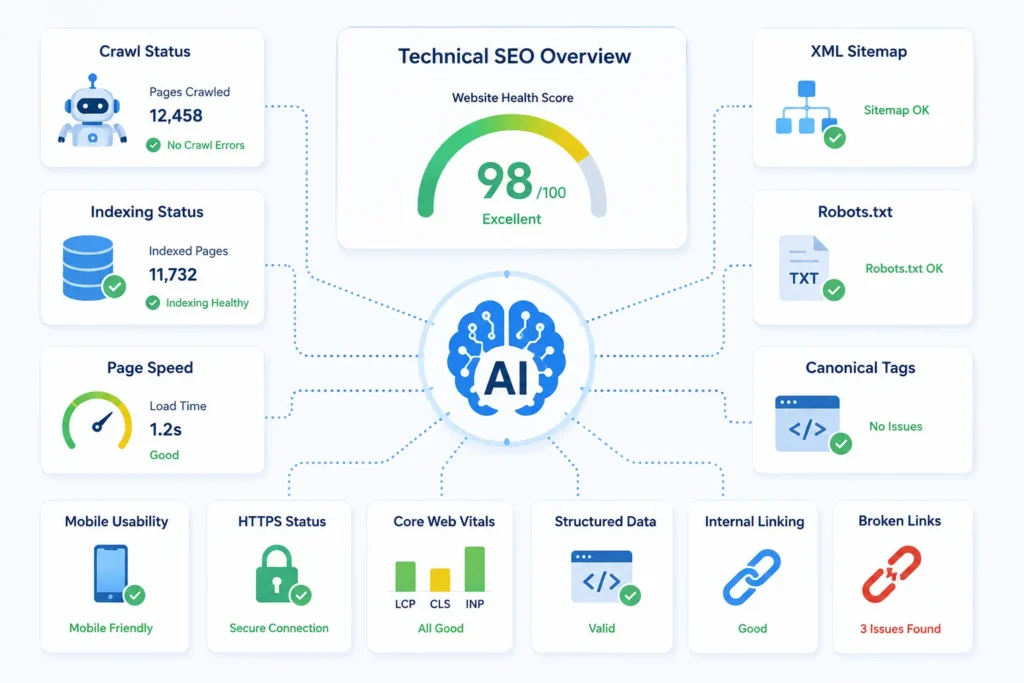
What Is AI Technical SEO?
AI technical SEO refers to using artificial intelligence to automate and improve the technical side of search optimization. This includes crawling, indexing, site speed, structured data, mobile usability, and overall site architecture.
Instead of running a manual crawl once a quarter, AI-powered tools monitor your site continuously. They flag new issues the moment they appear, rather than weeks later. In addition, many tools now analyze patterns across thousands of pages simultaneously, something a human auditor simply can’t do at the same speed.
How This Differs From Traditional Technical SEO
Traditional technical SEO relies heavily on scheduled audits and manual review. AI technical SEO, on the other hand, works continuously in the background. Because of this, issues get caught and often prioritized automatically, based on their likely impact on rankings and traffic.
This doesn’t mean human expertise becomes unnecessary. Rather, it shifts the specialist’s role from manually hunting for problems to reviewing and approving AI-generated fixes and recommendations.
A Simple Example of AI Technical SEO in Action
Consider an e-commerce site with 20,000 product pages. A manual quarterly audit might sample a few hundred pages and extrapolate from there. An AI technical SEO tool, on the other hand, can crawl the entire catalog regularly. It flags every duplicate title tag, every broken internal link, and every page returning a soft 404 error. Instead of guessing at scale, the team gets a complete, prioritized picture.
This kind of coverage used to require a large in-house team or an expensive agency retainer. Now, a single specialist with the right AI tools can maintain technical health across a site that size on their own. They check in on flagged issues rather than hunting for them manually.
Why AI Technical SEO Matters in 2026
A few converging trends explain why this topic deserves fresh attention this year.
Websites Have Become More Complex
Modern sites often rely on JavaScript frameworks, headless CMS platforms, and dynamic content rendering. Consequently, traditional crawlers can struggle to accurately see what search engines actually see. AI-powered crawlers handle this complexity far more reliably, rendering pages the way both Googlebot and AI crawlers would.
AI Crawlers Are Now Part of the Equation
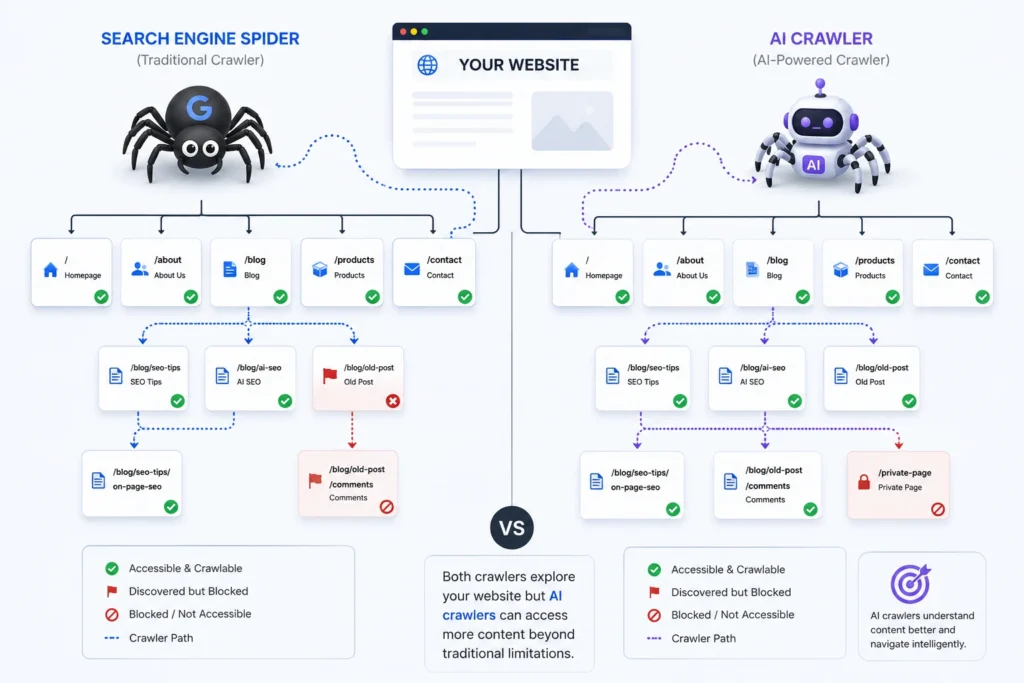
It’s not just Google crawling your site anymore. AI platforms like ChatGPT and Perplexity also send crawlers to retrieve content for their own answers. Therefore, technical SEO now needs to account for a wider range of crawler behavior, not just Googlebot’s.
Manual Audits Can’t Keep Pace With Site Scale
For sites with thousands of pages, a quarterly manual audit is simply too slow. By the time an issue is found, it may have already affected rankings for weeks. AI technical SEO closes that gap by monitoring continuously instead of periodically.
Google’s Own Guidance Reflects This Shift
Google’s official documentation on crawling and indexing emphasizes that sites should be easy for both crawlers and users to access and understand structurally (Google Search Central). In short, the fundamentals haven’t changed, but the tools available to maintain them have become significantly more capable.
Core Web Vitals Still Carry Real Weight
Page experience signals, including loading speed and visual stability, remain part of how sites get evaluated. However, tracking these metrics manually across hundreds of pages is tedious and easy to neglect. AI technical SEO tools monitor Core Web Vitals continuously. They flag regressions right after a code deployment rather than weeks later, once rankings have already started to slip.
The Cost of Falling Behind Is Higher Now
Because AI-driven search features surface answers directly on the results page, sites that lose visibility face a bigger problem. Technical issues now risk losing out on both traditional clicks and AI citations at once. Consequently, a slow-loading or poorly crawled site risks becoming invisible across two channels at once, not just one.
This Isn’t Just an Enterprise Concern
It’s tempting to assume AI technical SEO only matters for large sites with massive page counts. However, smaller sites benefit just as much, often more, since they typically lack a dedicated technical SEO specialist entirely. For a small business with a few hundred pages, an AI monitoring tool can catch issues that would otherwise go unnoticed for months. That’s simply because nobody on the team has the specialized knowledge to spot them manually.
Benefits of AI Technical SEO
Understanding the concrete benefits helps justify the investment in tools and process changes.
Faster Issue Detection
Instead of waiting for a scheduled audit, AI tools flag problems like broken links, crawl errors, or duplicate content almost immediately. As a result, issues get fixed before they meaningfully affect rankings.
Better Prioritization
Not every technical issue deserves equal attention. Good AI technical SEO tools rank issues by potential impact, helping teams focus on what actually matters instead of working through a flat, unsorted list.
Reduced Manual Workload
Repetitive tasks, like checking meta tags across thousands of pages or monitoring redirect chains, no longer require manual spreadsheets. Therefore, specialists can spend more time on strategy and less on repetitive checking.
Improved Crawl Efficiency
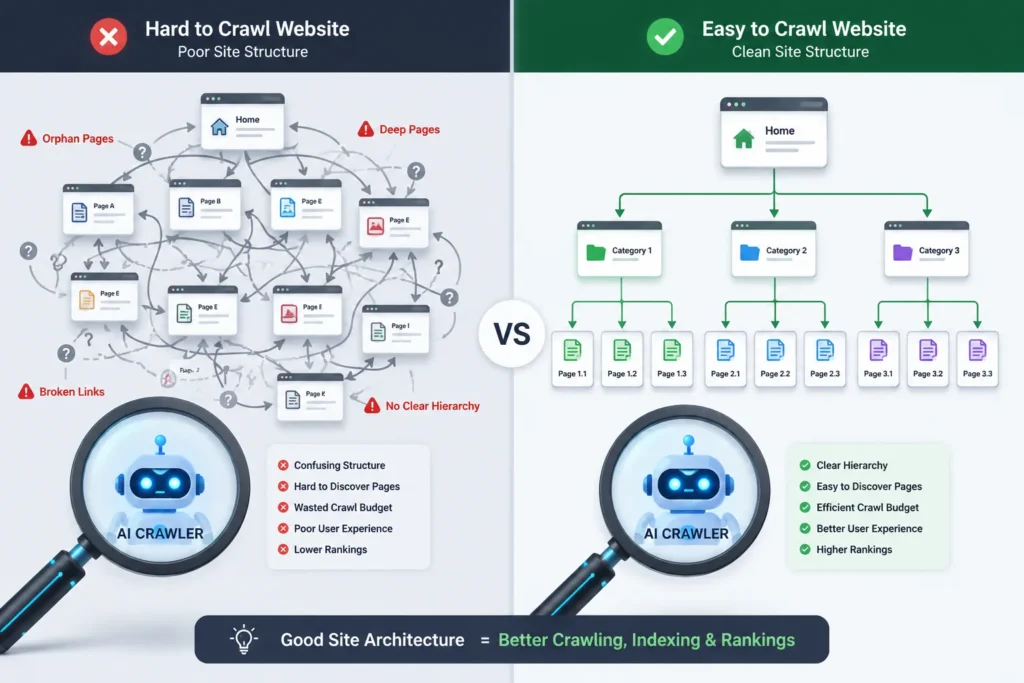
AI tools can identify where crawl budget is being wasted, such as on duplicate parameters or low-value pages. Consequently, search engines spend more of their limited crawl budget on pages that actually matter.
Better Alignment With AI-Driven Search
Since AI platforms now crawl and cite web content directly, keeping a site technically clean matters more. It also improves the chances of being retrieved and cited by AI-generated answers, not just traditional search results.
More Consistent Quality Across Large Sites
Large sites often struggle with consistency. One team might handle meta descriptions well, while another neglects alt text entirely. AI technical SEO tools apply the same standards uniformly across every page, regardless of which team or contributor originally created it.
Easier Reporting for Stakeholders
Translating technical issues into language executives understand has always been a challenge. Many AI tools now generate plain-language summaries automatically. They explain what changed, why it matters, and what’s being done about it, without requiring a specialist to manually write that report every month.
Faster Recovery From Site Migrations
Site migrations and redesigns are notoriously risky for search visibility, since a single misconfigured redirect can quietly tank rankings for months. Continuous AI monitoring catches these issues within days of a migration going live. It doesn’t wait for the next scheduled audit to notice a traffic drop that’s already well underway.
(For a broader look at how AI fits into a full SEO process, see our related guide.) It covers AI SEO Workflow Automation in more depth.
Best AI Technical SEO Tools
Rather than naming a single winner, it helps to understand the categories of tools available and what each one solves.
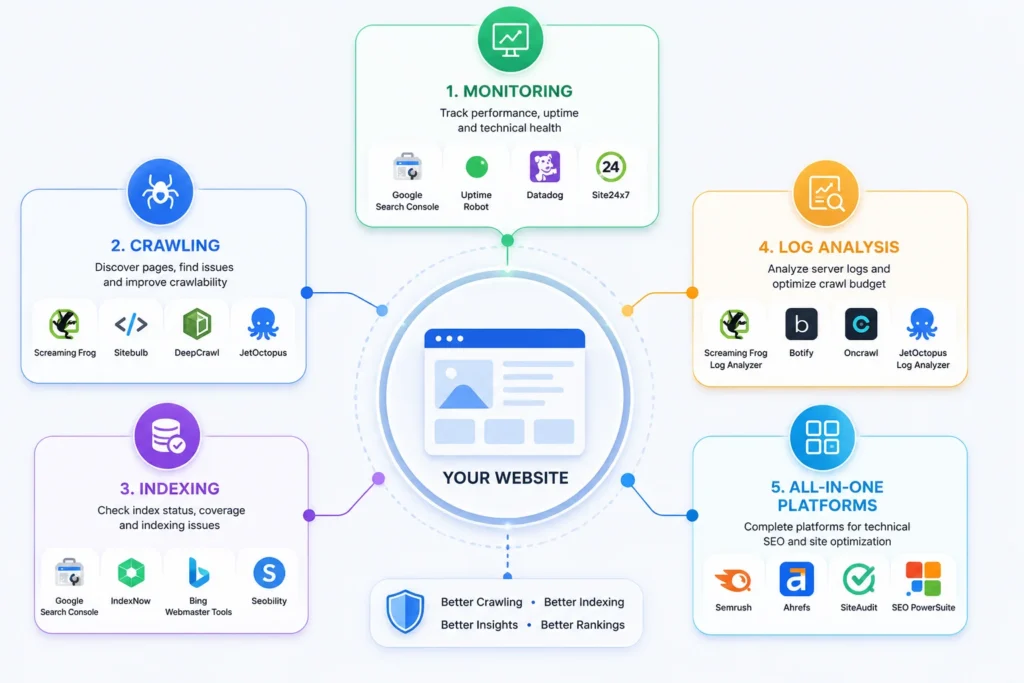
Continuous Site Monitoring Tools
This category monitors your site in real time rather than running periodic crawls. Instead of waiting for the next scheduled audit, these tools catch changes, like a sudden spike in server errors, the moment they happen.
Enterprise-Scale Crawlers
For very large sites, sometimes with millions of pages, enterprise-grade crawlers handle scale that smaller tools can’t. These tools typically integrate directly into development pipelines, catching technical regressions before a deployment even goes live.
Indexing Automation Tools
This category focuses specifically on getting new or updated pages indexed quickly. Rather than waiting for search engines to discover content naturally, these tools submit URLs automatically using protocols like IndexNow. This protocol notifies search engines the moment content changes.
Log File Analysis Tools
Server log analysis reveals exactly how crawlers, including AI crawlers, are interacting with your site. This category of AI technical SEO tools automatically summarizes crawl patterns and flags anomalies, saving hours of manual log review.
All-in-One AI SEO Platforms
Some platforms combine technical monitoring with content and indexing automation in a single workflow. These tend to suit teams that want one connected system rather than several standalone tools that require manual coordination between them.
Well-Known Tools Worth Researching
While the right choice depends on your site’s size and budget, a few names come up repeatedly in this space. Screaming Frog remains a popular desktop crawler for smaller sites and quick audits. Ahrefs has expanded its technical auditing capabilities to track a large number of predefined issue types automatically. For larger, more complex sites, enterprise crawlers like Lumar offer continuous monitoring built directly into development pipelines, catching regressions before they ever reach production.
It’s worth researching a few options directly rather than picking based on name recognition alone. The right fit depends heavily on your site’s size, your team’s technical resources, and whether you need standalone tools or a fully connected platform.
How to Evaluate These Tools for Your Site
Before committing to any AI technical SEO tool, run through a short evaluation process rather than choosing based on marketing claims alone. First, check whether the tool integrates with your existing CMS and analytics setup. A tool that requires manual data exports defeats much of the purpose of automation. Second, look closely at how the tool prioritizes issues. A useful tool should explain why it ranked one issue above another, not just present a flat list.
Third, test the tool on a smaller section of your site before rolling it out sitewide. This lets you catch false positives or misconfigured alerts early, without risking confusion across your entire team. Finally, factor in how much the tool actually reduces manual work. A tool that surfaces a thousand new alerts a day without meaningful prioritization can create more noise than it resolves. That defeats the purpose of adopting AI technical SEO in the first place.
AI Technical SEO vs. Manual Technical SEO: A Comparison
Before deciding how much to automate, it helps to see the practical differences side by side.
| Factor | Manual Technical SEO | AI Technical SEO |
|---|---|---|
| Audit frequency | Scheduled, often monthly or quarterly | Continuous, real-time monitoring |
| Issue detection speed | Delayed until the next scheduled audit | Immediate, often within hours |
| Prioritization | Based on specialist judgment alone | AI-ranked by likely ranking impact |
| Scale handling | Difficult for very large sites | Built for thousands or millions of pages |
| Crawl budget optimization | Manual analysis of log files | Automated pattern detection |
| AI crawler visibility | Limited, often overlooked | Explicitly tracked alongside Googlebot |
| Human oversight required | High, at every stage | Moderate, focused on review and fixes |
As the table shows, AI technical SEO doesn’t remove the need for expertise. Rather, it changes where that expertise gets applied, shifting from manual discovery to informed decision-making.
AI Technical SEO:How AI Improves Website Crawling and Indexing
Crawling and indexing sit at the foundation of technical SEO. Here’s how AI specifically improves this part of the process.
Smarter Crawl Budget Allocation
AI tools analyze which pages actually get crawled frequently versus which ones are being ignored. From there, they identify wasted crawl budget, like duplicate parameter URLs or thin pages, so you can redirect that budget toward pages that matter.
Faster Detection of Indexing Problems
Instead of manually checking Search Console page by page, AI tools flag sudden drops in indexed pages automatically. This matters because indexing issues can silently remove pages from search results for weeks before anyone notices manually.
Better Handling of JavaScript-Heavy Sites
Many modern sites rely on JavaScript to render content. AI-powered crawlers simulate rendering more accurately, helping teams catch content that search engines might otherwise fail to see properly.
Real-Time Alerts for Crawl Anomalies
Rather than discovering a spike in server errors during a routine check, AI monitoring tools send immediate alerts. As a result, teams can respond before the issue affects a meaningful portion of the site.
Improved Visibility Into AI Crawler Behavior
Since AI platforms crawl sites for their own generative answers, some tools now specifically track whether crawlers like GPTBot can successfully access your content. This is a newer but increasingly important layer of technical SEO.
Log File Analysis Made Practical
Server logs contain a complete record of every crawler visit, but reading them manually is tedious and time-consuming. AI-powered log analysis tools summarize this data automatically, highlighting which pages get crawled most often, which get ignored, and where crawlers encounter errors.
Prioritizing Fixes Based on Traffic Impact
Not every crawling or indexing issue deserves the same urgency. AI tools can cross-reference technical issues with traffic and revenue data. This helps teams fix the problems most likely to affect business outcomes first, rather than working through a list in no particular order.
A Real-World Example of AI Technical SEO in Practice
To make this concrete, consider how a mid-sized publisher might approach a technical SEO overhaul using AI tools. This works better than treating the idea only in the abstract.
The Starting Problem
Imagine a news and blog site with roughly 15,000 published articles built up over eight years. Rankings have been slowly declining, even though the editorial team keeps publishing consistently. A manual audit would take weeks to complete properly, and the team doesn’t have a dedicated technical SEO specialist on staff.
Step One: Continuous Crawling Reveals the Scope
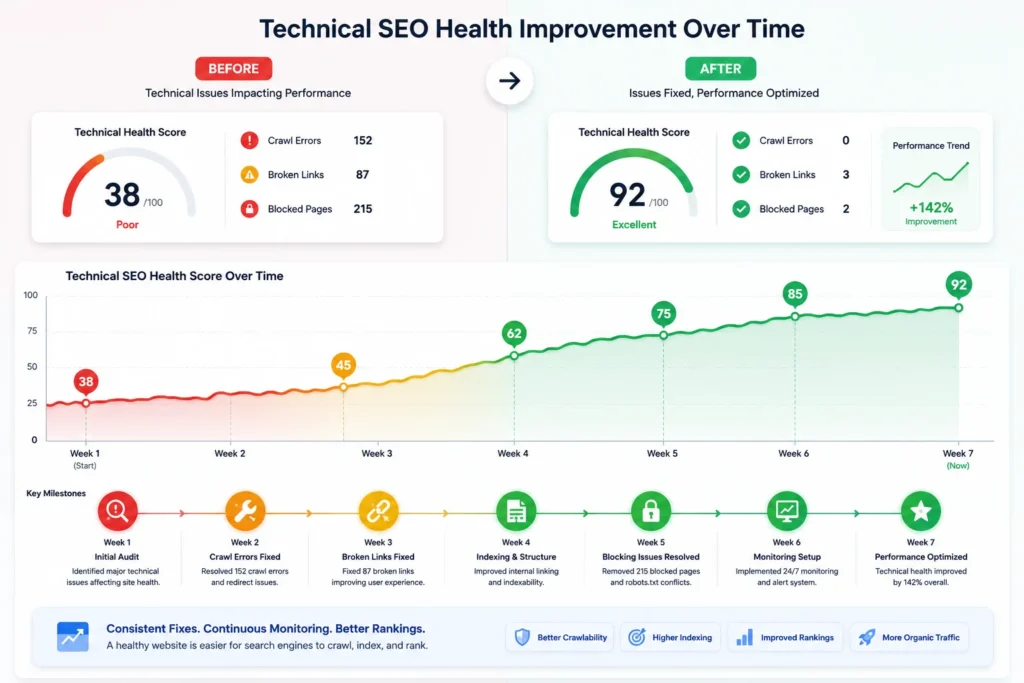
An AI-powered crawler scans the entire site within a day, instead of the weeks a manual process would require. It quickly surfaces several thousand pages with duplicate title tags. It also flags a significant number of broken internal links pointing to removed articles, plus a cluster of old category pages accidentally blocked from indexing.
Step Two: Prioritization Focuses the Team’s Effort
Rather than tackling all of these issues at once, the AI tool ranks them by estimated traffic impact. It turns out that a handful of high-traffic evergreen articles account for a disproportionate share of the site’s organic visits. Several of these have slow-loading images dragging down their Core Web Vitals scores. The team fixes these first.
Step Three: Ongoing Monitoring Prevents Regression
After the initial cleanup, the site moves to continuous monitoring instead of another long gap between audits. When a developer accidentally reintroduces a noindex tag on a template update a few months later, the AI tool flags it within hours. The team catches and fixes it before it meaningfully affects rankings.
The Outcome
Over several months, this combination of AI-driven prioritization and human review helps the site recover lost rankings. Notably, it also helps avoid a repeat of the same slow decline. The key wasn’t replacing the team’s judgment. It was giving them visibility they simply didn’t have the bandwidth to gather manually.
AI Technical SEO Checklist
Use this checklist as a practical starting point for auditing your own site.
Confirm crawlability
Check that important pages aren’t accidentally blocked by robots.txt or noindex tags. This is worth checking after every major site migration or redesign, since these changes are a common source of accidental blocking.
Review indexing status regularly
Monitor for sudden drops in indexed pages using Search Console or an AI monitoring tool. A sharp decline often signals a technical problem rather than a genuine ranking issue.
Audit crawl budget usage
Identify duplicate, thin, or low-value pages consuming crawl resources unnecessarily. This matters most for larger sites where crawl budget is genuinely limited.
Check site speed and Core Web Vitals
Slow-loading pages can hurt both rankings and user experience. Pay particular attention to your highest-traffic pages first.
Verify mobile usability
Ensure pages render correctly and remain easy to navigate on mobile devices, since most search traffic now originates from mobile users.
Review structured data
Confirm schema markup is implemented correctly and free of errors, since broken schema can prevent rich results from displaying at all.
Check for broken links and redirect chains
These waste crawl budget and create a poor user experience, particularly on older sites with years of accumulated content changes.
Confirm AI crawler access
Verify that crawlers like GPTBot aren’t unintentionally blocked, if you want visibility in AI-generated answers alongside traditional search results.
Monitor duplicate content
Use canonical tags correctly to avoid diluting ranking signals across similar pages, which is especially common on ecommerce sites with product variants.
Set up continuous monitoring
Move from periodic manual audits toward ongoing, automated tracking wherever possible, so new issues get caught within hours rather than months.
This checklist works well as a recurring review, not just a one-time exercise. Many teams find it useful to run through it monthly at first. Then, they shift toward continuous automated monitoring once they’ve confirmed which issues recur most often on their specific site.
Common AI Technical SEO Mistakes
A few recurring mistakes tend to undermine otherwise solid technical SEO efforts.
Trusting AI Recommendations Without Review
AI tools can occasionally misjudge an issue’s severity or misinterpret a site’s specific setup. Therefore, treat AI-generated recommendations as a starting point, not a final decision, especially for complex changes.
Ignoring AI Crawler Behavior
Many teams still optimize purely for Googlebot, overlooking AI-specific crawlers entirely. Because AI platforms now cite web content directly, ignoring their crawl behavior can quietly limit a brand’s visibility in AI-generated answers.
Fixing Issues Without Understanding Root Causes
Automated tools can flag a problem quickly, but applying a quick fix without understanding why it happened often leads to the same issue recurring later. A brief root-cause review saves time in the long run.
Over-Automating Without Human Checkpoints
Letting automated tools push technical changes live without review carries real risk, especially on high-traffic pages. A human approval step remains essential before any significant technical change goes live.
Neglecting Regular Manual Spot Checks
Even with strong automation in place, occasional manual review helps. It catches anything an AI tool might miss, particularly unusual site-specific edge cases that generic tools aren’t trained to recognize.
Treating Every Site the Same Way
Different sites have different priorities. An ecommerce catalog with thousands of near-duplicate product pages faces different challenges than a publisher site with deep archives. Applying a generic, one-size-fits-all checklist without adjusting for your site’s specific structure can lead to wasted effort on low-impact fixes.
Forgetting to Reassess Tool Accuracy Over Time
AI tools improve and change over time, and so do the crawlers they’re monitoring for. A tool configuration that worked well a year ago may need adjusting as search engines and AI platforms update their own crawling behavior. Periodically reassessing whether your tools are still catching the right issues helps prevent quiet gaps from forming in your monitoring coverage.
AI Technical SEO Best Practices
Following these practices helps you get real value from automation without introducing unnecessary risk.
AI Technical SEO:Start With Continuous Monitoring, Not Full Automation
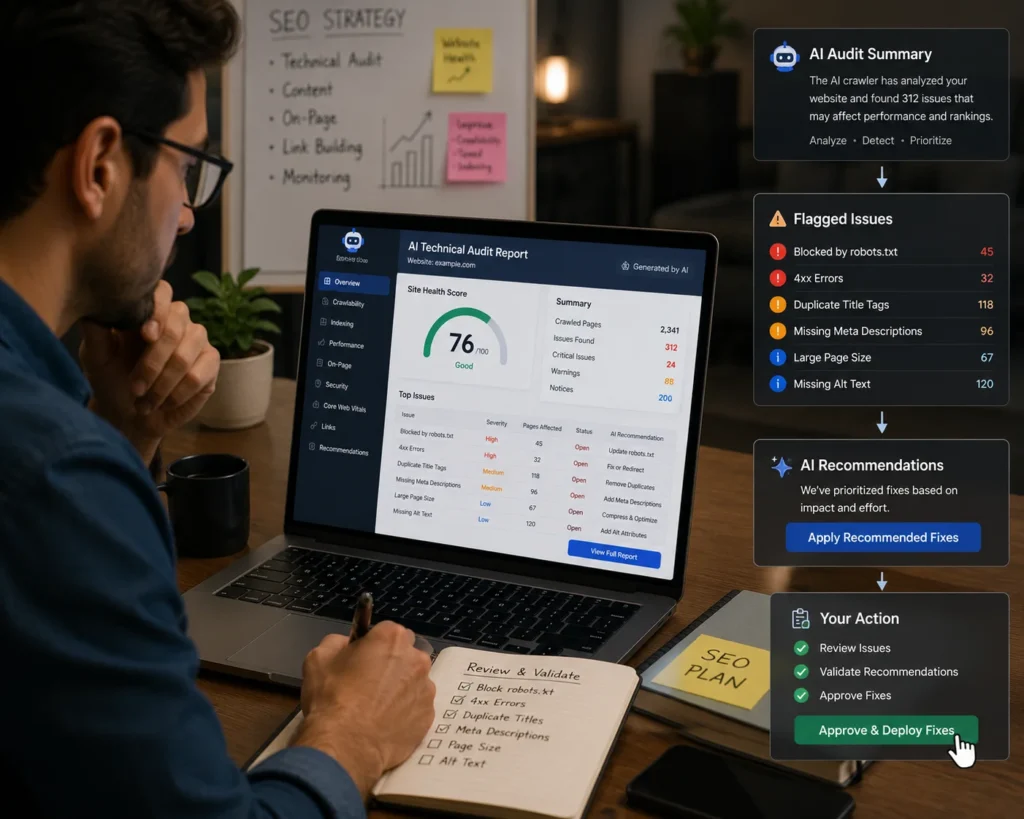
Begin by using AI tools to monitor and flag issues, rather than automatically implementing fixes. This builds trust in the system’s accuracy before granting it more autonomy.
AI Technical SEO:Combine AI Speed With Human Judgment
Use AI to detect and prioritize issues quickly, but keep a specialist reviewing anything before it goes live. This combination captures the speed benefits of automation without sacrificing quality control.
AI Technical SEO:Prioritize Fixes by Business Impact, Not Just Volume
A single issue on a high-traffic page often matters more than dozens of minor issues on low-traffic pages. Good AI technical SEO tools help rank issues this way, but final prioritization decisions should still account for business context.
AI Technical SEO:Keep AI Crawler Access in Mind
As AI-driven search grows, confirm that crawlers relevant to platforms like ChatGPT and Perplexity can access the content you want indexed there. Blocking them entirely may quietly limit visibility in AI-generated answers.
AI Technical SEO:Revisit Your Technical Setup Regularly
Even with continuous monitoring in place, periodically review your overall technical strategy. Site architecture, crawl priorities, and AI crawler behavior all evolve, so a strategy that worked last year may need adjusting.
AI Technical SEO:Document What Gets Automated and Why
As more tasks shift to AI tools, it’s easy to lose track of which processes run automatically and which still require manual review. Keeping a simple internal reference document helps new team members understand the workflow and prevents accidental gaps in oversight.
AI Technical SEO:Build in a Regular Review Cadence With Stakeholders
Technical SEO improvements aren’t always visible to non-technical stakeholders in the same way a new blog post is. Scheduling a brief, regular review, even quarterly, helps keep leadership informed about what’s being fixed and why it matters for overall site performance.
Frequently Asked Questions About AI Technical SEO
What is AI technical SEO?
AI technical SEO is the use of artificial intelligence to automate and improve technical optimization tasks. This includes crawling, indexing, site speed, and structured data, typically through continuous monitoring rather than periodic manual audits. It works alongside, not instead of, the core principles that have always mattered.
Do I still need a technical SEO specialist if I use AI tools?
Yes. AI tools handle detection and prioritization efficiently, but a specialist should still review flagged issues, understand root causes, and approve significant changes before they go live. The specialist’s role shifts toward judgment and strategy rather than manual discovery work.
Can AI technical SEO tools fix issues automatically?
Some tools can apply certain fixes automatically, like resolving simple redirect issues. However, it’s generally safer to keep a human approval step for anything affecting site structure or high-traffic pages. Even reliable tools can occasionally misjudge context that a specialist would catch immediately.
How is AI technical SEO different from AI content optimization?
AI technical SEO focuses on a site’s infrastructure, crawling, indexing, speed, and architecture. AI content optimization instead focuses on keyword usage, readability, and content structure. Both matter for overall search visibility, but they solve genuinely different problems and often involve different tools entirely.
Are AI crawlers like GPTBot something I need to worry about?
Increasingly, yes. As AI platforms cite web content directly in generated answers, ensuring these crawlers can access your important pages matters more now. This sits alongside the traditional focus on Googlebot and other search engine crawlers.
Final Thoughts: Making AI Technical SEO Part of Your Strategy
AI technical SEO isn’t about replacing the expertise that goes into a healthy website. Instead, it’s about catching issues faster, prioritizing them more intelligently, and freeing up specialists to focus on decisions that actually require human judgment.
Start with the checklist above, and consider adopting continuous monitoring before moving toward more automated fixes. Over time, this shift from periodic manual audits to ongoing, AI-assisted oversight becomes a meaningful competitive advantage, not just a technical upgrade.
Whether you’re managing a small business website or a large publisher with thousands of pages, the underlying principle stays the same. Technical health forms the foundation everything else in SEO gets built on. Content, links, and brand authority all matter less if search engines and AI crawlers can’t properly access, render, and understand your site in the first place. Investing in AI technical SEO now, even starting small with a single monitoring tool, pays off as your site continues to grow.
Ready to strengthen your site’s technical foundation? Check out our guide on AI SEO Workflow Automation to see how technical monitoring fits into a broader, connected SEO process.



Pingback: AI On-Page SEO: Best Practices, Tools & Checklist (2026) - AI Growth Lab
Pingback: AI SEO Analytics: Measure Ranking & More