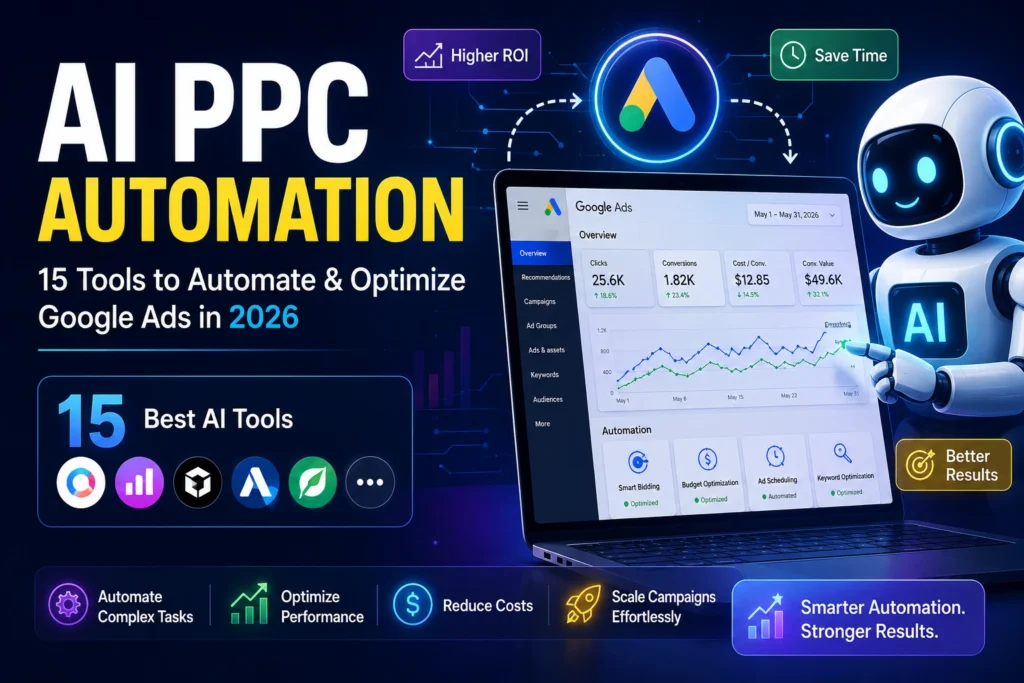

AI PPC Automation now covers a much wider territory than it did just a few years ago. It’s no longer just about Google’s Smart Bidding adjusting auction-level bids. Today it spans budget pacing across multiple platforms and creative testing at scale. It even includes conversational tools that let a manager query an account in plain language instead of digging through dashboards. However, the sheer number of tools claiming to automate PPC work makes choosing the right combination genuinely difficult.
This matters because the wrong tool wastes both budget and the time it was supposed to save. In this guide, you’ll find 15 of the best AI PPC automation tools in 2026. They span Google Ads, Microsoft Ads, and Amazon advertising. You’ll also see a comparison table and a framework for building your own tool stack. Beyond that, you’ll find answers to common questions about how much these platforms actually automate versus assist.
What Is AI PPC Automation, Exactly?
AI PPC automation refers to using machine learning to handle tasks that once required constant manual attention. This covers paid search and retail media accounts alike. It includes bid adjustments, budget pacing, creative testing, and increasingly, natural-language account analysis.
However, automation exists on a spectrum. Some tools execute changes automatically once configured. Others surface recommendations and require a human to approve each one. Therefore, understanding where a given tool falls on that spectrum matters more than whether it’s labeled “AI” at all.
Why This Category Has Expanded So Quickly
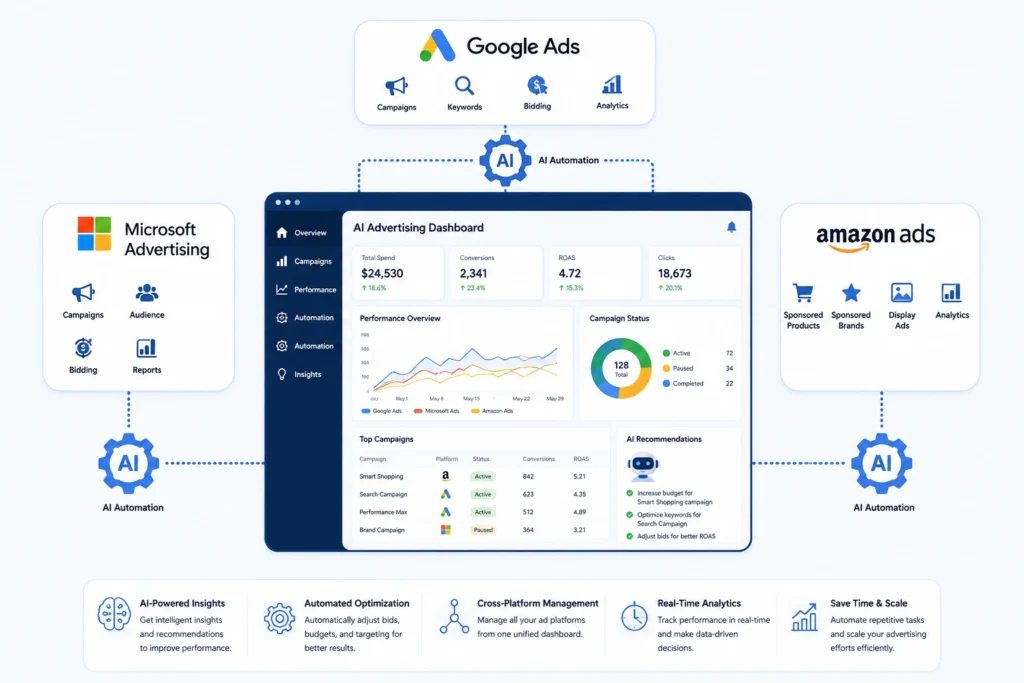
Ad accounts have grown more complex as advertisers spread budget across more platforms simultaneously. Google, Microsoft, and Amazon each report performance differently, which makes manual cross-platform reconciliation genuinely time-consuming. As a result, tools that unify this work have become increasingly central to how larger accounts operate. This matters more than just automating one platform in isolation.
The Shift Toward Conversational Automation
A newer subcategory has also begun to emerge in this space. Rather than executing pre-set rules, some tools now let managers ask plain-language questions and get real-time analysis or even direct account changes in response. This approach trades some predictability for flexibility in handling situations a fixed rule structure wasn’t built to anticipate.
What Genuine Automation Looks Like in Practice
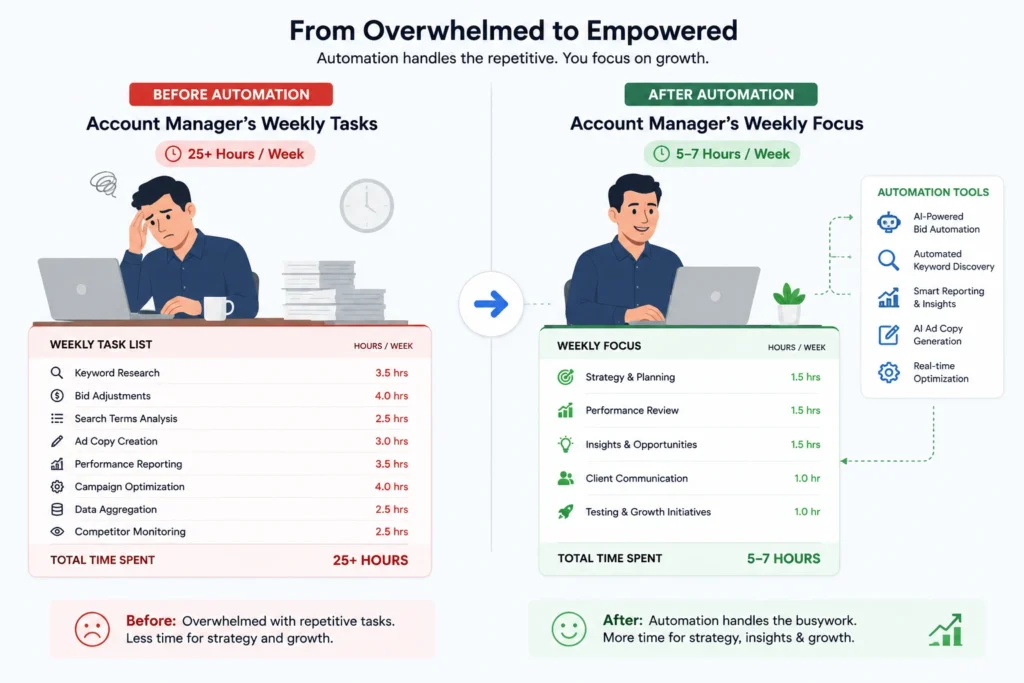
It helps to picture what a well-automated account actually looks like day to day, rather than treating this as an abstract concept. A manager overseeing a properly automated account typically starts the day reviewing a short list of flagged anomalies, rather than manually checking bid performance across dozens of campaigns one by one. Budget reallocation between top and underperforming campaigns happens automatically overnight. Reports that once took hours to compile arrive pre-built, needing only a final review before going to a client. The manager’s actual time gets spent on the handful of decisions that genuinely require judgment, not the repetitive checking that automation now handles.
(For a closer look specifically at Google’s own native automation, see our related guide.) It covers AI Google Ads Tools in full depth.
Best AI PPC Automation Tools for Bid and Budget Management
These platforms focus on the core task that started this category: adjusting bids and budgets automatically based on performance data.
1. Google Smart Bidding
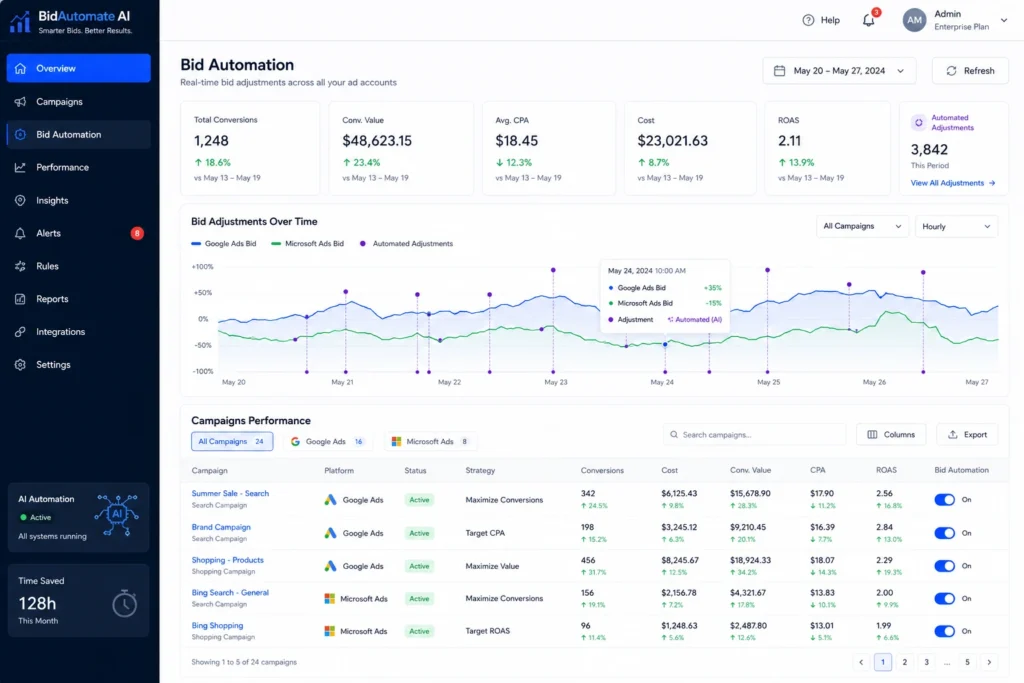
Smart Bidding remains the most widely deployed AI bid system in paid search. It’s built directly into Google Ads at no extra cost. It adjusts bids at the auction level using signals like device, location, and time of day. This makes it the natural starting point before layering on anything else.
2. Optmyzr
Optmyzr is considered the agency standard for rule-based Google Ads automation. It was built by former Google employees specifically to automate repetitive account management. Its Rule Engine allows a level of bid customization that native platforms don’t support. It also now includes an automation layer that lets AI assistants query and trigger rules directly.
3. Acquisio
Acquisio runs its proprietary Turing AI engine across more than 30 algorithms simultaneously. This optimizes bids, budgets, and pacing throughout the day. It works across Google, Microsoft, and Amazon Ads from a single interface. This suits agencies managing multiple accounts across different platforms at once.
4. Adzooma
Adzooma targets small businesses and solo marketers who want automation without complexity. It connects Google, Microsoft, and Meta Ads to provide AI-powered audits and one-click optimizations. A genuinely useful free tier backs the whole platform.
Best AI PPC Automation Tools for Cross-Channel Agencies
For agencies and larger teams managing many client accounts across platforms, these tools coordinate work at scale.
5. Skai
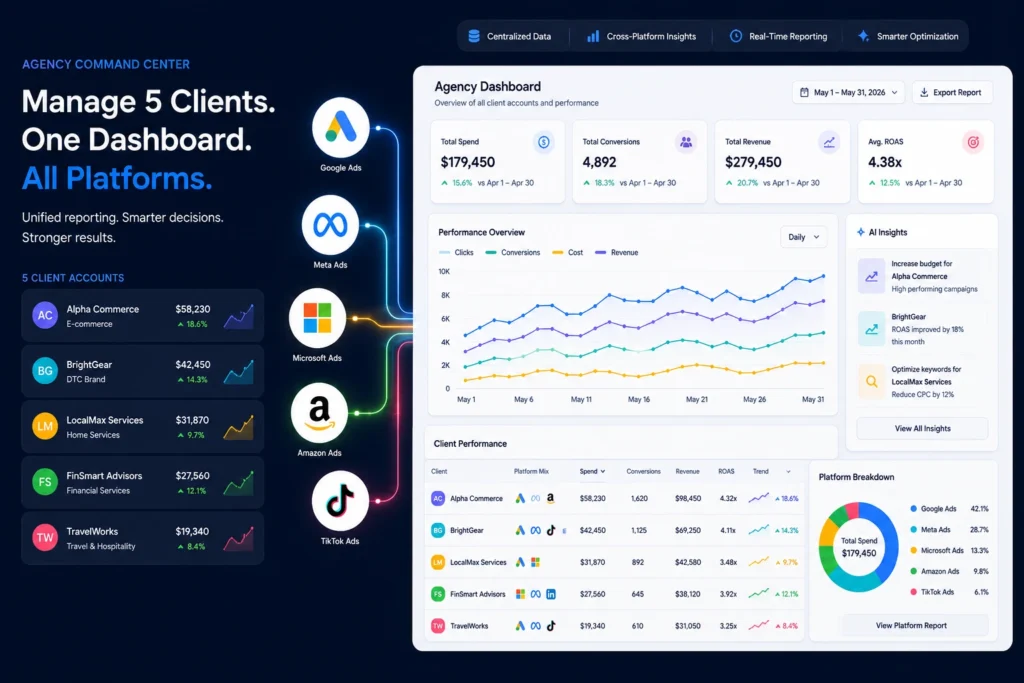
Skai offers enterprise-level cross-channel management, combining Google Ads with other major platforms under one reporting and optimization system. This suits larger advertisers who need a single source of truth rather than reconciling separate dashboards manually.
6. PaidSync
PaidSync represents a newer generation of AI PPC automation, built as a conversational assistant with write access across seven paid platforms through a single login. Rather than executing pre-defined rules like Optmyzr, it reasons through account situations in real time. This suits irregular, cross-platform problems that don’t fit a fixed rule structure.
7. Revealbot
Revealbot lets advertisers build custom automation rules spanning Google Ads and other platforms simultaneously. It shows particular strength in scaling creative-heavy campaigns. This helps standardize optimization logic across channels instead of managing each platform separately.
8. WordStream
Now operating under the LocaliQ brand following its acquisition, WordStream remains one of the most recommended entry points for small businesses new to paid search. Its guided setup and account health scoring help less experienced advertisers avoid common mistakes without requiring deep PPC expertise.
Best AI PPC Automation Tools for Amazon and Retail Media
Retail media has become its own distinct category, and these tools address the specific mechanics of Amazon and marketplace advertising.
9. Quartile
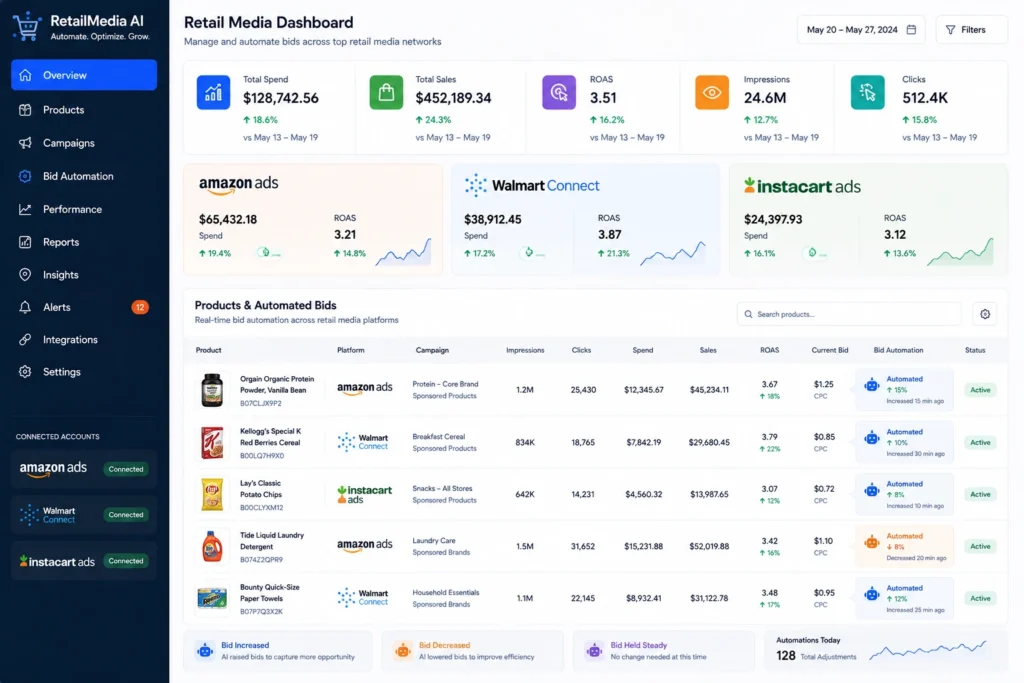
Quartile handles cross-marketplace automation for sellers running campaigns across Amazon, Walmart, and Instacart simultaneously. It suits sellers managing thousands of SKUs. Its pricing model, a percentage of optimized ad spend, makes it one of the pricier options in this category, though.
10. Perpetua
Perpetua focuses specifically on Amazon and similar retail platforms. It automates bids toward a TACoS, or total advertising cost of sale, goal set up front by the advertiser. This goal-based approach suits sellers who think in terms of overall profitability rather than isolated campaign metrics.
11. Teikametrics
Teikametrics uses what it calls a flywheel AI method to analyze performance data and automate bidding across Amazon and Walmart simultaneously. Its keyword recommendation engine and real-time bidding adjustments aim to scale advertising efficiency without constant manual oversight.
12. PPC Entourage
PPC Entourage suits smaller Amazon sellers who need accessible automation without an enterprise price tag. It covers the fundamentals well, including bid management, search term harvesting, and negative keyword handling.
Best AI PPC Automation Tools for Creative and Attribution
Beyond bidding, these tools address two other pieces of the automation puzzle: creative testing and understanding what’s actually driving conversions.
13. Madgicx
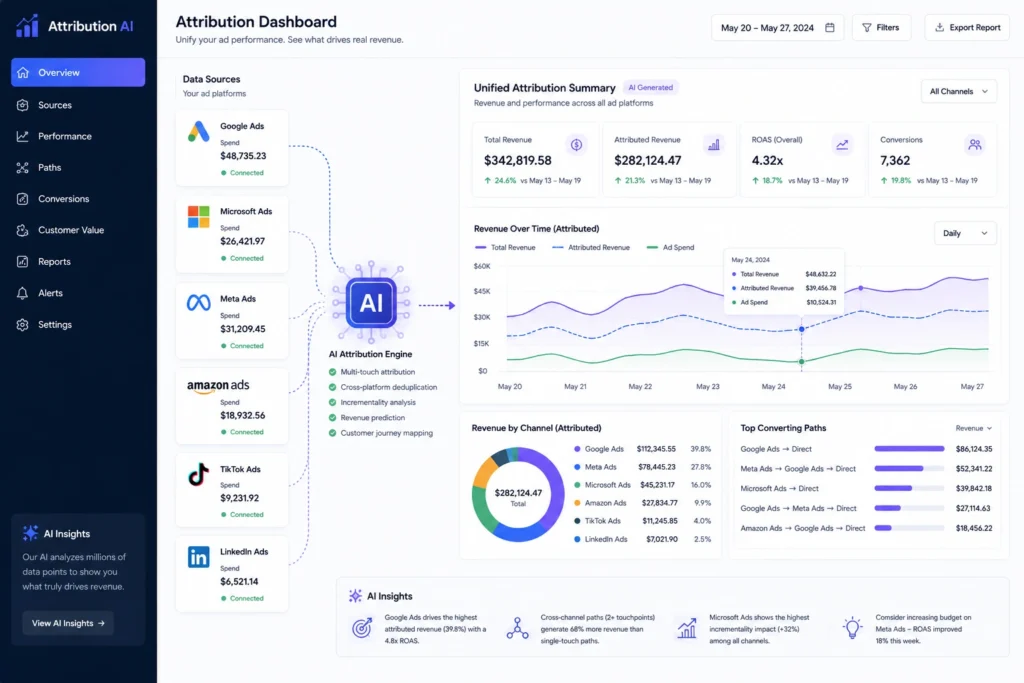
Madgicx pairs creative testing automation with audience AI. It was originally built with a strong Meta focus but has since extended into broader PPC automation. Its ability to identify which creative variants are actually driving performance helps teams stop guessing at what’s working.
14. Search Ads 360
Google’s own enterprise platform, Search Ads 360, lets advertisers manage bidding across multiple search engines, not just Google, from a single interface. This suits larger organizations that need cross-engine bid management alongside deep integration with Google’s broader marketing stack.
15. Triple Whale
Triple Whale focuses on attribution and reporting, pulling performance data across ad platforms into a single, AI-summarized view. For ecommerce brands, this helps clarify which channels and campaigns are genuinely driving revenue. It’s a real improvement over relying on each platform’s own, often conflicting, attribution model.
A Real-World Example of Building an AI PPC Automation Stack
To make this concrete, consider how a growing agency might assemble a tool stack gradually rather than adopting everything at once.
The Starting Problem
Imagine an agency managing paid search for 15 clients across Google and Microsoft Ads. Account managers spend hours each week manually checking bid performance and compiling reports. This leaves little time for actual strategy work.
Adding Tools One at a Time
The agency first adopts Optmyzr to automate rule-based bid management across all Google Ads accounts. This alone frees up several hours weekly per account manager. A few months later, once that tool has proven reliable, they add a reporting tool to automate client updates instead of building each report manually.
The Outcome
Within two quarters, the agency has a lean two-tool stack layered on top of Google’s native Smart Bidding. Account managers now spend their time reviewing flagged issues and making strategic calls. Manually adjusting bids or building spreadsheets from scratch no longer eats up most of the week.
Comparing the Best AI PPC Automation Tools
Before choosing, it helps to see how these categories differ side by side.
| Category | Example Tools | Best For | Platform Coverage |
|---|---|---|---|
| Bid & budget automation | Smart Bidding, Optmyzr, Acquisio, Adzooma | Core bid and pacing decisions | Google, Microsoft, Amazon |
| Cross-channel agencies | Skai, PaidSync, Revealbot, WordStream | Managing many accounts at scale | Multi-platform |
| Amazon & retail media | Quartile, Perpetua, Teikametrics, PPC Entourage | Marketplace-specific automation | Amazon, Walmart, Instacart |
| Creative & attribution | Madgicx, Search Ads 360, Triple Whale | Testing and understanding performance | Multi-platform |
As the table shows, no single tool covers the entire PPC automation landscape. Most effective stacks combine one bid automation tool with a second layer addressing a genuinely distinct bottleneck. Stacking several overlapping platforms rarely produces better results.
How to Build Your Own AI PPC Automation Stack
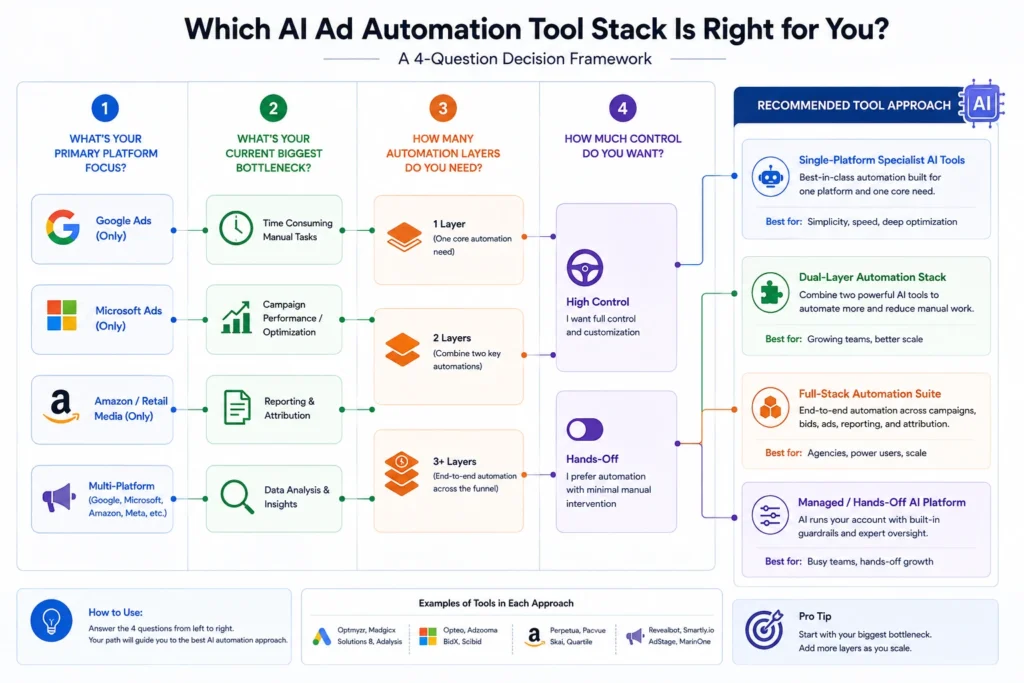
With so many categories to choose from, a clear framework helps narrow the decision.
Start With Native Automation First
Before paying for anything, confirm Smart Bidding and equivalent native tools on other platforms are configured correctly. Many accounts underuse these free options long before third-party automation becomes worth the investment.
Identify Your Specific Bottleneck
A tool built for Amazon retail media solves a fundamentally different problem than a Google-focused bid automation platform. Match the tool category to where your actual workflow slows down, rather than choosing based on a broad feature list.
Add One Layer at a Time
Running multiple overlapping automation tools simultaneously risks conflicting bid adjustments. Introduce one new tool, confirm it’s working reliably, and only then consider adding another.
Weigh Rule-Based Control Against Full Autonomy
Some tools, like Optmyzr, execute rules you define in advance. Others, like PaidSync, reason through novel situations with less predefined structure. Choose based on how much predictability your team needs versus how much flexibility the situation demands.
(For Google’s own guidance on native bid automation, see Google Ads Help.)
Common Mistakes When Adopting AI PPC Automation
A few recurring mistakes reduce how much value these tools actually deliver.
Automating Before Cleaning Up Account Structure
AI PPC automation tools amplify whatever structure already exists in an account. If campaigns are poorly organized or conversion tracking is inaccurate, automation simply scales those existing problems faster.
Choosing Tools Based on Marketing Claims Alone
Bold performance percentages are common across this category. However, real results vary significantly by account size, industry, and existing setup quality. A trial period on your own data reveals far more than a vendor’s case study.
Ignoring Ongoing Human Review
Even sophisticated automation can misjudge context specific to an account. A sudden stockout or a pricing change that isn’t reflected in the data feed are common examples. Regular human review catches these situations before they compound.
Underestimating the Setup Time Required
Tools with deep customization, like Optmyzr’s Rule Engine, take real time to configure properly. Budgeting for that setup period upfront prevents disappointment when results don’t appear immediately.
Treating Every Platform’s Automation the Same Way
Google’s Smart Bidding, Amazon’s retail media tools, and Microsoft’s equivalent systems each work differently under the hood. Assuming a strategy that worked well on one platform will translate directly to another often leads to disappointing results, since each system weighs signals and auction dynamics differently.
AI PPC Automation Pricing at a Glance
Budget often decides between two otherwise similar tools. Here’s a rough sense of where these platforms tend to fall.
Free or largely free: Google Smart Bidding and Adzooma’s entry tier cover core bid automation and audits without a subscription. These are worth exhausting before spending anything on more advanced platforms.
Mid-range, roughly $50 to $250 monthly: WordStream, Revealbot, Madgicx, and PPC Entourage generally fall in this range, scaling with account size or ad spend. This tier suits most small-to-midsize advertisers looking for a genuine upgrade over manual management.
Higher-tier and enterprise: Optmyzr, Skai, Acquisio, PaidSync, and Quartile typically sit here, particularly for agencies or larger accounts needing multi-client support or deep customization. Quartile in particular charges a percentage of managed ad spend, which can climb quickly for larger brands.
As always, confirm current pricing directly with each vendor, since tiers and models shift as these platforms evolve.
Frequently Asked Questions About AI PPC Automation
What are the best AI PPC automation tools?
The best AI PPC automation tools depend on your platform mix. Smart Bidding and Optmyzr suit Google-focused accounts. Acquisio and Skai handle cross-channel agency work. Quartile and Perpetua specialize in Amazon and retail media automation.
Is AI PPC automation only useful for large accounts?
No. Smaller accounts often benefit significantly, since they typically lack the staff to handle bid management and reporting manually. Free or low-cost tools like Adzooma and Google’s native Smart Bidding make automation accessible even for solo marketers.
Can AI PPC automation fully replace a PPC manager?
Generally, no. These tools handle repetitive execution well. However, strategic decisions, account structure, and judgment calls around unusual situations still benefit from human oversight, particularly for larger or more complex accounts.
How much do AI PPC automation tools typically cost?
Pricing varies widely. Google’s Smart Bidding is free, while tools like Adalysis or Madgicx start around $50 to $100 monthly. Mid-tier platforms like Optmyzr typically start around $200 monthly and scale with account complexity.
Should I use one platform or combine several tools?
Most accounts benefit from combining native automation with one or two specialized third-party tools, rather than relying on a single platform for everything. Start with one addition, though, and only expand once it’s proven reliable.
How is AI PPC automation different from AI Google Ads tools specifically?
AI Google Ads tools focus exclusively on Google’s own advertising platform, including Performance Max and Smart Bidding. AI PPC automation covers that same ground plus Microsoft Ads, Amazon, and other retail media platforms, since most modern advertisers manage budget across more than one channel simultaneously.
Final Thoughts: Building a PPC Automation Stack That Actually Works
There’s no single best AI PPC automation tool that fits every account. Instead, the strongest setups combine native automation, like Smart Bidding, with one or two specialized tools chosen for a genuine, identified bottleneck.
Start by cleaning up account structure and conversion tracking, since automation only amplifies what’s already there. From there, add tools one at a time, testing each on real data before committing to annual pricing. Over time, this deliberate approach tends to outperform adopting every new platform that claims to have solved PPC automation entirely.
Ready to go deeper on Google Ads specifically? Check out our guide on AI Google Ads Tools for a closer look at bidding, creative, and account-level automation.