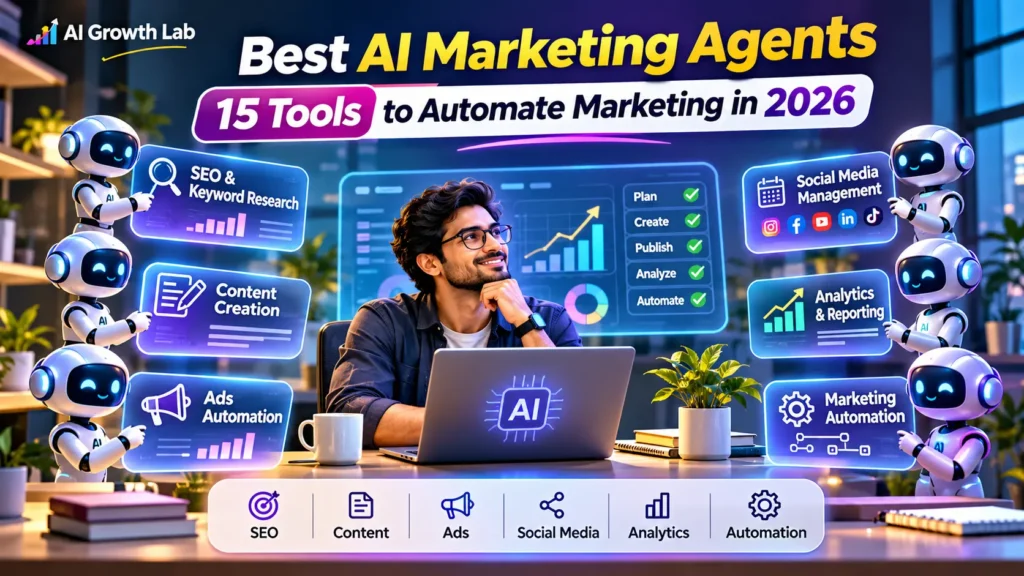

Your inbox probably has three pitches today for an “autonomous AI marketer.” Each promises to run your campaigns while you sleep. But choosing the best AI marketing agents in 2026 is not as simple as picking the software with the biggest promises. Few explain what these tools will actually do on Tuesday morning.
That gap is why choosing an AI marketing agent feels harder than it should. The category is crowded, and the labels are loose. A basic writing assistant now calls itself an agent. Meanwhile, a few platforms truly plan, act, and report with limited supervision.
As a result, this guide sorts the noise. You’ll learn what separates an agent from a copilot and which 15 tools deserve a place on your shortlist. We’ve grouped them by the jobs they perform. You’ll also get a comparison table, a step-by-step workflow, an automation maturity framework, real business use cases, an ROI method, and a troubleshooting checklist.
One note on honesty before we start: Most rankings online come from vendors who rank themselves first. We focus on capabilities and practical use cases rather than hype, and we distinguish vendor-reported claims from independently verifiable information. Pricing changes frequently, so always verify the latest details on each vendor’s official website.
What Are AI Agents for Digital Marketing?
An AI agent is software that pursues a goal across several steps. It can read data, decide what to do, use other tools, and take action. You supply the objective and the guardrails. The agent handles the legwork in between.
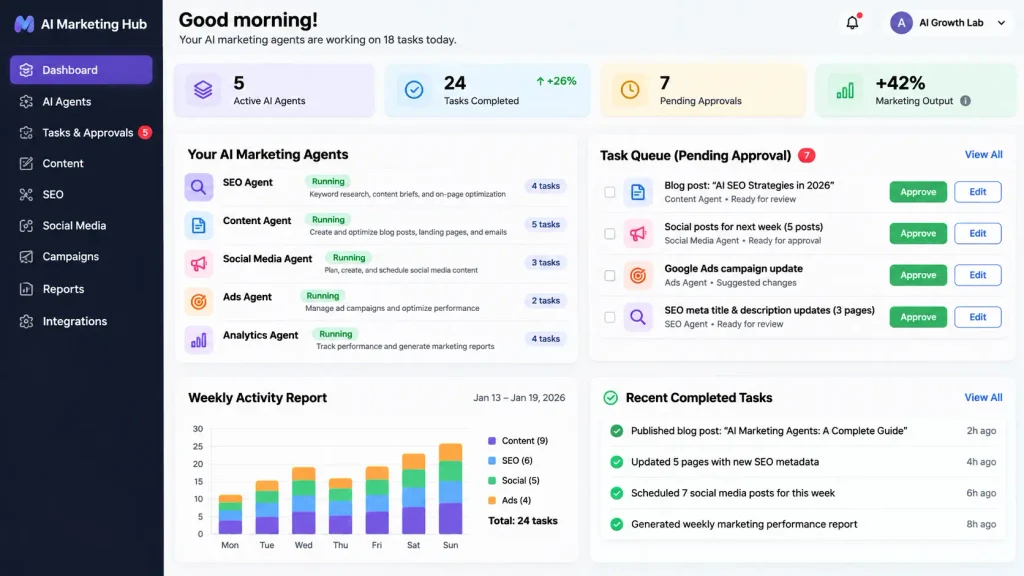
That differs from the chat assistants most people already know. A chat assistant waits for a prompt and returns text. An agent can watch your analytics, notice a page losing traffic, draft a fix, and queue it for approval.
[AI-powered search optimization]
AI Agent vs. AI Copilot
The difference is autonomy. A copilot helps you do a task faster. An agent does parts of the task itself.
Additionally. Plenty of useful tools sit in the copilot camp, and that’s fine. Reviewers often describe Jasper as a best-in-class copilot for content teams rather than a true agent platform. So when you evaluate tools, ask a plain question. Does it only suggest, or can it also act, and who approves the action?
Why Marketers Are Adopting Agents Now
Teams face a squeeze. They must publish more, across more channels, without matching headcount. At the same time, search is changing. People now research inside AI assistants, so visibility there matters too.
Meanwhile, AI agents for digital marketing help because they handle repetitive, rules-based work well. Think reporting, first drafts, list cleanup, and monitoring. That frees people for strategy and judgment, which software still handles poorly.
How We Chose the Best AI Marketing Agents
We screened tools against five criteria:
- Real automation: it completes multi-step work, not just single prompts
- Integrations: it connects to your CMS, CRM, ad accounts, or analytics
- Control: you can set approval steps and limits
- Pricing clarity: costs are findable and predictable
- Evidence of use: the vendor shows real workflows, not only demos
Tools that failed on control or clarity dropped out, even when the features looked impressive. Autonomy without guardrails is a risk, not a benefit.
As a result, we also relied on public product pages and comparison guides. Several of those guides are written by vendors, so we treated “best” claims cautiously. Zapier’s AI marketing tools roundup takes a similar workflow-first approach and is worth reading alongside this one.
[Internal Link Opportunity: link to your agency’s AI marketing automation or AI strategy service page here]
The Best AI Marketing Agents by Job
Instead of one long ranking, here are the best AI marketing agents grouped by the work they do. Prices are approximate starting points from public sources and will change.
Agents for SEO and Content Optimization
Surfer SEO scores your draft against top-ranking pages and flags gaps. Its newer features can update older content as search intent shifts. Plans have started roughly between $79 and $99 a month.
Frase automates much of the content pipeline, from research and briefs to optimization and AI-visibility tracking. The vendor describes broad pipeline coverage, so test it on your own topics. Plans start around $39 to $45 a month.
Semrush pairs classic SEO data with AI visibility tracking across ChatGPT and Google AI features. It suits teams that want rankings and AI mentions in one dashboard. The AI Visibility Toolkit has been sold as a roughly $99 add-on.
[AI Content Optimization]
Agents for Content Creation and Copy
Jasper focuses on brand voice and on-brand content at scale. It’s a strong copilot, with governance features that large teams value. Pricing starts near $49 a month.
Copy.ai leans toward go-to-market workflows, chaining steps for sales and marketing content. Expect a free tier and paid plans around $49 a month.
Writesonic offers affordable, search-focused article generation with built-in SEO checking. It’s a sensible pick for small teams watching budgets, starting near $20 a month.
Agents for Workflow Automation and Custom Builds
Zapier Agents lets you design agents that act across thousands of connected apps. It has a free tier with credit-based usage, so costs scale with activity.
Relevance AI is a no-code builder for “AI workers” handling prospect research, competitive analysis, and personalization. Paid plans start at around $19 a month.
Lindy targets marketing operations such as email follow-ups, lead enrichment, and meeting summaries. It works well when you want an agent without developer help.
Agents Inside Your Existing Platform
HubSpot Breeze runs inside HubSpot, so it uses your CRM data directly. It’s the natural choice for teams already living there, and it includes some free tools.
Salesforce Agentforce serves large organizations on Salesforce. It qualifies leads, personalizes campaigns, and updates records. Costs run substantially higher, and one comparison put typical spend near $1,800 a month or more.
Klaviyo K: AI focuses on ecommerce email and SMS. If your revenue depends on retention marketing, it’s a focused option.
Agents for Paid Media, Analytics, and Full-Funnel Work
Albert.ai optimizes paid media autonomously and targets large campaign budgets. Pricing is custom.
Improvado unifies marketing data for reporting. It delivers insights rather than publishing anything, so treat it as the analytics layer for your agents.
NoimosAI describes itself as a multi-agent team covering SEO, GEO, content, and social. Because most coverage comes from the vendor, run a trial before trusting its claims. Plans have started around $99 a month.
Comparison Table: Best AI Marketing Agents at a Glance
| Tool | Best For | Autonomy | Starting Price (approx.) |
|---|---|---|---|
| Surfer SEO | On-page optimization | Medium | $79–$99/mo |
| Frase | Content-led SEO | Medium to high | $39–$45/mo |
| Semrush | SEO plus AI visibility | Low to medium | Plans vary; AI add-on ~$99/mo |
| Jasper | Brand-voice content | Medium | ~$49/mo |
| Copy.ai | Go-to-market workflows | Medium | Free tier; ~$49/mo |
| Writesonic | Budget SEO articles | Medium | ~$20/mo |
| Zapier Agents | Cross-app actions | Medium to high | Free tier; credit-based |
| Relevance AI | Custom no-code agents | High | ~$19/mo |
| Lindy | Marketing operations | Medium to high | Verify with vendor |
| HubSpot Breeze | HubSpot-native teams | Medium | Some free tools; plans vary |
| Salesforce Agentforce | Enterprise Salesforce stacks | High | ~$1,800/mo and up |
| Klaviyo K:AI | Ecommerce email and SMS | Medium | Bundled with Klaviyo plans |
| Albert.ai | Autonomous paid media | High | Custom |
| Improvado | Marketing analytics | Low (insights only) | Custom |
| NoimosAI | Multi-channel execution | High | ~$99/mo |
Note: Prices come from public comparison pages and change often. Confirm current rates before you budget.
Starter Stacks by Budget
Many readers ask for a simple recipe. These combinations show how to assemble the best AI marketing agents without overbuying. Treat them as starting points, not rules.
Lean Stack (Under About $100 a Month)
Pair a budget content tool such as Writesonic with Zapier’s free tier. Add a spreadsheet for tracking results. This setup handles article drafts, simple automations, and basic reporting. It’s ideal for freelancers and very small businesses.
Growth Stack (Roughly $200 to $500 a Month)
Combine Surfer SEO or Frase for optimization, Jasper or Copy.ai for brand-voice copy, and Zapier Agents for handoffs. Add Semrush if AI visibility matters to your buyers. Teams of three to ten people usually land here.
Platform Stack (Custom Budgets)
If your company already runs on HubSpot or Salesforce, start with the native agents. Breeze or Agentforce can use your CRM data directly, which avoids messy integrations. Layer in an analytics tool like Improvado when reporting gets complex.
Whichever stack you choose, review it every quarter. Tools change quickly, and the best AI marketing agents today may share the stage with stronger newcomers by next year. A short, regular audit keeps you from paying for software your team no longer uses.
How to Choose the Best AI Marketing Agents for Your Stack
A shortlist is only useful if it fits your situation. Use this checklist before you pay for anything.
Match the tool to one job. Write down the task that costs you the most hours. Then shop for the agent built for that task. Broad “do everything” platforms look appealing, but they rarely excel at any one thing.
Check how it fits your stack. The best AI marketing agents plug into the CMS, CRM, and analytics you already use. A tool that needs a new platform for everything creates more work than it saves.
Ask about data handling. Find out where your customer data goes and whether the vendor trains models on it. For regulated industries such as healthcare or finance, involve legal or compliance early.
Look for control features. You want approval steps, activity logs, and spending caps. If a vendor can’t show them, that’s a red flag.
Test with your own content. Demos use perfect examples. A trial with real briefs, real data, and real brand rules shows what the tool does on a normal day.
Watch for lock-in. Confirm you can export your content, prompts, and workflows. Switching tools should never mean starting from zero.
Teams that follow this checklist usually cut their shortlist from fifteen tools to two or three within an afternoon.
How to Use the Best AI Marketing Agents: A Practical Workflow
Buying a tool is the easy part. The value comes from a repeatable process. Here’s a workflow that works for most small and mid-size teams.
Step 1: Pick One Painful, Repeatable Task
Start narrow when you adopt AI agents for digital marketing. Good candidates include weekly reporting, content briefs, or lead follow-up. Avoid “run all my marketing” as a first goal.
Step 2: Write the Rules Before You Switch It On
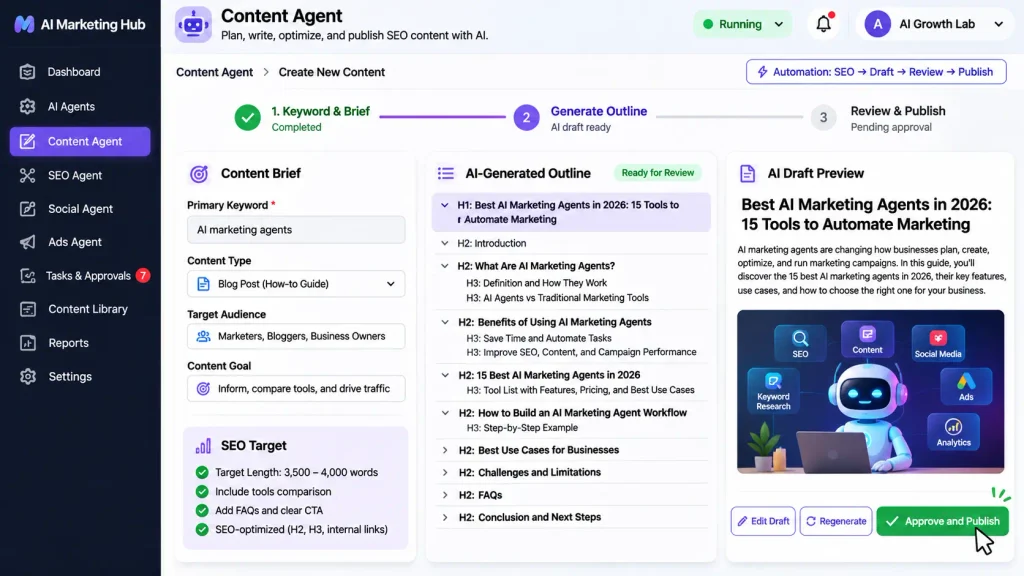
Document the goal, the brand voice, the off-limits topics, and what needs human approval. Agents follow instructions literally. Vague rules produce vague work.
Step 3: Connect Data and Set Approval Gates
Link only the accounts the agent needs. Then require approval for anything public, such as published posts or ad spend changes. You can loosen gates later.
Step 4: Run a Two-Week Pilot
Compare the agent’s output to your usual process. Track time spent, error rate, and revisions needed. Keep a simple log so you can judge fairly.
Step 5: Review, Correct, and Document
Every correction teaches you something. Update your rules after each review. Teams that skip this step often see quality drift.
Step 6: Expand Gradually
Once one workflow runs reliably, add the next. Chain them later, such as research feeding briefs feeding drafts.
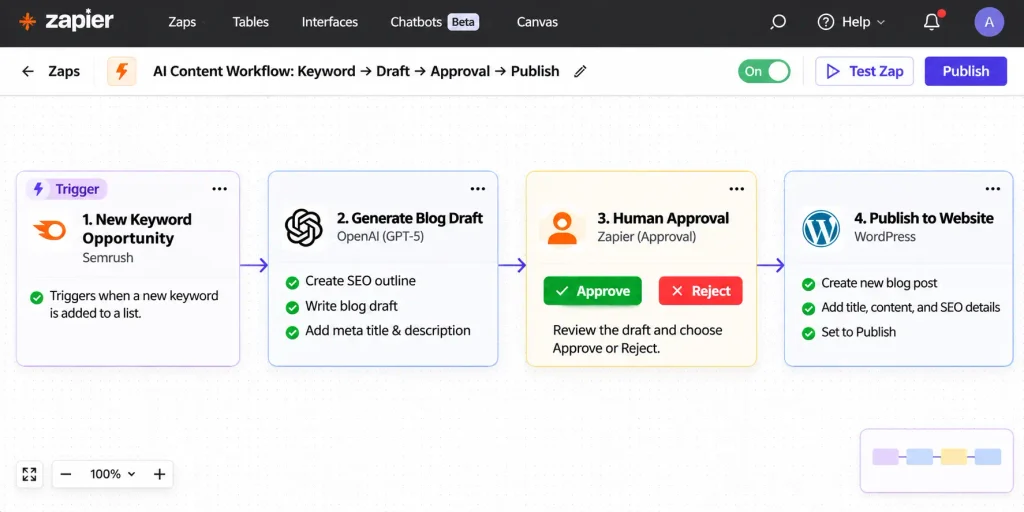
The Marketing Agent Automation Maturity Framework
Not every team should automate at the same depth. Most progress through four stages.
Stage one is assisted. You use copilots for drafting and research, and you do everything else by hand. It’s low risk and a solid start.
At stage two, agents run single tasks on a schedule. A weekly report builds itself, and a brief appears when a keyword is approved.
Stage three connects tasks into pipelines. Research flows into drafts, drafts into review, and review into scheduling. People approve at defined checkpoints.
The final stage is supervised autonomy. Agents monitor performance, propose changes, and act within set limits. Humans manage exceptions and strategy.
Most small businesses using the best AI marketing agents thrive at stage two or three. Large agencies may justify stage four. Moving up should follow proven results, not vendor pressure.
Real Business Use Cases for AI Marketing Agents
Here’s how different businesses put the best AI marketing agents to work.
Local Service Businesses
A dental or legal practice can use an agent to draft service pages, answer review requests, and follow up on form leads. The owner approves each item in minutes.
Ecommerce Stores
Retailers lean on email and retention agents, such as Klaviyo K:AI, for segmentation and campaign drafts. Product-content agents also help keep large catalogs fresh.
SaaS and B2B Teams
These teams use research and outreach agents to enrich leads and personalize messages. Content agents then turn product updates into briefs and drafts.
Marketing Agencies
Agencies benefit most from reporting automation and content pipelines. Standardized workflows let a small team serve more clients without hiring.
AI Agents for Digital Marketing and AI Search Visibility
Marketing no longer happens only on Google. People increasingly ask ChatGPT, Perplexity, and Google’s AI features for recommendations. If your brand never appears in those answers, you lose buyers you never knew existed.
Several tools above now address this directly. Semrush tracks brand visibility across AI assistants, and Frase and others bundle AI-visibility tracking with content work. According to Search Engine Land’s guide to generative engine optimization, earning a citation in an AI answer is a different goal from ranking in ten blue links.
Here’s the practical takeaway for agent-driven teams. Ask your agent to write answer-first sections with specific facts and named sources. Then have a human verify every claim. Specific, trustworthy content gets cited more often than generic copy, and that holds whether a person or an agent drafted it.
Google’s guidance on helpful, people-first content points the same direction. Experience, expertise, and trust matter more than volume. Agents can speed up the work, but they can’t supply your firsthand experience.
[Best AI Marketing Tools in 2026]
A Realistic Case Study: A Four-Person Agency
This is an illustrative scenario, not a named client result. Imagine a four-person agency serving 10 small-business clients. The team spent about 20 hours weekly on reports and content briefs.
They began with one task: weekly performance reports. An agent pulled data, drafted a summary, and flagged anomalies. A strategist reviewed each report before it went out.
Next, they added a brief-building workflow. A researcher approved keywords, and a content tool produced outlines. Writers then added real examples and client details.
After about three months, reporting time dropped sharply, and brief creation became far more consistent. The agency took on two more clients without hiring. Importantly, quality held because humans still approved every client-facing item. The lesson is simple: start narrow, keep approvals in place, and expand only after results prove out.
How to Measure ROI from AI Marketing Agents
Skeptical finance teams want numbers before they approve AI agents for digital marketing. Fortunately, the math is straightforward.
Start with time saved. Multiply weekly hours saved by your loaded hourly cost. Then subtract the tool’s subscription and your setup time.
Next, track output quality. Count revision rounds, error rates, and turnaround times before and after. Faster work that needs more fixes isn’t a win.
Then connect to revenue where you can. Look at lead response times, campaign launch speed, and conversion rates for agent-assisted work. Attribution is rarely perfect, so use trends rather than claiming certainty.
A simple rule helps. If a tool saves less than it costs after two months of honest use, change the setup or cancel it.
Troubleshooting Common AI Agent Problems
Even good tools stumble. Here’s how to handle the usual issues.
Output sounds generic. Add brand voice samples, real examples, and specific customer language to the instructions. Then edit before publishing.
The agent makes factual errors. Require sources for claims, and have a subject expert review anything public. Never let unverified numbers go live.
Costs creep upward. Credit-based tools charge per action. Set usage caps and review spend weekly.
Integrations break. Test connections after each software update. Keep a short list of who owns each one.
The team ignores the tool. Involve daily users early, and show quick wins. Adoption fails when people feel replaced instead of helped.
Results plateau. Revisit your rules. Often the task needs clearer goals, not a new tool.
Why Even the Best AI Marketing Agents Need Human Oversight
Autonomy sounds exciting until an agent publishes something wrong under your brand name. That’s why oversight isn’t optional.
Agents can state false facts with total confidence. They can also misread a brand’s tone, repeat a competitor’s claims, or send a message at the wrong moment. None of that is rare, and each mistake lands on your reputation, not the vendor’s.
Build three habits to stay safe. First, keep a human approval step on anything public. Second, require sources for every statistic, and check them. Third, review a sample of the agent’s output weekly, even when everything seems fine.
Disclosure matters too. Some platforms and regions have rules about AI-generated content, advertising claims, and customer communication. Check the rules that apply to your industry and location, and ask your legal contact when you’re unsure.
Handled this way, the best AI marketing agents become reliable junior teammates. They draft, monitor, and prepare. You decide.
Frequently Asked Questions About the Best AI Marketing Agents
What are the best AI marketing agents in 2026?
The best choice depends on the job. Surfer SEO and Frase suit SEO content, Jasper and Copy.ai suit copy, Zapier Agents and Relevance AI suit custom workflows, and HubSpot Breeze suits HubSpot teams. Pick by task first, then by budget.
What is the difference between an AI agent and an AI assistant?
An assistant responds to prompts and returns output. An agent pursues a goal across steps and can take actions in connected tools. Agents need clearer rules and approval settings because they act on their own.
Are AI agents for digital marketing safe to run unsupervised?
Not yet for public-facing work. Keep human approval on publishing, ad spend, and customer messages. Loosen limits only after the agent proves reliable.
Can small businesses afford AI marketing agents?
Yes. Several tools start between $19 and $50 a month, and some include free tiers. Start with one task and expand only when the savings are clear.
Will AI agents replace marketers?
Unlikely in the near term. They handle repetitive work well, but strategy, creativity, and relationship building still need people. Teams that pair both tend to do best.
Which AI marketing agent should I try first?
Start with the one that matches your biggest time sink. For content, try Surfer SEO, Frase, or Jasper. For automation, try Zapier Agents. For CRM-based work, use your platform’s built-in agent. A free trial on a single workflow tells you more than any review.
How long does it take to see results?
Time savings usually appear within the first few weeks. Quality and revenue gains take longer, often two to four months, because workflows need tuning.
Final Thoughts: Choose the Job First, Then the Agent
The best AI marketing agents aren’t the ones with the boldest promises. They’re the ones that solve a specific, repeatable problem, connect to your tools, and let you stay in control.
Pick one painful task this week. Write the rules, set an approval step, and run a two-week pilot. Then judge the results honestly and expand. Keep a short log of hours saved and mistakes caught, because that record will guide every purchase after this one. Over time, you’ll build a stack that reflects how your team really works, rather than how a vendor’s demo says it should.
Want help choosing and setting up the right agents for your team? Book a free AI marketing audit, and we’ll map your workflows and recommend a starting stack. [Internal Link Opportunity: link this CTA to your contact or consultation page]