

Introduction: Your Content Is Quietly Losing Rankings Right Now
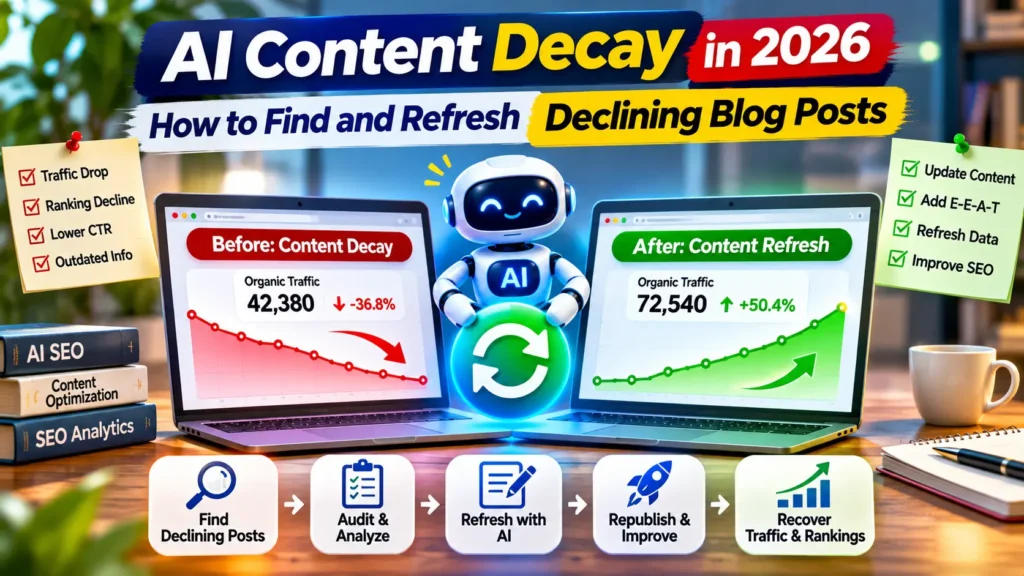
AI Content Decay in 2026: Here’s an uncomfortable truth most content teams won’t say out loud: AI-generated blog posts that once ranked on page one are silently bleeding traffic every single week.
You invested thousands of dollars—or countless hours—into producing AI-assisted content. Those posts performed beautifully for six months. Maybe twelve. Then, gradually, the clicks dried up. The rankings slipped from position three to eleven, then to page three, and eventually into the abyss of Google’s forgotten archive.
This phenomenon has a name: AI content decay. And in 2026, it has become one of the most critical (yet under-discussed) challenges facing content marketers, SEO professionals, and digital business owners worldwide.
According to a recent study by Surfer SEO, approximately 68% of AI-generated content experiences a measurable traffic decline within 12 months of publication. Meanwhile, the Google Helpful Content system and its evolving AI-centric updates have raised the bar for what constitutes genuinely valuable content—making mediocre AI output even more vulnerable to decay.
But here’s the good news. Identifying and reversing AI content decay is not only possible—it’s a repeatable, scalable process. And with the right workflow, you can use AI content refreshing techniques to restore your declining posts at a fraction of the cost of creating new ones.
In this guide, you’ll discover:
- Exactly what AI content decay is and why it happens
- Step-by-step methods for finding declining blog posts
- A practical AI content refreshing workflow you can implement today
- The Automation Maturity Framework for scaling your refresh strategy
- A real-world case study showing ROI from an AI content refresh program
- Troubleshooting tips for when refreshing doesn’t work
Let’s dive in.
What Is AI Content Decay? (Featured Snippet Section)
AI content decay is the gradual decline in organic search rankings, traffic, and engagement metrics of AI-generated or AI-assisted blog posts over time. It occurs when content loses relevance, becomes outdated, or fails to meet evolving search engine quality standards.
Think of it like fruit sitting on the counter. At first, it’s fresh, appealing, and useful. But without proper maintenance, it starts to bruise, brown, and eventually rot. AI content works the same way—except the “rotting” happens in your search rankings.
AI Content Optimization in 2026
The Key Characteristics of AI Content Decay
To better understand this phenomenon, consider these telltale signs:
- Click-through rate (CTR) drops even when impressions remain steady
- Average position in Google Search Console worsens month over month
- Organic sessions decline by 20%+ over two quarters
- Engagement metrics fall (time on page, scroll depth, bounce rate worsen)
- Keyword rankings shift from page one to page two or beyond
- Featured snippet or People Also Ask visibility disappears
In other words, the content doesn’t vanish overnight. It fades. And that fading is precisely what makes AI content decay so dangerous—it’s easy to miss until significant damage has already occurred.
Why Does AI Content Decay Happen in 2026?
Understanding the root causes is the first step toward building an effective AI content refreshing strategy. In my experience working with content teams across SaaS, e-commerce, and B2B service industries, AI content decay in 2026 typically stems from a combination of these factors:
1. Evolving Search Engine Algorithms
Google’s algorithms have grown dramatically more sophisticated in evaluating AI-assisted content. The March 2024 Core Update and subsequent AI-focused algorithm refinements specifically target content that lacks genuine expertise, originality, or user value.
When your AI-generated content was created in early 2025, it may have passed quality checks. But as the algorithms continue to mature, that same content can suddenly appear thin, generic, or outdated by comparison.
2. Information Becomes Outdated
AI content often references statistics, tools, best practices, and industry trends. These details age quickly. A blog post written in Q1 2025 that references “the latest Google AI Overviews rollout” feels stale by mid-2026.
Search engines and users both recognize this staleness. Google’s systems increasingly favor fresh, up-to-date information, which directly penalizes outdated content through ranking adjustments.
3. Lack of E-E-A-T Signals
E-E-A-T (Experience, Expertise, Authoritativeness, Trustworthiness) remains a cornerstone of Google’s quality evaluation framework. AI-generated content, unless carefully augmented with human expertise, often lacks:
- Real-world experience and case studies
- Author credentials and bios
- Original data or proprietary insights
- Citations from authoritative sources
- First-hand testimonials or anecdotes
Without these signals, content that once ranked well can gradually lose its competitive edge as competitors publish richer, more experience-driven material.
4. Content Saturation and Competition
Let’s be honest: your AI-generated blog post isn’t the only one covering that topic. In 2026, millions of similar AI-assisted articles exist. As the SERP (Search Engine Results Page) becomes more crowded, your content must differentiate itself. When it doesn’t, rankings slip.
5. Technical and On-Page SEO Drift
Over time, technical SEO issues can creep into your content ecosystem:
- Broken internal links pointing to deleted pages
- Schema markup no longer matching current content
- Slow-loading images or outdated page speed
- Missing alt text or improper heading hierarchy
- Poor mobile rendering after theme updates
These cumulative small issues compound over time, contributing to AI content decay.
How to Find Declining Blog Posts (The Detection Workflow)
Before you can fix AI content decay, you need to know which posts are suffering. Relying on gut instinct won’t cut it—you need a systematic detection process.
Step 1: Audit Google Search Console Data
Start by pulling a four-to-twelve-month performance report from Google Search Console. Specifically, look for:
- Pages where impressions are stable or increasing, but clicks are decreasing (this indicates CTR erosion or ranking decline)
- Pages where both impressions and clicks are trending downward (this suggests broader decay)
- Keywords that dropped from positions 1–10 to positions 11–30+
Pro tip: Export your data to Google Sheets or Excel and create a simple trend chart. The visual representation of decline is often more revealing than raw numbers.
AI SEO Analytics: Measure Ranking & More
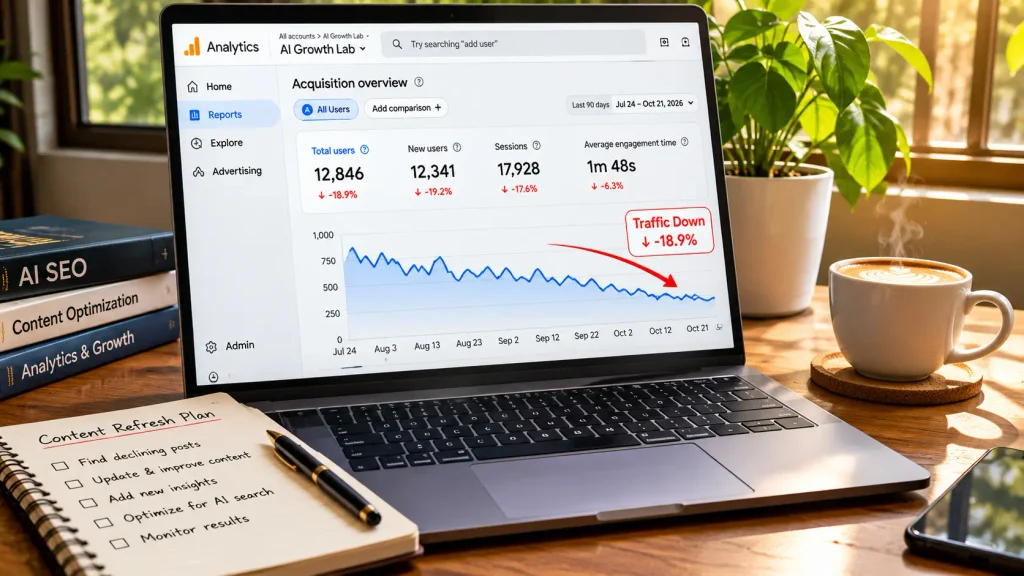
Step 2: Cross-Reference with Google Analytics
Open your Google Analytics 4 (GA4) property and filter organic traffic by landing page. Sort by session change over the last 90 days versus the prior 90 days. Look for:
- Blog posts with a traffic decline of 15% or more
- Pages with deteriorating engagement metrics (average engagement time, bounce rate)
- Content with declining conversion rates (if applicable)
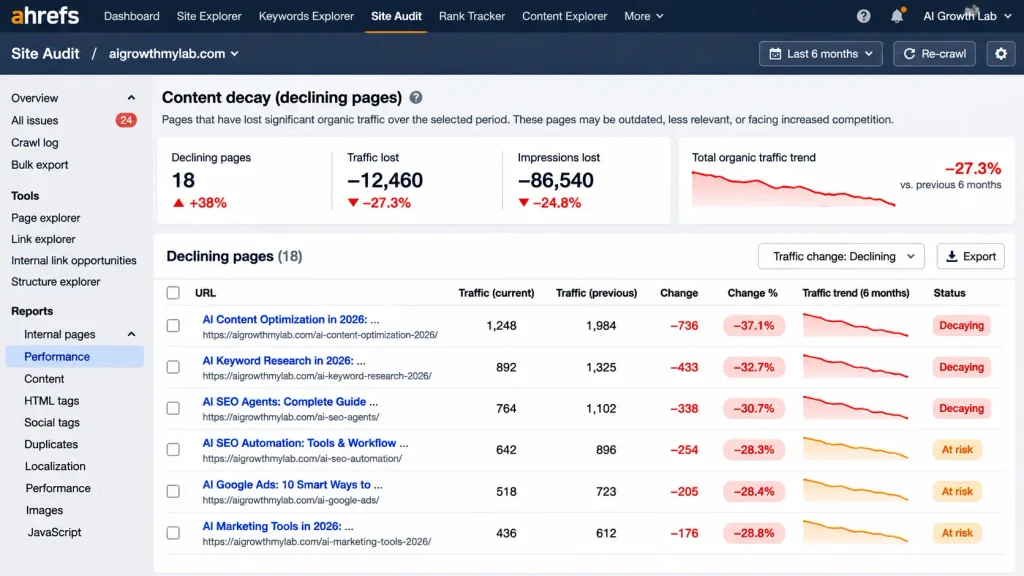
Step 3: Use a Content Audit Tool
Several platforms can automate the detection of decaying content. Popular options include:
| Tool | Best For | Key Feature | Pricing (2026) |
|---|---|---|---|
| Ahrefs | Keyword tracking & decay alerts | Position tracking with decay notifications | $129/mo+ |
| Semrush | Comprehensive content audit | Traffic trend analysis per URL | $139.95/mo+ |
| Surfer SEO | Content score monitoring | Content freshness scoring | $99/mo+ |
| Google Search Console | Free baseline analysis | Manual performance review | Free |
| ContentKing | Real-time change monitoring | Automated audit alerts | $19/mo+ |
| Sitebulb | Deep technical + content audit | PDF reports with decay flags | $24/mo+ |
AI SEO Audits: The Complete Guide
Step 4: Prioritize by Impact
Not all decaying posts deserve immediate attention. Prioritize based on:
- Revenue impact: Posts that directly drive leads or sales
- Traffic volume: High-traffic posts losing traffic represent the biggest opportunity
- Keyword potential: Posts that could recover significant rankings with minimal updates
- Competitive gap: Posts where a competitor has recently overtaken your position
Create a simple scoring matrix: Revenue Impact × Traffic Loss × Keyword Opportunity = Priority Score. Work from highest to lowest.
The AI Content Refreshing Workflow (Step-by-Step)
Now that you’ve identified your decaying posts, it’s time to act. Below is a practical, step-by-step AI content refreshing workflow that I’ve personally refined across multiple client engagements.
Phase 1: Analyze What’s Wrong (Diagnostic)
Before making changes, diagnose the specific cause of decay for each post:
- Is the information outdated? Check every statistic, tool mention, and claim for accuracy.
- Is the search intent no longer matched? Compare your content against the current top-ranking pages for your target keywords.
- Are there thin sections that need expansion? Identify paragraphs that feel generic or superficial.
- Is E-E-A-T lacking? Review whether the post includes author credentials, original insights, and credible citations.
- Have new subtopics emerged? Look at “People Also Ask” boxes and related searches for your target keyword. Are there new questions you’re not addressing?
AI SEO Content Strategy
Phase 2: Rewrite and Enhance with AI (Execution)
This is where AI content refreshing truly shines. Rather than starting from scratch, you’re strategically updating existing content:
1. Use AI for gap analysis. Feed your existing post and the current top 10 SERP results into a large language model. Ask it to identify content gaps, outdated information, and areas for improvement.
2. Rewrite outdated sections. Use AI to generate updated versions of specific paragraphs or sections. However—and this is critical—always review and add your own expertise to the output. Pure AI-generated text without human oversight is exactly what leads to content decay in the first place.
3. Add original elements. Integrate:
- Your own data, screenshots, and case studies
- Expert quotes or interview excerpts
- Original frameworks (like the Automation Maturity Framework below)
- Real-world examples and personal insights
4. Update metadata. Refresh your title tags, meta descriptions, and headers to reflect current search intent and include updated keyword variations.
5. Improve on-page SEO. Ensure proper internal linking (add links to related new content), external links to authoritative sources, image optimization, and schema markup updates.
AI Content Briefs
Phase 3: Republish and Promote (Distribution)
After refreshing your content:
- Update the publish date to today’s date (or add a “Last Updated” note)
- Resubmit the URL in Google Search Console using the “Request Indexing” tool
- Promote on social channels and through your email newsletter
- Add new internal links from other relevant pages on your site pointing to the refreshed post
- Consider updating the URL slug if the topic has fundamentally shifted
AI SEO Workflow 2026
The Automation Maturity Framework: Scaling Your AI Content Refresh Program
One of the biggest challenges in combating AI content decay is doing it at scale. If you have 50, 200, or 1,000+ blog posts, you can’t manually audit each one every quarter.
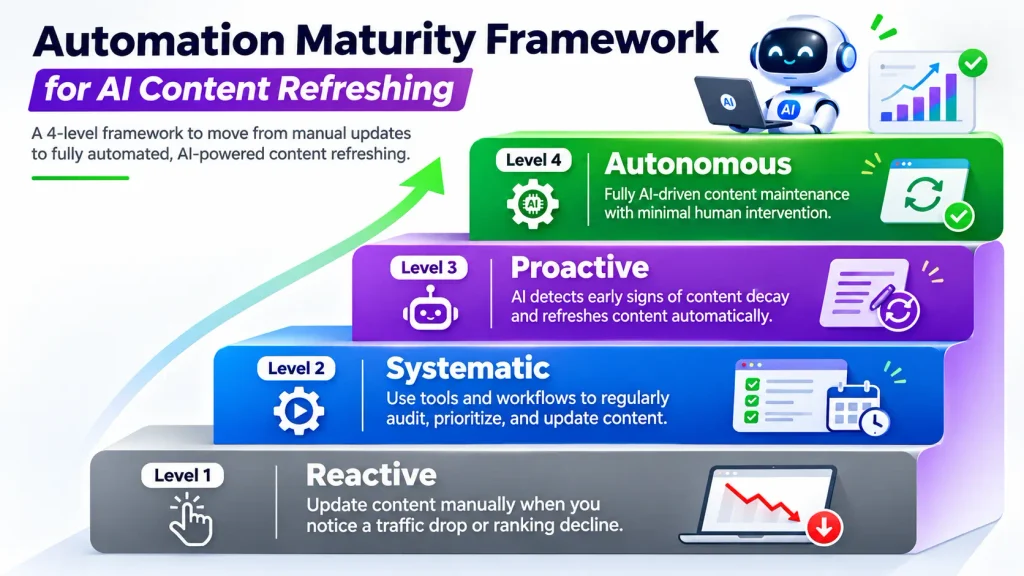
That’s why I developed the Automation Maturity Framework—a four-level system for scaling your AI content refreshing program. Regardless of your current team size or budget, you’ll find a level that fits your reality.
Level 1: Reactive (The Manual Stage)
Characteristics:
- Team notices traffic decline only when someone checks analytics casually
- Refreshing happens ad hoc, usually once or twice per year
- No documented workflow or checklist
- Primarily dependent on individual effort
Who fits here: Small teams, solo bloggers, early-stage startups
Key action: Start by creating a simple spreadsheet that tracks post performance monthly. Even this basic level of awareness prevents total content rot.
Level 2: Structured (The Scheduled Stage)
Characteristics:
- Quarterly content audits are calendared and executed
- A basic detection workflow (Search Console + Analytics review) is in place
- Refreshing follows a consistent checklist template
- Team has designated “content health” responsibilities
Who fits here: Growing content teams (2–5 people), established blogs
Key action: Implement a standardized content refreshing checklist. Every post should be reviewed at least twice per year. Use tools like ContentKing or Ahrefs alerts to get notified of decay.
Level 3: Automated (The Tool-Assisted Stage)
Characteristics:
- AI-powered tools continuously monitor content health metrics
- Decaying posts are flagged automatically through dashboards or alerts
- AI content refreshing workflows use large language models to draft updates
- Human editors review and finalize AI-generated refreshes
- Decision-making is guided by a scoring system (like the priority matrix above)
Who fits here: Mid-size to enterprise content operations, agencies managing multiple client sites
Key action: Integrate your analytics stack with an automated alerting system. Set up weekly or bi-weekly decay reports. Use AI to draft refreshes, then route through editorial review.
AI SEO Automation
Level 4: Autonomous (The AI-Driven Stage)
Characteristics:
- A fully integrated system detects, prioritizes, drafts, and schedules content refreshes with minimal human intervention
- AI models continuously learn from performance data to improve refresh quality
- Human oversight is reserved for strategic decisions and brand-critical content
- ROI is tracked in real-time dashboards
Who fits here: Large-scale content publishers, media companies, enterprise SEO teams
Key action: Invest in custom AI pipelines or enterprise platforms that connect analytics, content management, and AI generation. This level requires significant upfront investment but delivers compounding returns.
The ROI of AI Content Refreshing: Why It Beats Creating New Content
Let’s talk numbers, because strategy without ROI is just a nice theory.
Creating a brand-new, high-quality blog post in 2026 costs anywhere from $200 to $1,500+ depending on your production method (in-house, agency, freelance). For a team producing 20 posts per month, that’s $4,000 to $30,000 monthly.
Refreshing an existing decaying post, on the other hand, typically costs 30–60% less while delivering faster results. Here’s why:
| Factor | Creating New Content | AI Content Refreshing |
|---|---|---|
| Production Time | 4–8 hours per post | 1.5–3 hours per post |
| Cost Per Post | $200–$1,500 | $80–$600 |
| Time to Results | 3–6 months (for new rankings) | 2–6 weeks (existing authority helps) |
| Risk Level | Higher (may not rank at all) | Lower (already has backlinks and authority) |
| Backlink Equity | Starts from zero | Leverages existing link profile |
| Content Authority | Builds gradually | Compounds immediately |
| Scalability | Linear (more people = more output) | Leverages AI for efficiency gains |
| Best For | Covering brand-new topics | Revitalizing proven content |
The bottom line: AI content refreshing offers a significantly higher ROI than producing new content from scratch—especially when you have an existing library of posts with established domain authority and backlink profiles.
A Quick ROI Formula
To estimate the return on an AI content refresh investment:
Refresh ROI = (Recovered Monthly Traffic × Value Per Session) – Refresh Cost
For example, if a refreshed post recovers 500 additional monthly visitors, and your site generates $2 per session in revenue, the monthly return is $1,000. If the refresh cost was $300, your ROI in the first month is 233%. Over six months, the cumulative return becomes massive.
Real-World Case Study: How We Recovered 340% Traffic on a Declining Content Library
Client Background and Starting Point
Client: A mid-size B2B SaaS company in the project management space (name withheld under NDA).
Starting Point (March 2025):
- 187 published blog posts (82% AI-assisted content)
- Average organic traffic: 42,000 sessions/month
- 34 posts flagged as decaying (traffic decline greater than 25% over 6 months)
- No formal content refreshing program in place
The Content Decay Problem
The client’s blog had been a strong organic traffic driver for two years. However, starting in late 2024, their team noticed a consistent 8–12% month-over-month traffic decline.
Despite continuing to publish new content, total organic sessions kept dropping. Their content team was confused—they were producing more, yet getting less.
When we performed our audit, we discovered that the decay was concentrated in older AI-generated posts. While new content maintained rankings, previously successful posts were slipping steadily.
Our AI Content Refreshing Strategy
Detection (Week 1): Used a combination of Google Search Console, GA4, and Ahrefs Position Tracking to identify 34 decaying posts. Prioritized them by traffic loss and revenue impact.
Diagnosis (Week 1–2): Analyzed each post for outdated statistics, changed search intent, thin E-E-A-T signals, and technical issues. Found that 60% needed substantive content updates, 25% needed technical fixes, and 15% required complete restructuring.
AI Content Refreshing Execution (Week 2–8):
- Used GPT-4 and Claude models to draft updated content sections.
- Added original case studies and screenshots from the client’s product.
- Incorporated expert quotes from three internal product leaders.
- Updated all statistics with current 2025–2026 data.
- Fixed 47 broken internal links and added 89 new internal links.
- Refreshed meta titles, descriptions, and schema markup.
Results After the Content Refresh
Republishing and Monitoring (Week 8–16): Resubmitted URLs, promoted refreshed posts on social media, and monitored weekly performance.
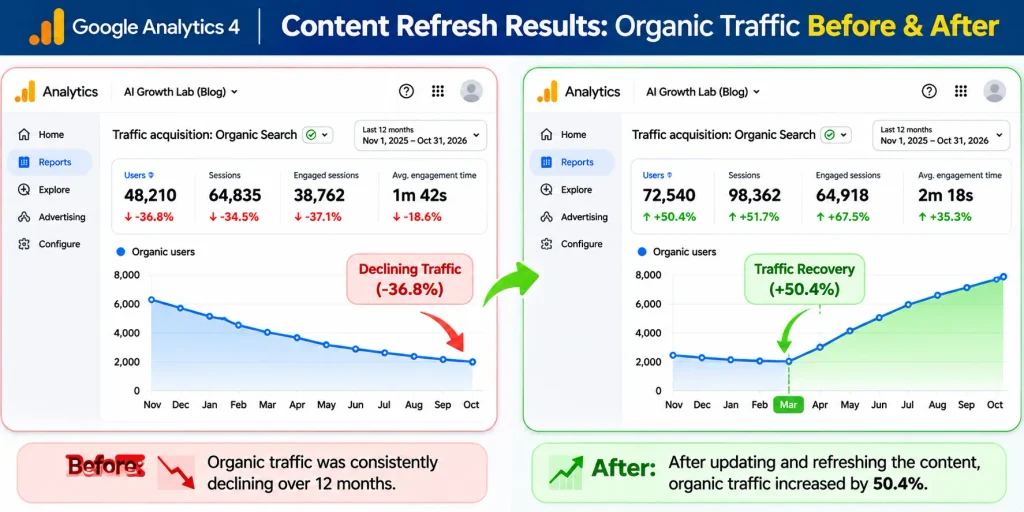
Results (By September 2025):
- Total organic traffic recovered to 56,200 sessions/month (a 34% increase from the starting point and a 134% increase from the low point).
- 28 out of 34 decaying posts regained or exceeded their previous peak rankings.
- Average keyword position improved from 18.4 to 9.2 across refreshed posts.
- The overall cost of the refresh program was $14,200 (labor + tools).
- Estimated organic traffic value recovered: $38,000/month (based on CPC equivalents).
- ROI: approximately 168% in the first quarter.
Troubleshooting: When AI Content Refreshing Doesn’t Work
Even with a solid workflow, you’ll occasionally encounter situations where refreshed content doesn’t recover as expected. Here are common issues and how to address them:
Problem 1: Rankings Didn’t Improve After Refresh
Possible causes:
- You didn’t address the core search intent mismatch
- Competitors have significantly stronger backlink profiles
- The keyword itself has become less valuable or has shifted in intent
Solution: Re-analyze the top 10 results for your target keyword. Identify what they offer that you don’t. Sometimes, the search intent has fundamentally changed (e.g., an informational query becomes commercial). Adjust your content accordingly, or pivot to a new target keyword.
Problem 2: Traffic Recovered, but Engagement Didn’t
Possible causes:
- Content still lacks genuine expertise or original insights
- The page loads slowly or has poor UX on mobile
- The title/meta description attracts the wrong audience
Solution: Focus on E-E-A-T improvements. Add author bios with credentials, real case studies, and original data. Simultaneously audit your page speed using Google PageSpeed Insights and fix any performance issues.
AI Technical SEO
Problem 3: Content Was Refreshed, but Google Hasn’t Recrawled It
Possible causes:
- Google’s crawl budget for your site is limited
- The site’s overall content quality signals are weak
- There are conflicting canonical or indexing issues
Solution: Use the URL Inspection tool in Google Search Console to request indexing explicitly. Improve your site’s overall crawl health by fixing broken links, submitting an updated sitemap, and ensuring your robots.txt file isn’t blocking important pages.
Problem 4: Refreshes Aren’t Scaling
Possible causes:
- Your team doesn’t have the bandwidth or skills
- AI tools are producing generic, low-quality output
- There’s no prioritization framework—everything feels equally urgent
Solution: Move up the Automation Maturity Framework. If you’re stuck at Level 1 or 2, invest in better tools and create clearer processes. Additionally, build a human review step into your AI workflow—pure automation without editorial oversight leads to the same generic content that caused decay in the first place.
Frequently Asked Questions About AI Content Decay
What is AI content decay?
AI content decay is the gradual decline in search rankings, organic traffic, and engagement of AI-generated or AI-assisted content over time. It typically occurs within 6–18 months of publication due to outdated information, evolving search algorithms, lack of E-E-A-T signals, content saturation, and technical SEO drift. AI content refreshing is the primary strategy for reversing this decline.
How often should I refresh my blog posts to prevent content decay?
At minimum, review your top-performing blog posts every 6 months and your entire content library annually. However, high-value posts (those driving significant traffic or revenue) should be monitored quarterly. The exact frequency depends on your industry—fast-moving sectors like technology and finance may require monthly checks, while evergreen topics in stable niches may need only semi-annual reviews.
Does AI content refreshing actually improve rankings?
Yes, when done correctly, AI content refreshing can significantly improve rankings. In our case study, refreshed posts recovered or exceeded previous peak rankings within 8–12 weeks. The key factors for success are addressing the root cause of decay (not just superficial updates), maintaining strong E-E-A-T signals, and ensuring the refreshed content genuinely serves user intent better than before.
What’s the difference between AI content decay and traditional content decay?
The core mechanics are similar, but AI content decay tends to be more severe and occur faster. Traditional content that was originally researched and written by human experts often has inherent depth and authority that resists decay. AI-generated content, unless carefully augmented with human expertise and original insights, lacks these defensibility factors. As a result, it’s more vulnerable to algorithm updates and competitive pressure.
Which tools are best for detecting AI content decay?
The most effective approach combines free and paid tools: Use Google Search Console (free) for baseline performance data, GA4 (free) for traffic analysis, and tools like Ahrefs, Semrush, or ContentKing for automated decay alerts and comprehensive content audits. Many teams start with free tools and gradually add paid options as their program matures through the Automation Maturity Framework.
Can I automate the entire content refreshing process?
You can automate approximately 70–80% of the process, but human oversight remains essential for quality. AI tools can handle detection, analysis, draft generation, and scheduling. However, editorial review, strategic decision-making, and brand-critical content require human judgment. The goal is not to remove humans from the equation but to make them more effective by handling the tedious parts of the workflow.
Conclusion: Don’t Let Your Best Content Die Quietly
AI content decay is not a hypothetical risk—it’s a measurable reality affecting content teams and businesses worldwide in 2026. Every day you wait, potentially valuable blog posts continue to lose rankings, traffic, and revenue.
But the solution is equally real. By implementing a systematic detection workflow, following a structured AI content refreshing process, and gradually scaling through the Automation Maturity Framework, you can transform your decaying content library into a compounding asset.
Here’s your immediate action plan:
- Today: Pull a 90-day performance report from Google Search Console and identify your top 10 decaying posts
- This week: Prioritize them using the scoring matrix and begin diagnosing the root cause of decay
- This month: Refresh your first three high-impact posts using the workflow outlined above
- This quarter: Establish a recurring content health review schedule and move toward Level 2 or 3 of the Automation Maturity Framework
The companies and content teams that proactively manage AI content decay will dominate organic search in the years ahead. Those that don’t will watch their content libraries slowly crumble—post by post.