

Introduction
You’ve probably felt it already. The days of manually adjusting keyword bids every Tuesday morning with a spreadsheet and a cup of coffee are fading fast. Google’s algorithms have grown sharper, faster, and far more opinionated about how your budget gets spent. If you’re still treating AI keyword bidding as an optional experiment, you’re leaving real money on the table — and possibly losing ground to competitors who figured this out months ago.
However, here’s the truth most guides won’t tell you: AI bidding in Google Ads is not a “set it and forget it” magic button. Instead, it is a powerful system that rewards preparation, punishes neglect, and demands a fundamentally different way of thinking about your campaigns. In other words, giving Google more control does not mean giving up responsibility for your campaign.
In this article, you’ll learn exactly how AI keyword bidding works under the hood in 2026, which smart bidding strategies actually match your business goals, and how to avoid the costly mistakes that trip up even experienced media buyers. I’ll walk you through a real-world case study, a practical step-by-step workflow, and an automation maturity framework you can apply to your own account this week.
Whether you manage a local service business in Austin or a national e-commerce brand shipping across three continents, this guide is built to give you clarity — not jargon.
Link AI Google Ads → your complete AI Google Ads guide.
What Is AI Keyword Bidding and Why It Matters in 2026
At its simplest, AI keyword bidding is the process of letting Google’s machine learning models determine how much you pay for each auction — rather than setting fixed bids yourself. Instead of telling Google “I’ll pay $2.50 for the keyword emergency plumber near me,” you tell it “I want to maximize conversions while keeping my cost per acquisition under $45.” The algorithm then adjusts your bid in real time, auction by auction, based on dozens of contextual signals.
So why does this matter more now than ever?
Three big shifts have converged in 2025–2026:
- Privacy-driven signal loss. With third-party cookies effectively gone and Apple’s ATT framework maturing, the old playbook of hyper-granular audience targeting is crumbling. AI bidding compensates by finding patterns in first-party data you didn’t even know existed.
- Auction complexity has exploded. Google now runs billions of auctions daily, each influenced by device type, location, time of day, user intent signals, ad rank history, and more. No human can process that volume. The machines can.
- Performance Max and Demand Gen campaigns have made AI bidding the default, not the exception. Even traditional Search campaigns now lean heavily on automated bid strategies to stay competitive.
Link → AI for Keyword Research.
In short, understanding AI keyword bidding is no longer a “nice-to-have” skill. It’s the baseline for running profitable Google Ads in 2026.
How AI Bidding in Google Ads Actually Works Under the Hood
The Machine Learning Engine Behind Smart Bidding
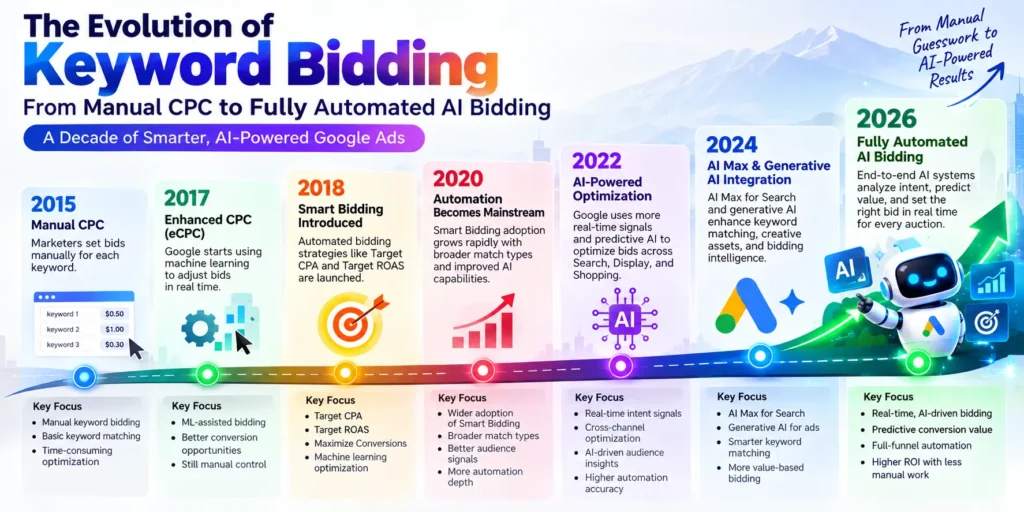
When you activate a Smart Bidding strategy, you’re handing control to Google’s Smart Bidding engine—a machine-learning system that evaluates auction data and adjusts bids automatically. At the same time, the process happens extremely quickly, often within the time it takes for a search auction to complete.
First, the system collects available information about the user, query, context, and account history. Next, it estimates the likelihood that the impression will lead to your chosen conversion goal. Then, based on that probability and your target, it calculates an appropriate bid. Finally, the auction outcome feeds back into the system, allowing future predictions to improve.
As a result, your role changes from manually adjusting individual bids to providing accurate conversion data, clear goals, and a well-structured campaign.
This cycle repeats billions of times per day. Your job isn’t to micromanage individual bids — it’s to feed the system good data and clear objectives.
Signals That Shape Every AI Keyword Bidding Decision
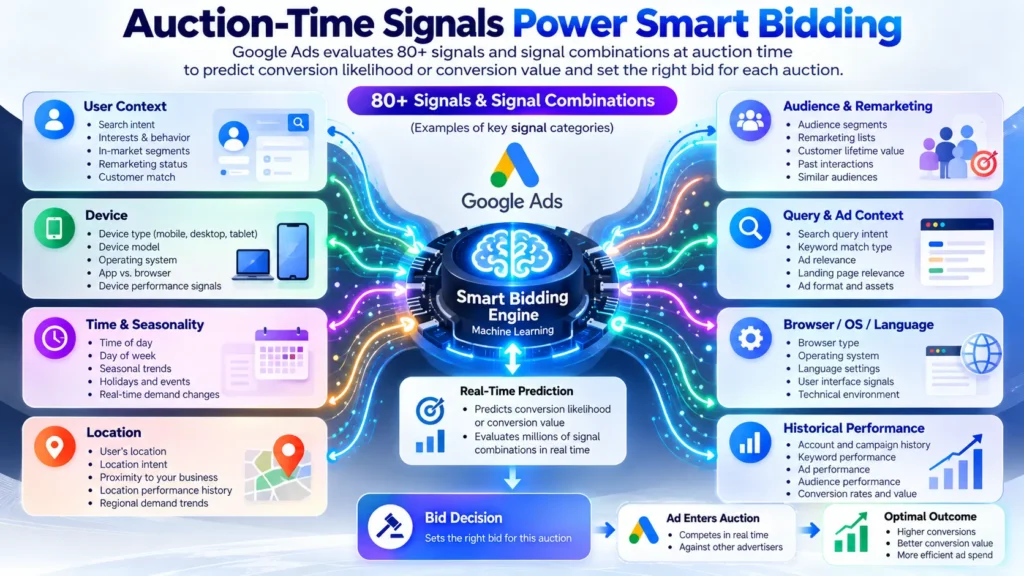
Google has publicly confirmed that its AI bidding models consider over 80 real-time signals per auction. While you can’t control all of them, understanding the major categories helps you structure campaigns more intelligently:
- Device and operating system (iPhone 16 on iOS 19 vs. a budget Android device)
- Location and proximity (a user 2 miles from your store vs. 200 miles away)
- Time of day and day of week (Tuesday 10 AM vs. Saturday 11 PM)
- Search query intent (informational vs. transactional phrasing)
- Remarketing list membership (past site visitors vs. cold traffic)
- Browser language and interface settings
- Historical ad performance for similar queries in your account
The key takeaway is that these signals work together rather than independently. For example, location alone may not determine a bid, but location combined with device, query intent, time, and historical performance can change the predicted value of an auction. Therefore, the quality and volume of conversion data you provide become increasingly important as automation takes over more bidding decisions.
Smart Bidding Strategies Compared: Which One Fits Your Goals?
Choosing a Smart Bidding strategy should begin with your business objective rather than the strategy name itself. For example, a lead-generation campaign may prioritize conversion volume, while an e-commerce business may care more about revenue or return on ad spend. Therefore, the right strategy depends on what you want Google Ads to optimize.
| Strategy | Best For | Goal | Data Requirement | Control Level | Typical Use Case |
|---|---|---|---|---|---|
| Maximize Conversions | Growth phase, new campaigns | Get the most conversions within budget | Low (works with limited data) | Low | Lead gen with flexible CPA |
| Target CPA (tCPA) | Stable campaigns with consistent conversion volume | Maintain a specific cost per acquisition | Medium (30+ conversions/month recommended) | Medium | Service businesses with known margins |
| Maximize Conversion Value | E-commerce with varying order values | Maximize total revenue within budget | Medium | Low | Online stores with broad product catalogs |
| Target ROAS (tROAS) | Mature e-commerce accounts | Hit a specific return on ad spend | High (50+ conversions/month with value data) | High | High-volume retailers optimizing profitability |
| Enhanced CPC (eCPC) | Transitioning from manual bidding | Let AI adjust manual bids up or down | Low | High | Conservative advertisers testing automation |
A practical note: In 2026, Google has been gradually deprecating Enhanced CPC in favor of fully automated strategies. If you’re still running eCPC, consider this your signal to start planning a migration. You can learn more about Google’s official Smart Bidding documentation here (outbound link to support.google.com).
The Automation Maturity Framework: Where Does Your Account Stand?
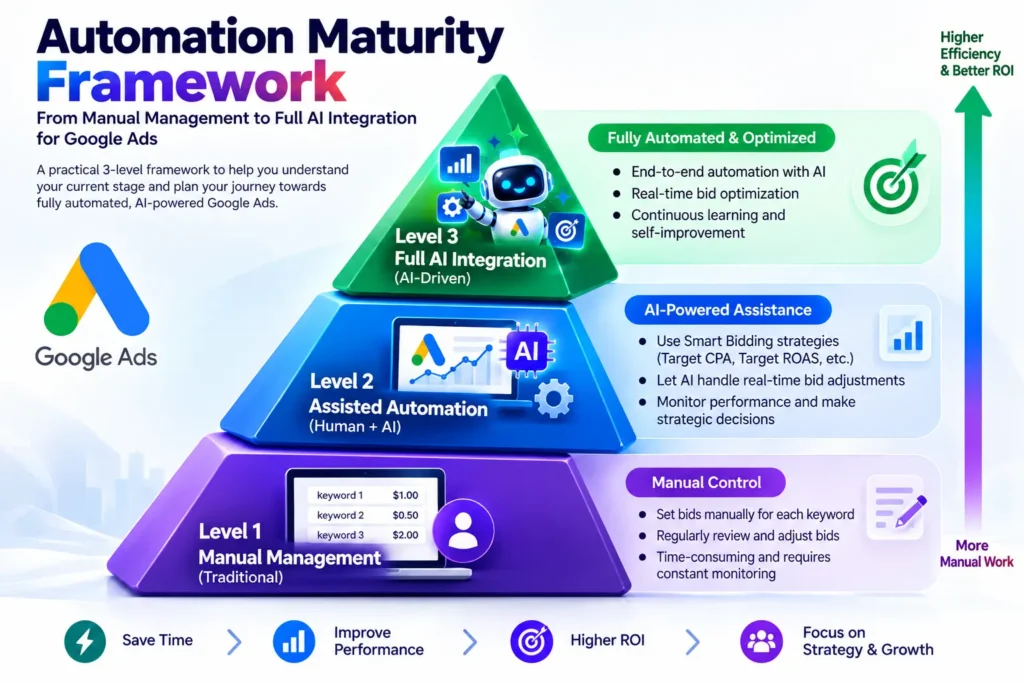
One of the biggest gaps I see in the industry is that advertisers jump straight to full AI bidding without building the necessary foundation. Instead, successful automation usually develops in stages. For that reason, this three-level framework helps you identify where your account currently sits and what should be improved before moving to the next stage
Level 1 – Manual Foundations
At this stage, you’re running manual CPC or Enhanced CPC. Your conversion tracking is basic (maybe a thank-you page fire and nothing else). You have fewer than 20 conversions per month per campaign.
Your priority: Fix your tracking. Implement Google Tag Manager, set up enhanced conversions, and start passing first-party data back to Google Ads. Without reliable conversion signals, AI keyword bidding will optimize toward noise.
Level 2 – Assisted Automation
You’ve moved to Maximize Conversions or Target CPA on your core campaigns. Conversion volume is steady (30–50 per month). You’re using audience signals in Performance Max and have started experimenting with value-based bidding.
Your priority: Improve data quality. Implement offline conversion imports (OCI) so the algorithm learns which leads actually turned into revenue, not just which ones filled out a form. This single step often improves AI bidding performance by 15–25%.
Level 3 – Full AI Bidding Google Ads Integration
You’re running tROAS across e-commerce campaigns, using Profit-Based Bidding (PBB) with margin data, and feeding CRM data back into Google Ads via API. Your account generates 100+ conversions per month with reliable value data.
Your priority: Focus on creative and feed optimization. At this level, the bidding algorithm is doing its job well. Your biggest lever is improving ad relevance, landing page experience, and product feed quality — not tweaking bid targets by 5%.
Link → AI PPC Automation: 15 Best Tools to Automate Google Ads in 2026.
Real-World Case Study: How a Mid-Size E-Commerce Brand Cut CPA by 38%
The Starting Point
Let me share a story from a client engagement in late 2025. The brand was a U.S.-based home goods retailer generating roughly $4 million in annual online revenue. Its Google Ads account used a mix of manual CPC and Target CPA, while blended CPA had climbed to $62 and ROAS was around 3.2x.
The Problems We Found
The biggest issue was conversion tracking. The account was optimizing for “add to cart” events rather than completed purchases, so the bidding system was learning from a proxy instead of actual revenue. The account also contained 14 separate Search campaigns with overlapping keyword coverage, which fragmented conversion data and reduced the learning volume available to each campaign.
What We Changed
We made four major changes:
- Consolidated campaigns. We merged the 14 Search campaigns into four tightly themed groups, increasing the conversion data available to each campaign.
- Fixed conversion tracking. We implemented server-side purchase tracking through Google’s Enhanced Conversions API and replaced the unreliable “add to cart” proxy.
- Switched to Target ROAS. Once reliable purchase-value data was available, we moved from tCPA to tROAS. The campaign started with a conservative 3.0x target and gradually moved to 4.2x over eight weeks.
- Added offline conversion imports. For the wholesale inquiry channel, Shopify CRM data was connected to Google Ads so actual order values could be fed back into the system 14 days after the click.
Results After 90 Days
The account showed measurable improvement after the changes:
- CPA dropped from $62 to $38.40, a 38% reduction.
- ROAS increased from 3.2x to 4.8x.
- Total ad spend decreased by 12% while revenue increased by 19%.
- The learning period for new campaigns fell from approximately three weeks to about eight days.
What This Case Study Shows
The main lesson is that the bidding system was not the fundamental problem. Poor conversion data and a fragmented campaign structure were limiting performance. Once the account had cleaner signals and enough conversion volume, automated bidding had a much stronger foundation for optimization. With cleaner signals and enough volume, it outperformed anything the team could have achieved manually.
Practical Workflow: Setting Up AI Keyword Bidding Step by Step
Ready to implement this in your own account? Here’s the exact workflow I recommend, based on hundreds of campaign launches and migrations.
Step 1 – Audit Your Conversion Tracking
Before you touch a single bid strategy, open your Google Ads conversion settings and ask:
- Are you tracking the right conversions (purchases, qualified leads, booked appointments) — or vanity metrics like page views?
- Is your conversion window aligned with your actual sales cycle? A 7-day window makes no sense for a B2B SaaS product with a 45-day evaluation period.
- Are enhanced conversions enabled? This feature hashes first-party user data (email, phone) to improve attribution accuracy, and it’s essentially table stakes for effective AI bidding in Google Ads in 2026.
Step 2 – Choose the Right Smart Bidding Strategy
Refer back to the comparison table above. A few rules of thumb:
- New campaigns with limited data: Start with Maximize Conversions. Let the algorithm explore before you constrain it.
- Established lead gen with known CPA targets: Move to Target CPA once you have 30+ conversions in the last 30 days.
- E-commerce with reliable revenue data: Go straight to Target ROAS if you have 50+ purchase conversions monthly.
Step 3 – Set Guardrails and Budget Controls
AI keyword bidding works best when you give it clear boundaries. In practice, this means:
- Setting maximum CPC limits within your Smart Bidding strategy (yes, this is still possible in 2026 via portfolio bid strategies).
- Using campaign budget caps to prevent runaway spend during the learning phase.
- Implementing seasonality adjustments for known demand spikes (Black Friday, tax season, back-to-school) so the algorithm doesn’t misinterpret temporary surges as permanent trends.
Step 4 – Monitor, Learn, and Iterate
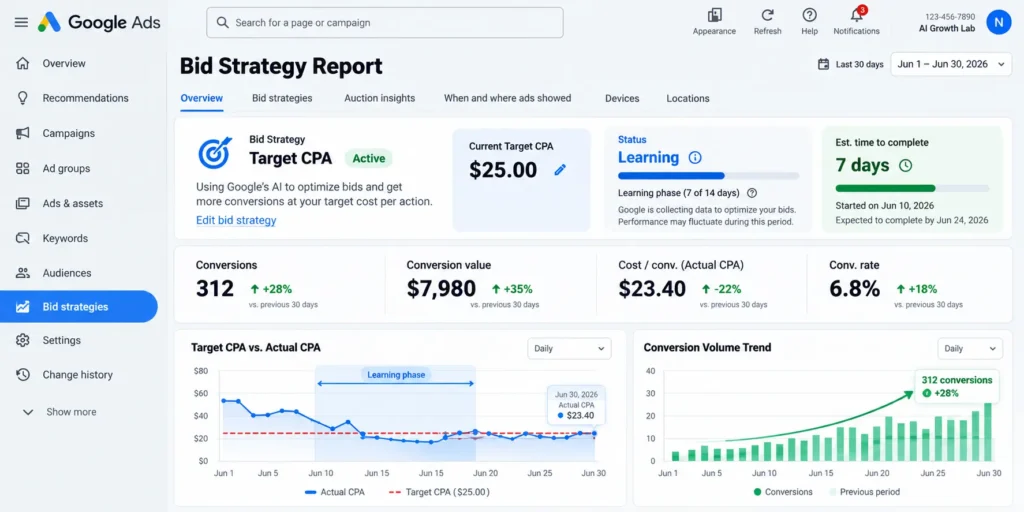
Once your AI bidding strategy is live, resist the urge to make changes for at least two full weeks. The learning phase typically takes 7–14 days, and every premature adjustment resets the clock. After the learning period, review:
- Bid strategy report (under Campaigns > Bid Strategies): Is the algorithm hitting your target?
- Auction insights: Are you losing impression share to specific competitors?
- Search terms report: Is the AI bidding aggressively on irrelevant queries that need negative keyword exclusions?
Troubleshooting Common AI Bidding Google Ads Problems
Even well-configured accounts can run into problems. Fortunately, most issues can be traced to a small number of common causes, and each one has a practical solution.
“My CPA spiked after switching to Smart Bidding.”
In most cases, this happens for one of two reasons: the learning period has not finished, or the target is too restrictive. For example, if your historical CPA was $50 and you set a tCPA of $25, the algorithm may struggle to find enough qualifying auctions. Instead, start with a target that is 10–20% above your historical CPA. Then, gradually tighten the target as the campaign gathers more reliable conversion data.
“The algorithm is spending all my budget on broad match keywords.”
At the same time, this can be a legitimate concern when broad match is combined with Smart Bidding. To maintain better control, build robust negative keyword lists and use brand exclusions in Performance Max campaigns where appropriate. Additionally, separating brand and non-brand traffic into different campaigns can make performance easier to evaluate and manage.
“My conversions dropped after enabling AI keyword bidding.”
Before changing the bidding strategy, check your conversion tracking. In roughly 60% of cases I’ve audited, the issue has been linked to a broken tag, a duplicate conversion action, or a misconfigured consent mode that prevents signal collection. Once the tracking setup is verified, use Google’s Tag Assistant to identify and resolve any remaining measurement problems.
“ROAS looks great, but actual revenue is flat.”
In this situation, the bidding system may be optimizing toward low-value conversions rather than meaningful business outcomes. As a result, reported ROAS can look healthy even when overall revenue remains stagnant. To address this, implement value-based bidding with actual revenue data instead of estimated values so the system has a stronger signal to optimize against.
ROI Expectations: What the Data Actually Shows
Let’s talk numbers, because that is ultimately what matters. However, performance improvements vary considerably according to account structure, conversion volume, tracking quality, and business model. For that reason, the figures below should be treated as practical benchmarks rather than guaranteed outcomes.
Based on aggregated data from industry reports and my own client portfolio through early 2026, here’s what you can realistically expect when migrating from manual to AI keyword bidding. In general, accounts with cleaner data, sufficient conversion volume, and well-structured campaigns tend to benefit more consistently from automation than accounts that make the switch prematurely.
- CPA improvement: A 15–40% reduction may be possible within the first 90 days, depending on data quality and account structure.
- ROAS improvement: E-commerce accounts using value-based bidding with accurate revenue data may see a 20–50% increase.
- Time savings: Advertisers may reclaim 5–10 hours per week previously spent on manual bid management. As a result, that time can be redirected toward creative testing, landing page optimization, and broader campaign strategy.
- Learning curve cost: A temporary 10–20% performance decline can occur during the first 2–3 weeks while the algorithm calibrates. During this period, avoid making unnecessary changes so the system has enough stability to learn.
Ultimately, data maturity is the critical variable. When conversion tracking is reliable, conversion volume is sufficient, and campaigns are properly structured, automated bidding has a stronger foundation for optimization. Conversely, accounts with incomplete tracking or fragmented campaign structures may struggle even when the bidding strategy itself is appropriate.
Therefore, the goal should not be to automate bidding as quickly as possible. Instead, build the right data foundation first, introduce automation gradually, and evaluate results against meaningful business outcomes.
Frequently Asked Questions
1. What is AI keyword bidding in Google Ads?
AI keyword bidding is Google’s automated system that uses machine learning to set keyword bids in real time. Instead of manually setting fixed bids, you define a business goal such as target CPA or ROAS, and then the system adjusts bids according to the predicted value of each auction.
2. How long does Smart Bidding take to learn?
The learning phase typically lasts 7 to 14 days, though it can extend to 3–4 weeks for accounts with low conversion volume. During this period, performance may fluctuate. Avoid making significant changes to your campaigns until the learning phase is complete, as each major edit can restart the process.
3. Can I still use manual bidding in 2026?
Technically, yes—manual CPC is still available. However, automated strategies have become increasingly important as Google’s auction environment has become more complex.
4. Does AI bidding work for small budgets?
It can, but with caveats. For example, accounts with limited conversion volume may need a simpler bidding strategy until sufficient data accumulates.
5. How do I measure the ROI of AI bidding in Google Ads?
Compare your key performance metrics — CPA, ROAS, conversion volume, and impression share — from the 30 days before and after your Smart Bidding migration. Use Google Ads’ bid strategy reports and the Change History tool to isolate the impact of the bidding change from other variables like seasonality or creative updates.
6. What’s the biggest mistake people make with AI keyword bidding?
Poor conversion tracking. The algorithm can only optimize toward the signal you give it. If your conversion action fires on a page view instead of a purchase, or if your tracking breaks on mobile, the AI will confidently optimize toward the wrong outcome. Always audit your tracking before enabling any automated bid strategy.
Conclusion: Your Next Steps
AI keyword bidding in Google Ads is no longer the future—it’s the present. However, successful automation still depends on human decisions around tracking, campaign structure, strategy selection, and data quality. Ultimately, the advertisers who benefit most are not those who simply hand over control to the algorithm, but those who give it reliable signals and clear objectives.
Once those foundations are in place, automation can handle much of the repetitive bidding work while you focus on creative testing, landing pages, offers, and overall campaign strategy.
Here’s what I’d recommend doing this week:
- Audit your conversion tracking using Google Tag Assistant. Fix anything that’s broken.
- Assess your automation maturity using the three-level framework above. Be honest about where you actually are.
- Run a controlled test. Pick one well-structured campaign with at least 30 monthly conversions, switch it to Target CPA or Target ROAS, and let it run untouched for 14 days.
- Compare results against your historical benchmarks and decide whether to expand.
The algorithm is ready. The question is whether your account is.
Want a deeper dive into your specific situation? Contact our team for a free Google Ads automation audit (CTA link placeholder), and we’ll show you exactly where AI keyword bidding can unlock the most value in your campaigns.