

Keyword research is one of the foundations of a successful SEO strategy. However, finding useful keywords can become increasingly difficult as your website, competitors, and target topics grow.AI for Keyword Research: How to Find High-Value Keywords Faster introduces a more efficient approach. Instead of spending hours generating keyword ideas, sorting spreadsheets, grouping similar phrases, analyzing competitors, and interpreting search intent, marketers can use AI to accelerate many of these repetitive tasks.
However, AI should not replace the research process or your strategic judgment. The strongest approach combines AI with reliable SEO data, human expertise, and a clear understanding of your audience.
AI can help you discover long-tail keywords, organize large keyword lists, identify semantic relationships, classify search intent, uncover competitor gaps, and turn keyword data into practical content opportunities.
For bloggers, content marketers, SEO professionals, agencies, and small businesses, this can make keyword research considerably more scalable.
In this guide, you’ll learn how to use AI to discover and prioritize keywords, build topic clusters, analyze competitors, identify quick-win opportunities, and create a more effective SEO content strategy.
What Is AI for Keyword Research?
AI for keyword research is the use of artificial intelligence to accelerate tasks such as keyword discovery, clustering, search-intent analysis, competitor research, content planning, and keyword prioritization.
Traditional keyword research often involves exporting large datasets, filtering keywords manually, comparing metrics, and organizing related phrases into groups. AI can speed up many of these activities by analyzing large amounts of information and identifying patterns.
For example, you can give an AI system a broad topic such as:
AI marketing
and ask it to generate related topics, long-tail variations, questions, comparison searches, and potential content clusters.
The result isn’t necessarily a finished keyword strategy. Instead, it gives you a starting point that can then be validated against real SEO data.
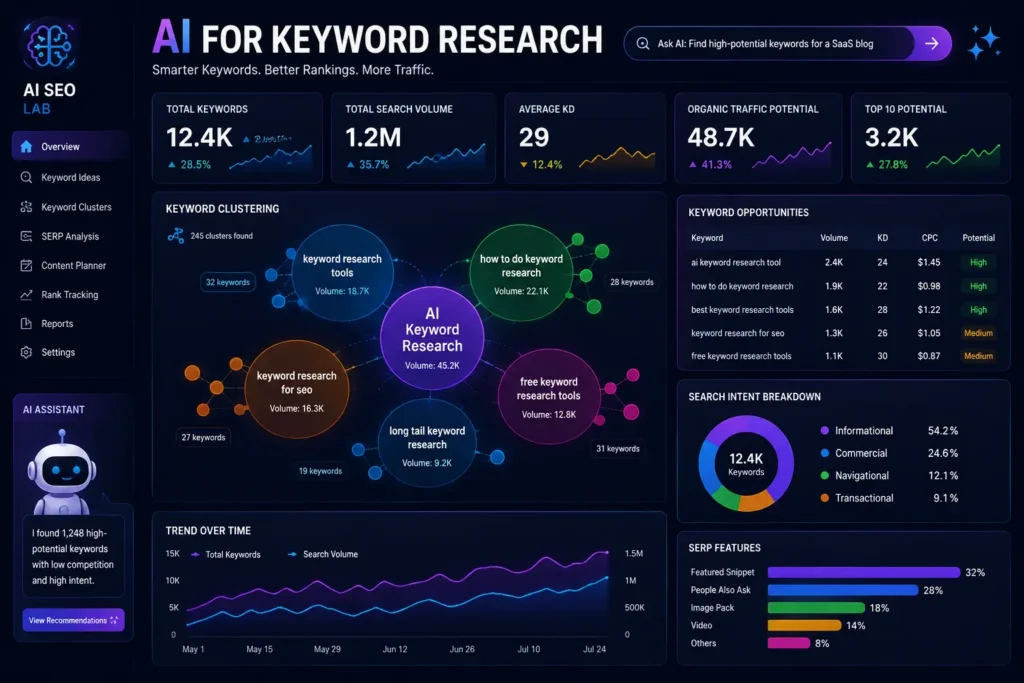
Why AI Is Changing Keyword Research
Search behavior is becoming more complex. Users don’t always search for one exact phrase when researching a topic. Instead, they may use different queries at different stages of their journey.
Consequently, effective keyword research now requires more than finding a list of high-volume keywords.
You need to understand:
- What people are searching for
- Why they are searching
- Which topics are connected
- What competitors already cover
- Which opportunities are realistic
- What content should be created
AI can make this analysis faster.
AI for Keyword Research: From Individual Keywords to Topic Clusters
A modern SEO strategy should not necessarily treat every keyword as a separate article.
Instead, related keywords can be grouped into broader topics.
For example, a website targeting AI keyword research might build supporting content around:
- AI keyword research tools
- Search intent analysis
- Keyword clustering
- Long-tail keyword research
- Competitor keyword analysis
- AI content optimization
- SEO automation
- Topic clusters
AI can help identify relationships between these terms and organize them into logical groups.
This makes it easier to create content hubs rather than publishing unrelated articles.
Understanding Search Intent
Search intent describes what the user is trying to accomplish with a search.
Common categories include:
- Informational: The user wants to learn something.
- Navigational: The user wants to find a specific website or brand.
- Commercial: The user is researching products or solutions.
- Transactional: The user is ready to take action.
For example:
“What is keyword clustering?” is primarily informational.
“best AI keyword research tools” has a stronger commercial intent.
“buy SEO keyword research software” is much closer to transactional intent.
AI can help classify large keyword datasets into these categories, allowing you to create content that better matches the searcher’s needs.
Faster Competitor Analysis
Competitor research is another area where AI can reduce manual work.
With appropriate data, AI can help identify:
- Keywords competitors rank for that you don’t
- Topics competitors cover extensively
- Content gaps
- Long-tail opportunities
- Weak areas in competing content
- Potential topic clusters
Rather than manually comparing dozens of spreadsheets, you can use AI to organize and summarize the findings.
However, always validate the recommendations before investing resources into a new topic.
Better Content Planning
Keyword research should ultimately lead to better content decisions.
AI can help turn a keyword dataset into:
Keywords → clusters → search intent → content topics → content briefs → articles
This makes keyword research part of a broader SEO workflow rather than a standalone task.es and readers.
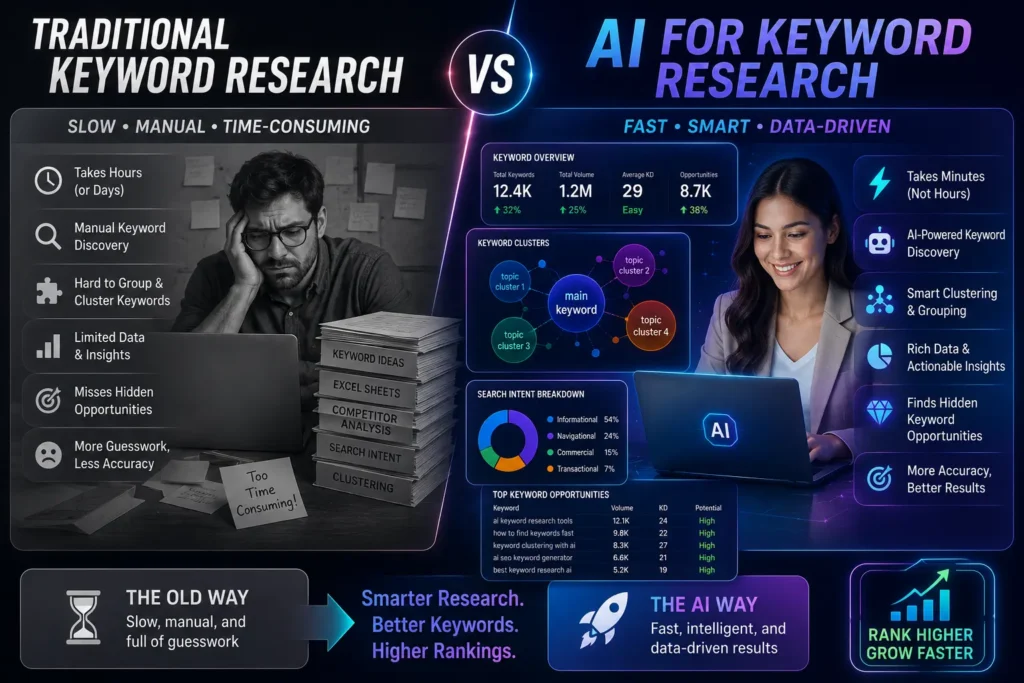
Traditional Keyword Research vs. AI-Assisted Research
| Feature | Traditional Research | AI-Assisted Research |
|---|---|---|
| Keyword discovery | Mostly manual | Faster idea generation |
| Keyword clustering | Time-consuming | AI-assisted grouping |
| Search intent | Manual analysis | Automated assistance |
| Competitor analysis | Spreadsheet-heavy | Faster pattern detection |
| Content planning | Manual | AI-assisted topic planning |
| Scalability | Limited by time | Handles large datasets |
| Strategic decisions | Human-led | Human + AI |
The important point is that AI isn’t necessarily replacing traditional SEO tools.
Instead, it can make those tools easier to use by helping marketers analyze and interpret large amounts of information.
Best Practices for Using AI Effectively
To get the most value from AI-powered keyword research:
- Start with a clear seed topic.
- Validate AI suggestions using reliable SEO metrics such as search volume and keyword difficulty.
- Focus on user intent instead of keyword volume alone.
- Build topic clusters rather than isolated articles.
- Review AI-generated recommendations before publishing to ensure accuracy and relevance.
- Update your keyword strategy regularly as search trends evolve.
Overall, AI is a powerful assistant, but your experience but your experience, industry knowledge, and understanding of your audience remain essential for creating content that genuinely helps readers.
Three Ways to Use AI for Keyword Research
- First, General AI assistants (ChatGPT, Claude, Gemini): Great for ideation and data analysis if you upload a CSV. But they lack live keyword data of their own.
- Next, AI-powered SEO tools (Ahrefs, SEMrush, SEOmonitor): These have keyword databases with AI features built in. You get accurate volume, keyword difficulty (KD), and SERP data alongside AI analysis.
- Finally, AI + MCP (Model Context Protocol): A newer approach where you connect a general AI model directly to a keyword database. Claude with the Ahrefs MCP can query real search data mid-conversation and reason over it in the same pass.
What AI Can and Cannot Do
AI is extremely useful for certain parts of keyword research. However, it also has limitations.
What AI Does Well
AI can help you:
- Generate hundreds of keyword variations
- Expand seed topics
- Group related keywords
- Classify search intent
- Find potential content gaps
- Organize competitor data
- Identify question-based searches
- Create topic clusters
- Prioritize large keyword lists
Where Human Judgment Still Matters
AI cannot fully understand your business strategy without appropriate context.
You still need to decide:
- Which keywords are relevant to your business
- Which topics are commercially valuable
- Whether you can create better content than competitors
- Which keywords match your audience
- Which opportunities deserve investment
- How each topic fits your broader content strategy
For example:
AI can accelerate keyword discovery and analysis, but your final strategy should focus on creating useful content that satisfies the needs of your audience. Google’s Search documentation provides additional guidance on how search performance can be measured and analyzed.
Link: Google Search performance guidance
Think of AI as a research assistant, not the final decision-maker.

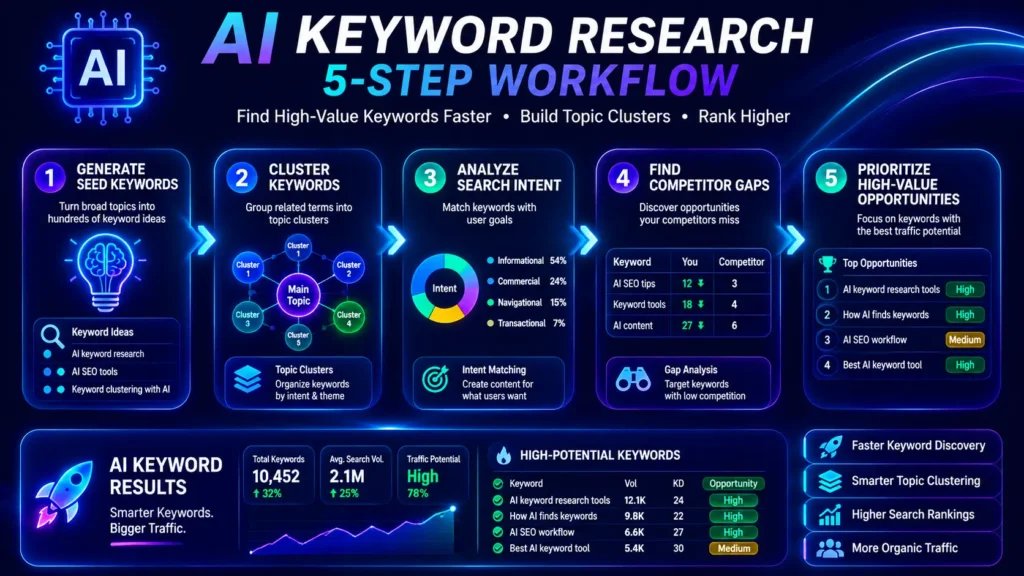
How to Use AI for Keyword Research: A 5-Step Workflow
Step 1: Generate Seed Keywords
Start with a broad topic related to your business.
For example:
AI marketing
Then ask your AI assistant to generate related keyword categories.
Example prompt
I run a digital marketing website for small businesses. Generate 50 keyword ideas around AI marketing. Group them into informational, commercial, transactional, and comparison keywords. Include long-tail variations and question-based searches.”
The key is to request structured output rather than an unorganized list.
Step 2: Cluster Keywords by Topic and Intent
Large keyword lists can quickly become difficult to manage.
AI can help group related terms into topic clusters.
For example:
Parent topic: AI Keyword Research
Possible clusters:
- AI keyword research tools
- AI keyword clustering
- AI search intent
- AI competitor research
- Long-tail keyword research
Example prompt
“Take this keyword list and group the terms by parent topic and search intent. For each cluster, suggest a potential primary keyword, supporting keywords, and a suitable content angle.”
After clustering, manually review the results.
Not every keyword in a cluster necessarily belongs on the same page.
Step 3: Find Competitor Keyword Gaps
Competitor gap analysis can reveal topics your competitors cover that your website doesn’t.
For example, provide an exported keyword dataset containing:
- Your rankings
- Competitor rankings
- Search volume
- Keyword difficulty
- URLs
Then ask AI to identify potential gaps.
Example prompt
“Analyze this competitor keyword dataset. Identify relevant keywords where competitors rank, but my website does not. Group the opportunities by topic and search intent, then prioritize them by relevance and potential.”
The important word here is potential.
A competitor ranking for a keyword doesn’t automatically mean you should target it.
Step 4: Identify Low-Hanging Opportunities
One of the most useful SEO opportunities is improving pages that already have some visibility.
For example, look for keywords where your pages rank around positions 4–20.
These pages may already have some relevance but could potentially benefit from:
- Better title tags
- Improved content
- Additional sections
- Stronger internal links
- Better search-intent alignment
- Updated information
You can export your Search Console data and ask AI to identify patterns.
Example prompt
“Analyze this Search Console keyword data. Identify pages and keywords ranking between positions 4 and 20. Prioritize opportunities based on impressions, relevance, and potential traffic improvement.”
Then manually inspect the pages before making changes.
Step 5: Discover Questions and Long-Tail Keywords
Question keywords can reveal what users want to know.
Examples include:
- How does AI keyword research work?
- What is AI keyword clustering?
- How can AI find long-tail keywords?
- Which AI keyword research tool is best?
- Can AI replace traditional keyword research?
AI can help organize these questions into topic groups.
However, validate important opportunities with actual search data before making them the foundation of your content strategy.
Best Practices for AI Keyword Research
To get better results, follow these principles.
1. Start With a Clear Seed Topic
Give AI enough context about your website, audience, industry, and goals.
2. Don’t Trust AI Metrics Blindly
If an AI model provides search volume or keyword difficulty without a reliable data source, treat those figures as unverified.
3. Focus on Search Intent
Search volume alone doesn’t tell you whether a keyword is valuable.
4. Build Topic Clusters
Look beyond individual keywords and create interconnected content around important subjects.
5. Combine AI With Real SEO Data
Use tools such as Google Search Console and appropriate SEO platforms to validate opportunities.
6. Keep a Human in the Loop
Your final keyword decisions should reflect your business goals, audience, expertise, and available resources.
Common AI Keyword Research Mistakes
1. Trusting AI-Generated Metrics
AI can generate plausible-looking numbers that aren’t necessarily current or accurate.
Always verify important metrics with a reliable data source.
2. Publishing Every Keyword as a Separate Article
A list of 100 keywords does not mean you need 100 articles.
Some keywords belong on the same page.
3. Ignoring Search Intent
Two keywords can be closely related but require completely different content.
4. Chasing Search Volume Alone
A keyword with 10,000 searches isn’t necessarily better than one with 300 searches.
Relevance, competition, intent, business value, and conversion potential matter too.
5. Skipping Human Review
AI can organize information quickly, but strategic judgment still matters.
How to Combine AI With Google Search Console
One of the most practical approaches is to combine AI with your own first-party search data. Google Search Console provides information about the queries, impressions, clicks, CTR, and average position associated with your site, making it useful for validating AI-generated keyword ideas and identifying existing optimization opportunities.
Link: Google Search Console Performance Report
This is an especially good link for your article because you’re explaining how to combine AI with real SEO data, rather than relying blindly on AI-generated keyword suggestions. Rather than relying entirely on third-party keyword ideas.
FAQ
How do I get started with AI for keyword research on a budget?
Start with the tools and data you already have. Google Search Console can provide valuable information about the queries generating impressions for your website. You can then use a general AI assistant to organize, classify, and analyze exported data.
As your SEO needs grow, consider adding a dedicated keyword research platform with reliable search data.
Can AI replace traditional keyword research tools?
Not completely.
AI is excellent at generating ideas, clustering terms, analyzing patterns, and organizing information. However, accurate search metrics generally require access to a reliable data source.
The strongest approach combines AI + SEO data + human judgment.
Can I use ChatGPT or Gemini for keyword research?
Yes. General AI assistants can be useful for keyword ideation, clustering, search-intent classification, and analyzing datasets that you provide.
However, don’t assume that an AI-generated search-volume or difficulty figure is accurate unless the model is connected to a reliable data source.
Is AI keyword research better than traditional keyword research?
It’s better to think of AI as an enhancement to traditional keyword research.
AI can dramatically reduce repetitive work and help analyze large datasets. Traditional SEO data and human expertise remain important for validation and strategic decision-making.
Final Takeaway
AI for keyword research isn’t about replacing SEO professionals. It’s about giving them better tools to work faster and make smarter decisions.
The most effective workflow combines three things:
AI for speed and scale
Reliable SEO data for validation
Human expertise for strategy
Start with a seed topic, expand your keyword ideas, cluster related searches, analyze intent, investigate competitor gaps, and identify opportunities that fit your business.
Then validate those opportunities using real search data before creating or optimizing content.
The goal isn’t to produce the biggest keyword list.
The goal is to find the right keywords, understand why people search for them, and turn those insights into content that genuinely deserves to rank. You’ll be surprised what you’ve been missing.



Pingback: AI Tools for SEO Agencies – Best Tools and Workflow 2026 - AI Growth Lab
Pingback: AI Marketing Tools 2026: 25 Best AI Platforms for SEO & Growth - AI Growth Lab