


Learning how to get cited by ChatGPT in 2026 is becoming an important part of modern SEO. As more people use AI-powered search to discover products, services, and information, businesses need to make their websites accessible, trustworthy, and useful enough to appear as sources in ChatGPT-generated answers. If your competitors appear in those answers while your website remains invisible, it’s time to improve your AI search optimization strategy.
The good news is that citations aren’t random. In fact, ChatGPT follows a fairly predictable process when it searches the web. Some of that process involves technical SEO, while the rest depends on how you create and structure your content. Fortunately, you can improve both areas with practical changes.
This guide explains how to get cited by ChatGPT by showing how it selects sources and how you can make your website eligible and quotable. Additionally, you’ll get a step-by-step workflow, an automation maturity framework, a comparison table, a case study, an ROI method, and a troubleshooting checklist. We’ve kept everything practical, so you can start applying these strategies right away.

How ChatGPT Selects Websites to Cite in Search
Before changing anything on your site, it helps to understand the machine you’re optimizing for. ChatGPT doesn’t cite sources every time. It only cites when it goes out and searches the live web.
How ChatGPT Search Finds Websites to Cite
When ChatGPT answers from its training data alone, there are no citations. It’s simply recalling patterns. When it decides a question needs current or specific facts, it switches to search. Only then do links appear.
This distinction matters for your strategy. You can’t earn a citation on a question ChatGPT answers from memory. Instead, aim at questions that benefit from fresh, specific, checkable information, such as pricing, comparisons, local services, and “best X for Y” queries.
How ChatGPT Rewrites Queries to Find Sources
According to OpenAI’s help documentation, ChatGPT search sometimes partners with other search providers. It typically rewrites your question into one or more targeted queries and sends those out. Third-party analyses add that Bing’s index plays a significant role, though OpenAI doesn’t publish a full list of data sources.
In practice, this means your page competes for the rewritten query, not the exact words the user typed. A person might ask, “Which accountant should a freelancer hire?” Meanwhile, ChatGPT might search for “freelancer accountant services pricing comparison.” Your content needs to match that kind of language.
What the OpenAI Crawlers Actually Do
OpenAI documents several bots on its official crawler page. Three matter here:
- OAI-SearchBot finds and surfaces websites in ChatGPT search features
- GPTBot collects content for model training
- ChatGPT-User visits a page when a user asks ChatGPT to open it
Blocking GPTBot does not remove you from ChatGPT search. Blocking OAI-SearchBot can. That single difference trips up a lot of well-meaning site owners.
How to Get Cited by ChatGPT: Technical SEO Requirements
Think of technical access as a gate. If the gate is closed, nothing else you do will matter. Fortunately, most of these checks take under an hour, and they’re the first step in how to get cited by ChatGPT reliably.
Allow OAI-SearchBot to Improve ChatGPT Search Visibility
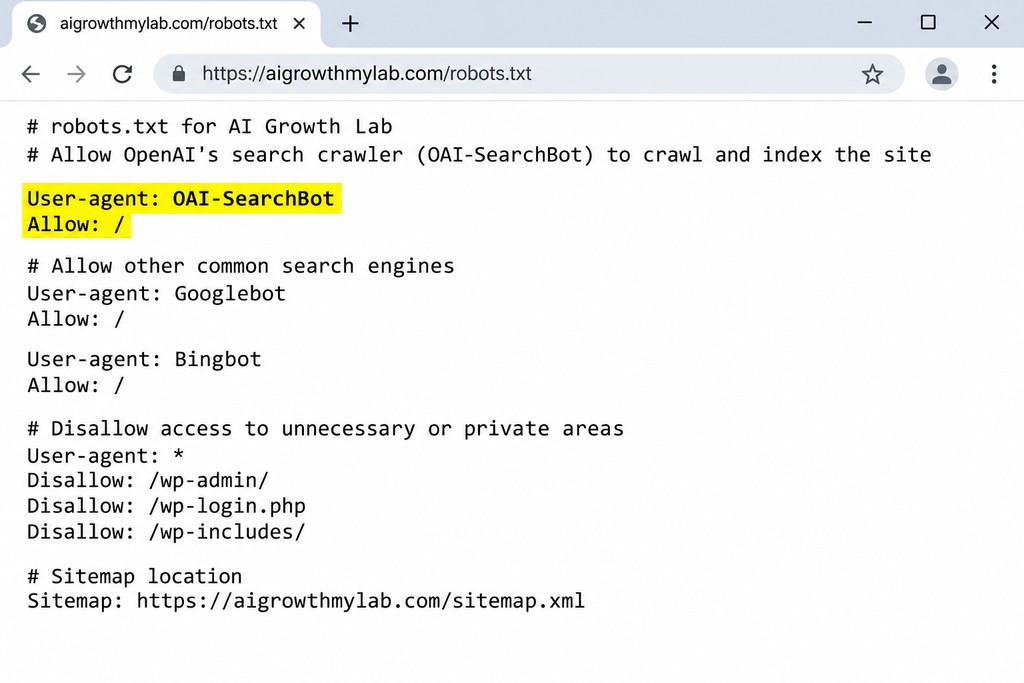
Open yoursite.com/robots.txt and look for any rule that blocks OAI-SearchBot. Also look for a blanket “User-agent: *” followed by “Disallow: /”. Either one can keep ChatGPT from surfacing your pages. OpenAI recommends allowing OAI-SearchBot if you want to appear in search answers.
Check Your CDN and Firewall Settings
Here’s the trap most people miss. Your robots.txt might welcome AI crawlers while your CDN quietly turns them away. Cloudflare’s “block AI bots” toggle and similar firewall rules can return errors to legitimate crawlers.
To test this, review your server logs for OAI-SearchBot requests and look for 403 or 429 responses. If you see them, adjust your bot rules to allow OpenAI’s published crawler IP ranges.
Get Indexed Where ChatGPT Looks
Several third-party analyses report that ChatGPT search leans on Bing’s index alongside its own crawler. OpenAI hasn’t confirmed every detail, so treat this as a strong hint rather than a guarantee. Even so, the action is cheap and useful. Verify your site in Bing Webmaster Tools, submit your sitemap, and confirm key pages are indexed.
Make Sure the Content Loads Without JavaScript
Some crawlers don’t run scripts well. If JavaScript hides your main text until a visitor interacts with the page, some crawlers may see an empty page Test by viewing your page source. If the core answer isn’t in the raw HTML, ask your developer about server-side rendering.
How to Get Cited by ChatGPT Through Content Optimization
Access gets you into the pool. Content quality decides whether you get picked, which makes it the second half of how to get cited by ChatGPT. ChatGPT is building one answer from a handful of sources, so it favors pages that hand over clean, specific facts.
Write Answer-First Content to Earn ChatGPT Citations
Put the answer in the first one or two sentences under a heading. Then add context, examples, and caveats. This structure helps readers who skim. It also gives an AI system a clean passage to lift.
Compare these two openings. “There are many factors to consider when pricing a website redesign” says nothing quotable. “A typical small-business website redesign costs between $3,000 and $15,000, depending on page count and custom features” gives a retrievable fact. Use the second style.
Create Trustworthy Content That ChatGPT Can Cite
Generic statements give an AI nothing to cite. Numbers, dates, named sources, and clear definitions do. Whenever you make a claim, ask whether a stranger could verify it. If not, add the evidence or soften the claim.
Moreover, link out to credible sources. Google’s guidance on helpful, people-first content stresses experience, expertise, and trust. AI systems appear to reward the same qualities.
Target Search Questions People Ask ChatGPT
Write headings as real questions people ask, such as “How do I make my website visible in ChatGPT search?” Then answer it plainly underneath. Because ChatGPT rewrites queries, covering several phrasings of the same question improves your odds of a match.
Build Content Authority for ChatGPT Citations
Add an author name, a short bio, and relevant credentials. Include “Display the date when you last updated the content.” and refresh important pages every few months. Stale pages lose to fresher competitors, especially on topics where facts change.
Off-Site SEO Strategies to Get Cited by ChatGPT
Your own website is only part of the picture. ChatGPT often cites independent sources about a brand, such as directories, review platforms, and news coverage. Consequently, a thin or inconsistent presence elsewhere can hold you back.
Start by making your business details consistent everywhere they appear. Name, address, services, and descriptions should match across your site, directory listings, and social profiles. Next, pursue mentions in places your audience already trusts, such as industry publications, podcasts, and comparison articles.
In addition, build relationships with relevant industry publications, contribute expert insights to trusted websites and maintain accurate business profiles. These activities can strengthen your online reputation and help more people discover your brand.
Search Engine Land’s guide to generative engine optimization makes a similar point. Earning a place among a handful of cited sources is a different game from ranking in ten blue links. Brand mentions across the web help you get there.
Best SEO Strategies for Getting Cited by ChatGPT
Not every tactic carries equal weight. This table ranks the main ones by effort and likely impact, based on how citations work today.
| Tactic | Effort | Likely Impact | Best For | Watch Out For |
|---|---|---|---|---|
| Allow OAI-SearchBot in robots.txt | Very low | Very high (eligibility) | Every site | Blanket “Disallow: /” rules |
| Fix CDN or firewall bot blocks | Low to moderate | High | Sites behind Cloudflare or a WAF | 403 and 429 errors in logs |
| Verify site in Bing Webmaster Tools | Low | Moderate to high | Sites not yet indexed in Bing | Assuming Google indexing is enough |
| Answer-first content rewrites | Moderate | High | Pages that already rank | Padding answers with fluff |
| Add stats, dates, and sources | Moderate | High | Thin or generic pages | Citing weak sources |
| Third-party mentions and PR | High | Moderate to high | Competitive categories | Inconsistent brand details |
| Publishing an llms.txt file | Low | Unproven | Teams that like experiments | Expecting guaranteed results |
Note: OpenAI doesn’t publish a ranking formula, so these impact ratings come from documented crawler behavior and third-party testing. Treat them as informed guidance, not guarantees.
How to Get Cited by ChatGPT: Step-by-Step SEO Workflow
Here’s a repeatable process any team can follow to get cited by ChatGPT more often. It also shows where AI tools can save you time.
Step 1: Build a List of Target Questions
List 20 to 30 questions your customers actually ask. Pull them from sales calls, support tickets, and search suggestions. AI assistants can cluster these into themes in minutes, which saves hours of manual sorting.
Step 2: Test Each Question and Record Who ChatGPT Cites
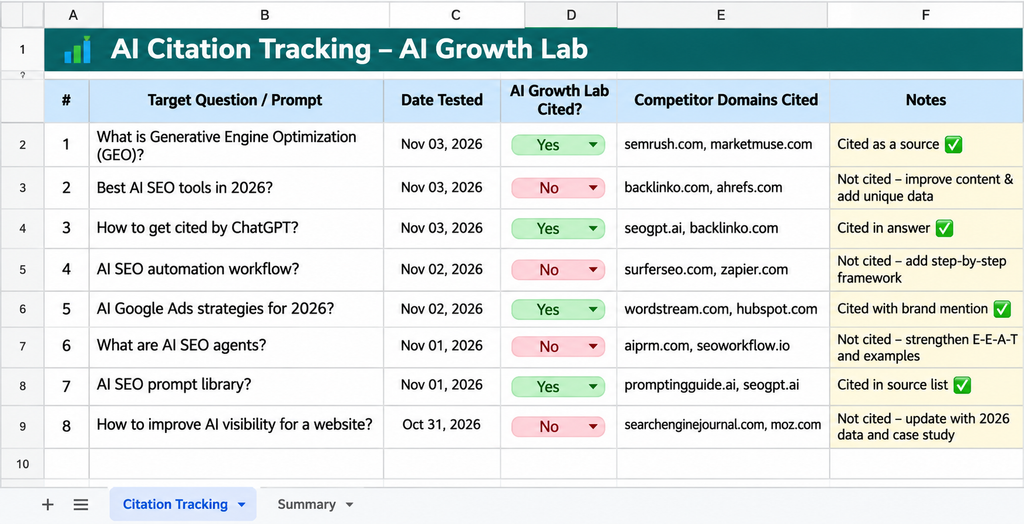
Run each question and note which sources appear. Save the cited domains, the phrasing used, and whether your brand showed up. This baseline is the most valuable thing you’ll create, because it shows exactly where you’re missing.
Step 3: Fix Access Problems First
Work through the technical checklist above. Don’t rewrite a single page until crawlers can reach it. This step often produces the fastest wins.
Step 4: Rewrite Priority Pages Answer-First
Pick the five pages closest to your target questions. Add a direct answer at the top of each section, plus specific facts and sources. Have a subject-matter expert review every draft for accuracy.
Step 5: Strengthen Off-Site Presence
Update directory listings, request reviews, and pitch one or two expert contributions to trusted publications. Small, steady efforts add up here.
Step 6: Re-Test Monthly
Repeat your question set every month and compare results to your baseline. AI responses vary between sessions, so look for trends rather than single runs.
The ChatGPT Citation Automation Maturity Framework
You don’t need to automate everything on day one. Most teams grow through four stages.
Stage one is manual testing. Someone runs questions by hand and logs results in a sheet. It’s slow, but it teaches you how answers behave.
At stage two, you add AI-assisted research. Assistants help cluster questions, draft answer-first outlines, and flag vague claims. Humans still write and approve everything.
Stage three brings scheduled monitoring. You use a visibility tracking tool to run your question set each week automatically and alert you to changes. Platforms such as Semrush now offer AI visibility tracking, which removes much of the manual logging.
The final stage connects monitoring to action. Alerts feed your content calendar, so a drop in citations automatically creates a refresh task. Larger teams and agencies benefit most here, since the setup cost spreads across many pages.
Most small businesses do well at stage two or three. Jump ahead only when the manual work becomes a real bottleneck.
One caution applies at every stage. Automation should speed up testing and reporting, not replace editorial judgment. A tool can tell you a page lost a citation. It can’t tell you whether your advice is still correct, so a human should always own that call.
Real Business Use Cases: Who Benefits Most
The tactics above work across industries, though the emphasis shifts. Here’s how it plays out for four common business types.
How to get cited by ChatGPT: Local Service Businesses
Plumbers, dentists, accountants, and law firms win on specifics. Clear service areas, real price ranges, and consistent directory listings give ChatGPT concrete facts for “near me” style questions. Therefore, local pages deserve the same answer-first treatment as your main service pages.
How to get cited by ChatGPT: E-Commerce Stores
Shoppers ask comparison questions, such as which product suits a certain need. Detailed specs, honest pros and cons, and fresh pricing make product and category pages easier to cite. Reviews on trusted third-party platforms add outside confirmation.
How to get cited by ChatGPT: SaaS and B2B Companies
Buyers research long before they talk to sales. Pages that explain pricing models, integrations, and use cases in plain language tend to get picked up. Comparison pages and glossary entries also help, provided they stay factual rather than promotional.
How to get cited by ChatGPT: Publishers and Consultants
If your expertise is the product, original data is your edge. A small survey, a benchmark, or a documented process gives AI systems something that no competitor can copy. In turn, that makes your page the natural source to cite.
Common Mistakes That Hurt Your Chances of Being Cited by ChatGPT
A few habits quietly undo good work. Watch for these.
Blocking every AI bot out of fear. Some site owners block all AI crawlers to protect their content. That’s a legitimate choice for training bots. However, blocking OAI-SearchBot removes you from the answers where buyers are looking.
Keyword stuffing for AI. Repeating a phrase doesn’t help. AI systems read meaning, not density, so natural language wins.
Publishing AI-written pages without review. Unedited drafts tend to be generic and sometimes wrong. A knowledgeable human should verify every number and claim before publishing.
Chasing one screenshot. Seeing your brand cited once proves little, because responses vary. Track trends across many questions and many weeks instead.
Ignoring the basics of SEO. Strong traditional SEO still feeds this process. Sites with weak fundamentals rarely get cited consistently.
A Realistic Case Study: A Local Accounting Firm
The following is an illustrative scenario that reflects the typical pattern, not a named client result. Imagine a six-person accounting firm serving freelancers in one metro area. Its website ranked decently on Google. Yet when the owner asked ChatGPT for “best accountant for freelancers near me,” competitors and a directory appeared. The firm didn’t.
A quick audit found three problems. A security plugin was returning errors to unfamiliar bots. The service pages opened with long, generic introductions. And the firm’s directory listings described its services in three different ways.
The team fixed the firewall rule first. Then they rewrote five service pages answer-first, adding real price ranges, turnaround times, and a named CPA as author. They also cleaned up the directory listings so details matched everywhere.
After about three months of monthly re-testing, the firm began appearing in several of its tracked questions. Importantly, it also gained branded searches and direct inquiries, which showed the work paid off beyond the AI platform itself. The lesson holds broadly: access, specificity, and consistency did the heavy lifting.
How to Measure ChatGPT Citations and AI SEO Performance
Citations don’t always create clicks. So you need a mix of signals.
First, track your citation rate. Divide the number of tracked questions where you’re cited by the total questions tested. A rising trend is your clearest direct metric.
Second, watch branded search volume in Google Search Console. When people see your name in an AI answer, some search for you afterward. That lift often appears before referral traffic does.
Third, check referral traffic from chatgpt.com in your analytics. It’s usually small today, but it’s growing and tends to convert well because the visitor arrives already informed.
Finally, ask new customers how they found you. A simple “Did an AI assistant mention us?” field on your intake form reveals influence that analytics can miss. Combine these signals, and you’ll have a credible ROI story without overclaiming.
For budgeting, compare the hours spent against the value of one new customer. Most of this work is a one-time cleanup plus light monthly maintenance. Consequently, even a few inquiries that you can attribute to this work can justify the investment for a small business
ChatGPT SEO Troubleshooting: Why isn’t my website cited?
If you’ve done the basics and still see nothing, work through this list in order.
Your site never appears on any question. Check robots.txt, firewall logs, and indexing first. Access problems are the most common cause.
Competitors appear, but you don’t. Compare their pages to yours. They probably give a cleaner direct answer, more specific facts, or stronger third-party backing.
Directories get cited instead of your brand. ChatGPT may prefer independent sources for some queries. Keep those listings complete and accurate, then build your own authority gradually.
Citations appear and then disappear. This is normal. AI answers vary between runs and change as indexes update. Judge progress over weeks, not hours.
Answers show no citations at all. ChatGPT probably didn’t trigger a search. Target questions that need current, specific information instead.
How to get cited by ChatGPT: Tools That Make the Work Faster
You can do all of this with a spreadsheet and patience. Still, a few tools shorten the job considerably.
Bing Webmaster Tools is free. It shows whether your pages are indexed and lets you submit sitemaps. Google Search Console remains useful for spotting branded search growth, which is one of your best ROI signals.
For testing, ChatGPT itself works fine as a manual checker. Add a visibility platform such as Semrush’s AI Visibility Toolkit when you want scheduled tracking across several AI assistants. Server log tools, or the logs in your hosting dashboard, help you confirm that OAI-SearchBot can actually fetch your pages.
Finally, use AI writing assistants carefully. They’re helpful for clustering questions and drafting outlines. However, the final copy needs a real expert’s facts, examples, and voice.
Quick Pre-Publish Checklist
Before you push any important page live, run through this list:
- The first sentence under each heading answers the question directly
- Every statistic has a named source or a date
- A real author with credentials is credited
- A “last updated” date is visible
- The main text appears in the raw HTML, not only after scripts run
- Add the page to your sitemap and verify that search engines have indexed it
- Your robots.txt and firewall allow OAI-SearchBot
- Business details match your directory listings
Print it, pin it, and reuse it. Consistency across dozens of pages is what separates teams that get cited from teams that only try once.
Frequently Asked Questions About How to Get Cited by ChatGPT
How do I make my website visible in ChatGPT search?
Allow OAI-SearchBot in your robots.txt, make sure your CDN isn’t blocking it, and get your pages indexed. Then write answer-first content with specific, sourced facts. Visibility depends on both technical access and content that’s easy to quote.
Does blocking GPTBot stop ChatGPT from citing my site?
No. GPTBot is OpenAI’s training crawler. OAI-SearchBot is the one tied to ChatGPT search. You can block GPTBot and still appear in search answers, as long as OAI-SearchBot has access.
Do I need an llms.txt file?
Probably not yet. It’s a proposed convention, and no major engine has confirmed it affects citations. Adding one is harmless, but don’t expect it to replace the fundamentals above.
How long does it take to get cited?
Technical fixes can show effects within weeks once pages are re-crawled. Content and authority improvements usually take two to four months. Results vary by industry competitiveness, so track trends monthly.
Can small or local businesses get cited too?
Yes. Specific, locally relevant content often performs well because large competitors skip the detail. Clear service areas, real prices, and consistent listings give an AI system concrete facts to use.
Final Thoughts: Start with Access, Then Earn the Quote
knowing how to get cited by ChatGPT comes down to two important questions: Can OAI-SearchBot reach your pages? And does your content offer something useful and trustworthy enough to cite?
First, fix technical access. Next, make your important pages clear, specific, and answer-focused. Meanwhile, strengthen your website authority and monitor your AI search visibility regularly.
Ultimately, consistent improvements matter more than one-time SEO changes. Start this week by checking your robots.txt, testing ten relevant questions in ChatGPT, and recording the sources it cites. Use that baseline to guide your next steps.d by ChatGPT first, check your robots.txt, test ten questions in ChatGPT, and write down what you find. That baseline will guide every decision after it.
Want help finding where your brand is missing from AI answers? Request a free AI visibility audit, and we’ll map the gaps and show you the fastest fixes.




Pingback: Best AI Marketing Agents in 2026: 15 Tools Compared