

Introduction:
AI Marketing Tools 2026 are no longer optional for brands that want to grow faster, create better content, and automate repetitive marketing work. From SEO and AI search visibility to email campaigns, CRM, content writing, design, and workflow automation, the right tools can save hours every week while improving campaign performance. This guide compares 25 of the best AI marketing tools in 2026 based on real use cases, pricing, strengths, and limitations so you can choose the right platform for your business.
What This AI Marketing Tools 2026 Guide Covers
In this guide, we’ve tested and compared 25 of the best AI marketing tools in 2026 across SEO, content writing, email marketing, CRM, creative production, and workflow automation. You’ll see what each tool does best, where it fits in a real marketing stack, how much it costs, and which ones are worth shortlisting for your business.
What Are AI Marketing Tools, and Why Do They Matter in 2026?
The biggest reason AI marketing tools matter in 2026 is simple: they help marketers produce more work in less time without sacrificing strategy, speed, or personalization.
What AI Marketing Tools in 2026 Actually Do
AI marketing tools are platforms like Surfer SEO, Jasper, HubSpot Breeze, Klaviyo, Semrush, and Canva. Each tool is built for a specific job, such as SEO optimization, content writing, CRM automation, email marketing, AI visibility tracking, or creative production.
Why AI Marketing Tools in 2026 Matter More Than Ever
What’s changed in the last twelve months isn’t just better writing quality, although that has improved too. More importantly, AI tools now plug directly into the channels that matter most. In other words, they no longer sit off to the side as drafting assistants you copy and paste from.
How We Selected the Best AI Marketing Tools in 2026
We evaluated the best AI marketing tools in 2026 based on real marketing use cases, category fit, workflow value, pricing structure, and how well each platform supports modern channels like SEO, AI search visibility, content creation, CRM automation, design, and workflow automation.
AI Marketing Tools 2026 and the Shift to AI Search
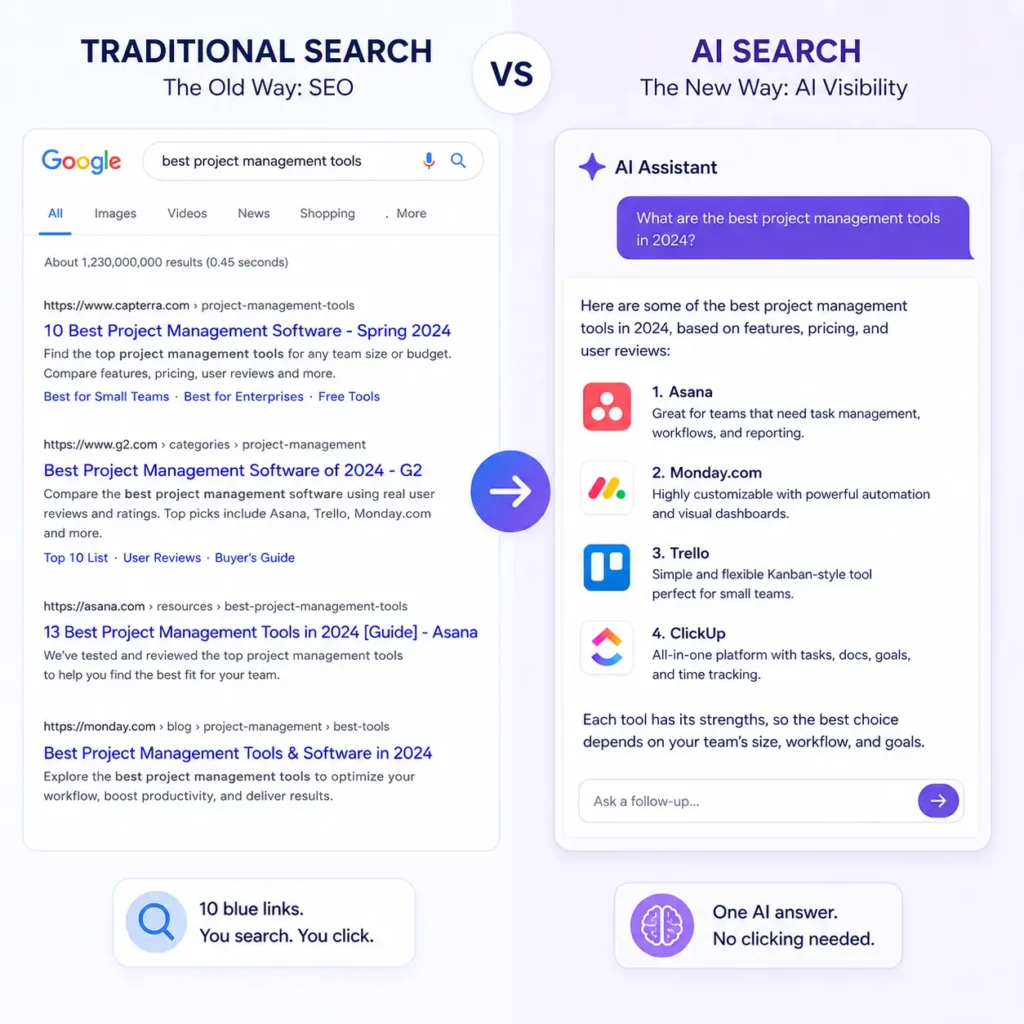
Traditional Google rankings still matter. However, it also matters whether ChatGPT, Gemini, and Perplexity mention your brand when someone asks a question in your category. If a potential customer asks an AI assistant for a recommendation and your brand never appears, you may lose a sale without even realizing it.
AI Marketing Tools 2026 and Changing Pricing Models
Meanwhile, vendors like HubSpot have started moving away from flat per-seat subscriptions toward outcome-based and credit-based pricing. As a result, what you pay depends more on usage and outcomes than on headcount alone.
How AI Marketing Tools 2026 Are Turning Marketers Into Builders
At the same time, AI website and app builders are maturing quickly. As a result, marketers without coding backgrounds can now prototype landing pages and internal tools without waiting weeks for development support.
Why Quality Matters More in AI Marketing Tools 2026
Because AI content is everywhere, genuinely useful, well-researched, and specific content stands out more than ever. By contrast, generic AI-flavored filler gets buried or actively penalized by both search engines and readers.

AI Marketing Tools 2026 for SEO and Content Optimization
If organic search is part of your growth strategy, this is one of the most valuable AI tool categories to invest in. The best AI marketing tools in 2026 do much more than generate text. They help you research keywords, optimize content, improve on-page SEO, and track whether your brand appears in AI-generated answers. As a result, this category now covers both traditional SEO performance and AI search visibility.
Best AI Marketing Tools in 2026 for Content Optimization
Surfer SEO:
Surfer SEO remains one of the most trusted tools for content optimization. It compares your draft against live search results and gives real-time recommendations while you write. For example, it can suggest missing keywords, heading improvements, and content depth adjustments. Because of that, it works well for teams that publish SEO content regularly and want a more structured workflow.
Best for: Content teams and agencies publishing SEO-driven articles at scale
Watch out for: It focuses mainly on content optimization, so you may still need another SEO platform for backlinks and technical audits.
MarketMuse:
MarketMuse takes a broader strategic view than article-level optimization tools. Instead of focusing only on one post, it analyzes your content library and identifies topic gaps compared with competitors. That makes it useful for building topical authority and planning content clusters over time. In other words, it is better suited to long-term content strategy than daily blog editing.
Best for: Brands building topic clusters, pillar pages, and long-term authority
Watch out for: The platform has a steeper learning curve than simpler writing or optimization tools.
Best AI Marketing Tools in 2026 for AI Visibility and Technical SEO
Semrush AI:
Semrush has expanded beyond traditional SEO by adding AI visibility tracking into its broader platform. That means marketers can monitor whether their brand appears in AI Overviews and chatbot-generated answers, while also managing keyword research and technical SEO in the same ecosystem. It’s a strong option for teams already using Semrush for search marketing.
Best for: Existing Semrush users who want SEO and AI visibility data in one platform
Watch out for: If you only need AI visibility tracking, a dedicated tool may be more cost-effective.
OtterlyAI:
OtterlyAI focuses specifically on AI search visibility. It tracks how often your brand is mentioned in tools like ChatGPT, Perplexity, and Google AI Overviews. It also compares your visibility against competitors, which makes it easier to spot where your brand is missing from AI-generated recommendations. Because of that, it is especially useful for marketers exploring GEO and AEO strategies.
Best for: Brands that want a dedicated AI visibility monitoring tool
Watch out for: AI visibility metrics are still evolving, so use trend data rather than relying on a single score.
Alli AI:
Alli AI is designed for marketers who want to automate site-wide SEO improvements without waiting on a developer. It helps deploy changes across title tags, meta descriptions, internal links, and other on-page SEO elements. This can save a huge amount of time for large sites with hundreds or thousands of pages. As a result, it is particularly useful for ecommerce stores and content-heavy websites.
Best for: Large websites that need site-wide on-page SEO updates at scale
Watch out for: Review automated changes carefully before publishing them across your entire site.
AI Marketing Tools 2026 for Copywriting and Content Creation
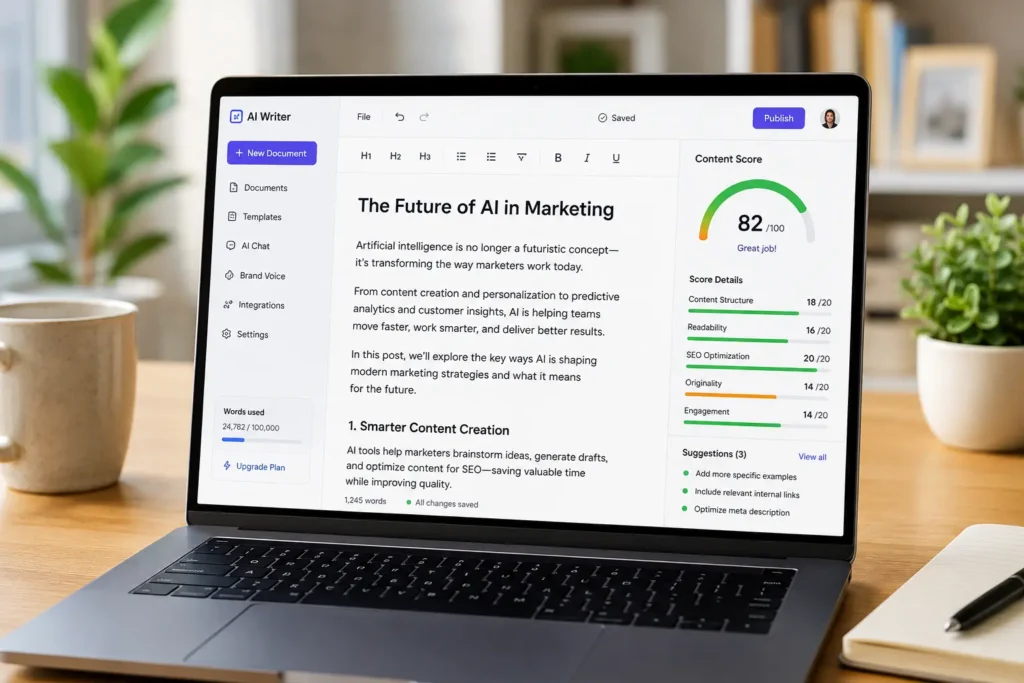
Once your SEO data tells you what to write about, these tools help you actually produce the content — at a pace no single writer could match alone. This is the most crowded category in AI marketing, partly because writing is the easiest task to demo convincingly and partly because the underlying language models have gotten genuinely good at it. But “good at writing” and “good for your specific marketing team” are different questions, and the five tools below answer them in different ways.
Jasper:
Jasper positions itself as a full marketing content workspace rather than a simple text generator, and that framing matters for understanding what it’s actually for. Its standout feature is Brand Voice training. You upload a style guide or sample content, and Jasper adapts its tone to match. That helps keep output consistent across a whole marketing team. For agencies juggling several client brands, this single feature can be the difference between a tool that saves time and one that creates a new editing burden.
Jasper’s Surfer SEO integration means you can see live content scores without leaving the editor, which is genuinely useful for teams producing SEO content at volume. The platform also includes campaign-level tools for generating ad copy variations, social captions, and email sequences from a single brief.
- Best for: Marketing teams that need on-brand content across blogs, ads, emails, and social in one place, especially agencies managing multiple client voices
- Pricing: Pro starts around $59/month for a single seat (annual billing); team pricing requires contacting sales
- Watch out for: No simple multi-seat tier — scaling past one user means moving into custom Business pricing
- Official website: Jasper
Pricing: Check the latest plans on the official pricing page
Copy.ai:
Copy.ai takes a different pricing approach than Jasper — you pay for a tier that includes multiple seats rather than per individual user. Its Pro plan bundles unlimited word generation for several team members, which makes it attractive for small teams producing high content volumes without their bill scaling linearly with every new hire.
Beyond core writing, Copy.ai has been pushing into workflow territory with its Agents tier, which chains together multiple AI steps into one automated process — researching a topic, drafting an outline, writing the post, and generating social captions, all triggered from one input.
- Best for: Small teams that want several people writing without per-seat costs stacking up, and teams interested in chaining content tasks into semi-automated workflows
- Watch out for: The jump to the Agents tier is a significant price increase over entry plans
- Official website: Copy.ai
Pricing: Check the latest plans on the official pricing page
Writer:
Built with enterprise compliance in mind, Writer is the choice for larger organizations that need SOC 2-level data handling and tight brand governance across many contributors. Where Jasper focuses on brand voice, and Copy.ai focuses on seat economics, Writer’s value proposition centers on control — terminology management, style guide enforcement, and the kind of audit trail that legal and compliance teams in regulated industries tend to require before approving any AI tool for company-wide use.
This shows up in features smaller tools often skip: granular permissioning over who can publish AI-assisted content without review, and terminology databases that flag banned or discouraged terms.
- Best for: Enterprise teams where compliance and brand consistency matter as much as output speed, particularly in regulated industries
- Watch out for: The governance features that make Writer valuable at scale can feel like unnecessary friction for small teams who just want to draft a blog post quickly
- Official website: Writer
Pricing: Check the latest plans on the official pricing page
Grammarly (Business AI): Still one of the most widely used writing assistants on the planet, Grammarly’s AI features now go beyond grammar checks into tone adjustment and clarity suggestions, with support for multiple English variants — useful for global teams switching between regional conventions without manually proofreading for spelling differences every time.
What’s notable about Grammarly’s position in 2026 is that it has become less of a standalone destination and more of an editing layer that sits on top of whatever else you’re using. Marketers increasingly draft in Jasper or ChatGPT, then run the output through Grammarly as a final pass before publishing.
- Best for: A final editing layer across every piece of content, regardless of which tool drafted it, especially for teams writing in a non-native language
- Watch out for: Grammarly catches grammar and clarity issues well, but it won’t tell you whether your content is factually accurate or strategically sound
- Official website: Grammarly
Pricing: Check the latest plans on the official pricing page
ChatGPT
It’s not purpose-built for marketing, but ChatGPT remains genuinely popular with marketers for fast drafts, brainstorming, and image generation. A Digital Marketing Institute survey found that the majority of marketers consider ChatGPT the most effective AI marketing tool they’ve used, which says less about it being objectively superior to specialized tools and more about how often a flexible, general-purpose assistant fits into the messy, varied reality of a marketer’s actual day.
The trade-off is that it doesn’t connect natively to content management systems, ad platforms, or CRMs, so you’re often copying and pasting output manually. It also lacks the brand-voice training and SEO scoring that specialized tools like Jasper and Surfer build their entire product around.
- Best for: Quick drafts, idea generation, and one-off creative tasks without a big platform commitment
- Watch out for: Without brand-voice training or built-in optimization, output quality depends heavily on the user’s prompting skill
- Official website: ChatGPT
Pricing: Check the latest plans on the official pricing page
AI Marketing Tools 2026 for Email, CRM, and Personalization
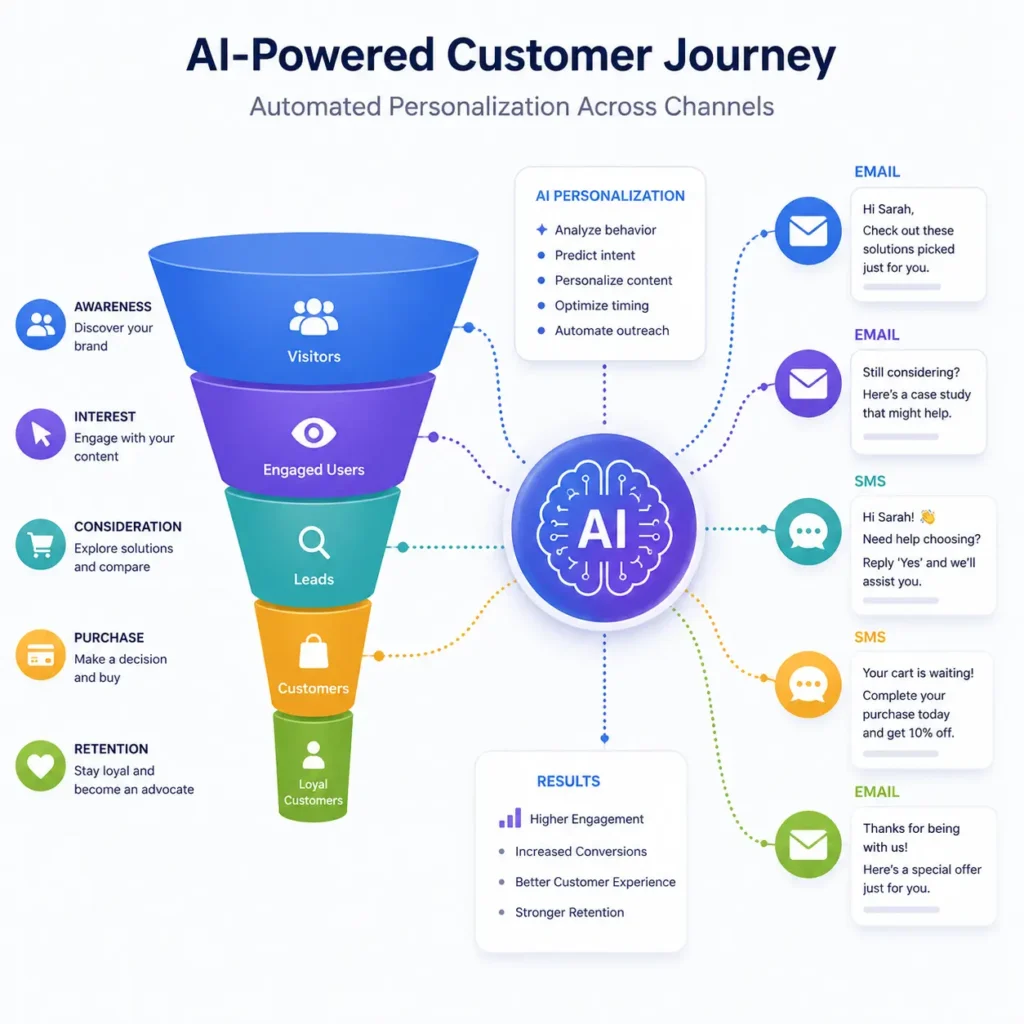
Content gets people to your site. These tools turn that traffic into actual relationships and repeat customers — and this is arguably the category where AI personalization has matured the most, because email and SMS marketing have decades of behavioral data behind them that AI models can learn from. A subject line generator that’s seen millions of past campaigns and their open rates has a genuinely useful dataset to draw on, unlike, say, an image generator trying to guess what “looks good” for your specific brand.
HubSpot (Breeze AI)
HubSpot’s AI layer, called Breeze, now runs across the entire platform — marketing, sales, and service — rather than living in one isolated feature. IIt includes a Content Agent for blog posts and landing pages, a Social Media Agent for captions and scheduling, and a Prospecting Agent for lead research. That prospecting tool pulls together public information and engagement history into a usable sales brief.
The pricing model has shifted notably in 2026: HubSpot moved several AI agents to outcome-based pricing, meaning you pay per resolved conversation or qualified lead rather than a flat fee. This cuts both ways — a team with strong conversion rates may pay less than under flat pricing, while a team still refining its funnel might find the unpredictability harder to budget for.
What makes HubSpot worth its category-leading reputation isn’t any single AI feature in isolation — it’s that all of it sits inside one CRM, so the AI has context a standalone tool simply doesn’t have access to.
- Best for: Teams that want marketing, sales, and service AI unified under one CRM rather than stitched together from several disconnected tools
- Watch out for: Advanced AI features generally require Professional or Enterprise-tier subscriptions, plus a usage-based credit system on top
- Official website: HubSpot (Breeze AI)
Pricing: Check the latest plans on the official pricing page
Klaviyo
Klaviyo remains the go-to for ecommerce brands running email and SMS together. Its AI features handle send-time optimization, subject line generation, and customer segmentation based on purchase behavior, with strong native integrations across major ecommerce platforms like Shopify and WooCommerce.
The segmentation piece is where Klaviyo’s AI genuinely earns its reputation. Instead of building segments manually, the platform identifies behavioral patterns automatically. For example, it can flag early signs of churn or purchase patterns that suggest a customer may respond well to a specific recommendation. For ecommerce brands where email and SMS revenue is significant, this translates directly into measurable dollars.
- Best for: B2C ecommerce brands that need deep email and SMS personalization tied to purchase data
- Watch out for: Pricing scales with contact list size, so model out your expected list growth before committing to annual pricing
- Official website: Klaviyo
Pricing: Check the latest plans on the official pricing page
Mailchimp
Mailchimp bakes its AI features — subject line suggestions, send-time optimization, audience segmentation — directly into its Standard plan rather than charging separately, making it one of the more cost-efficient entry points for small businesses focused mainly on email.
For a small business sending a handful of campaigns a month, Mailchimp’s AI features cover the basics well without requiring a steep learning curve like Klaviyo or HubSpot. The trade-off is depth: Mailchimp’s segmentation is noticeably less sophisticated than Klaviyo’s once your list and complexity grow.
- Best for: Small businesses that want AI email features without a separate AI subscription
- Watch out for: As your contact list and campaign complexity grow, you may eventually hit a ceiling where Klaviyo offers better personalization meaningfully
- Official website: Mailchimp
Pricing: Check the latest plans on the official pricing page
involve.me
A lesser-known but genuinely useful pick for interactive marketing: involve.me uses AI to generate forms, quizzes, and surveys that double as lead generation tools. The core insight is that interactive content captures both attention and useful first-party data better than a static landing page form, because people are more willing to answer playful questions than fill out a generic contact form.
AI speeds up the part that used to be the bottleneck: designing good quiz logic. Instead of manually mapping branching question paths, you describe the outcome you want and let the tool generate a first draft of the structure.
- Best for: Marketers building interactive lead capture experiences without custom development
- Watch out for: This is a lead-generation supplement, not a replacement for your core email or CRM platform
- Official website: involve.me
Pricing: Check the latest plans on the official pricing page
AI Marketing Tools 2026 for Design, Video, and Creative Production
Creative used to be the bottleneck. These tools compress what used to take a design team days into a process that takes minutes — though, as we’ll cover, that speed comes with trade-offs worth understanding, particularly around brand consistency, licensing, and the gap between “fast” and “genuinely good.”
Canva (Magic Studio)
Canva’s AI suite, Magic Studio, now spans text-to-design, video, and even a free version of the professional Affinity design suite it acquired. The newest addition is a conversational design interface — describe what you want, and the editor builds an editable design rather than a flat image, meaning you can still drag, resize, and swap elements afterward.
This editability distinction matters more than it might seem. A flat AI-generated image is frustrating in real use, because the moment you need to change one word of text or swap a color to match your brand guidelines, you’re stuck regenerating the whole thing. Canva’s approach solves that specific frustration, which is probably why Magic Studio has become a default starting point for marketers without dedicated design support.
- Best for: Marketers who need fast, professional-looking creative without a dedicated design team
- Watch out for: The highest-end conversational AI features burn through monthly usage allowances quickly compared to standard image generation
- Official website: Canva (Magic Studio)
Pricing: Check the latest plans on the official pricing page
Midjourney
Still the benchmark for stylized, artistic image generation. Marketers reach for Midjourney specifically for ad creative, posters, and brand storytelling visuals where a distinctive aesthetic matters more than photorealism. Where Canva prioritizes speed and editability, Midjourney prioritizes painterly textures and striking lighting that’s become genuinely recognizable across social media.
This makes it a better fit for top-of-funnel brand campaigns and a worse fit for anything requiring precise, literal product representation — Midjourney has historically struggled with accurately rendering specific products or exact text.
- Best for: Brand and ad creative that needs a strong artistic point of view
- Watch out for: Output is interpretive rather than literal — don’t reach for it when you need an exact representation of a real product
- Official website: Midjourney
Pricing: Check the latest plans on the official pricing page
Adobe Firefly
Firefly’s advantage is commercial safety — it’s trained to avoid the copyright concerns that come with some other image generators, which matters for brands that need to use AI visuals in paid campaigns without legal ambiguity. Adobe has built Firefly’s training data and licensing terms to give enterprise customers the kind of indemnification legal departments ask for before approving AI imagery for large-scale paid media.
This positioning has made Firefly the practical default for larger brands and agencies who can’t afford the risk of a copyright dispute, even if its visual style is sometimes considered less distinctive than Midjourney’s. Its deep integration with the rest of Adobe Creative Cloud also lets designers generate elements directly inside Photoshop or Illustrator.
- Best for: Brand and legal teams that prioritize commercially safe AI-generated imagery
- Watch out for: The visual style reads as more conventional than Midjourney’s, a deliberate trade-off for commercial safety
- Official website: Adobe Firefly
Pricing: Check the latest plans on the official pricing page
Runway
Runway turns short text or image prompts into video clips and motion graphics, making it a practical entry point for brands that want video content without a full production crew. The platform has moved quickly into something agencies and in-house teams genuinely use for short-form social ads, B-roll-style footage, and stylized transitions that would have required a much larger production budget two years ago.
The realistic use case in 2026 isn’t replacing professional video production entirely, but filling the gap for the volume of “good enough, fast” video content that social platforms demand constantly.
- Best for: Short-form video ads and social content produced in-house
- Watch out for: Quality and consistency can vary noticeably between generations, so budget time for multiple attempts
- Official website: Runway
Pricing: Check the latest plans on the official pricing page
Synthesia / HeyGen
Both platforms convert text or existing content into studio-quality talking-head videos using AI avatars — increasingly popular for turning blog posts or product updates into video without filming anything. You write or paste a script, choose an avatar, and the platform generates a polished video with synchronized lip movement in a fraction of the time traditional production requires.
This has proven especially valuable for turning a backlog of written content into video for YouTube and LinkedIn, and producing internal training videos at a volume that would be impractical to film traditionally, particularly when content needs localizing into multiple languages.
- Best for: Repurposing written content into video at scale, especially for product explainers and training content
- Watch out for: Audiences are increasingly attuned to spotting AI avatars, so transparency is worth considering for trust-sensitive content like testimonials
- Official website: Synthesia / HeyGen
Pricing: Check the latest plans on the official pricing page
Lumen5
Lumen5 takes blog content and automatically turns it into short videos complete with captions, stock visuals, and music. It can even connect to your blog’s RSS feed and generate a video every time you publish a new post, making it a genuinely “set it and forget it” addition to a content workflow.
The practical value here is repurposing efficiency rather than originality — Lumen5 isn’t trying to create a stunning, bespoke video; it’s squeezing additional distribution value out of content you’ve already written, reaching audiences who’d never read the original blog post.
- Best for: Repurposing blog content into social-ready video with minimal manual editing
- Watch out for: The automated stock visuals and pacing can feel generic compared to custom or Runway-generated video
- Official website: Lumen5
Pricing: Check the latest plans on the official pricing page
AI Marketing Tools 2026 for Workflow Automation and Operations
Why workflow automation tools matter for modern marketing teams:
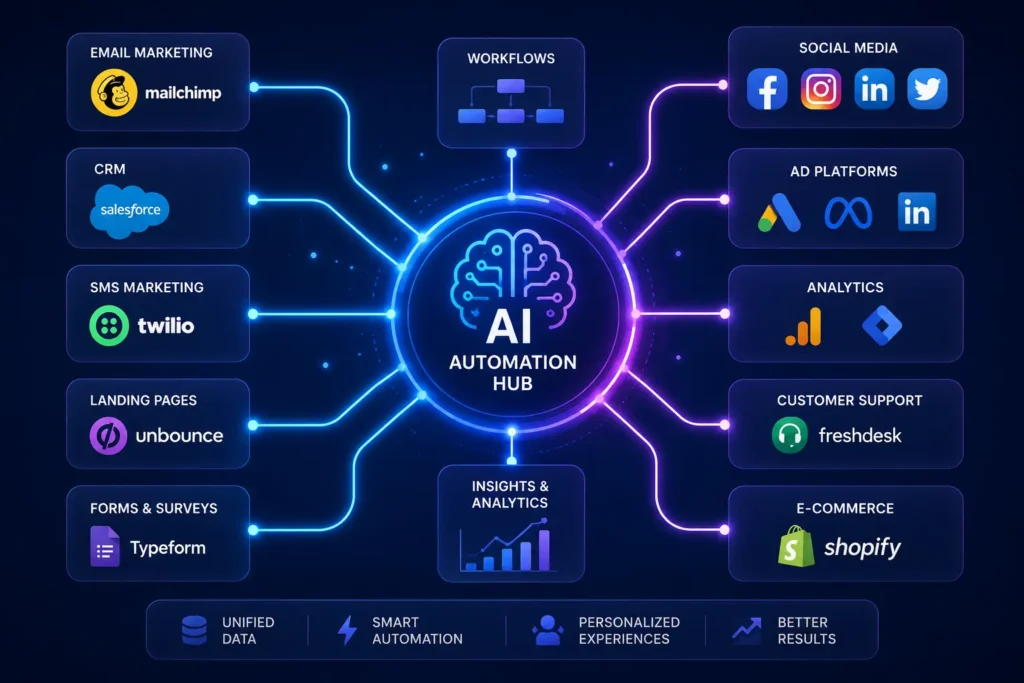
This category is where AI stops being a single-task assistant and starts acting more like a digital teammate that connects your other tools. If the previous categories were about doing individual tasks faster, this one is about removing the manual glue that holds a marketing operation together — the copying data from one tool into another, the manually checking whether something needs a response, and the repetitive multi-step processes that eat hours without requiring much actual judgment.
Gumloop
Gumloop functions like Zapier with a generative AI layer on top — it connects different LLMs to your existing marketing tools and builds automated workflows without writing code. Notably, it includes access to premium AI models without requiring your own API keys, which removes a common cost barrier for smaller teams.
A practical example: a workflow that monitors a Google Sheet of competitor blog URLs, summarizes any new post using an AI model, checks relevance to your content calendar, and posts a Slack notification with a suggested response angle — all without a human checking competitor blogs every morning.
- Best for: Marketers automating multi-step workflows across tools without engineering support
- Watch out for: Periodically audit your workflows for accuracy — an automated process that quietly starts producing wrong results can run for weeks before anyone notices
- Official website: Gumloop
Pricing: Check the latest plans on the official pricing page.
Zapier (AI Workflows)
Still the most widely adopted automation platform, Zapier’s AI features now let you describe a workflow in plain language and have it build the automation steps automatically, connecting thousands of apps in the process. This lowers the barrier to entry significantly compared to Zapier’s earlier years, when building a multi-step “Zap” required understanding the platform’s logic manually.
Zapier’s biggest advantage over newer, more AI-native competitors is simply breadth: with thousands of supported app integrations built up over more than a decade, it’s far more likely your obscure tool already has a ready-made connection.
- Best for: Teams already using multiple disconnected tools that need them to talk to each other
- Watch out for: Costs can climb quickly once you’re running many multi-step workflows at high task volume
- Official website: Zapier (AI Workflows)
Pricing: Check the latest plans on the official pricing page
Brand24
A reputation and brand monitoring tool that scans news sites, social media, blogs, and forums for brand mentions, then applies sentiment analysis to flag how people actually feel about what they’re saying. Rather than relying on a team to manually search platforms, Brand24 continuously monitors a much wider net of sources and surfaces a single dashboard view of mention volume and sentiment trend.
The value of this kind of tool tends to become obvious at the worst possible moment — during a customer service issue going viral or negative press — when an early warning system means responding within hours instead of finding out two days later.
- Best for: Teams that need to catch and respond to negative sentiment before it escalates
- Watch out for: Sentiment analysis on sarcasm and niche jargon is still imperfect across the entire category, so treat scores as a useful signal rather than an infallible verdict
- Official website: Brand24
Pricing: Check the latest plans on the official pricing page
v0 by Vercel
Technically a developer tool, v0 has become popular with non-technical marketers for prototyping landing pages by simply describing what they want. It’s free to start, with costs kicking in once you’re prompting heavily, making it a low-risk way to test whether AI-assisted prototyping fits your workflow.
Claude (with Claude Code and connected tools)
The specific value for marketers is speed of iteration during the idea stage — describing a landing page concept and getting a working prototype back in minutes, rather than waiting for design and development feedback rounds. That prototype then typically gets handed to a developer for production-quality implementation.
- Best for: Marketers who want to design and test landing pages without waiting on a dev team
- Watch out for: Treat output as a fast prototype for internal alignment and testing, not necessarily production-ready code
- Official website: v0 by Vercel
Pricing: Check the latest plans on the official pricing page
Beyond general writing and research help, marketers are increasingly using Claude’s “skills” and connected tools (like Google Drive or SEO platforms) to handle repeatable marketing and content tasks, and using Claude Code to build small internal tools — like trackers that flag which articles need a content refresh based on traffic decline or outdated information.
What distinguishes this from a typical single-purpose AI tool is flexibility. Instead of being limited to whatever features a vendor built in, a marketer can describe an unusual, specific need and get something built around that exact need, rather than hoping a pre-built feature happens to match.
- Best for: Marketers who want one AI assistant that can research, write, and connect to their existing tools and data
- Watch out for: Getting the most value takes a bit more setup and prompting comfort than picking up a single-purpose tool with a fixed feature set
- Official website: Claude
Pricing: Check the latest plans on the official pricing page
Best AI Marketing Tools in 2026 Comparison Table
Quick comparison of pricing, features, and best use cases:25 Best AI marketing tools in 2026
| Tool | Best For | Starting Price | Standout Feature |
|---|---|---|---|
| Surfer SEO | SEO content optimization | ~$99/mo | Real-time SERP-based content scoring |
| MarketMuse | Topical authority planning | Custom pricing | Content gap analysis vs. competitors |
| Semrush AI Visibility Toolkit | AI search visibility tracking | Add-on to Semrush plans | Combines SEO + AI visibility data |
| OtterlyAI | Standalone AI visibility monitoring | Subscription tiers | Tracks citations across ChatGPT, AI Overviews, Perplexity |
| Alli AI | Site-wide technical SEO fixes | Subscription tiers | Automated on-page deployment, no code |
| Jasper | Brand-consistent content at scale | ~$59/mo (1 seat) | Brand Voice training |
| Copy.ai | Multi-seat content teams | ~$49/mo (5 seats) | Unlimited word generation per tier |
| Writer | Enterprise content governance | Custom pricing | SOC 2 compliance, brand controls |
| Grammarly (Business AI) | Editing layer across all content | Subscription tiers | Tone and clarity suggestions, multi-variant English |
| ChatGPT | Quick drafts and brainstorming | ~$20/mo (Plus) | Fast, flexible all-purpose generation |
| HubSpot Breeze | Unified CRM + marketing AI | Included in Pro/Enterprise Hubs | Outcome-based AI agent pricing |
| Klaviyo | Ecommerce email & SMS | Usage-based, contact tiered | Behavior-based segmentation |
| Mailchimp | Small business email AI | ~$20/mo | AI features bundled, no add-on cost |
| involve.me | Interactive lead generation | Subscription tiers | AI-generated forms, quizzes, surveys |
| Canva (Magic Studio) | Fast design production | Free / Pro tier | Conversational design interface |
| Midjourney | Artistic ad creative | Subscription tiers | Stylized, distinctive visual output |
| Adobe Firefly | Commercially safe AI imagery | Subscription tiers | Copyright-conscious training data |
| Runway | In-house video ad production | Subscription tiers | Text/image-to-video generation |
| Synthesia / HeyGen | Talking-head video at scale | Subscription tiers | AI avatar video from text |
| Lumen5 | Blog-to-video repurposing | Subscription tiers | RSS feed auto-video generation |
| Gumloop | No-code AI automation | Free to start | Built-in access to multiple LLMs |
| Zapier (AI Workflows) | Connecting disconnected tools | Free to start | Plain-language workflow building |
| Brand24 | Brand sentiment monitoring | Subscription tiers | Real-time sentiment analysis |
| v0 by Vercel | Landing page prototyping | Free to start | Text-to-design-quality frontend code |
| Claude | All-purpose marketing assistant | ~$20/mo (Pro) | Connected tools, skills, and Claude Code |
Note: Pricing changes frequently — always confirm current rates on each vendor’s official pricing page before purchasing.
How to Choose the Right AI Marketing Tools in 2026 for Your Team
Choosing the best AI marketing tools in 2026 is not about buying the platform with the longest feature list. Instead, it is about finding the tools that solve the biggest problems in your current workflow. Some teams need better SEO support, while others need help with email automation, reporting, design, or content production. The right tool is the one that saves time, improves performance, and fits the way your team already works.
Start With Your Biggest Marketing Bottleneck
First, identify the task that consumes the most time or creates the most friction. For example, if your team struggles to produce blog content consistently, a writing or SEO optimization tool may deliver the fastest return. On the other hand, if your marketing stack feels disconnected, an automation platform may be a better first investment.
Compare Pricing Beyond the Entry Plan
Next, look beyond the headline monthly price. Many AI marketing tools in 2026 advertise an affordable starting plan, but the most useful features may sit behind higher tiers, usage credits, or team upgrades. Therefore, always compare the real cost of the plan you would actually use.
Match the Tool to Your Team’s Skill Level
It is also important to consider how comfortable your team is with data, automation, and new software. Some platforms are beginner-friendly and easy to adopt, while others require more training and experimentation. Choosing a tool that matches your team’s technical comfort level will improve adoption and reduce wasted spend.
Test AI Marketing Tools on a Real Campaign
Whenever possible, run a real campaign or workflow through the platform before committing long term. This gives you a much clearer picture of how the tool performs in everyday use. It also helps you see whether the tool saves time, improves results, or simply adds another dashboard to manage.
Review Your AI Tool Stack Regularly
Finally, remember that the best AI marketing tools in 2026 will continue to evolve quickly. A platform that feels perfect today may be overtaken by a stronger competitor next year. For that reason, it is smart to review your stack every few months and keep only the tools that continue to deliver measurable value.
Common Mistakes Marketers Make When Using AI Marketing Tools in 2026
Even the best AI marketing tools in 2026 can disappoint if they are used without a clear workflow. In many cases, the problem is not the software itself, but the way teams adopt it. Avoiding a few common mistakes can help you get much more value from your AI marketing stack.
Buying the Tool Before Defining the Workflow
One of the most common mistakes is subscribing to a tool before deciding exactly how it will fit into your marketing process. If no one knows when to use it, who owns it, or what result it should improve, the platform often ends up underused. That is why it is better to map the workflow first and choose the tool second.
Publishing AI Output Without Human Editing
AI can save a huge amount of time, but it should not replace review and editing. A tool may produce clean, fluent copy, yet still miss context, facts, or brand nuance. Because of that, human review remains essential for accuracy, tone, and trust.
Trying to Automate Everything at Once
Another mistake is automating too much too quickly. While automation is one of the biggest benefits of AI marketing tools in 2026, not every task should be handed off immediately. It is usually better to automate one repeatable process at a time, test the results, and then expand gradually.
Ignoring Hidden Costs and Usage Limits
Some AI tools look affordable at first but become expensive once your team scales usage, adds more seats, or unlocks premium features. As a result, marketers sometimes underestimate the real monthly cost of their stack. Always review pricing details carefully before building a workflow around a tool.
Treating Every AI Tool as a Permanent Solution
The AI marketing landscape changes fast. New products launch constantly, and existing tools improve or change direction within months. Therefore, avoid treating every platform as a permanent part of your stack. Instead, keep reviewing whether each tool still earns its place.
Frequently Asked Questions About AI Marketing Tools in 2026
What are the best AI marketing tools in 2026?
The best AI marketing tools in 2026 depend on your goals. Surfer SEO and Semrush are strong choices for SEO and AI visibility. Jasper and Copy.ai work well for content creation. HubSpot and Klaviyo are useful for CRM and email automation, while Canva remains one of the most accessible tools for fast creative production.
Are AI marketing tools worth it for small businesses?
Yes, in many cases they are. Small businesses can save time, improve content quality, and automate repetitive tasks without hiring a large team. However, it is usually smarter to start with one tool that solves a clear problem rather than paying for multiple platforms at once.
Can AI marketing tools replace a marketing team?
No. AI tools can speed up research, writing, personalization, and reporting, but they do not replace strategic thinking, creative judgment, or brand decision-making. In most businesses, AI works best as a support layer that helps marketers move faster and focus on higher-value work.
How much do AI marketing tools typically cost?
Pricing varies widely depending on the category. Some tools start around $20 per month, while more advanced SEO, CRM, or enterprise platforms can cost hundreds or even thousands per month. The total cost depends on the number of users, usage limits, and the type of features you need.
Do I need separate tools for SEO and AI search visibility?
Not always. Some platforms, such as Semrush, now combine traditional SEO features with AI visibility tracking. Others focus only on AI search monitoring. If you already use an SEO suite, it may be more efficient to choose a platform that includes both.
How do I know if an AI marketing tool is actually working?
The best way is to measure a clear before-and-after result. For example, you might track time saved, content production speed, traffic growth, email performance, or lead quality. Without a defined metric, it becomes difficult to know whether the tool is genuinely improving your marketing performance.
Final Thoughts on the Best AI Marketing Tools in 2026
The best AI marketing tools in 2026 are the ones that solve a real problem in your workflow, whether that is SEO, content creation, email automation, design, or reporting. Instead of chasing every new platform, focus on the tools that save time, improve performance, and fit your team’s current needs.
Start with one or two AI marketing tools in 2026 that address your biggest bottleneck, test them on real campaigns, and measure the results. As AI marketing continues to evolve, the smartest approach is to build your stack gradually, review it regularly, and keep the tools that genuinely support growth.


Pingback: AI Tools for SEO Agencies – Best Tools and Workflow 2026 - AI Growth Lab
Pingback: AI for Keyword Research: How to Find High-Value Keywords Faster - AI Growth Lab
Pingback: AI Content Optimization Guide 2026 - AI Growth Lab