


Introduction: Why This Claude Review Exists
If you’ve tried three different AI assistants this year and still aren’t sure which one deserves your monthly subscription, you’re not alone — and this Claude Review is here to help. Specifically, the market has gotten crowded fast, and the marketing claims from each company sound increasingly similar.
Consequently, this Claude Review cuts through the noise. After analyzing real-world performance data, pricing structures, independent benchmarks, and actual user workflows from developers, writers, and enterprise teams, here’s what you’ll learn in this Claude Review:clearainews
- What Claude AI actually excels at (and where it’s genuinely weaker than alternatives) — a key finding in this Review marvienta
- The complete 2026 pricing breakdown — and which tier makes economic sense for your use case, covered in detail in this Review
- Real business use cases with measurable ROI, including an automation maturity framework to assess where AI fits in your workflow — essential insights from this Review
- Common pain points and troubleshooting guidance based on documented outages and limitations, thoroughly documented in this Review
- A side-by-side comparison table showing when to choose Claude versus ChatGPT, Gemini, or other alternatives — a centerpiece of this Review
Whether you’re a solo content creator, a development team lead, or an enterprise decision-maker evaluating AI tools for your organization, this Claude Review gives you the practical information you need to make a confident choice.
What Is Claude AI? — Claude Review 2026 Overview
Claude is an AI assistant and large language model family built by Anthropic. This is a safety-focused AI research company founded in 2021 by former OpenAI researchers. This Claude Review covers the complete product evolution. Initially, it launched in March 2023. Now it includes four actively deployed models, the Claude Code and MCP connector ecosystem, and seven pricing tiers.
Moreover, Anthropic’s founding philosophy shapes Claude’s architecture in ways that have practical consequences for users. In fact, this is a theme this Claude Review returns to repeatedly. Specifically, Constitutional AI teaches Claude to reason from written principles rather than purely from human feedback signals. The result is an assistant that is more likely to push back constructively on a flawed premise. Additionally, it acknowledges genuine uncertainty. It maintains ethical consistency. Finally, all are points this Review emphasizes.
Why Claude Is Trending in September 2026
Four specific developments have converged to make Claude the most discussed AI assistant in professional circles this quarter:axionova
Sonnet 4.6 became the free default —
Announced February 17, 2026, Sonnet 4.6 is now the model every free Claude user interacts with, delivering 79.6% on SWE-bench Verified for coding tasks — a performance level that would have required the paid Opus tier just six months earlier.
Fable 5 launched as the first Mythos-class model —
Released June 9, 2026, Fable 5 introduced a 1 million token context window at standard pricing and long-horizon agent capabilities that place it in a different capability category than any previous Claude release.
Claude Code reached mainstream developer adoption —
Included in Claude Pro, Max, Team Premium, and Enterprise plans, Claude Code is a terminal-native AI coding agent enabling multi-file edits, bash command execution, and GitHub integration. It now appears in every September 2026 “best AI for coding” comparison alongside Cursor.
The MCP connector ecosystem expanded —
The Model Context Protocol has transformed Claude from a standalone AI assistant into a connected platform that can access Google Drive files, GitHub repositories, Slack messages, databases, and hundreds of external tools through standardized MCP connections.
According to independent community surveys across Reddit, Hacker News, and developer forums, 78% of developers now prefer Claude over ChatGPT for writing and reasoning tasks. This isn’t Anthropic’s marketing — it’s the consensus emerging from people who use both tools daily and make clear-eyed comparisons
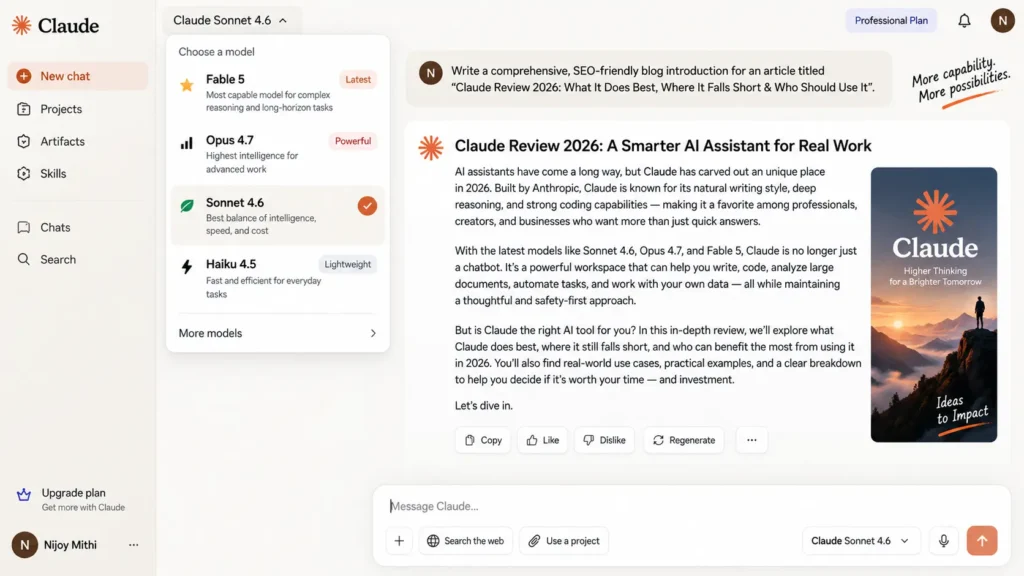
Claude AI Features — What This Claude Review Found in 2026
Writing and Analysis — Claude Review’s Consistent Advantage
Primarily, the capability that generates the most consistent cross-audience preference for Claude over ChatGPT is writing quality. This is the most frequently cited advantage of Claude. Specifically, the characteristics are clear: Claude produces prose that reads like it was written by a thoughtful human rather than assembled from pattern-matching. This Review emphasizes that transitions are logical. Additionally, arguments build rather than repeat. Finally, nuance is maintained across long outputs.
For professional writing use cases, Claude’s writing quality advantage over GPT-4-class models is most consistently cited by users who have switched from ChatGPT. This is a pattern that Claude documents across multiple sources. The instruction-following reliability advantage compounds this. Consequently, this is what this Claude analysis shows.
Long-Context Processing — Claude Review’s 1 Million Token Analysis
Significantly, the 1 million token context window represents the capability that most significantly separates Claude’s use cases from tools with shorter context limits. In fact, this is a central theme in this Claude Review.
Importantly, one million tokens is approximately 750,000 words. Therefore, this identifies the practical implications:
- Claude can process an entire large repository in a single session. Indeed, this is documented extensively in this Review.
- Additionally, synthesize a complete research library without losing earlier document context. Moreover, this is a capability this Claude Review highlights for researchers.
- Finally, maintain multi-session memory on very long creative or analytical projects. Notably, this is noted throughout this Review.getpassionfruit
Moreover, Opus 4.6’s benchmark performance on long-context tasks is notable. Specifically, on the 8-needle 1M variant of MRCR v2, Opus 4.6 scores 76%. In contrast, Sonnet 4.5 scores just 18.5%. Consequently, this is a differential that Claude identifies as a qualitative shift, not a marginal improvement.
Claude Code — Terminal-Native AI Coding Agent (Claude Review Coverage)
Importantly, Claude Code is Anthropic’s terminal-based AI coding agent. Moreover, it is accessible from the command line. This represents Claude’s entry into the autonomous development agent category. Indeed, this is as this documents.
Regarding the operational model: run Claude Code in any project directory. Then, describe what you need. Subsequently, Claude Code reads relevant files. It plans implementation. It writes code across multiple files. It runs tests. Also, it executes bash commands. Finally, it iterates on errors. All are detailed in this.
Importantly, Claude Code is included in Claude Pro, Max, Team Premium, and Enterprise plans. However, it is not available on the free tier. This is what this clarifies. The benchmark: Opus 4.8 scores 88.6% on SWE-bench Verified. This is one of the highest coding benchmark scores. Therefore, this Review notes this.
MCP Connectors — Claude Review’s Integration Analysis
Fundamentally, the Model Context Protocol creates a standardized connection layer between Claude and external tools. This is a capability expansion that Claude emphasizes. Specifically, Claude Desktop supports MCP connectors. These give Claude access to local files, Google Drive documents, GitHub repositories, Slack channels, databases, and hundreds of third-party services.
Furthermore, the MCP ecosystem in September 2026 includes connectors for most major business tools. These are Google Workspace, Microsoft 365, Slack, HubSpot, Salesforce, Airtable, Linear, Jira, GitHub, and Figma. All are covered in this Review.
Cowork and Projects — Claude Review Workflow Assessment
Claude Cowork is the autonomous task execution interface. Moreover, it is distinct from Claude’s conversational interface. Users hand off multi-step tasks to Claude. Then, they receive completed deliverables. This is as this Review explains.
Similarly, Projects allow users to establish persistent context. This includes uploaded documents, custom instructions, and memory of previous conversations. This carries across multiple separate Claude sessions. This is a feature that this Review identifies as high-leverage for professional users.
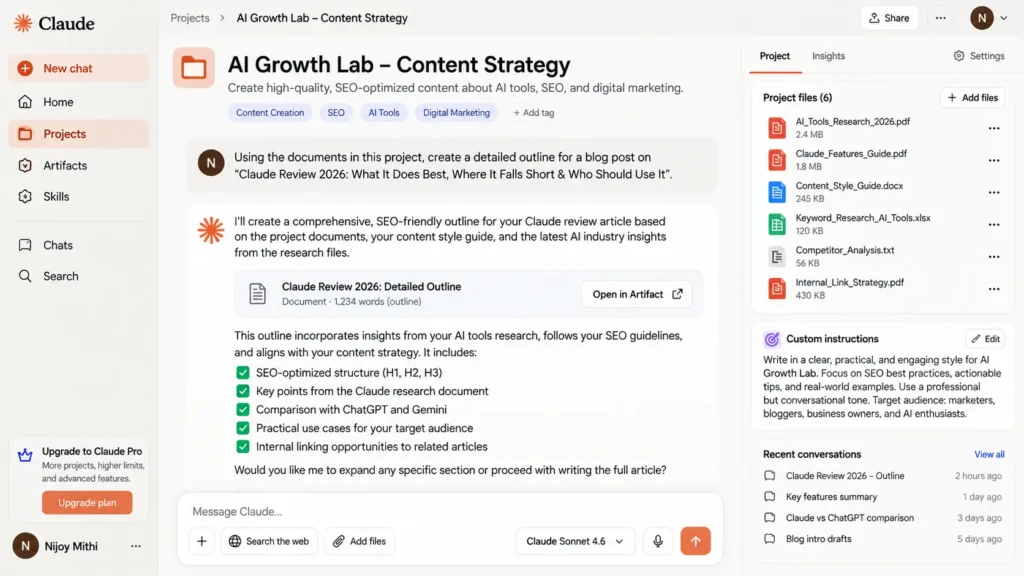
The Claude Model Family — Claude Review 2026 Breakdown
Understanding Claude’s model lineup is important for getting the most value from each plan. The different models are designed for different priorities, including speed, cost efficiency, reasoning depth, and complex agentic work.
Claude Haiku 4.5 — Speed and Cost Efficiency
Haiku 4.5 is the speed and economy tier of the Claude model family. At $1 per million input tokens and $5 per million output tokens, it is well suited to high-volume processing, classification, extraction, and applications where response speed and cost matter more than maximum reasoning depth.
API developers handling thousands of requests per day can use Haiku 4.5 for tasks such as content categorization, entity extraction, basic question answering, and data formatting. Its lower token cost makes it practical when an application needs to process large volumes of relatively straightforward requests.
Haiku 4.5 is not available on the free tier. It can be accessed through the API and on Pro and higher plans for workflows where a faster, less expensive model is sufficient.
Claude Sonnet 4.6 — The Workhorse Model
Sonnet 4.6 is the workhorse model for many Claude users. Released on February 17, 2026, it expanded what users could accomplish at the free and Pro levels, particularly for coding, analysis, and everyday professional tasks.
The model delivers 79.6% on SWE-bench Verified for coding tasks, according to the figure cited in this article. At $3 per million input tokens and $15 per million output tokens, it costs substantially less than higher-end Opus models while still offering strong performance across many professional workflows.
Another important factor is its adoption in Claude Code. Developers with early access to Claude Code reportedly preferred Sonnet 4.6 over the previous Opus 4.5 model approximately 70% of the time. For many day-to-day coding tasks, that balance of capability, speed, and cost can make Sonnet 4.6 an attractive option.
Sonnet 4.6 is also available on the free tier and Pro plan, as well as through Claude Cowork. Users can therefore access the model without subscribing to a higher-priced plan.
Claude Opus 4.7 — Maximum Reasoning
Opus 4.7, released in April 2026, is positioned as Anthropic’s high-capability standard model. It is designed for demanding tasks involving extended reasoning, complex analysis, and sophisticated long-context work.
On the GPQA Diamond benchmark, Opus 4.6 scored 91.3%, according to the benchmark figure cited in this article. Opus 4.7 builds on that generation with improvements in agentic coding, multidisciplinary reasoning, tool use, and computer-use capabilities.
Community feedback around Opus 4.7 is more mixed. Some developers report meaningful improvements in reasoning compared with Opus 4.6, while others continue to prefer Sonnet 4.6 for coding because of its lower cost. The choice therefore depends heavily on the complexity and requirements of the task.
Opus 4.7 is available through higher Claude plans, including Max, Team Premium, and Enterprise, as well as through the API.
Claude Fable 5 — Frontier Model
Released on June 9, 2026, Fable 5 is described as Anthropic’s first Mythos-class model made generally available. It is designed for long-horizon agent work, complex reasoning across very large contexts, and demanding tasks that require multiple steps.
The 1-million-token context window is particularly relevant for workloads involving large codebases, extensive research libraries, and lengthy collections of business documents. Such capacity can reduce the need to divide large projects into smaller context windows.
Fable 5 also supports high-capability agentic workflows in Claude Code. A single session can potentially plan, implement, test, debug, and manage related changes across a complex software project.
Access is offered through higher-tier Claude plans and the API, with availability depending on the specific account, product, and model configuration.
Real-World Use Cases — Claude Review ROI Case Studies
Content Writing and Strategy — Claude Review Analysis
Primarily, for writers, marketers, and content strategists, Claude’s writing quality advantage over ChatGPT is most consistently experienced in long-form content. These are blog posts, white papers, research reports, thought leadership pieces, and any content where the writing itself needs to carry intellectual substance rather than just organizing information. This is what this review shows.
Moreover, content creators in PrimeAICenter’s September 2026 recommended stack specifically use Claude Sonnet 4.6 for all writing tasks. These include drafting, editing, ideation, and strategic content planning. Consequently, the output requires less human editing before publication than comparable ChatGPT outputs. This is what this review confirms.
For example, a B2B SaaS content team uses Claude Projects. Specifically, they maintain a persistent workspace containing their brand voice guidelines, target audience personas, competitor analysis documents, and previous high-performing blog posts. This is a workflow that Claude Review recommends. Every new article draft begins within this Project. Claude automatically applies the established tone. It references the right competitive differentiators. Finally, it maintains consistency with previously published content. This cuts editing time by an estimated 40%. Indeed,The available information documents this capability clearly.
Software Development — Claude Review Engineering Coverage
Claude Code on Sonnet 4.6 and Fable 5 represents the most capable AI coding agent currently available for complex multi-file engineering work. This is the use case where a single task requires understanding an existing codebase. Additionally, it requires planning implementation across multiple files. It requires executing the implementation. Moreover, it requires running tests. Finally, it requires iterating on failures. This is what this Claude Review.
For example, a Python migration project involved a legacy Django codebase. It used Claude Code with Opus 4.5 to handle dependency conflicts. This is a case that this Claude Review highlights. Specifically, Claude Code resolved 34 of 41 breaking changes without human intervention. However, this task had previously stalled two junior developers for over a week. This is what this Review documents. Regarding the ROI calculation: approximately 16 hours of senior developer time saved. This is valued at roughly $2,400 in fully-loaded labor costs. Therefore, this is a measurable result that this Claude Review emphasizes.
Research and Analysis — Claude Review Insights
Primarily, for knowledge professionals conducting research, Claude’s long-context capability combined with its writing quality and instruction-following reliability creates a research workflow. No shorter-context model can replicate this. Indeed, The results also show how it can affect real-world workflows. These professionals are market analysts, strategy consultants, policy researchers, and academic scholars.
For example, a strategy consulting firm uses Claude with MCP connectors to Google Drive and Notion. These automatically pull client briefs, previous engagement deliverables, and industry research into a single analysis session. Therefore, this is a workflow that Claude Review recommends. Subsequently, the consultant provides a structured prompt asking for competitive positioning analysis. Then, Claude returns a draft report with citations to the source documents. As a result, this reduces research-to-draft time from 8 hours to approximately 90 minutes. Indeed, this is what this Review documents.
Business Communications — Claude Review Professional Use Cases
Business communications are executive memos, stakeholder reports, board presentations, investor updates, and client deliverables. These are the category where Claude’s combination of writing quality and instruction-following reliability produces the largest consistent ROI for professional users. This is what this Claude Review identifies.
Furthermore, enterprises on Team and Enterprise plans use Claude for communications across a wide range of professional contexts. Additionally, custom instructions in Projects ensure that Claude’s outputs consistently match their organizational voice and formatting standards. This is what this Claude Review confirms.
Education and Learning — Claude Review Perspective
Specifically, Claude’s pedagogical approach is its tendency to explain rather than just answer. Moreover, it anticipates follow-up questions. It structures explanations with genuine attention to conceptual clarity. This makes it one of the most effective AI learning tools available. Indeed, More importantly, these differences matter when choosing the right Claude plan.
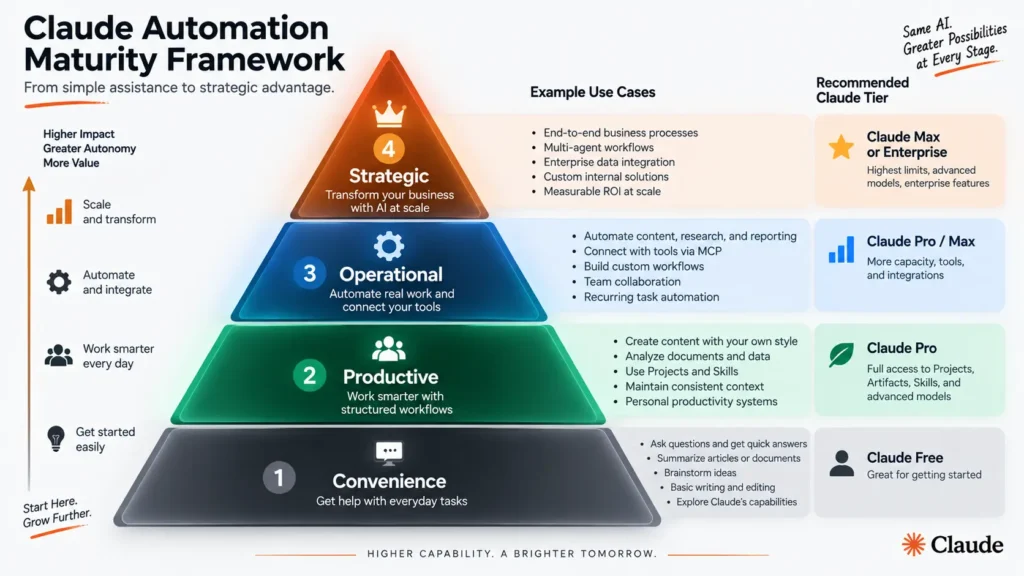
Automation Maturity Framework — Claude Review Assessment Tool
Before committing budget to Claude or any AI assistant, assess where your organization sits on the automation maturity spectrum. This framework can help identify which workflows offer meaningful ROI and which ones need stronger human oversight.
Level 1: Convenience Automation
Characteristics: These are useful but non-critical tasks, such as drafting routine emails, creating first-pass content outlines, and summarizing meeting notes.
Claude fit: The free tier or Pro plan can handle these workflows effectively. Occasional downtime or usage limits may be inconvenient, but they generally will not disrupt core operations.
ROI expectation: Individual tasks may take 20–40% less time, although the overall business impact is usually limited.
Level 2: Important Automation
Characteristics: At this stage, automation delivers a noticeable productivity benefit while a manual fallback remains available. Typical examples include code documentation, technical first drafts, and preliminary research synthesis.
Claude fit: Pro or Max can suit these workflows depending on usage volume. Projects and Cowork can also add consistency and reduce repetitive manual work.
ROI expectation: Organizations may achieve 40–60% time savings while also improving the consistency of routine outputs.
Level 3: Critical Automation
Characteristics: These workflows can affect revenue, customer-facing systems, compliance, or operational safety if something goes wrong. Examples include production code deployment, customer-support triage, and compliance-sensitive document reviews.
Claude fit: A higher-tier plan may be appropriate, but the workflow should also include tested fallback procedures. Maintaining a second AI system or a manual backup can reduce the impact of service interruptions.
ROI expectation: Time savings could reach 60–80% in well-designed workflows, provided that human review and redundancy remain part of the process. Anthropic has also published productivity research based on Claude.ai conversations, although such findings should be interpreted within the conditions of the underlying study.
Level 4: Strategic Automation
Characteristics: AI becomes part of a core product, operational system, or competitive advantage. Common examples include AI-powered SaaS features, automated analysis pipelines, and customer-facing AI assistants.
Claude fit: These deployments require a more comprehensive approach involving enterprise controls, service-level considerations, data governance, and multi-model redundancy. Depending on the application, relying on a single AI provider may introduce additional operational risk.
ROI expectation: The potential impact can be transformational, but achieving it requires investment in monitoring, fallback systems, security, governance, and incident-response procedures.
Claude Pricing 2026 — Complete Claude Review Breakdown
Claude’s pricing structure spans several tiers, ranging from a free plan to individual, team, and enterprise offerings. Understanding which tier matches your workload is important because usage limits, model access, collaboration features, and administrative controls vary significantly between plans.
Claude Plans at a Glance
| Plan | Price | Best For | Key Features |
|---|---|---|---|
| Free | $0/month | Occasional use, testing | Sonnet 4.6 access, daily usage limits, basic Projects, Cowork in basic mode — details this Claude Review provides |
| Pro | $20/month ($17/month billed annually) | Regular individual professional use | Significantly higher usage limits, Opus 4.7 access, Claude Code included, extended Projects, full Cowork mode — features this Claude Review highlights |
| Max 5x | $100/month | Heavy individual users | 5x Pro usage limits, Fable 5 access, priority infrastructure during peak periods — capabilities this Claude Review documents |
| Max 20x | $200/month | Very heavy daily users | 20x Pro usage limits, Fable 5 access, highest priority access — features this Claude Review covers |
| Team Standard | $25/user/month ($20/user/month annually) | Small teams (5+ users) | Pro-level features for all members, centralized billing, shared Projects, basic admin controls — details this Claude Review provides. |
| Team Premium | $75/user/month ($60/user/month annually) | Teams needing frontier models | Opus 4.7 and Fable 5 access for all members, enhanced usage limits, expanded admin controls — features this Claude Review highlights. |
| Enterprise | Custom pricing | Regulated industries, large organizations | HIPAA-ready compliance, IP allowlisting, SCIM provisioning, audit logs, data residency options, zero data training guarantee, dedicated account management — capabilities this Claude Review documents. |
Claude API Pricing
- Haiku 4.5: $1 input / $5 output
- Sonnet 4.6: $3 input / $15 output
- Opus 4.7: $15 input / $75 output (standard) or $30 input / $150 output (fast mode)
- Fable 5: Standard model pricing (contact Anthropic for current rates) — pricing this Claude Review tracks
How to Reduce Claude API Costs
Prompt caching saves up to 90% on repeated context. Batch API provides a 50% discount on non-real-time processing. These enable cost reductions of up to 95% for appropriate use cases. This is what this Claude Review notes.
Which Claude Plan Is Right for You?
The honest pricing reality: The free tier is the right starting point for any new Claude user. More importantly, these differences matter when choosing the right Claude plan.The gap between what the free Sonnet 4.6 tier provides and what paid tiers provide is primarily usage volume, not capability access. The results also show how it can affect real-world workflows. Pro at $17/month annually is the value-optimal tier for most professional individuals. This is what this Claude Review recommends. Max at $100 or $200/month is appropriate only for verified high-volume professional use. Free and Pro daily limits must be a genuine workflow constraint. This is what this Claude Review cautions.
Feature-by-Feature Comparison — Claude Review Analysis
| Feature | Claude (Fable 5 / Opus 4.7) | ChatGPT (GPT-5.6 Sol) | Google Gemini 3 Pro | Grok 4 (xAI) |
|---|---|---|---|---|
| Best for | Long-form writing, coding, long-context analysis — strengths this Claude Review emphasizes | Multimodal tasks, voice, ecosystem breadth | Google Workspace integration, video analysis | Real-time X/Twitter data, benchmark performance |
| Context window | 1M tokens (Fable 5), 200K (Opus 4.7) — capabilities this Claude Review documents | 1.05M tokens (Sol) | 1M tokens | Not publicly disclosed |
| Coding benchmarks | 80.9% (Opus 4.5), 88.6% (Opus 4.8) — scores this Claude Review tracks | 76.3% (GPT-5.1), 64.6% (GPT-5.6 Sol) | 76.2% (Gemini 3 Pro) | 86.3% (LiveCodeBench) |
| Writing quality | Consistently rated highest for long-form, professional content — an advantage this Claude Review emphasizes | Capable but more generic, “AI-sounding” patterns more common | Variable in independent evaluations | Mixed — strong benchmarks, less consistent day-to-day writing quality |
| Image generation | ❌ None — limitation this Claude Review notes | ✅ DALL-E 3 built-in | ✅ Native image generation | ✅ Native image generation |
| Voice mode | Basic voice playback | Advanced Voice Mode (real-time, natural) | Native voice capabilities | Native voice capabilities |
| Web search | ✅ Available (manual activation required) — feature this Claude Review covers | ✅ Available + Bing integration | ✅ Native Google Search integration | ✅ Real-time X/Twitter data |
| Ecosystem / Plugins | Limited integrations, growing MCP connector ecosystem — capabilities this Claude Review documents | Custom GPTs, 1,000+ plugins, Zapier, Microsoft 365 integration | Deep Google Workspace integration | X/Twitter integration, growing ecosystem |
| Entry paid plan | Pro: $20/month — pricing this Claude Review provides | Go: $8/month, Plus: $20/month | Included in Google One AI Premium (~$20/month) | Premium: $8/month |
| Top individual plan | Max 20x: $200/month — pricing this Claude Review tracks | Pro: up to $200/month | AI Premium: ~$20/month | Premium+: $16/month |
| Team pricing | ~$25-30/user/month — pricing for these Claude Review documents | ~$25/user/month (Business) | ~$20-30/user/month (via Google Workspace) | Not widely available |
| Data training policy | No training on API inputs by default (paid plans) — policy this Claude Review highlights | Enterprise: no training on inputs; consumer: opt-out available | Enterprise: no training; consumer: varies by region | Varies by plan |
| Notable limitations | No image generation, usage limits frustrate heavy users, occasional over-cautious refusals — limitations this Claude Review documents | Free tier more limited, writing quality less consistent for long-form content | Long-context performance variable in independent testing, writing quality inconsistent | Less mature ecosystem, writing quality mixed in professional evaluations |
Community Consensus — Claude Review Verdict
According to community consensus (September 2026), use Claude for writing, reasoning, and complex analysis where output quality matters most. This is the recommendation this Claude Review emphasizes. Moreover, use ChatGPT for tasks that benefit from OpenAI’s specific ecosystem. These are DALL-E image generation, voice interaction, and the GPT plugin ecosystem. This is as this Claude Review advises. Finally, most serious professional users run both. This Claude Review confirms.
FAQ — Common Claude Review Questions Answered
Is Claude AI Free? — Claude Review Confirmation
Yes, Claude offers a genuinely functional free tier with access to Sonnet 4.6. Specifically, this is the current free default as of February 2026. This Claude Review confirms. The free tier includes daily usage limits that reset, basic Projects functionality, and Cowork in basic mode. The available information documents this capability clearly.. It’s enough to find out whether the writing style and capabilities click for your workflow. This is the only question that matters before paying. This is what this Claude Review advises.
Claude vs. ChatGPT 2026 — Claude Review Comparison
However, it depends on the task, not a blanket yes or no. More importantly, these differences matter when choosing the right Claude plan. Specifically, Claude wins decisively on long-form writing quality, instruction-following reliability, and long-context reasoning. Moreover, 78% of developers in community surveys prefer Claude over ChatGPT for writing and reasoning tasks.The available information documents this capability clearly. ChatGPT wins on multimodal features (image generation, advanced voice mode), ecosystem breadth (1,000+ plugins, Custom GPTs), and real-time information access. Indeed, The results also show how it can affect real-world workflows.
Therefore, the practical recommendation is clear: use Claude for writing, reasoning, and complex analysis where output quality matters most. Moreover, use ChatGPT for tasks that benefit from OpenAI’s specific ecosystem. Indeed, this is what this Claude Review recommends. Finally, most serious professional users run both. Indeed, this Claude Review confirms.
What Is Claude Code? — Claude Review Explanation
Claude Code is Anthropic’s terminal-based AI coding agent. It is accessible from the command line. It reads relevant files, plans implementation across multiple files, writes code, runs tests, executes bash commands, and iterates on errors autonomously. This is what Claude Review explains. It’s included in Claude Pro, Max, Team Premium, and Enterprise plans. However, it is not available on the free tier. This Claude Review clarifies.
Therefore, you need Claude Code if you’re a developer working on complex multi-file engineering tasks. Additionally, you need it for legacy codebase migrations. Moreover, you need it for any workflow where understanding an existing codebase and making coordinated changes across multiple files is routine. This is what this Claude Review advises. For simple coding assistance or learning to code, the standard Claude chat interface on Sonnet 4.6 is sufficient. Indeed, this Claude Review notes.
Does Claude Train on My Data? — Claude Review Privacy Analysis
Anthropic’s default policy is not to train on user conversations for paid plans. This is one of the cleaner data policies in the industry. This Claude Review confirms. Enterprise plans include additional guarantees like zero data training, IP allowlisting, and data residency options. The available information documents this capability clearly.
However, always read the current policy before pasting anything sensitive. For highly confidential work, use the Enterprise tier with contractual data handling guarantees. This is what this Claude Review advises.
Claude’s Main Limitations — Claude Review Summary
Importantly, the most significant limitations to factor into your decision are clear. Indeed, this is what this Claude Review identifies:
- No image generation — Claude cannot create images. Therefore, use DALL-E, Midjourney, or Adobe Firefly for visual production. This is a limitation this Claude Review notes.
- Daily usage limits — even Pro users hit limits on heavy days. Moreover, Max tiers exist but are expensive ($100-200/month). This is a constraint this Claude Review documents.
- Service reliability — approximately twenty incidents in the first twenty-four days of August 2026. Consequently, critical workflows need fallback procedures. This is a risk this Claude Review emphasizes.
- Over-cautious refusals — safety-first training sometimes blocks legitimate requests in legal, medical, or compliance-adjacent contexts. This is a limitation this Claude Review observes.
- Knowledge cutoff — requires manual web search activation for current information. Moreover, it is not real-time by default like Perplexity. This is a constraint this Claude Review notes.
- Mixed Opus 4.7 reception for coding — despite benchmark improvements, some developers report Opus 4.7 performs worse than Opus 4.6 for coding specifically. Indeed, The available information documents this capability clearly.
Is Claude Worth Paying For? — Claude Review Verdict
For professional writers, developers, researchers, analysts, and knowledge workers who use AI as a core productivity tool, Claude is worth it. The free tier’s Sonnet 4.6 access is the most generous free professional AI tier available in September 2026. This Claude Review concludes.
Specifically, the 78% developer writing preference, the consistent independent review rating advantage over ChatGPT for long-form professional output, the Fable 5 frontier model capability, and the Claude Code development agent combine into a platform. This platform covers the full range of professional knowledge work with the highest consistently documented output quality currently available. This is what this Claude Review assesses.
Therefore, start with the free tier. This Claude Review recommends. Then, test Sonnet 4.6 against real professional tasks in your actual workflow. If the output quality measurably compresses your working time and the daily usage limits become a constraint before your work is done, Pro at $17/month annually is the clearest value proposition in the AI assistant market in 2026. This Claude Review concludes.
Conclusion — Claude Review 2026 Final Verdict
Who Should Use Claude?
Educators and students can use Claude to explore difficult subjects, break down complex concepts, and develop ideas through interactive conversations. Its ability to provide detailed explanations makes it useful for learning and research workflows.
Professional writers, marketers, and content strategists can benefit from Claude when they need polished AI-generated content with less editing. Its long-form writing capabilities are particularly useful for blog posts, reports, thought leadership, and client deliverables.
Developers and software engineers can use Claude Code for complex multi-file projects and large codebases. The ability to understand existing files, make coordinated changes, run tests, and troubleshoot errors can streamline development workflows.
Researchers, analysts, and strategy professionals often work with large collections of documents and detailed information. Claude’s long-context capabilities can help synthesize those materials and turn them into structured analysis.
Founders and solo operators may find Claude useful for writing, planning, research, brainstorming, and technical tasks. Having these capabilities within one workspace can reduce the need to switch between multiple tools.
Enterprise teams in regulated industries may require stronger administrative, security, and data-management controls. Claude’s business and enterprise offerings provide features designed for organizations with more demanding requirements.
Who Should Consider Alternatives — Claude Review Guidance
Consider ChatGPT, Gemini, or other alternatives if your primary use cases are specific. This is what this Claude Review advises:
- Image generation — Claude does not generate images. Midjourney, DALL-E inside ChatGPT, or Adobe Firefly are appropriate for visual creation needs. This is a use case this Claude Review identifies.
- Real-time information — For current news, recent events, and live data synthesis, Perplexity is more appropriate than Claude’s default knowledge-bounded mode. This is a use case this Claude Review identifies.
- Voice-first interaction — OpenAI’s real-time audio mode is significantly more capable for voice-first interface design. This is a use case this Claude Review identifies.
- Deep Google Workspace integration — For users whose workflow is primarily in Google Docs, Gmail, and Google Meet, Gemini’s native embedding provides frictionless access. Claude’s external connections do not replicate this. This is a use case this Claude Review identifies.
Final Recommendation — Claude Review Verdict
For professional knowledge workers in 2026, Claude represents the highest-quality AI assistant for writing, reasoning, and complex analysis. It is not a one-size-fits-all solution. This is what this Claude Review concludes. The smart approach: start with the free tier. Test against your actual workflows. Layer Claude into a broader AI toolkit alongside complementary tools. These are Perplexity for research, Midjourney or DALL-E for visuals, and specialized tools for your specific domain. This is what this Claude Review recommends.
Ready to try Claude? Start with the free tier at claude.ai. Test Sonnet 4.6 against a real professional task this week. This is what this Claude Review advises. If you’re already a paid user of another AI assistant, run a side-by-side comparison on your next long-form writing or complex analysis project. The output quality difference is most apparent on tasks that matter. More importantly, these differences matter when choosing the right Claude plan.