

If you’ve spent any time trying to rank a page, you already know on-page SEO isn’t optional — it’s the foundation everything else sits on. But here’s the shift that’s happened over the last couple of years: doing it manually, page by page, keyword by keyword, just doesn’t scale. That’s where AI On-Page SEO comes in.
Additionally, Search engines are smarter. Search intent is more nuanced. And content teams are expected to publish more, faster, without sacrificing quality. AI has quietly become the thing that makes that balancing act possible.
In this guide, you’ll learn what AI On-Page SEO actually means, why it matters heading into 2026, which AI On-Page SEO tools are worth your time, and how to build a repeatable optimization process using a practical checklist.
Whether you’re a solo blogger, an in-house marketer, or an agency managing dozens of client sites, you’ll walk away with a clear action plan you can start using today.
What Is AI On-Page SEO?
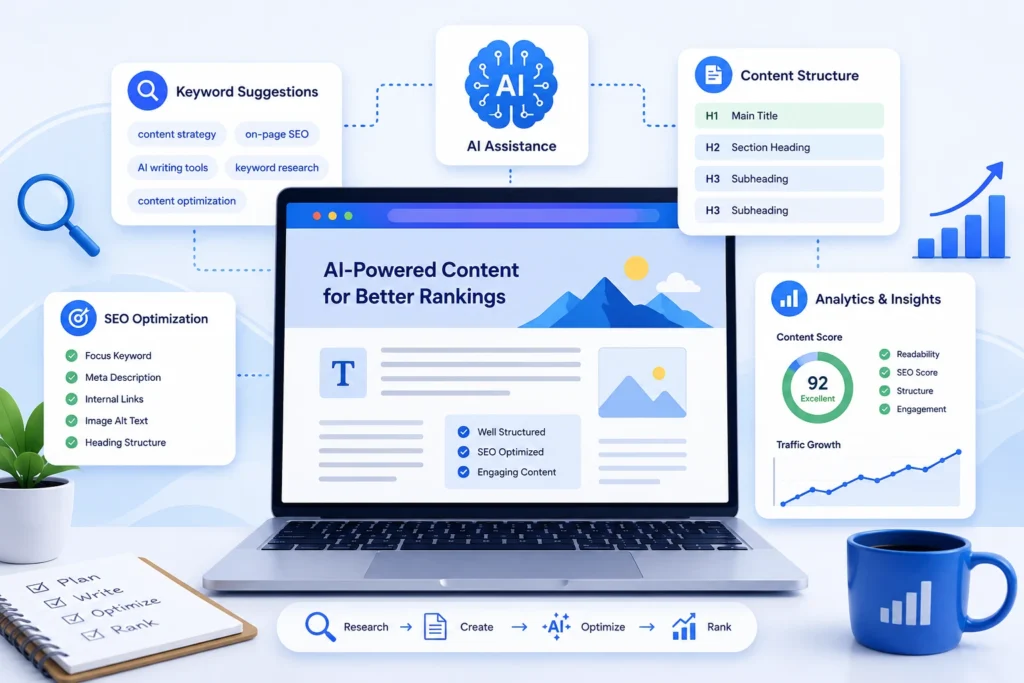
AI On-Page SEO refers to using artificial intelligence to analyze, optimize, and improve a webpage’s individual elements
Traditional on-page SEO covers things like title tags, meta descriptions, header structure, internal linking, image alt text, and keyword placement. AI On-Page SEO takes those same fundamentals and layers in intelligent automation.
Instead of manually guessing which keywords to target or how to structure a heading, AI tools analyze search intent, competitor content, and semantic relationships to recommend (or even generate) optimizations in real time.
However, in simple terms: it’s the difference between optimizing a page based on a checklist you memorized years ago, and optimizing a page based on what’s actually working in search results right now.
Consequently, AI doesn’t replace the SEO fundamentals — it accelerates them. A well-trained AI model can scan a page, compare it against top-ranking competitors, and flag missing subtopics, thin content.
Or awkward keyword usage within seconds, a process that used to take an experienced SEO specialist an hour or more per page.
Key Elements AI On-Page SEO Typically Covers
- Keyword research and semantic keyword clustering
- Title tag and meta description generation
- Header (H1–H3) structuring based on search intent
- Content gap and topic completeness analysis
- Readability and tone optimization
- Internal linking suggestions
- Image alt text and schema markup recommendations
Why AI On-Page SEO Matters in 2026
Search has changed dramatically. Between AI-generated search summaries, zero-click results, and increasingly conversational queries, ranking well today requires more precision than it did even two years ago. Here’s why AI On-Page SEO has moved from “nice to have” to essential.
AI On-Page SEO: Search Engines Are Using AI, So Optimization Should Too
Search engines rely heavily on machine learning to understand context, intent, and content quality. If the algorithm evaluating your page is powered by AI, however, it only makes sense that your optimization process should account for how those systems actually interpret content — not just how they did five years ago.
AI On-Page SEO: Content Volume Is Exploding
Similarly, More brands are publishing more content than ever. Standing out increasingly depends on precision and depth rather than sheer output.
AI tools help you identify exactly what’s missing from your page compared to what’s already ranking, so you’re not just adding more words — you’re adding the right words.
AI On-Page SEO: User Intent Is Getting More Specific
Additionally, Generic keyword targeting is losing effectiveness. Modern searchers ask nuanced, multi-part questions, and AI-driven on-page optimization helps content teams map their pages to those specific intents rather than a single broad keyword.
AI On-Page SEO: Speed Is a Competitive Advantage
Manually auditing and optimizing dozens or hundreds of pages simply isn’t realistic for most teams. Similarly, AI On-Page SEO Tools compress that timeline substantially, freeing up strategists to focus on higher-level decisions rather than repetitive audits.
Benefits of AI On-Page SEO
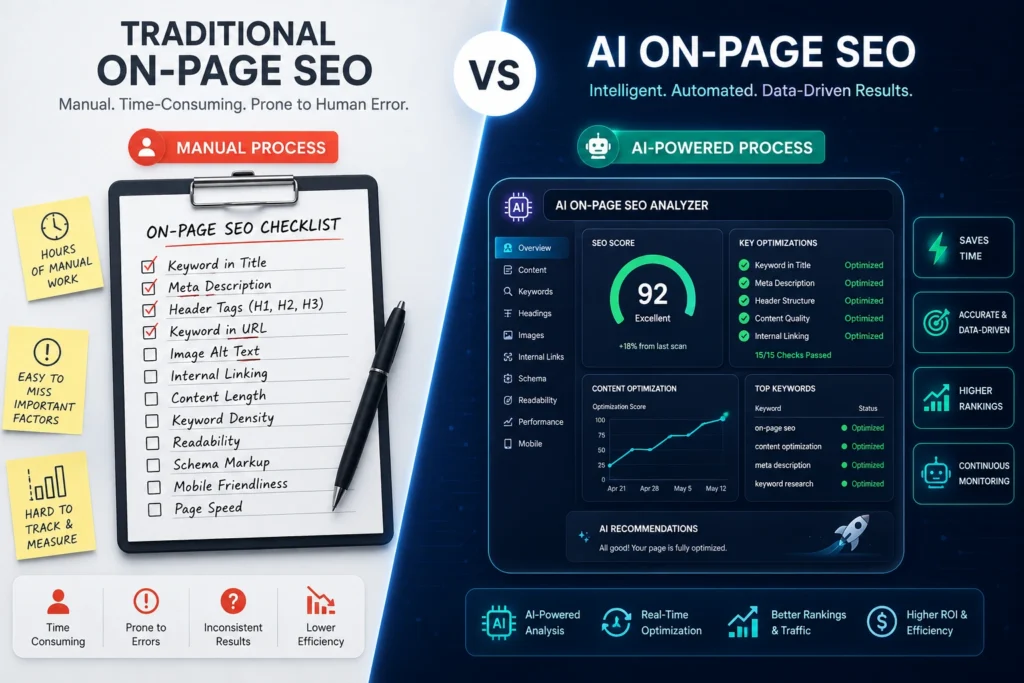
Adopting an AI-assisted approach to on-page optimization brings measurable advantages, particularly for teams managing content at scale.
1. AI On-Page SEO: Faster Content Audits
Rather than manually reviewing every heading, keyword, and meta tag, AI tools can scan an entire page — or an entire site — in minutes, surfacing prioritized recommendations instead of a vague list of issues.
2. AI On-Page SEO: More Consistent Optimization
Human reviewers get tired, skip steps, or apply inconsistent standards across large content libraries. AI applies the same evaluation criteria every time, which is particularly useful for larger teams with multiple writers.
3. AI On-Page SEO: Better Search Intent Alignment
AI models trained on search data can identify patterns in what’s already ranking, helping you shape content around the intent behind a query rather than just the keyword itself.
4. AI On-Page SEO: Improved Content Depth
AI tools often flag “content gaps” — subtopics or related questions that competing pages address but yours doesn’t. Filling those gaps tends to improve topical authority.
5. AI On-Page SEO: Scalability for Growing Content Teams
Whether you’re publishing five articles a week or fifty, AI-assisted workflows make it realistic to maintain a consistent quality bar without proportionally growing your team.
6. AI On-Page SEO: Data-Backed Decision Making
Instead of relying purely on intuition, AI On-Page SEO gives teams quantifiable metrics — content scores, keyword density, readability grades — that make it easier to track improvement over time.
Best AI On-Page SEO Tools
There’s no shortage of platforms claiming to offer AI-powered optimization, but the following categories and examples represent where most of the real value currently sits. As always, it’s worth testing a tool on a small batch of pages before rolling it out across your whole site.
Surfer SEO
Known for its content editor that scores pages against top-ranking competitors in real time, Surfer SEO is often used by content teams that need to optimize articles for specific keywords quickly. It suggests keyword usage, headings, and word count targets based on live SERP data.
Clearscope
Clearscope focuses heavily on semantic keyword coverage and readability. It’s popular among enterprise content teams that need a clean, straightforward scoring system writers can follow without deep SEO expertise.
MarketMuse
MarketMuse leans more toward content strategy and planning, using AI to identify topic clusters, content gaps, and opportunities across an entire site rather than just single pages.
Frase
Frase combines content briefs, AI writing assistance, and on-page optimization scoring in one workspace, making it a solid option for smaller teams that want an all-in-one solution.
SEMrush’s SEO Writing Assistant
As part of the broader SEMrush suite, this tool checks readability, tone, originality, and SEO factors like keyword usage, and integrates well for teams already using SEMrush for research.
Alli AI and Similar Automation Platforms
Some newer platforms go a step further, allowing automated on-page changes to be pushed live directly (with approval workflows), which can be useful for very large sites where manual implementation isn’t feasible.
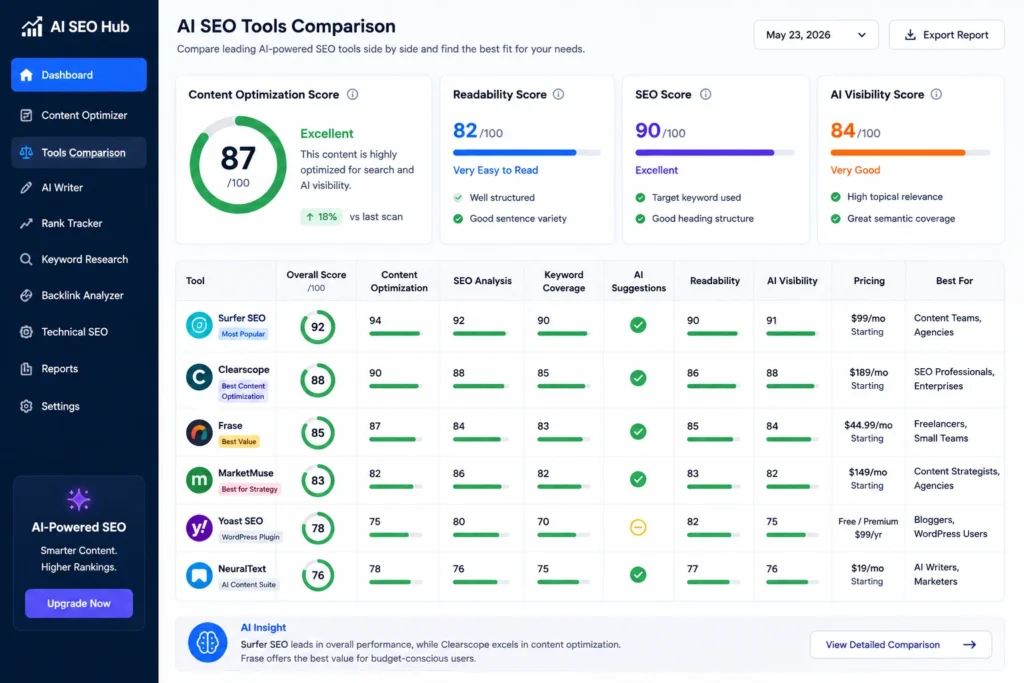
Comparison Table: Top AI On-Page SEO Tools
| Tool | Best For | Key Strength | Learning Curve |
|---|---|---|---|
| Surfer SEO | Content teams optimizing existing pages | Real-time SERP-based scoring | Moderate |
| Clearscope | Enterprise & agency content teams | Semantic keyword coverage | Low |
| MarketMuse | Site-wide content strategy | Topic cluster & gap analysis | High |
| Frase | Small teams & solo creators | All-in-one briefs + optimization | Low |
| SEMrush SEO Writing Assistant | Teams already using SEMrush | Readability + originality checks | Low |
| Alli AI | Large sites needing automation | Automated on-page implementation | Moderate–High |
Naturally, the “best” tool depends on your budget, team size, and whether you need strategy-level insights or page-level execution.
Smaller teams often find more value in an all-in-one option like Frase, while larger organizations may prefer combining a strategy tool like MarketMuse with an execution-focused tool like Surfer SEO.
How AI Improves Content Optimization
First, It’s worth understanding the mechanics behind these tools, since that context helps you use them more effectively rather than blindly following every suggestion.
Natural Language Processing (NLP) for Semantic Relevance
Next, Most AI On-Page SEO tools use NLP models to understand the relationships between words and concepts, not just exact keyword matches.
This is why modern tools recommend related terms and entities rather than simply telling you to repeat your primary keyword more often.
Competitive Content Analysis
Also, AI tools scan top-ranking pages for a given keyword and extract common patterns — word count ranges, subtopics covered, heading structures, and even average readability scores. This gives you a data-informed baseline rather than a guess.
Predictive Content Scoring
Many platforms assign a numeric “optimization score” based on how closely your content matches patterns associated with top-ranking pages. While not a guaranteed ranking predictor, it’s a useful proxy for content completeness.
Automated Structural Suggestions
AI can recommend heading hierarchies, suggest where to add subheadings, and even flag when a page’s structure doesn’t match common search intent patterns (for example, a listicle format versus a long-form guide).
Real-Time Readability and Tone Feedback
Lastly, since user experience signals matter for rankings, many tools flag overly complex sentences, passive voice overuse, or inconsistent tone, helping ensure content stays accessible to a general audience.
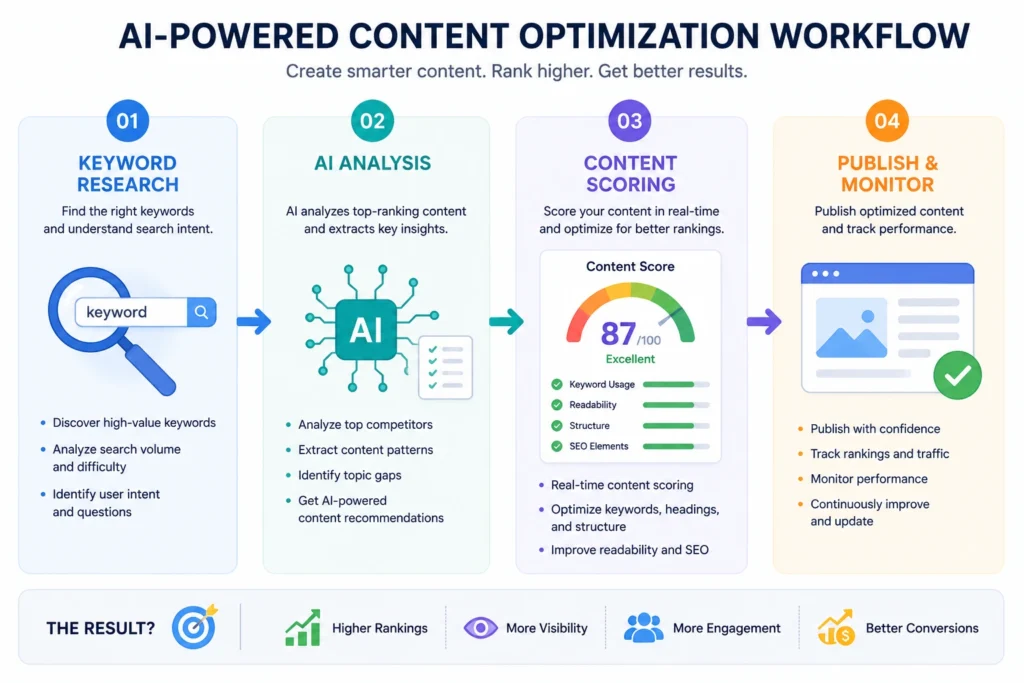
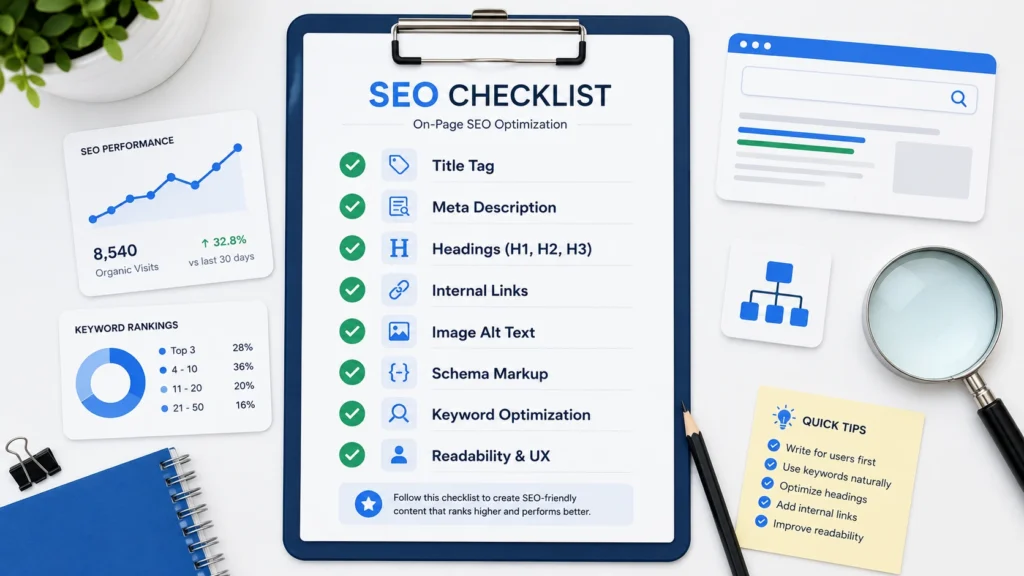
AI On-Page SEO Checklist
Use this checklist as a repeatable framework for optimizing any page, whether you’re using AI tools or applying the same principles manually.
AI On-Page SEO: Confirm search intent first
Before optimizing anything, check what type of content is currently ranking — is it a guide, a comparison, a product page, a listicle?
AI On-Page SEO: Run a competitor content gap analysis
Identify subtopics and questions competitors cover that your draft doesn’t.
AI On-Page SEO: Optimize the title tag
Include your primary keyword naturally, ideally near the beginning, while keeping it under 60 characters.
AI On-Page SEO: Write a compelling meta description
Aim for 150–160 characters, include the primary keyword, and clearly state the value of clicking through.
AI On-Page SEO: Structure headings around search intent
Use H2s for main sections and H3s for subtopics, incorporating keyword variations where they read naturally.
AI On-Page SEO: Maintain natural keyword density
Target roughly 1–2%, prioritizing readability over repetition.
Add internal links
Link to at least two to three relevant pages on your own site to strengthen topical relevance and site architecture.
Include outbound links to credible sources
This supports trustworthiness and gives readers additional context.
Optimize images.
Use descriptive file names and alt text that include relevant keywords without stuffing.
Check readability
Aim for shorter paragraphs, varied sentence length, and a tone appropriate for your target audience.
Add schema markup where relevant
FAQ schema, article schema, and breadcrumb schema can all support better visibility in search results.
Review for featured snippet opportunities
Include a direct, concise answer near the top of a relevant section for common questions.
Proofread and humanize
Read the content aloud or have someone else review it to ensure it doesn’t sound robotic or overly generic.
Common AI On-Page SEO Mistakes
AI tools are powerful, but they’re not foolproof. Here are mistakes that tend to trip up even experienced content teams.
AI On-Page SEO: Over-Relying on Keyword Density Scores
Some teams treat an AI tool’s suggested keyword count as a hard rule rather than a guideline, resulting in awkward, repetitive phrasing. Keyword density should always take a back seat to natural, useful writing.
AI On-Page SEO: Ignoring Search Intent Entirely
An AI tool might tell you to add certain keywords, but if the underlying content format doesn’t match what’s actually ranking (for example, writing a short blog post when the top results are in-depth guides), optimization scores alone won’t fix that mismatch.
AI On-Page SEO: Publishing Unedited AI Output
Generative AI can draft content quickly, but publishing it without human review often results in generic phrasing, factual inaccuracies, or a tone that doesn’t match your brand. Human editing remains essential.
AI On-Page SEO: Skipping Internal Linking
It’s easy to focus entirely on keyword and heading optimization while neglecting internal links, which remain one of the simplest ways to strengthen topical authority and help search engines understand site structure.
AI On-Page SEO: Treating AI Scores as the Final Word
An optimization score is a helpful signal, not a guarantee. Content can score well on a tool’s scale and still underperform if it doesn’t genuinely answer the reader’s question better than competing pages.
AI On-Page SEO: Neglecting E-E-A-T Signals
AI tools rarely account for demonstrated expertise, first-hand experience, or authorship credibility — factors that increasingly influence how content is evaluated. Adding author bios, citing credible sources, and including original insights still matters.
AI On-Page SEO Best Practices
Bringing it all together, here are the best practices worth building into your workflow long-term.
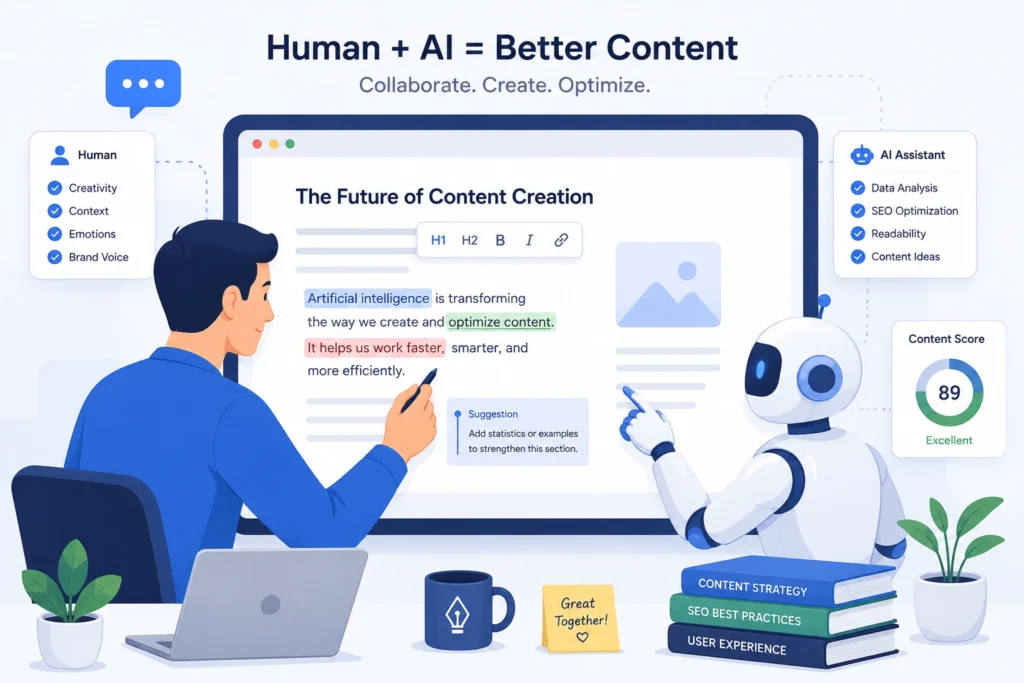
Combine AI Insights With Human Judgment
Use AI tools to identify gaps, patterns, and opportunities, but let human writers and editors make the final call on tone, accuracy, and brand voice. The best results tend to come from this hybrid approach rather than full automation.
Prioritize Search Intent Over Tool Scores
Before chasing a higher content score, double-check that your content format and depth genuinely match what searchers are looking for.
Update Existing Content Regularly
AI tools make it far easier to re-audit older pages periodically, identifying where competitors have since outranked you and what’s changed in the SERP landscape.
Build Topical Clusters, Not Isolated Pages
Rather than optimizing pages in isolation, use AI-driven content planning tools to map out topic clusters with strong internal linking between related articles.
Keep Content Genuinely Useful
Ultimately, no amount of optimization compensates for content that doesn’t actually help the reader. Use AI to refine and structure your work, not to replace original thinking or firsthand expertise.
Monitor Performance After Publishing
Track rankings, click-through rates, and engagement metrics after implementing AI-driven changes, since this feedback loop helps you understand which recommendations are genuinely moving the needle for your specific site.
Frequently Asked Questions About AI On-Page SEO
Is AI On-Page SEO better than manual optimization?
AI On-Page SEO isn’t necessarily “better” — instead, it’s faster and more consistent. That said, it works best when combined with human oversight. AI tools can identify patterns and gaps, but they can’t fully replace editorial judgment or brand voice.
Can AI tools guarantee higher rankings?
No. Instead, AI On-Page SEO Tools improve the likelihood that your content is well-structured and comprehensive. However, rankings depend on many additional factors, including backlinks, site authority, and overall user experience.
How much does AI On-Page SEO software typically cost?
Generally, pricing varies widely. Specifically, it ranges from free tools with limited features to enterprise platforms costing several hundred dollars per month. Generally speaking, most mid-tier tools fall somewhere between $50 and $200 per month.
Will using AI tools make my content sound robotic?
It can, if you rely on AI-generated text without human editing. Therefore, the key is using AI for research, structure, and optimization suggestions. Instead, keep the actual writing and final review human-led.
Do I still need to know traditional SEO if I use AI tools?
Yes. In fact, understanding fundamentals like search intent and keyword research still matters. As a result, this knowledge helps you evaluate whether an AI tool’s recommendations actually make sense for your page.
Final Thoughts
Overall, AI On-Page SEO isn’t a shortcut around good content. Instead, it’s a way to get there faster, with more precision. Overall, the tools covered here can help you identify gaps and structure pages more effectively. They also help you keep up with a search landscape that keeps evolving. That said, the fundamentals haven’t changed. Search engines, and the people using them, still reward content that’s genuinely useful, well-organized, and trustworthy.
If you’re just getting started, simply take it one step at a time. First, pick one tool from the comparison table above. Then, run it against a single underperforming page. Finally, work through the checklist step by step. Chances are, you’ll quickly see where the biggest gaps are within the first audit.
Ready to put this into practice? Start by auditing your top three highest-traffic pages using an AI On-Page SEO tool this week. Then compare the before-and-after results after 30 days. After all, small, consistent improvements compound over time — and that’s ultimately what moves the needle in search.




Pingback: AI Search Optimization: The Complete Guide (2026)