

AI Ad Copy Generators have quietly become one of the most crowded categories in marketing software. Nearly every platform now claims to write “high-converting” ad copy in seconds. However, the actual output quality varies enormously between tools. Some genuinely produce usable headlines and descriptions with minimal editing. Others generate generic scaffolding. That scaffolding still needs a human to add the angle, tension, and specificity that makes copy actually convert.
This matters because Google Ads itself now rewards accounts that provide a wide range of strong ad copy variations. Responsive search ads test multiple headlines and descriptions automatically. So, a thin or generic set of assets limits how well that testing can actually work. In this guide, you’ll find 15 of the best AI ad copy generators for Google Ads and other platforms in 2026. You’ll also see a comparison table, common mistakes to avoid, and a clear framework for choosing the right tool for your workflow.
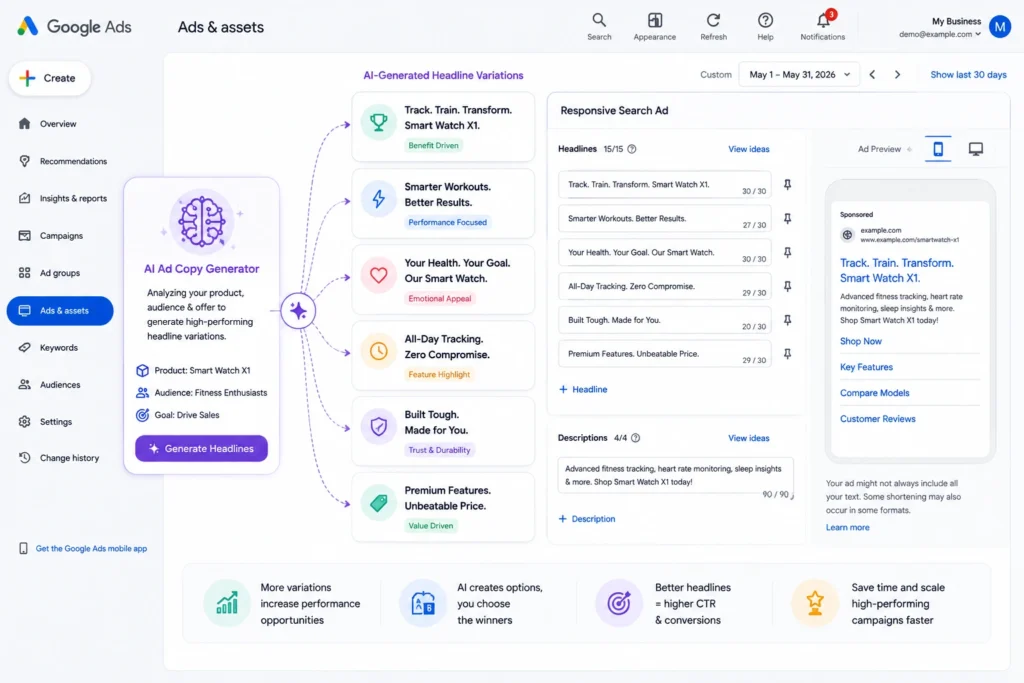
Multiple ad headline variations flowing out of a single AI-generated source, with a Google Ads interface in the backgroundWhat Are AI Ad Copy Generators, Exactly?
AI ad copy generators use large language models to produce advertising copy, headlines, descriptions, and calls to action. They work based on inputs like product details, target audience, and campaign goals. Instead of brainstorming every variation manually, advertisers provide context and receive multiple drafts within seconds.
However, not every tool produces copy at the same quality level. Some are built specifically for platform requirements, like Google’s character limits and Ad Strength scoring. Others are general-purpose writing assistants adapted for ads as one use case among many. Therefore, understanding this distinction matters more than any single feature comparison.
Why This Matters More for Google Ads Specifically
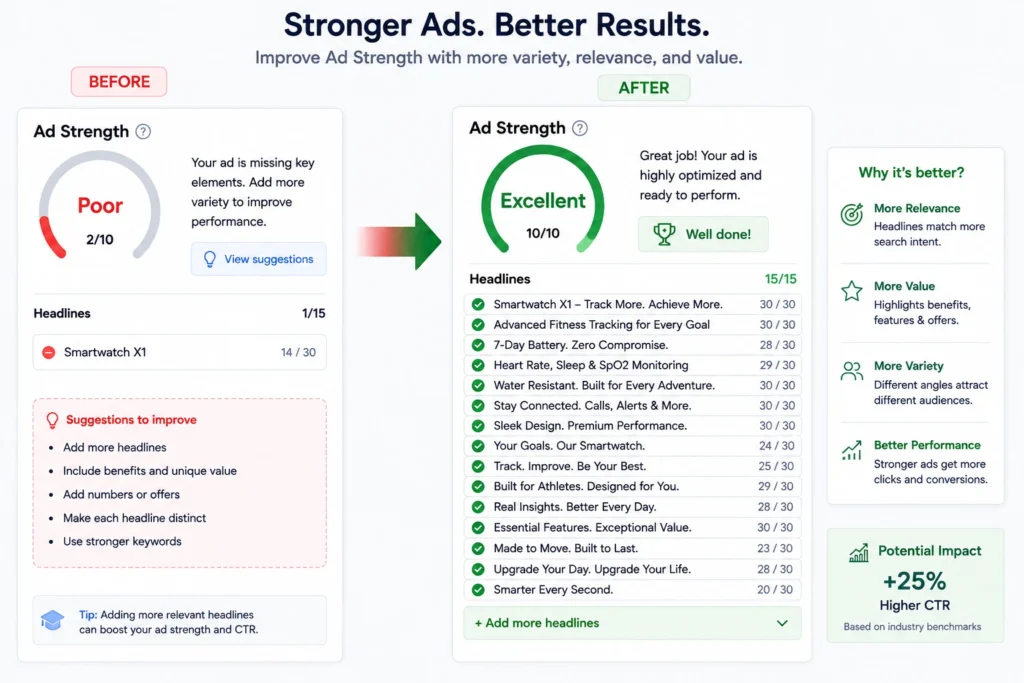
Google’s responsive search ads automatically test combinations of headlines and descriptions to find what performs best. Google’s own guidance confirms something worth knowing here. Advertisers who improve their Ad Strength rating from “Poor” to “Excellent” see 15% more clicks and conversions on average (Google Ads Help). Since Ad Strength depends heavily on having enough varied, high-quality assets, a strong generator directly supports this system rather than working around it.
Why the Category Has Grown So Crowded
Part of the reason so many tools now exist comes down to demand. Most PPC managers spend a meaningful chunk of their week just writing ad variations by hand, and that bottleneck has made even a modest AI assistant feel valuable. As a result, new entrants keep launching, some genuinely differentiated, others simply repackaging the same underlying language model with a different interface on top.
What Separates a Genuinely Useful Tool From a Generic One
The strongest AI ad copy generators tend to share a few traits. They understand platform-specific formatting without manual correction, they draw on real performance patterns rather than generic phrasing, and they leave room for a human to add the specific detail that makes an ad feel like it’s actually about your product. Tools missing these traits can still save time, but they typically require far more editing before the output is genuinely publishable.
(For a broader look at how this fits into a full automation stack, see our related guide.) It covers AI Google Ads Tools in full depth.
Best AI Ad Copy Generators for Google Ads
These tools are purpose-built or particularly well-suited for Google’s specific ad formats and character requirements.
1. Copy.ai
Copy.ai handles bulk copy generation well. This makes it a strong fit for advertisers managing large product catalogs that need many headline variations quickly. Its templates cover Google Ads formats directly, including character-limit-aware headline and description fields.
2. Anyword
Anyword pairs copy generation with performance prediction scoring. It estimates how well a given variation might perform before it even goes live. This suits teams that want data-informed guidance rather than a flat list of untested options.
3. Jasper
Jasper excels at longer-form, brand-driven creative writing, which carries over well into ad copy that needs a distinct voice. Teams with established brand guidelines tend to get more consistent results here than with more generic tools.
4. Writesonic
Writesonic offers an accessible free plan alongside paid tiers. This makes it a reasonable entry point for smaller teams or solo advertisers just starting to experiment with AI-assisted copywriting.
5. AdCreative.ai
AdCreative.ai combines copy generation with visual creative and performance scoring in one platform. It particularly suits advertisers who need both text and image assets produced together at scale for Performance Max asset groups.
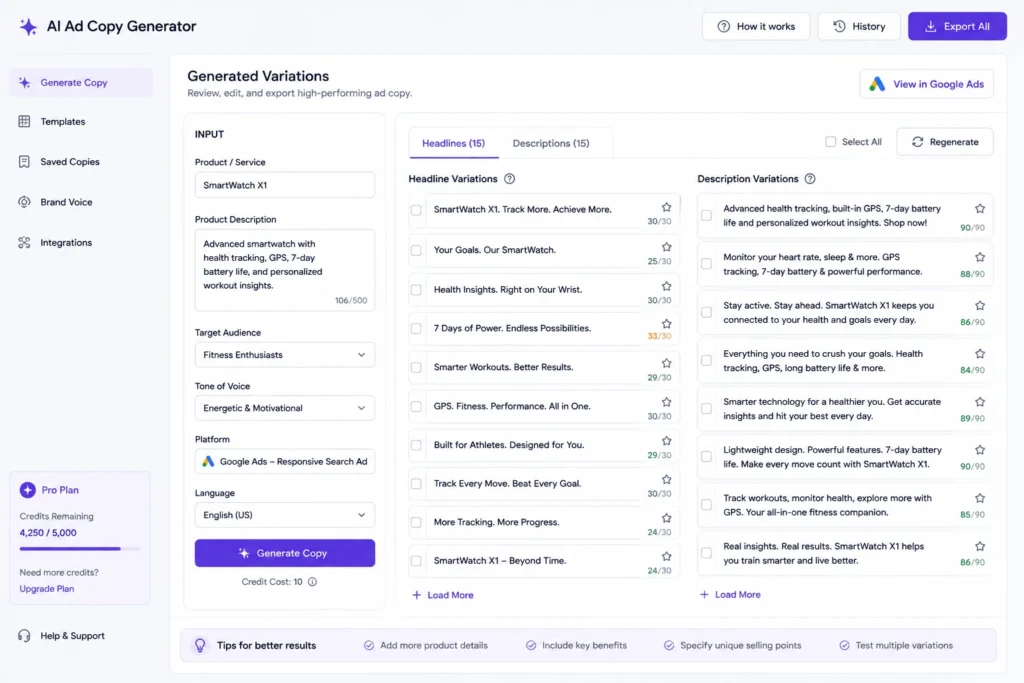
Best AI Ad Copy Generators for Multi-Platform Campaigns
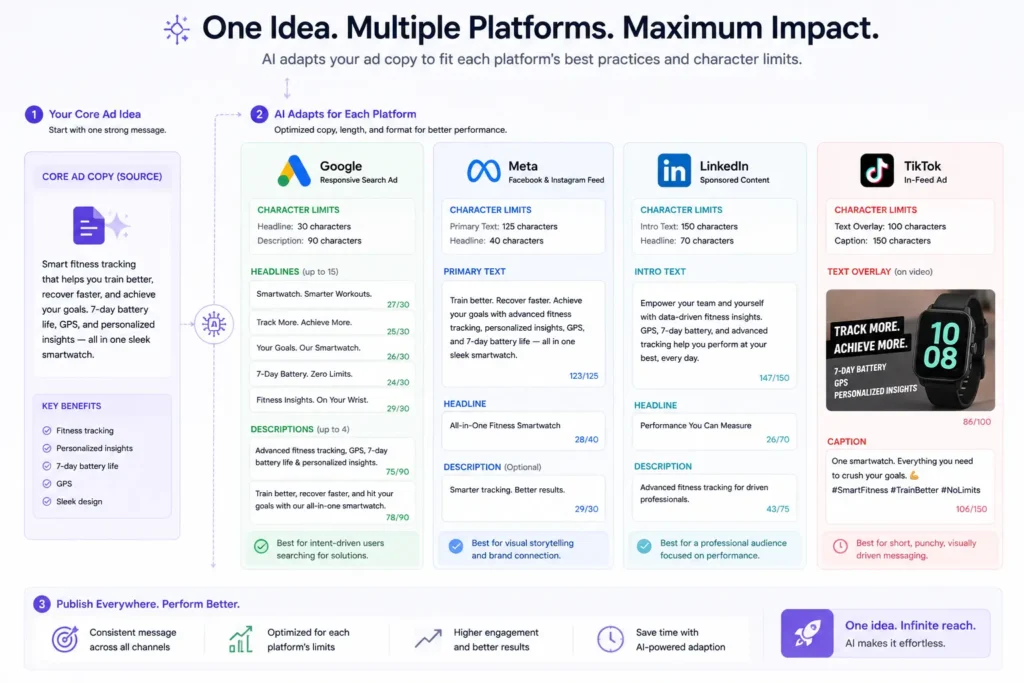
For advertisers running copy across Google, Meta, LinkedIn, and other platforms simultaneously, these tools handle that broader scope well.
6. Persado
Persado uses a more structured, data-driven approach to language generation, drawing on a large database of tested phrases and emotional triggers. Larger enterprise advertisers tend to favor this platform for its rigor, though it comes with a steeper price point.
7. Omneky
Omneky pairs copy generation with your own historical creative performance data. It tailors suggestions based on what’s actually worked for your account before. This personalization sets it apart from tools that generate copy in a vacuum.
8. Pencil
Pencil focuses specifically on producing genuinely campaign-ready output with minimal rewriting needed. It also integrates directly with split-testing workflows. Advertisers who value speed from draft to live campaign tend to appreciate this focus.
9. Copysmith
Copysmith takes a modular approach, combining several focused tools under one platform for different parts of the copywriting process. This spans everything from brainstorming to product description generation. It suits teams that want flexibility across different content types beyond just ads.
10. AdStellar
AdStellar specializes in performance-based AI training for ad copy, particularly for Meta advertisers, though its capabilities extend to Google Ads as well. Teams focused purely on measurable performance data over creative flexibility tend to prefer this option.
Best General-Purpose AI Tools for Ad Copy
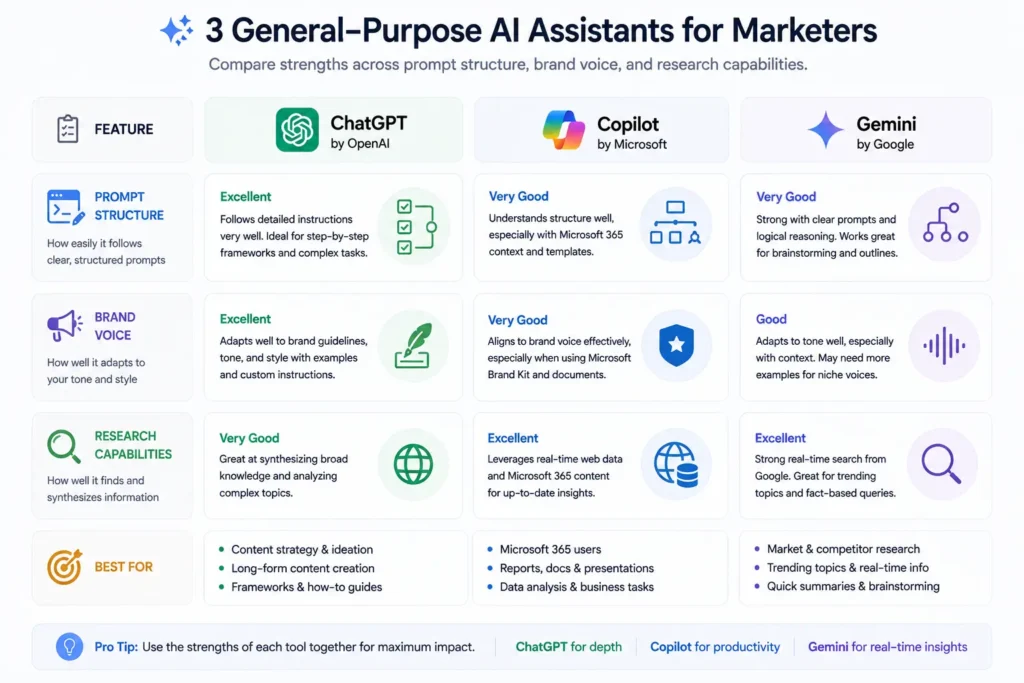
These aren’t built exclusively for advertising, but they remain genuinely strong options when used with the right approach.
11. ChatGPT
ChatGPT produces solid scaffolding for ad copy quickly, especially with a clear, structured prompt specifying tone, audience, and format. It works best as a starting point that still benefits from a round of human sharpening before publishing.
12. Claude
Claude tends to perform particularly well on angle specificity and nuanced brand voice when given a detailed, structured prompt. This requires more upfront prompt-engineering investment than a purpose-built ad tool. Even so, it often rewards that effort with stronger first drafts.
13. Rytr
Rytr offers a straightforward, budget-friendly option for generating ad copy variations alongside broader content types. Its simplicity makes it approachable for advertisers who don’t need an extensive feature set.
14. AdMake AI
AdMake AI pairs copy generation with built-in ad research, letting advertisers reference competitor ads before generating new variations. This closes a gap that pure copy-generation tools often leave open. Knowing what’s already working informs better output.
15. Smartly.io
Smartly.io includes AI-assisted copy generation as part of a broader creative automation platform. It’s particularly suited to larger teams managing high-volume, multi-format campaigns across several channels simultaneously.
A Real-World Example of Using AI Ad Copy Generators
To make this concrete, consider how a small ecommerce team might approach improving a struggling Google Ads account.
The Starting Problem
Imagine a team running responsive search ads with only three headlines per ad group, well below Google’s recommended range. Their Ad Strength ratings sit at “Poor” across most campaigns. The team doesn’t have the bandwidth to manually write dozens of new variations.
Bringing in an AI Ad Copy Generator
The team adopts Copy.ai to generate a much larger pool of headline and description variations for each ad group. They use their existing top-performing ad as a reference point. Within an afternoon, they have enough varied, on-brand copy to hit Google’s recommended asset counts.
Reviewing and Refining
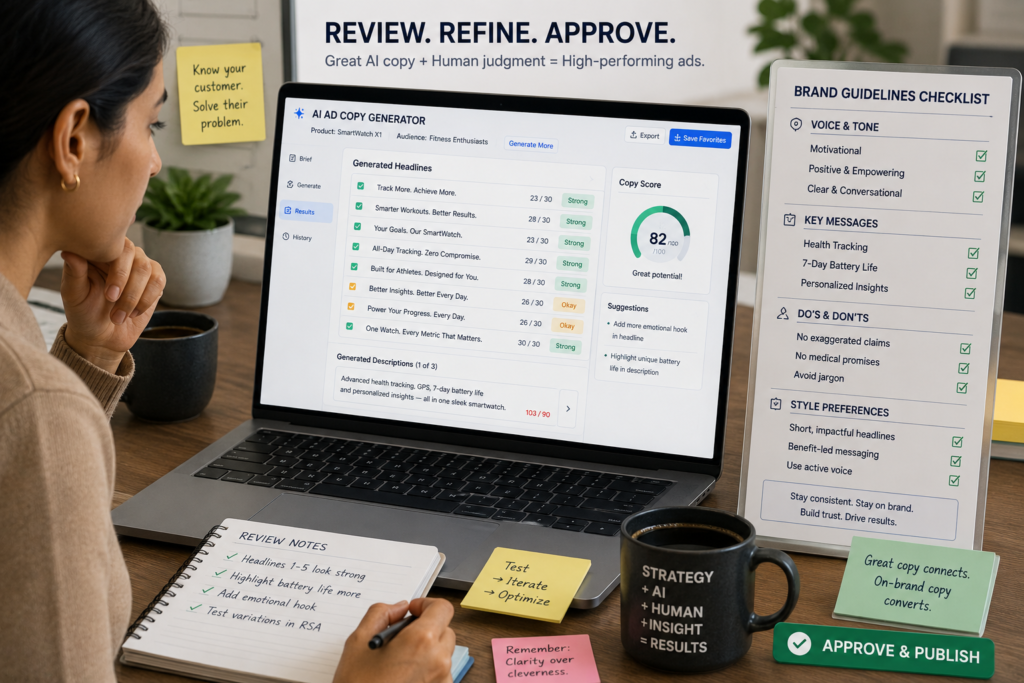
Rather than uploading every generated variation directly, the team reviews the output first. They select the strongest options, edit a few for tone, and remove near-duplicates that would compete against each other instead of adding real variety.
The Outcome
Within a few weeks, Ad Strength ratings across their campaigns improve from “Poor” to “Good” or “Excellent.” Click-through rates rise alongside that improvement. This is consistent with the pattern Google’s own data describes for accounts that make this same shift.
Comparing the Best AI Ad Copy Generators
Before choosing, it helps to see how these tools differ side by side.
| Tool Category | Example Tools | Best For | Platform Focus |
|---|---|---|---|
| Google Ads-specific | Copy.ai, Anyword, AdCreative.ai | Bulk headline and description generation | Primarily Google Ads |
| Multi-platform | Persado, Omneky, Pencil | Advertisers running several channels | Google, Meta, LinkedIn |
| General-purpose AI | ChatGPT, Claude, Rytr | Teams comfortable with prompt engineering | Any platform, with setup |
| Creative + copy combined | AdCreative.ai, Smartly.io | Teams needing visuals and copy together | Multi-platform |
As the table shows, the right choice depends less on which tool is objectively “best.” It depends more on which category matches your actual workflow and platform mix.
How to Choose the Best AI Ad Copy Generator for Google Ads
With so many options available, a clear framework helps narrow the decision.
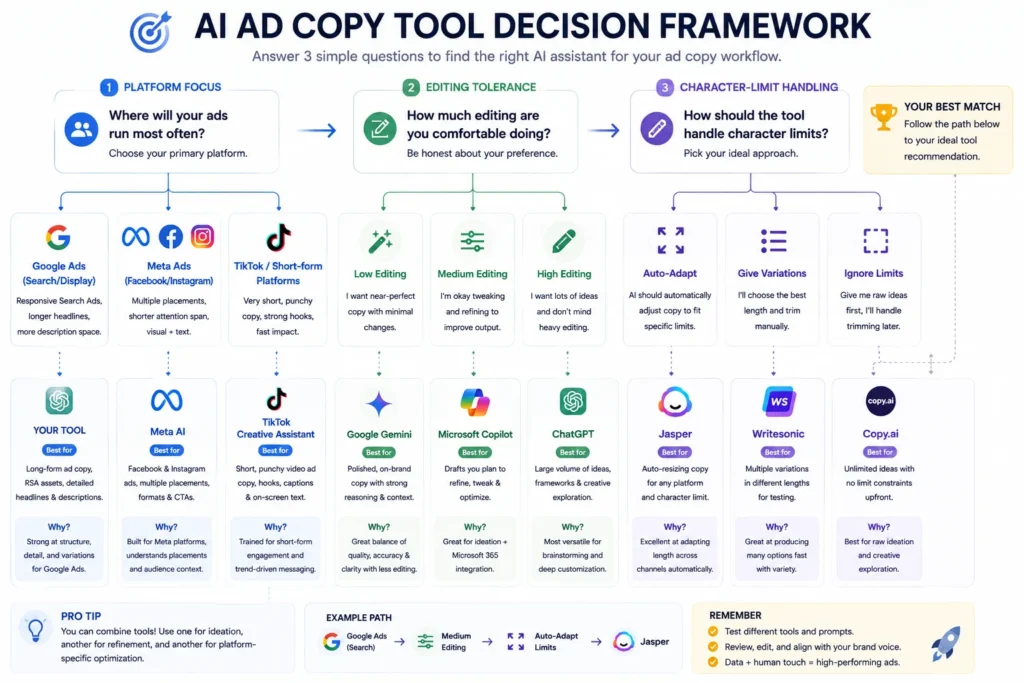
Match the Tool to Your Platform Mix
If Google Ads is your primary channel, a purpose-built tool like Copy.ai or Anyword will likely need less adaptation than a general-purpose assistant. Multi-platform advertisers, however, may prefer a tool designed for that broader scope from the start.
Prioritize Editability Over Raw Output Volume
A tool that produces 50 mediocre headlines isn’t necessarily more useful than one that produces 15 genuinely strong ones. Look for output that requires minimal rewriting. Heavy editing erodes much of the time savings automation is meant to provide.
Test With Your Own Product Data First
Generic demo examples rarely reflect how a tool performs with your actual products, audience, and brand voice. Run a real test before committing to a subscription. Output quality varies significantly based on the specificity of what you feed the tool.
Consider How the Tool Handles Character Limits
Google’s headline fields support up to 30 characters, and description fields support up to 90. A genuinely useful ad-focused tool should respect these limits automatically, rather than requiring manual trimming after generation.
Common Mistakes When Using AI Ad Copy Generators
A few recurring mistakes reduce how much value these tools actually deliver.
Publishing Generated Copy Without Review
Even strong tools occasionally produce copy that misses brand tone or factual accuracy. A quick human review before publishing catches these issues before they reach live campaigns.
Generating Near-Duplicate Variations
Producing many headlines that say essentially the same thing in slightly different words doesn’t add real testing value. Google’s own guidance specifically recommends unique headlines that don’t repeat similar phrases. Redundant options restrict how effectively the system can test genuine variety.
Ignoring Platform-Specific Character Limits
Copy generated for a general audience sometimes runs long for Google’s specific field limits. Always confirm generated copy fits within actual character requirements before uploading it.
Relying on a Single Tool for Every Platform
A tool excellent for Google Ads bulk generation might produce weaker results for LinkedIn’s more professional tone. Matching the tool to the platform, rather than forcing one tool to cover everything, tends to produce stronger results overall.
Skipping the Research Step Before Generating
Jumping straight to generation without reviewing what’s already working, whether from your own past campaigns or competitor ads, often produces copy that’s technically fine but strategically unfocused. A brief research step first tends to sharpen the angle before a single headline gets written.
Assuming More Tools Means Better Results
Some teams adopt three or four AI copy tools simultaneously, hoping to compare outputs and pick the best. In practice, this often multiplies the review workload without meaningfully improving final copy quality. One well-chosen tool, used consistently, tends to outperform a scattered multi-tool approach.
AI Ad Copy Generator Pricing at a Glance
Budget often narrows the decision once a shortlist forms. Here’s a rough sense of where these tools tend to fall.
Free or largely free: ChatGPT’s free tier and Writesonic’s entry plan cover basic generation needs without a subscription. These work well for testing the category before committing to a paid tool.
Mid-range, roughly $30 to $100 monthly: Copy.ai, Rytr, Jasper, and Copysmith generally fall in this range, scaling with usage volume or team size. This tier suits most small-to-midsize advertisers who need consistent, ongoing output.
Higher-tier, $100 and up: Anyword, AdCreative.ai, Pencil, and Omneky typically sit here, particularly for teams needing performance prediction or combined creative and copy generation. Persado and Smartly.io often land at the enterprise end, reflecting their broader feature sets and larger target customers.
As always, confirm current pricing directly with each vendor, since these figures shift as products and tiers evolve.
Frequently Asked Questions About AI Ad Copy Generators
What are the best AI ad copy generators for Google Ads?
The best AI ad copy generators for Google Ads campaigns include Copy.ai and Anyword for bulk headline generation, AdCreative.ai for combined copy and visual creative, and Claude or ChatGPT for teams willing to invest in structured prompting.
Can AI ad copy generators fully replace a copywriter?
Generally, no. These tools handle volume and initial drafting well. However, genuine brand voice, emotional nuance, and strategic positioning still benefit from human review and refinement before anything goes live.
Do I need a paid tool, or can free options work well enough?
Free tools and general-purpose assistants like ChatGPT can produce solid results, especially with well-structured prompts. Paid, purpose-built tools tend to save more time at scale and often include platform-specific formatting built in.
How many ad copy variations should I generate per ad group?
Google recommends at least 8 to 10 headlines per responsive search ad, along with multiple unique descriptions. Include at least 5 headlines that don’t repeat similar phrasing, since this gives the system enough variety to test effectively.
Will using AI-generated ad copy hurt my Quality Score or Ad Strength?
No, Ad Strength doesn’t penalize AI-generated content specifically. It evaluates asset diversity and the potential for combination. Well-varied AI-generated copy can improve this score just as effectively as manually written copy.
How do I know if a tool’s generated copy is actually good?
Compare it against your best historically performing ad copy, and check whether it reads as specific to your product rather than generic enough to apply to any competitor. If a headline could apply to almost any brand in your category, it likely needs more sharpening before it’s ready to test.
Final Thoughts: Choosing Your AI Ad Copy Generator
There’s no single best AI ad copy generator that fits every advertiser. Instead, the right choice depends on your primary platform, how much editing you’re willing to do, and whether you need copy alone or copy paired with visual creative.
Start by testing one or two tools against your actual product data, rather than choosing based on marketing claims alone. Over time, pairing a strong AI ad copy generator with genuine human review tends to produce far better results than either manual writing alone or fully automated, unreviewed output.
Ready to see how ad copy generation fits into a broader automation strategy? Check out our guide on AI Google Ads Tools for a complete breakdown of bidding, auditing, and cross-channel automation options.