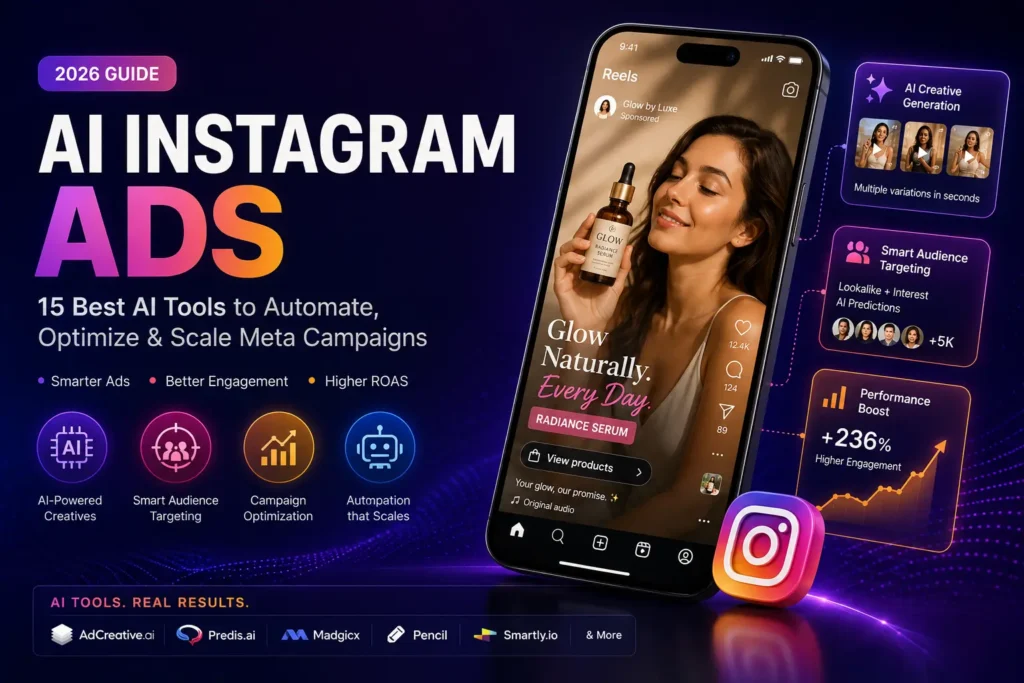

Reels now account for roughly half of all time people spend on Instagram. That shift has changed what a well-performing ad actually looks like. AI Instagram Ads now shape everything from video layout to automatic caption translation. Instagram runs through the same Meta Ads Manager as Facebook. However, the platform’s specific formats- Reels, Stories, Explore, and Shopping- reward a genuinely different creative approach.
This matters because treating Instagram as a smaller version of Facebook leaves real performance on the table. Meta’s own testing found something worth noting here. Catalog product video delivered to Reels placements produced 33% higher incremental conversions than campaigns without it. In this guide, you’ll learn how AI Instagram Ads actually work in 2026. You’ll also see why the shift toward Reels and shoppable formats matters, and which AI tools are worth adding to your strategy. Beyond that, you’ll find a comparison table, common mistakes to avoid, and a clear framework for building campaigns that fit how people actually use Instagram now.
What Are AI Instagram Ads, Exactly?
AI Instagram Ads refers to using Meta’s built-in artificial intelligence to plan, generate, and optimize advertising for Instagram specifically. Third-party tools add another layer on top. This includes Advantage+ Creative’s automatic video generation, AI-powered captioning, and voiceover translation. Automated product video for Shopping placements rounds out the core toolkit.
However, Instagram isn’t a separate ad platform with its own account or budget. It runs through the same Meta Ads Manager as Facebook, sharing data and feeding the same Advantage+ system. Therefore, understanding AI Instagram Ads means understanding two things at once. You need to know what’s shared with Facebook, and what’s genuinely distinct to Instagram’s own formats.
Why Instagram’s Formats Demand a Different Approach
Reels, Stories, Explore, and Shop each reward different creative choices. A Reels ad needs a vertical, full-screen format. It also needs to hook viewers within the first couple of seconds, since people can skip past it as easily as scrolling to the next post. A repurposed website banner or a square Feed image simply doesn’t perform the same way in this environment.
How This Fits Alongside Facebook Advertising
Since both platforms share the same Ads Manager, most of the underlying automation, bidding, budget pacing, audience targeting, works identically across Facebook and Instagram. What changes is the creative layer. A campaign built purely around Facebook Feed specs will technically run on Instagram too, but it won’t take advantage of what makes Instagram’s placements distinct.
Why This Distinction Trips Up Even Experienced Advertisers
It’s an easy mistake to make, since Meta’s interface treats both platforms as placement checkboxes within the same campaign. However, an ad that performs well on Facebook Feed can perform noticeably worse on Instagram Reels if the creative wasn’t built with that format’s pacing and aspect ratio in mind. Recognizing this early saves a team from misreading a placement-specific creative problem as a targeting or bidding issue instead.
(For a broader look at Meta advertising tools that span both platforms, see our related guide.) It covers AI Facebook Ads in full depth.
Why AI Instagram Ads Matter More in 2026
A few converging trends explain why this deserves fresh attention this year.
Reels Have Become the Default Experience
Instagram now has more than 2 billion monthly active users. Reels drives the majority of time spent in the app. Brands that still treat Reels as a side experiment, rather than their default ad format, are increasingly falling behind competitors who’ve already adapted.
Advantage+ Creative Now Generates Video Automatically
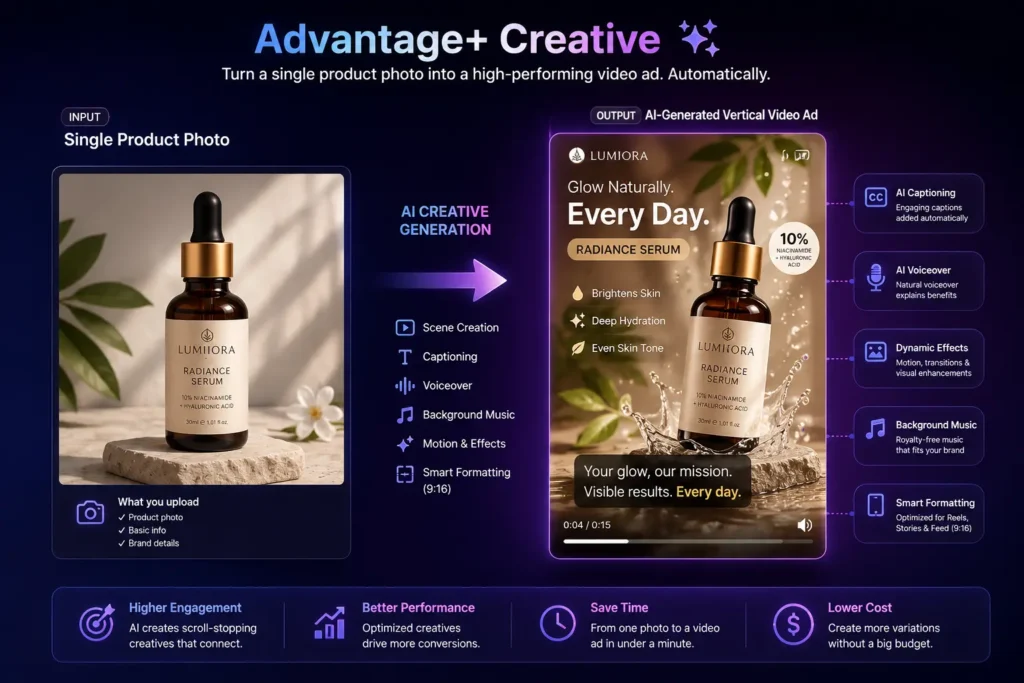
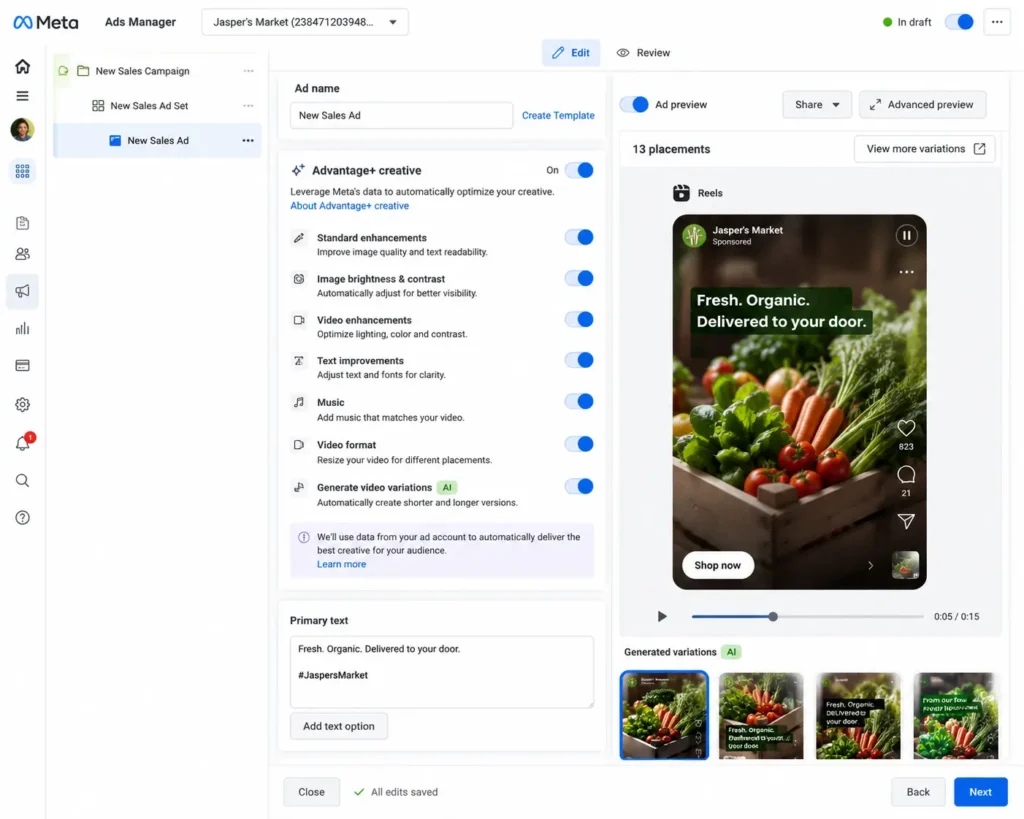
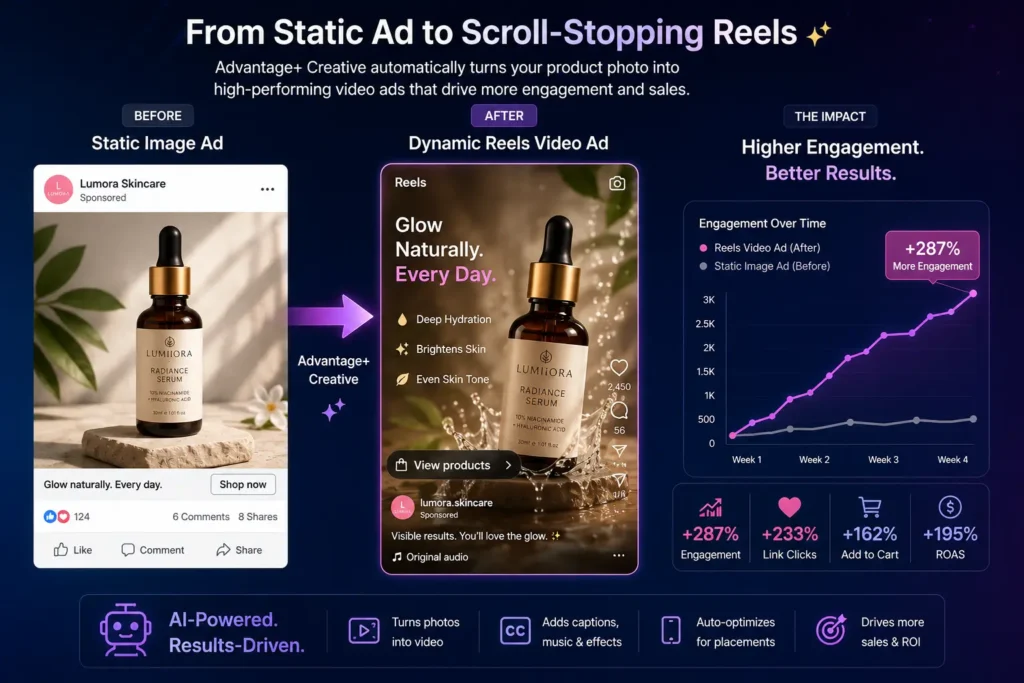
Meta’s Advantage+ Creative tool can generate studio-style videos from a single product image. Its enhanced features let brands produce content in the style of user-generated posts, complete with AI avatars and voiceovers. This addresses a real bottleneck. Producing enough creative variety across formats used to demand more effort from a creative team.
Shopping Is Fully Integrated Into the Format
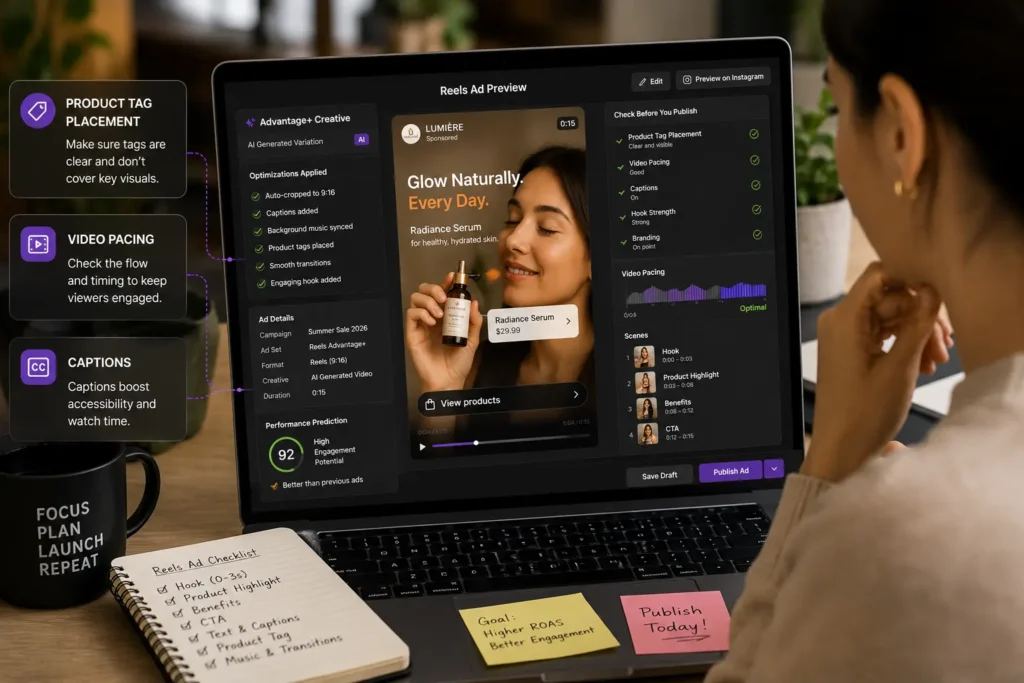
Product tags now let viewers tap “View products” directly inside a Reel. This turns content into a storefront without redirecting anyone away from the app. Meta’s own catalog-driven video tools automatically transform product images into immersive video. The system adapts the layout based on whatever creative assets are actually available.
AI Now Handles Localization and Accessibility Automatically
Voiceover translation and automatic caption generation mean something significant for global brands. A single piece of creative can reach multiple language markets without a separate production run for each one. This matters increasingly for brands expanding beyond a single primary market.
Benefits of Using AI for Instagram Ads
Understanding the concrete benefits helps justify investing time into adapting your strategy for this shift.
More Creative Variety Without More Production Time
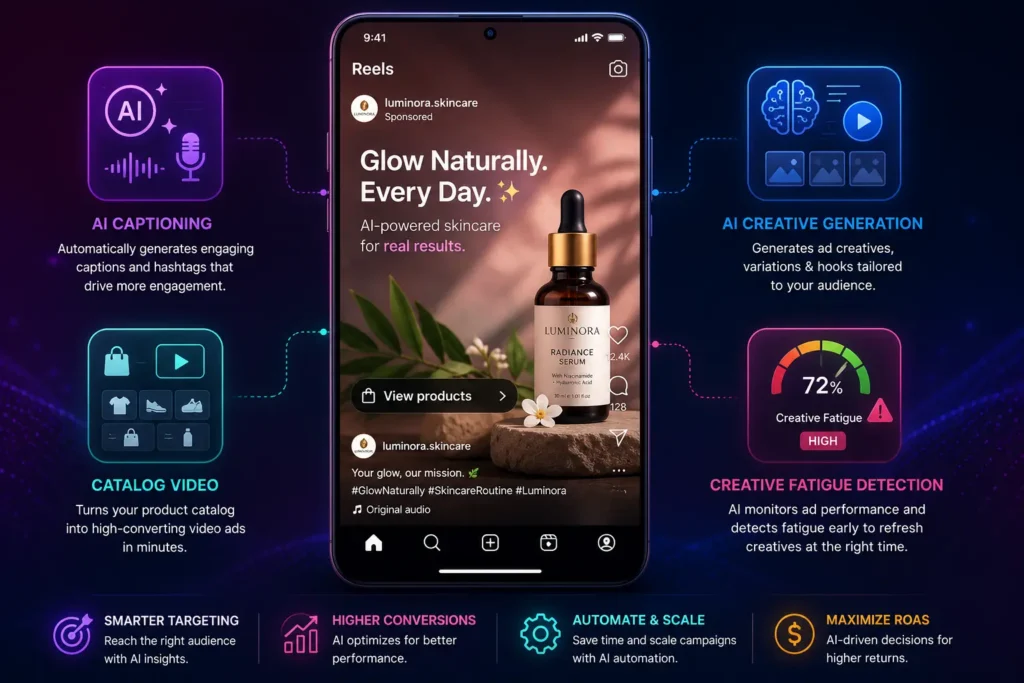
Advantage+ Creative can generate multiple video variations from existing assets. This gives Meta’s delivery system more material to test and learn from. It directly addresses the creative fatigue problem that used to require constant manual production.
Better Performance From Catalog Video
Meta’s own testing found that catalog product video delivered to Reels placements produced measurably higher incremental conversions. For ecommerce brands specifically, this makes automated catalog video one of the highest-leverage additions to a Reels strategy.
Automatic Fatigue Detection
AI-powered systems can now flag when creative starts to fatigue. They automatically rotate in fresh assets once that happens. This catches a problem that used to require a human manually monitoring frequency and engagement metrics across dozens of ad sets.
Easier Multi-Market Expansion
Automatic voiceover translation and caption generation let a single creative asset serve multiple language markets. No separate shoots or manual subtitling are required. This lowers the barrier to testing new geographic markets.
Discovery Through Instagram-Native Search
Natural-language captions, optimized bios, and descriptive alt text increasingly influence discoverability. This applies both within Instagram’s own search and through AI systems that summarize brand content elsewhere. Treating captions as a discovery signal, not just a caption, has become a genuinely useful habit.
How AI Instagram Ads Actually Work
Understanding the mechanics helps you use these tools more effectively, rather than treating them as a black box.
Advantage+ Creative and Automatic Video Generation
Advantage+ Creative analyzes existing image and video assets. From there, it generates variations automatically, adjusting aspect ratio, adding music, or producing entirely new video from a single still image. Advertisers can opt into this at the ad level inside Ads Manager.
Catalog-Driven Shopping Video
A product catalog can connect directly to a Meta Business account. Once connected, the system can automatically generate video ads for Reels and Shop placements, pulling straight from product images, prices, and descriptions. The system selects the layout most likely to perform for each specific product. It doesn’t just apply one template across an entire catalog.
Placement-Level Format Adaptation
Meta’s AI can adapt a single piece of creative across Feed, Stories, Reels, and Explore, adjusting crop and aspect ratio automatically. Separate assets for every placement aren’t strictly required anymore. That said, purpose-built vertical creative still tends to outperform adapted horizontal content, particularly in Reels.
(For official design specifications, see Meta’s Instagram Stories Ads requirements.)
Creative Fatigue Detection and Rotation
AI monitoring tools, both Meta’s native systems and third-party platforms, track engagement decay across running ads. They flag when it’s time to introduce new variations, ideally before performance actually drops off noticeably.
A Real-World Example of AI Instagram Ads in Practice
To make this concrete, consider how a mid-sized apparel brand might restructure its Instagram strategy around these tools.
The Starting Problem
Imagine a brand running mostly static Feed ads on Instagram, repurposed from its website banners. Engagement has been declining. The creative team can’t produce new Reels content fast enough to keep pace with how quickly it fatigues.
Shifting to Reels-First Creative
The team restructures its campaigns around vertical, Reels-native video. They connect their product catalog to Meta Business and enable Advantage+ Creative to generate video variations automatically from existing product photography.
Adding Automated Shopping Video
With the catalog connected, the system begins generating catalog-driven video ads for Shop and Reels placements automatically. It adapts layout by product, rather than using one fixed template across the entire range.
The Outcome
Within a few months, engagement rates on Reels placements climb noticeably. The catalog video ads specifically outperform the brand’s older static Feed ads on conversion rate. The creative team, freed from manually producing every variation, shifts its focus toward a smaller number of genuinely original hero videos instead.
A static product photo ad transforming into a dynamic Reels video ad with a rising engagement graphAI Instagram Ads vs. Traditional Instagram Advertising: A Comparison
Before restructuring a strategy, it helps to see the practical differences side by side.
| Factor | Traditional Instagram Ads | AI Instagram Ads |
|---|---|---|
| Creative production | Manually produced per placement | Auto-generated variations from existing assets |
| Catalog video | Manually built per product | Automatically generated and adapted by product |
| Creative fatigue handling | Manual monitoring and rotation | Automatically detected and rotated |
| Multi-language content | Separate production per market | Automatic voiceover translation and captions |
| Format adaptation | Manual resizing per placement | Automatic crop and aspect ratio adjustment |
| Shopping integration | Manual product tagging | Catalog-driven, automatically adapted layouts |
As the table shows, the shift isn’t about removing creative judgment from Instagram advertising. Rather, it’s about removing the repetitive production work that used to limit how much genuine variety a team could produce.
How to Choose the Right AI Instagram Ads Approach
With native tools and third-party platforms both available, a simple framework helps decide where to start.
Start With What’s Already Built Into Ads Manager
Before adding any third-party tool, confirm Advantage+ Creative and catalog integration are set up correctly. These native features already cover a meaningful share of the automation most brands need, at no additional cost beyond ad spend itself.
Add Third-Party Tools for Specific Gaps
If your team still struggles with creative volume, testing rigor, or attribution clarity after using Meta’s native tools, that’s the signal to look at a specialized third-party platform. Our related guide on AI Facebook Ads tools breaks down these options in more depth, since most apply equally to Instagram placements.
Match Investment to Catalog Size
A brand with a small handful of products doesn’t need the same automation depth as one managing thousands of SKUs. Scale your investment in tools and setup time to the actual complexity of your catalog and campaign structure.
Common Mistakes With AI Instagram Ads
A few recurring mistakes tend to undermine otherwise solid Instagram strategies.
Treating Instagram as a Smaller Version of Facebook
Repurposing Facebook Feed creative directly for Instagram tends to underperform, especially without adapting for vertical formats and Reels-native pacing. Instagram’s audience and format expectations differ meaningfully from Facebook’s.
Ignoring Catalog Quality Before Enabling Automation
Meta’s catalog-driven video tools depend entirely on the quality of the underlying product feed. Thin titles, missing attributes, and low-resolution images all suppress how well automated video actually performs. This holds regardless of how good the AI generation itself is.
Publishing AI-Generated Video Without Review
Automatically generated variations occasionally miss brand tone or produce an awkward layout for a specific product. A quick human review before a variation scales into full rotation catches these issues early.
Skipping Reels Entirely Out of Unfamiliarity
Some brands still avoid Reels because the format feels less controlled than a polished Feed ad. Given how much of Instagram’s attention now flows through Reels, avoiding the format entirely means missing the platform’s primary distribution channel.
Not Disclosing AI-Generated Personas or Voiceovers
Transparency matters as AI-generated avatars and voiceovers become more common in ad creative. This applies both for audience trust and increasingly for platform policy compliance. Using these tools thoughtfully, with clear disclosure where appropriate, protects brand credibility over time.
AI Instagram Ads Best Practices
Following these practices helps brands get genuine value from these tools without losing creative quality.
AI Instagram Ads: Prioritize Vertical, Reels-Native Creative First
Since Reels now drives the majority of Instagram’s engagement, build creative for that format first. Then, adapt outward to Stories and Feed, rather than the reverse.
AI Instagram Ads: Keep Catalog Data Clean and Complete
High-resolution images, descriptive titles, and complete product attributes directly affect how well automated catalog video performs. Treat catalog quality as a genuine creative input, not just a technical formality.
AI Instagram Ads: Let Advantage+ Creative Handle Variation, Not Strategy
Use automatic generation to produce volume and test variations. However, keep core creative direction, brand voice, and campaign strategy in human hands.
AI Instagram Ads: Monitor Fatigue Signals Even With Automation Running
Automated rotation helps, but periodically reviewing performance trends yourself still matters. This catches nuances a fully automated system might miss, particularly around brand-specific context.
AI Instagram Ads: Treat Captions and Alt Text as Discovery Signals
Write natural-language captions and descriptive alt text deliberately. These increasingly influence discoverability, both within Instagram’s own search and through AI systems summarizing brand content elsewhere.
AI Instagram Ads:Test Reels and Static Formats Side by Side Before Committing
Rather than assuming Reels will automatically outperform every other format for your specific brand, run a genuine test across a few campaigns first. Some product categories still see strong results from Stories or Feed placements, so validating with your own data beats following a general trend blindly.
Frequently Asked Questions About AI Instagram Ads
What are AI Instagram Ads?
AI Instagram Ads refers to using Meta’s built-in AI tools, like Advantage+ Creative and catalog-driven video generation, along with third-party platforms. Together, these produce, optimize, and manage advertising specifically for Instagram’s Reels, Stories, Explore, and Shopping placements.
Do I need a separate budget or account to advertise on Instagram?
No. Instagram ads run through the same Meta Ads Manager and Business account as Facebook. You need an Instagram Business profile connected to your Meta Business account, but no separate budget is required.
Why do Reels ads perform differently than Feed ads?
Reels reward vertical, full-screen, fast-paced content that hooks viewers within the first couple of seconds, since people can skip past them easily. Repurposed horizontal or static creative tends to underperform in this format compared to purpose-built vertical video.
What are the best AI Instagram Ads tools in 2026?
Meta’s own Advantage+ Creative and catalog video tools form the essential foundation. Beyond that, third-party platforms covered in our related guide on AI Facebook Ads tools extend this further, particularly those focused on creative generation and fatigue detection.
Does AI-generated video hurt ad performance compared to manually produced content?
Not inherently. Performance depends on whether the creative genuinely resonates and fits Instagram’s native formats, not whether AI or a human produced it. Reviewing and refining AI-generated variations before they scale tends to produce the strongest results.
How important is Instagram Shopping for AI-driven ad performance?
Very. Catalog-driven video ads, powered by clean product data, are among the highest-performing formats Meta currently offers for ecommerce brands. This holds especially true when served into Reels and Shop placements.
Final Thoughts: Building Your AI Instagram Ads Strategy
AI Instagram Ads aren’t about replacing creative judgment with automation. Instead, they’re about removing the repetitive production work, resizing, translating, and generating catalog video that used to limit how much genuine creative variety a team could produce for Instagram’s specific formats.
Start by prioritizing Reels-native creative. Clean up your product catalog if you sell physical goods, and let Advantage+ Creative handle variation while your team focuses on strategy and brand voice. Over time, this combination of AI-generated volume and genuine human direction tends to outperform either fully manual production or fully automated, unreviewed output.
Whether you’re managing a single Instagram account or coordinating campaigns across several brands, the underlying principle stays the same. Reels-first creative, clean catalog data, and genuine human oversight of AI-generated variations form the foundation everything else builds on.
So, treat this shift as an evolution of good creative practice, not a replacement for it. The brands seeing the strongest results in 2026 aren’t the ones handing everything over to automation. Instead, they’re the ones using AI to produce more genuine creative variety, faster, while still applying real judgment to what actually gets published.
Ready to see how this fits into a broader Meta advertising strategy? Check out our guide on AI Facebook Ads Tools for a closer look at creative generation, audience intelligence, and automation platforms that span both placements.