
Search has changed. Instead of scrolling through ten blue links, people now ask a question and get a direct answer. That answer often comes from an AI system, not a traditional results page. As a result, AI Search Optimization has become one of the most important skills in modern marketing.
If you’ve noticed your traffic shifting, or your rankings feel less predictable, you’re not imagining it. AI-powered search engines work differently than the search engines we grew up with. Therefore, the old playbook only gets you partway there.
In this guide, you’ll learn exactly what AI Search Optimization means. You’ll also discover why it matters heading into 2026. Additionally, you’ll see how AI search actually retrieves information, and which techniques and tools help you rank. By the end, you’ll have a practical, repeatable AI Search Optimization Guide you can apply today.
This shift affects nearly every industry, from ecommerce to local services to B2B software. Whether you run a small blog or manage enterprise content, the underlying principles apply. Ultimately, the businesses that adapt early tend to build a lasting advantage.

What Is AI Search Optimization?
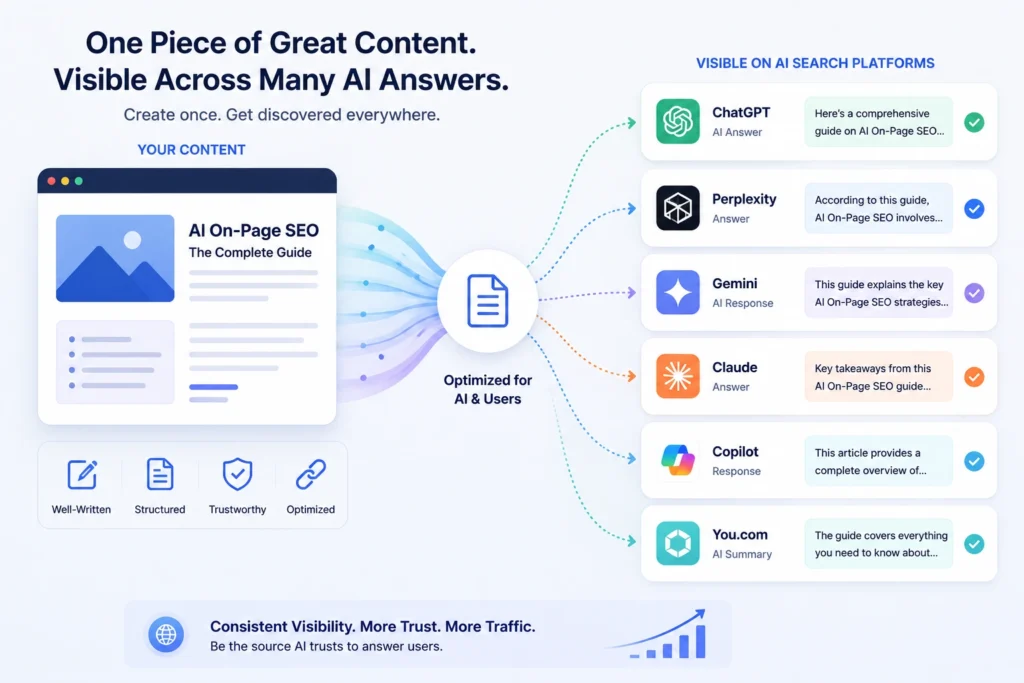
AI Search Optimization is the practice of structuring and writing content so AI-powered search systems can find it. It also involves technical preparation so these systems can understand and use that content in their answers. This includes tools like AI Overviews, ChatGPT search, Perplexity, and other generative answer engines.
Traditional SEO mainly focuses on ranking a page in search results. AI Search Optimization, however, works a bit differently. Specifically, it focuses on getting your content selected, cited, or summarized inside an AI-generated answer.
In other words, the goal isn’t just to appear on a results page anymore. Instead, the goal is to become a trusted source that an AI model references when building its response.
This shift matters because AI search doesn’t always send a click to your website. Sometimes, it simply pulls your information into its own answer. Consequently, brands need a strategy that accounts for both visibility and citation, not just clicks.
Think of it this way: traditional SEO gets you a seat at the table. AI Search Optimization determines whether you actually get quoted once you’re there. Both matter, but they require slightly different tactics to win.
Core Components of AI Search Optimization
- Clarity and structure. Content that’s easy for AI models to parse, with clear headings and direct answers.
- Topical authority. Depth across a subject area, not just a single keyword or page.
- Verifiable facts. Original data, statistics, and insights that support your claims.
- Technical readiness. Clean HTML structure, fast load times, and schema markup.
- Cross-platform consistency. A presence that extends beyond your own site, including mentions elsewhere.
Each of these components reinforces the others. For example, strong topical authority becomes more credible when backed by verifiable data. Consistent mentions across the web add to that credibility as well.
It’s worth noting that AI Search Optimization isn’t a single tactic you apply once. Instead, it’s an ongoing discipline that touches content, technical SEO, and brand reputation together. Think of it as a system, not a checkbox.
Why AI Search Optimization Matters in 2026
AI-powered search has moved from novelty to default behavior. Many users now expect a direct, conversational answer instead of a list of links. Because of this shift, businesses that ignore AI Search Optimization risk becoming invisible in an entire category of search traffic.
Answer Engines Are Replacing Traditional Results Pages
Increasingly, search platforms show a generated summary above or instead of organic listings. As a result, users often get their answer without ever clicking through. Therefore, if your content isn’t structured for AI systems to reference, you may lose visibility. This can happen even in cases where you’d otherwise rank well.
This shift isn’t limited to a single search engine either. Voice assistants, AI browser extensions, and even in-app search features increasingly rely on the same underlying retrieval methods. As a result, the impact reaches far beyond one platform.
Buying Behavior Is Shifting Toward AI Assistants
More people are researching products, services, and decisions through AI chat tools. For example, someone comparing software options might ask an AI assistant directly instead of searching manually. Consequently, being cited inside that conversation carries real commercial value, often more than a mid-page ranking would.
Trust Signals Matter More Than Ever
AI models tend to favor sources that demonstrate genuine expertise and credibility. In other words, thin or generic content is less likely to get referenced. This is precisely why E-E-A-T principles- expertise, experience, authority, and trust- have become central to AI Search Optimization.
Early Movers Gain a Real Advantage
Because many brands haven’t adapted yet, there’s a genuine opportunity right now. Specifically, businesses that optimize for AI search today can build citation patterns that compound over time. In fact, early consistency often matters more than sheer content volume.
Local and Niche Businesses Benefit Too
It’s worth noting that AI Search Optimization isn’t just for large brands. Local businesses, niche publishers, and small teams can compete effectively by focusing on genuine expertise within a specific area. Often, a narrow, well-documented specialty outperforms broad, generic coverage.
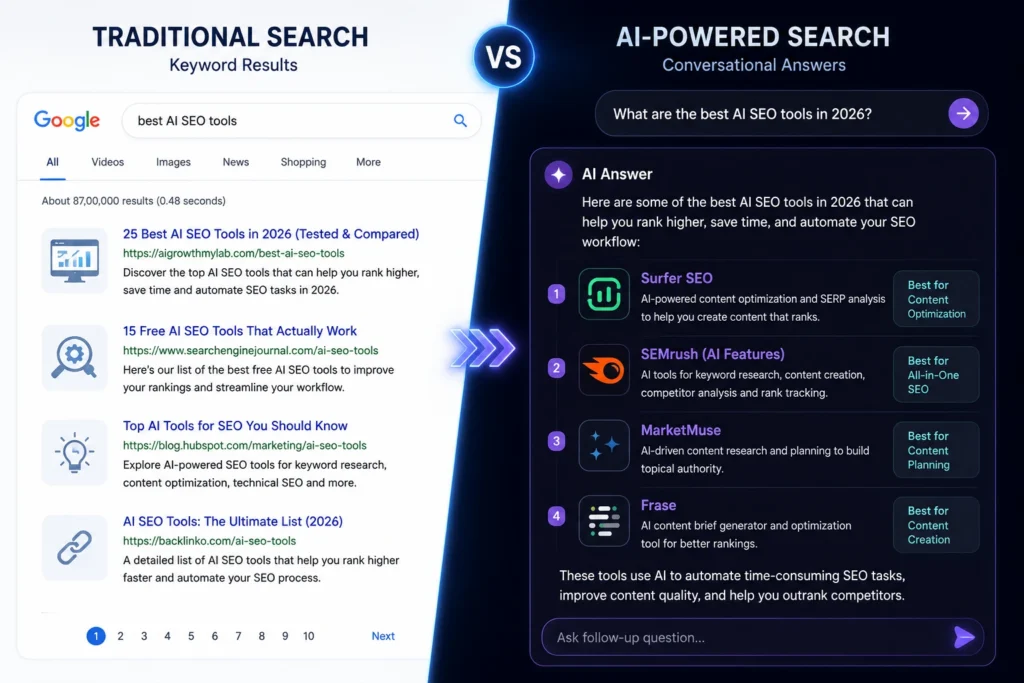
How AI Search Differs from Traditional SEO
Understanding the differences helps you avoid applying outdated tactics to a new environment.
Traditional SEO Focuses on Rankings
Classic SEO revolves around ranking a specific URL for a specific keyword. Success is typically measured by position on a results page and the resulting click-through rate.
AI Search Focuses on Retrieval and Synthesis
AI Search Optimization, on the other hand, is less about a single ranking position. Instead, it’s about whether your content gets retrieved and synthesized into an answer. A page can even be cited without ever appearing as a traditional top result.
Keywords Matter Less Than Topics
Traditional SEO often centers on exact-match keywords. AI search, however, relies heavily on semantic understanding. As a result, covering a topic comprehensively tends to outperform narrowly targeting one phrase.
Multiple Sources Get Blended
In classic search, one page wins one spot. In AI search, however, an answer might draw from several sources at once. Therefore, your goal shifts. Instead of simply “beating competitors,” you’re aiming to become one of the trusted references in a blended response.
Citations Replace Clicks as a Success Metric
Because AI answers can fully satisfy a query, traffic isn’t always the right success metric anymore. Instead, tracking brand mentions, citations, and share of voice inside AI answers becomes increasingly important.
Freshness and Update Frequency Carry More Weight
AI systems often favor recently updated content, especially for fast-changing topics. Consequently, a page that hasn’t been touched in years may lose ground, even if it once ranked well. For example, a pricing guide from three years ago is far less useful to an AI system. A version updated last month tends to earn more trust.
Comparison Table: Traditional SEO vs. AI Search Optimization
| Factor | Traditional SEO | AI Search Optimization |
|---|---|---|
| Primary goal | Rank a URL highly | Get retrieved and cited in an answer |
| Success metric | Click-through rate | Citations, mentions, share of voice |
| Keyword approach | Exact-match targeting | Semantic, topic-based coverage |
| Content structure | Optimized for skimming | Optimized for parsing and extraction |
| Competitive model | One winner per position | Multiple sources blended together |
| Trust signals | Backlinks and domain authority | Expertise, consistency, and verifiable facts |
Naturally, these two approaches aren’t mutually exclusive. In fact, strong traditional SEO often lays the groundwork that AI Search Optimization builds on. Rather than choosing one over the other, most successful strategies blend both.
Consider a typical mid-sized business site. It likely still needs solid technical SEO, clean URLs, and reasonable page speed to get crawled in the first place. On top of that foundation, topical depth and structured formatting help the same content perform well in AI-generated answers. Neither layer replaces the other; instead, they work together.
How AI Search Engines Retrieve Information
To optimize effectively, it helps to understand what’s happening behind the scenes.
Crawling and Indexing Still Matter
AI search systems still rely on crawled and indexed content, much like traditional search engines. Therefore, basic technical SEO, including crawlability, site speed, and clean site architecture, remains foundational. Without it, none of your other efforts can be discovered in the first place.
Retrieval-Augmented Generation (RAG)
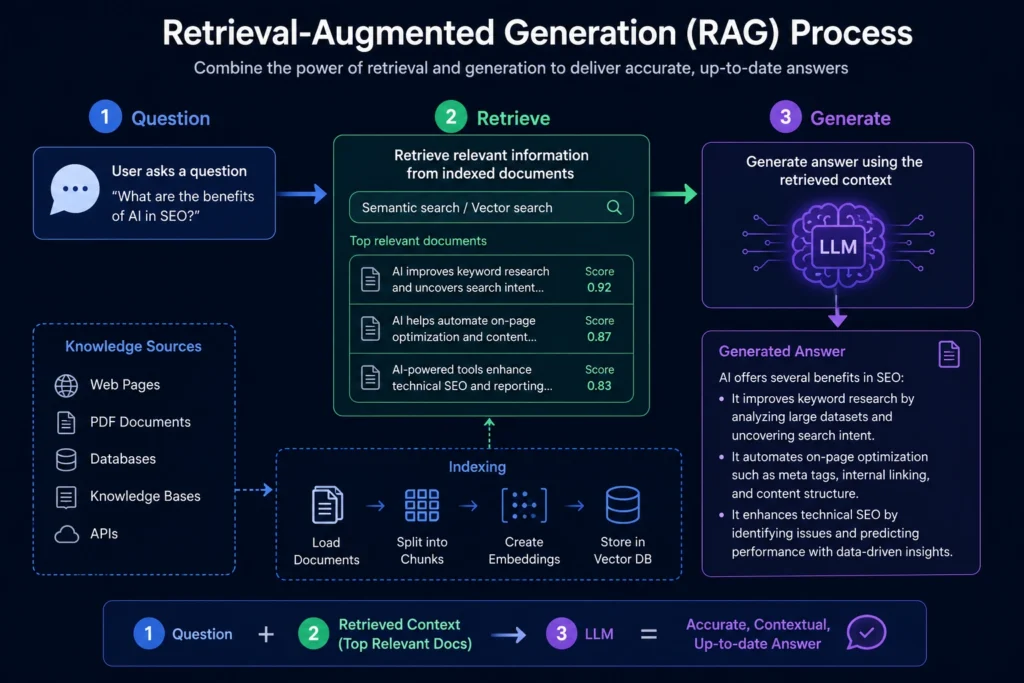
Many AI search tools use a process called retrieval-augmented generation. Essentially, the system retrieves relevant documents first. It then generates an answer using that retrieved information. As a result, being retrievable, meaning well-structured and clearly written, is essential.
Semantic Matching Over Exact Phrases
AI systems match concepts and meaning rather than exact keyword phrases. For instance, a page about “budget-friendly laptops” can be retrieved for a query about “affordable computers,” with no exact match needed.
Content Chunking
AI systems often break pages into smaller chunks or passages instead of evaluating a whole page at once. Consequently, each section of your content should be able to stand on its own. It should answer a specific question clearly, without relying on surrounding context.
Source Credibility Signals
Finally, AI models weigh signals like domain reputation, author expertise, and consistency across the web. In other words, a single well-optimized page won’t help much if your broader online presence lacks credibility. That’s why building authority across multiple channels matters just as much as any one page.
Best AI Search Optimization Techniques
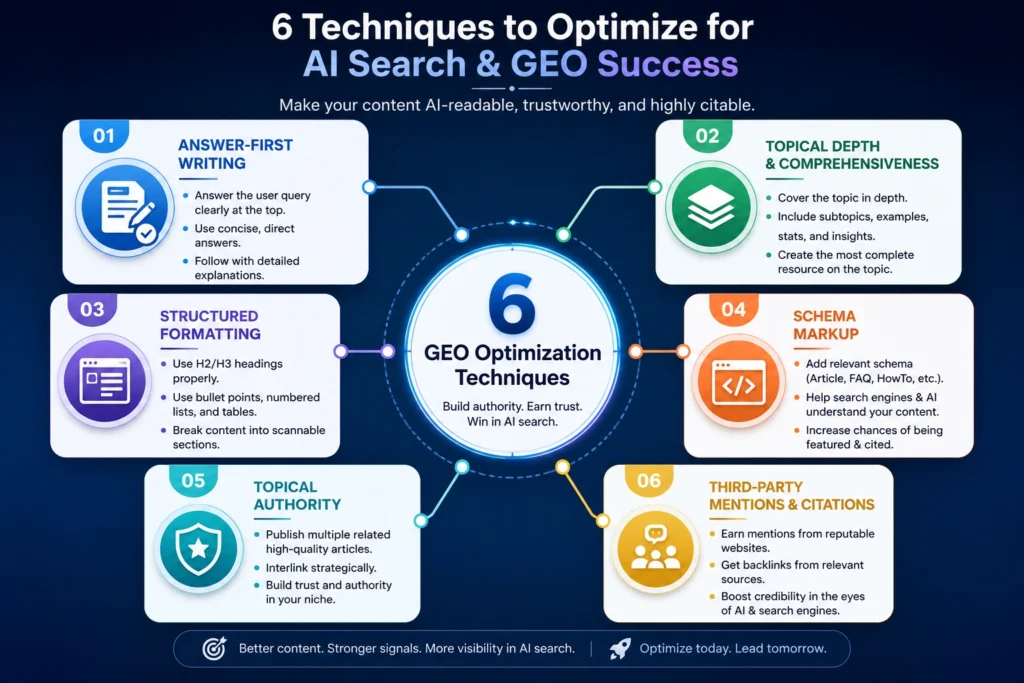
Here’s where strategy turns into action. These techniques form the foundation of a strong AI Search Optimization Guide.
Write in Clear, Answer-First Language
Structure your content so the direct answer appears early, ideally within the first sentence or two of a section. This mirrors how featured snippets work, and it makes it easier for AI systems to extract a clean answer.
Cover Topics Comprehensively
Rather than writing narrowly around one keyword, address the full range of related questions a reader might have. This builds topical depth, which AI systems tend to reward over shallow, single-angle coverage.
Use Structured Formatting
Headings, bullet points, numbered lists, and tables all help AI systems parse your content more easily. Specifically, structured formatting makes it simpler to extract a clean, quotable chunk of information.
Add Schema Markup
Structured data, such as FAQ schema, article schema, and how-to schema, gives AI systems explicit signals. These signals clarify your content’s structure and meaning. As a result, schema can improve both traditional visibility and AI retrieval.
Build Genuine Topical Authority
Publish a cluster of related content rather than a single isolated page. In turn, this signals depth of expertise around a subject. That depth strengthens your credibility in the eyes of AI systems.
Get Cited and Mentioned Elsewhere
Since AI models weigh consistency across sources, being mentioned on reputable third-party sites matters. Therefore, digital PR, guest contributions, and industry mentions all support AI Search Optimization indirectly.
Keep Facts Accurate and Verifiable
AI systems are increasingly cautious about citing unverifiable claims. Consequently, include specific data, cite credible sources, and avoid vague or exaggerated statements.
Refresh Content on a Regular Schedule
Because freshness is a growing signal, revisit key pages periodically. Update statistics, examples, and recommendations so your content continues to reflect current information.
Write for a Specific Reader, Not a Search Engine
It’s tempting to write toward an algorithm, but that approach tends to backfire. Instead, picture an actual reader with a specific question. Content written this way tends to be clearer and more useful. In turn, it’s easier for AI systems to extract and trust.
AI Search Optimization Tools
Several categories of tools can help you monitor and improve your presence in AI search results.
AI Visibility Trackers
Tools like Profound, Otterly.AI, and Peec AI monitor how often your brand appears in AI-generated answers. They track this across platforms like ChatGPT, Perplexity, and Google’s AI Overviews. As a result, these tools help you measure citation frequency rather than just keyword rankings.
Traditional SEO Platforms with AI Features
Platforms such as Semrush and Ahrefs have started adding AI search tracking features. These sit alongside their traditional ranking tools. Consequently, they offer a useful bridge between classic SEO and emerging AI visibility metrics.
Content Optimization Tools
Tools like Surfer SEO and Clearscope help ensure your content covers topics comprehensively. This depth supports both traditional rankings and AI retrieval at the same time.
Schema Markup Generators
Tools such as Merkle’s Schema Markup Generator make it easier to add structured data. Many WordPress SEO plugins now offer similar built-in functionality. Consequently, you don’t need manual coding experience to implement schema correctly.
Answer Engine Testing
Manually testing your own queries inside ChatGPT, Perplexity, and Google’s AI Overviews remains useful. In fact, it’s one of the simplest, most direct ways to see whether your content gets referenced.
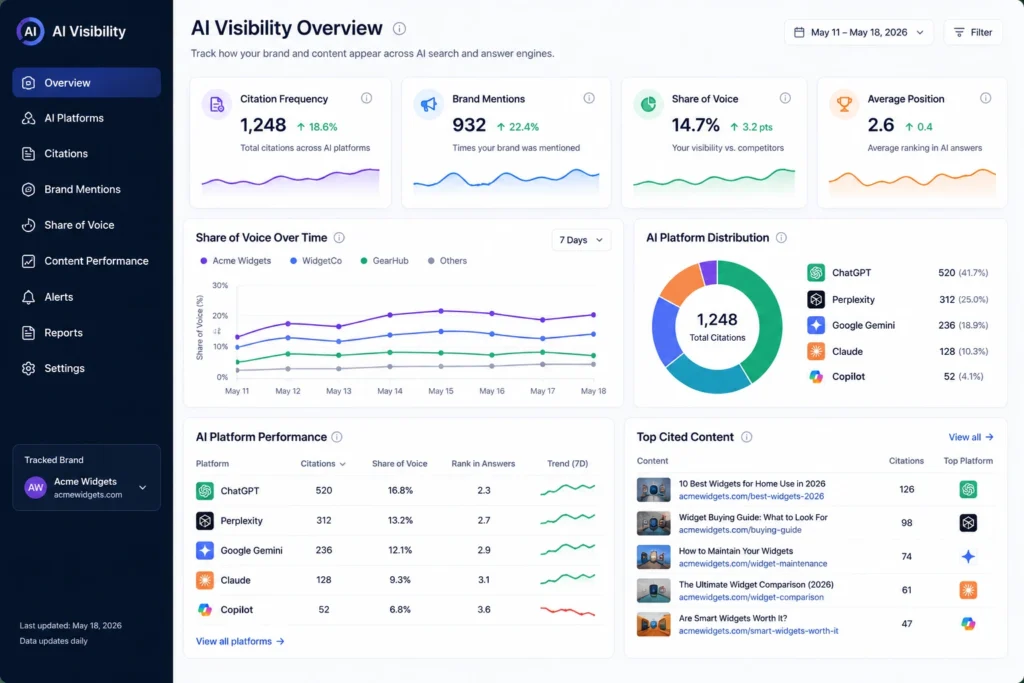
Comparison Table: AI Search Optimization Tools
| Tool | Best For | Key Strength |
|---|---|---|
| Profound | Brand visibility across AI platforms | Citation and mention tracking |
| Otterly.AI | Monitoring AI Overviews and chat answers | Cross-platform reporting |
| Semrush | Teams blending SEO and AI tracking | Established SEO data plus AI features |
| Surfer SEO | Content depth and topical coverage | Real-time content scoring |
| Schema Generators | Technical implementation | Simplified structured data setup |
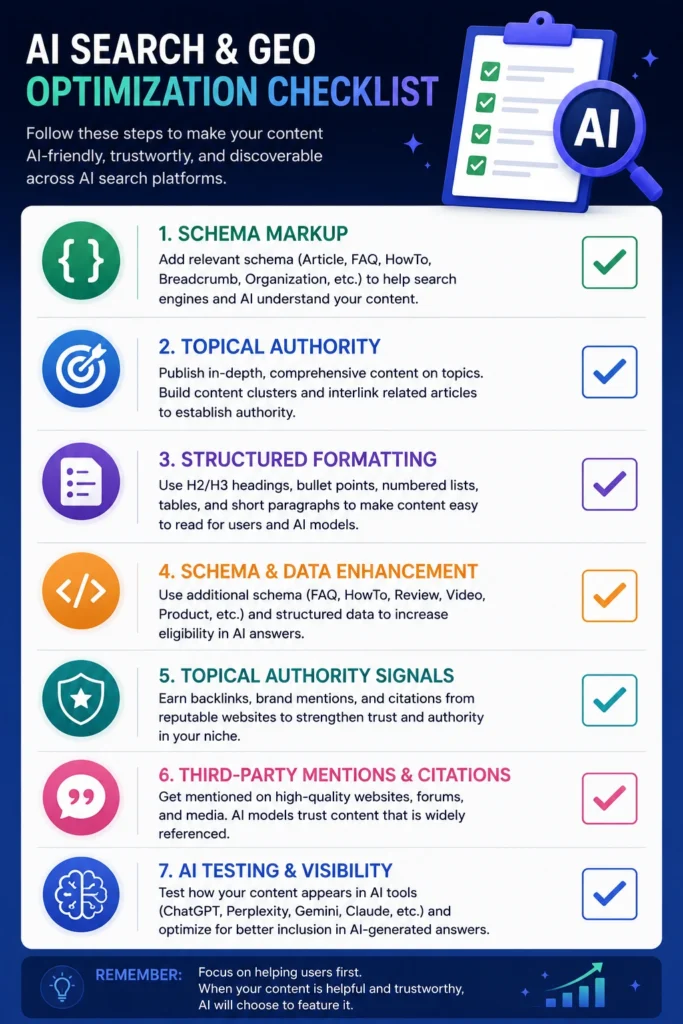
AI Search Optimization Checklist
Use this checklist as a repeatable process for any page you want AI systems to find and cite.
- Identify the core question your page answers. Make sure that answer appears clearly within the first few sentences.
- Map related subtopics and questions. Cover them thoroughly rather than focusing on a single narrow keyword.
- Use clear headings and structured formatting. This includes bullet points, numbered steps, and tables where relevant.
- Add relevant schema markup. FAQ, article, and how-to schema all help AI systems understand your content.
- Include specific, verifiable data. Cite credible sources wherever possible to strengthen trust signals.
- Optimize for natural keyword density. Aim for roughly 1–2%, prioritizing clarity over repetition.
- Add internal links. Connect this page to related content on your site to reinforce topical authority.
- Include outbound links to authoritative sources. This supports credibility and gives readers additional context.
- Ensure fast load times and mobile-friendliness. Technical performance still affects crawlability and indexing.
- Build a presence beyond your own site. Seek mentions, citations, and guest contributions on reputable platforms.
- Test your content in AI tools directly. Ask a related question in ChatGPT or Perplexity. See whether your brand appears in the answer.
- Review and update regularly. AI search rewards freshness, so revisit key pages every few months.
Common AI Search Optimization Mistakes
Even experienced marketers stumble into these pitfalls when adapting to AI search. Recognizing them early can save months of wasted effort.
Treating It Like Traditional Keyword SEO
Some teams simply swap in the phrase “AI search” while keeping the same narrow, keyword-focused approach. However, this misses the point entirely. AI Search Optimization rewards topical depth over exact-match repetition.
Ignoring Structure and Formatting
Dense, unstructured paragraphs are harder for AI systems to parse and extract. Therefore, skipping headers, lists, and clear formatting makes your content less citable, even if the information itself is accurate.
Publishing Thin or Generic Content
AI models are increasingly good at spotting shallow, templated content. As a result, pages that don’t offer genuine insight or original data are less likely to get referenced or trusted.
Overlooking Technical Fundamentals
Some teams focus entirely on content while neglecting crawlability, site speed, or clean architecture. Yet, none of that content matters if AI systems can’t access or index it in the first place.
Measuring Success by Clicks Alone
Since AI answers can fully satisfy a query without a click, relying only on traffic metrics can be misleading. Instead, track citation frequency and brand mentions alongside traditional analytics.
Neglecting Off-Site Credibility
Focusing only on your own website ignores how AI models weigh consistency across the broader web. Therefore, third-party mentions and citations deserve real strategic attention, not just an afterthought.
Forgetting to Update Older Content
Many teams optimize a page once and never revisit it. However, since freshness signals matter, stale content can quietly lose visibility over time, even if it performed well initially.
AI Search Optimization Best Practices
Bringing everything together, here’s how to build a sustainable long-term strategy. These practices work whether you’re just starting out or refining an existing approach.
AI Search Optimization: Prioritize Genuine Expertise
Write from real experience and back claims with credible data. This isn’t just good practice; it’s increasingly a ranking factor in AI-powered search.
AI Search Optimization: Structure Content for Extraction
Assume that any paragraph might be pulled out and used on its own. Consequently, write each section so it makes sense independently, without relying entirely on surrounding paragraphs.
AI Search Optimization: Maintain Consistency Across Platforms
Ensure your brand’s facts, statistics, and positioning stay consistent across your website, social profiles, and third-party mentions. In turn, this consistency builds the kind of trust AI systems favor.
AI Search Optimization: Combine AI Search Optimization with Traditional SEO
Rather than treating these as separate strategies, integrate them. Strong technical SEO and topical authority support both traditional rankings and AI citations at the same time.
AI Search Optimization: Monitor and Adapt Regularly
AI search technology is still evolving quickly. Therefore, revisit your strategy every few months. Test your visibility directly, and adjust based on what’s actually working for your specific content.
AI Search Optimization: Document Your Expertise Clearly
Include author bios, credentials, and firsthand experience wherever relevant. This reinforces the expertise and trust signals that AI systems increasingly rely on when choosing sources to cite.
Frequently Asked Questions
What is AI Search Optimization? AI Search Optimization is the practice of preparing content so AI-powered search tools can find, understand, and cite it. This includes platforms like ChatGPT, Perplexity, and Google’s AI Overviews. Unlike traditional SEO, it focuses on being retrieved and referenced, not just ranked.
Is AI Search Optimization replacing traditional SEO? Not entirely. Traditional SEO fundamentals, like crawlability and site structure, still matter. However, AI Search Optimization adds a new layer focused on topical depth, structured formatting, and cross-platform credibility.
How do I know if my content is showing up in AI search results? You can manually test relevant questions inside tools like ChatGPT and Perplexity. Alternatively, dedicated AI visibility trackers can monitor citation frequency automatically across multiple platforms.
Does AI Search Optimization require new content, or can I update existing pages? Both work well. Updating existing pages with clearer structure, added data, and schema markup often improves AI visibility faster than starting from scratch.
How long does it take to see results from AI Search Optimization? Timelines vary, but many businesses start noticing shifts within a few months. Consistency, however, tends to matter more than speed. AI systems generally favor sources with a sustained pattern of credibility over time.
Do small businesses benefit from AI Search Optimization? Yes, often significantly. Local and niche businesses can compete effectively here. The key is focusing on genuine, well-documented expertise within a specific area, rather than covering everything broadly.
Final Thoughts
AI Search Optimization isn’t a replacement for good SEO. Instead, it’s an extension of it, built for a search landscape where answers, not just links, decide what gets seen. The businesses that adapt now will have an edge. By structuring content clearly and building genuine authority, they’ll be the ones AI systems trust and cite later.
Start small. First, pick one high-value page and run it through the checklist above. Then test it directly inside an AI search tool to see how it performs. From there, expand the approach across your most important content.
Ready to get started? Audit your top three pages for AI Search Optimization this week. Then test each one inside ChatGPT or Perplexity to see where you currently stand. Small, consistent improvements now will compound into stronger visibility as AI search continues to grow.