

Introduction
Keyword research, content briefs, technical audits, reporting. Handling all of this manually used to be the norm. It no longer is. AI SEO automation now connects these tasks into a single, ongoing process instead of a pile of separate manual jobs. As a result, teams that once needed a large staff can now maintain the same output with far fewer hours spent on repetitive work.
This matters because search keeps getting more complex, not less. Between traditional rankings, AI-generated answers, and technical health checks, there’s simply more to manage than most teams can track by hand. In this guide, you’ll learn what AI SEO automation actually looks like, why it matters more in 2026, and how to automate SEO with AI step by step. You’ll also see the best tools available, common mistakes to avoid, and clear best practices for using automation responsibly.
What Is AI SEO Automation?
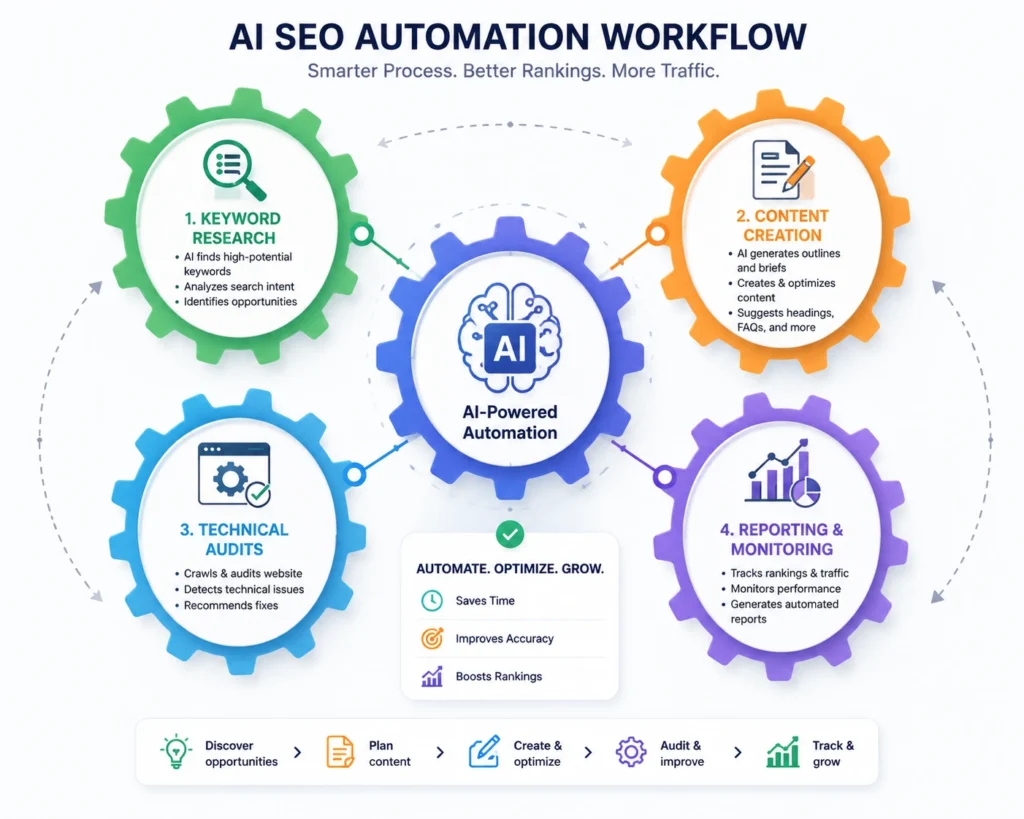
AI SEO automation refers to using artificial intelligence to handle SEO tasks with minimal manual intervention. Instead of a person manually running each step, connected tools pass data automatically from one stage to the next.
For example, keyword research feeds directly into content briefs. Content briefs then guide drafts. Drafts get checked for technical and on-page issues before publishing. Each of these steps used to require someone manually moving information between spreadsheets and tools. Automation removes that manual handoff.
How This Differs From Just Using AI Tools
Plenty of teams already use individual AI tools. They might use one tool for keyword research and a separate one for drafting content. That’s helpful, but it’s not the same as true automation. Without connections between tools, someone still has to manually transfer data from one step to the next. That person becomes the bottleneck.
Genuine AI SEO automation removes that bottleneck. It treats SEO as one connected system, not a series of disconnected tasks handled by different tools.
A Simple Example of AI SEO Automation in Practice
Consider a mid-sized ecommerce brand publishing new product pages every week. Without automation, someone manually researches keywords, writes a brief, drafts the page, checks it for technical issues, and eventually reports on how it performed. Each handoff between these steps takes time and depends on someone remembering to do it.
With AI SEO automation in place, keyword research feeds directly into a generated brief the moment a new product category is identified. The brief flows into a draft. Before publishing, the page gets automatically checked for meta tag length, broken links, and duplicate content. Rankings and traffic then get tracked automatically once the page goes live, with alerts sent if something unexpected happens.
The team still reviews and approves each stage. However, nobody has to manually remember to move the process forward. That shift alone often accounts for the biggest time savings teams report after adopting automation.
Why AI SEO Automation Matters in 2026
A few converging trends explain why this topic deserves serious attention this year.
AI SEO Automation: Search Has Gotten More Complex
Ranking well today involves more than keywords and backlinks. It requires technical health, structured data, and visibility inside AI-generated search summaries. Juggling all of this manually, one task at a time, is genuinely difficult to sustain as a site grows.
AI SEO Automation: The Competitive Baseline Has Risen
More teams now use some form of automation, which quietly raises expectations for everyone else. A site relying entirely on manual processes risks falling behind competitors who publish faster and catch technical issues sooner.
AI SEO Automation: Manual Work Simply Doesn’t Scale
For a site with hundreds or thousands of pages, manually tracking rankings, auditing technical health, and updating content is genuinely unsustainable. Therefore, automation isn’t just a convenience anymore. It’s becoming a practical requirement for sites operating at scale.
AI SEO Automation: Agentic Systems Are Reshaping What’s Possible
The automation landscape has shifted from simple scheduled tasks, like a weekly rank check, toward more autonomous systems capable of executing multi-step workflows with less oversight. This shift means the gap between manual and automated SEO is widening faster than it has in previous years.
AI SEO Automation: Small Teams Feel the Pressure Most
Larger companies can sometimes absorb the cost of manual SEO work by hiring more staff. Smaller teams don’t have that option. As a result, AI SEO automation has become less of a luxury and more of a practical way for lean teams to compete against much larger competitors.
AI SEO Automation: The Cost of Falling Behind Keeps Rising
Every quarter a team delays adopting automation, competitors using it pull further ahead in publishing speed and technical responsiveness. This compounding effect is part of why so many teams are moving on this now rather than waiting to see how the technology matures further.
Benefits of Automating SEO with AI
Understanding the concrete benefits helps justify the investment in tools and process changes.
Significant Time Savings
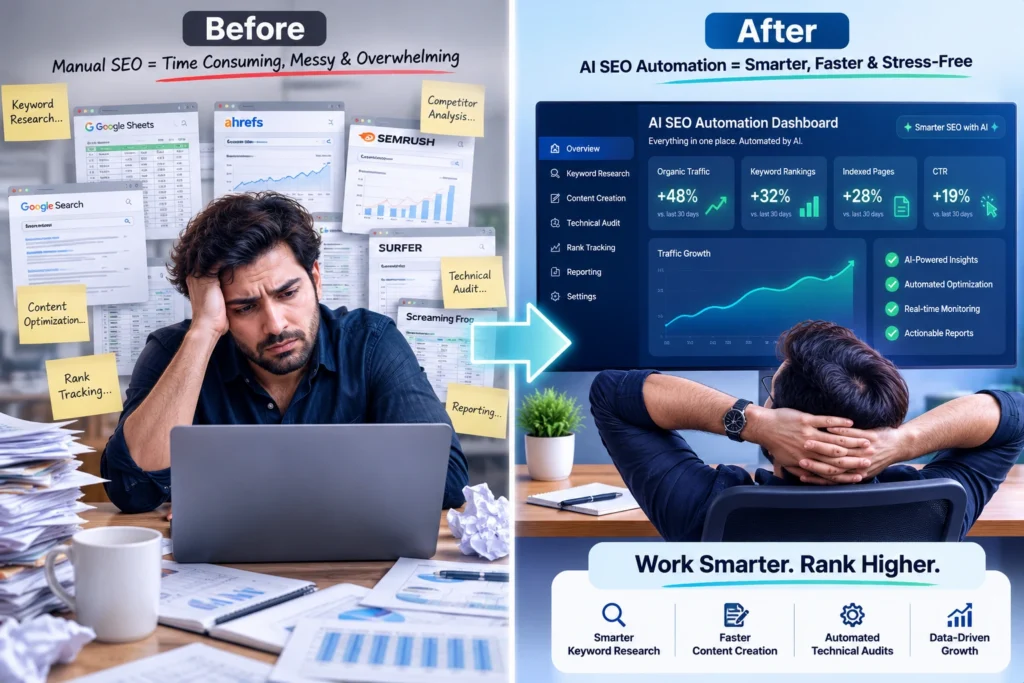
Automating repetitive tasks like rank tracking and reporting frees up meaningful hours each week. Instead of manually pulling data and building reports, teams can redirect that time toward strategy and creative work.
Faster Issue Detection
Automated monitoring catches problems, like a sudden ranking drop or a technical error, far sooner than a scheduled manual check would. This matters because early detection often means the difference between a quick fix and a prolonged traffic decline.
More Consistent Execution
Manual processes vary depending on who’s doing the work and how much time they have that week. Automated workflows apply the same standards every time, regardless of team bandwidth or turnover.
Better Use of Specialist Time
Rather than spending hours on repetitive checks, specialists can focus on strategic decisions that genuinely require human judgment. This shift tends to improve both morale and the quality of strategic thinking across a team.
Improved Visibility Into AI-Driven Search
Since AI platforms now crawl and cite content directly, automated monitoring can track whether your content shows up in AI-generated answers, not just traditional rankings. This is a newer benefit that manual processes rarely covered well.
Easier Reporting for Stakeholders
Translating SEO performance into language executives understand has always been a challenge. Many automated systems now generate plain-language summaries on a schedule, explaining what changed and why, without requiring someone to manually compile that report every month.
Fewer Costly Human Errors
Manual processes are prone to small mistakes: a missed redirect, a forgotten meta description, a typo in a title tag. Automated checks catch these consistently, reducing the number of avoidable errors that slip through simply because someone was rushing or distracted.
(For a deeper look at one piece of this puzzle, see our related guide on AI SEO Agents and Automation Tools.)
Best AI SEO Automation Tools
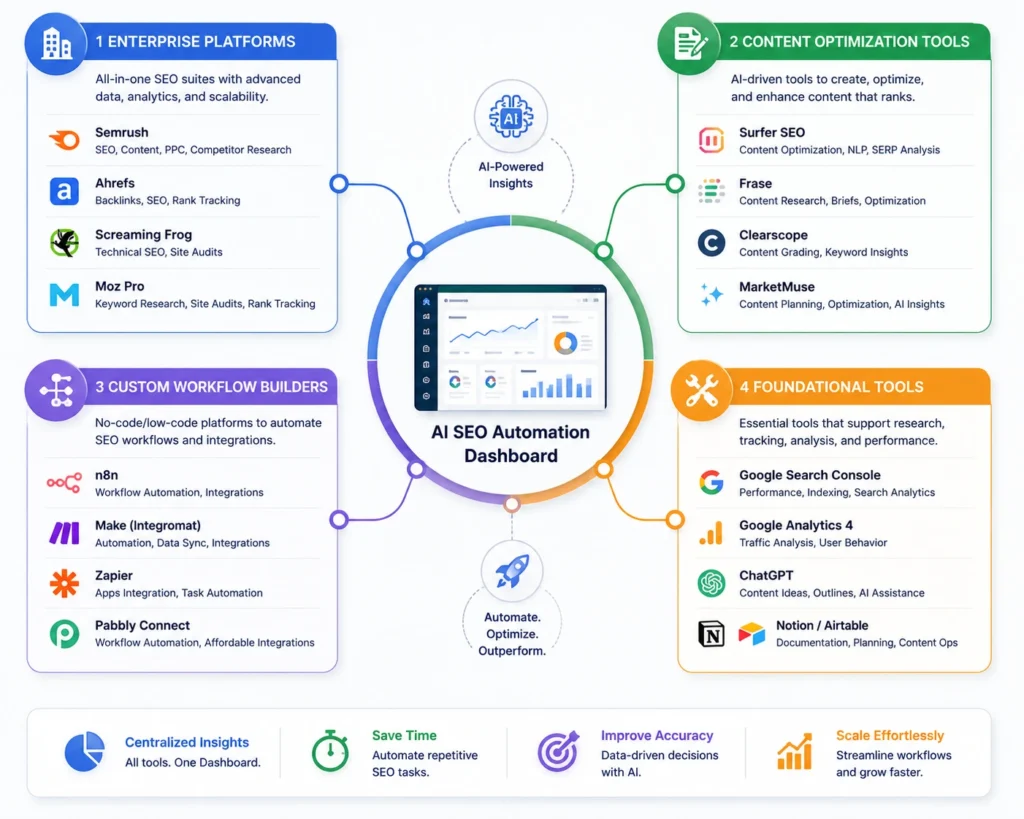
Rather than naming a single winner, it helps to understand the categories available and what each one solves.
All-in-One Enterprise Platforms
Some platforms combine rank tracking, site auditing, and reporting into a single connected system. Semrush is a well-known example here, automating scheduled rank tracking while also using AI to power visibility scoring across traditional and AI-driven search.
Content Optimization and Workflow Tools
This category focuses on content specifically, automating the process from keyword clustering through content briefs and optimization suggestions. Surfer SEO falls into this category, automatically pulling search results data and suggesting content changes based on what’s currently ranking.
Custom Workflow Builders
For teams wanting more control, tools like n8n let you build custom automated pipelines. A common setup pairs Google Search Console data with an AI model, automatically analyzing performance and generating reports without manual intervention at each step.
Free and Foundational Tools
It’s worth noting that Google Search Console remains a genuinely essential, free tool in any automated stack. Pairing it with an AI model for analysis is a common and effective starting point, even before investing in paid platforms.
How to Choose the Right Combination
Most effective setups in 2026 combine more than one tool rather than relying on a single platform. Start by identifying your biggest time drain, whether that’s reporting, content production, or technical monitoring, and automate that piece first before expanding further.
How to Build an AI SEO Workflow
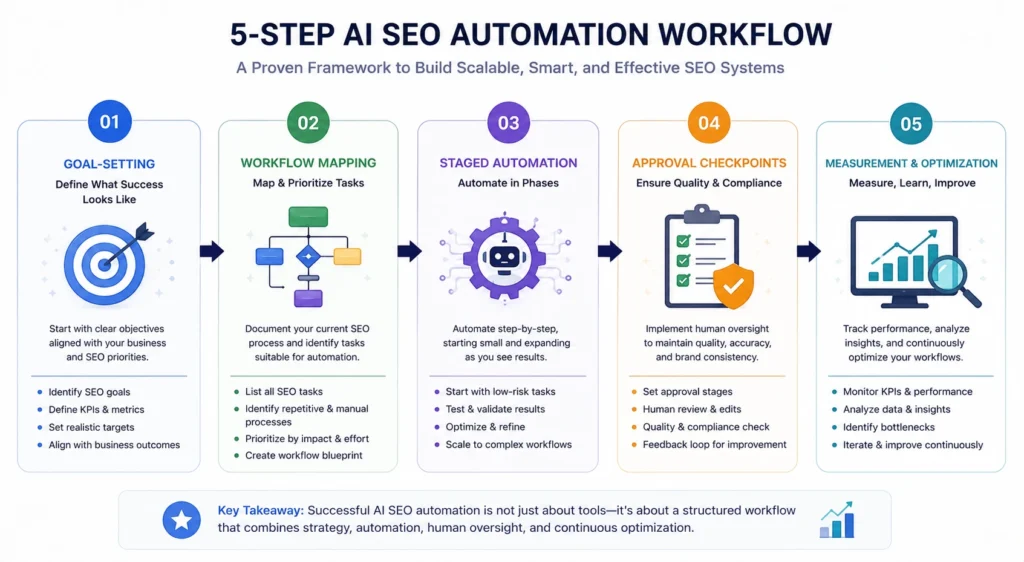
Knowing how to automate SEO with AI starts with a clear, phased approach rather than trying to automate everything at once.
Step 1: Define Clear Goals First
Before adopting any tool, decide what you actually want to achieve. A goal like increasing organic traffic by a specific percentage within six months helps determine which tools and processes to prioritize.
Step 2: Map Your Existing Workflow
Write out how your team currently handles keyword research, content creation, and technical audits. This makes it much easier to spot where automation would genuinely save time, rather than guessing at what to automate first.
Step 3: Automate One Stage at a Time
Start with the lowest-risk, most repetitive task, often rank tracking or technical audits. Once that stage runs reliably, connect the next one, gradually building a fully connected system instead of overhauling everything simultaneously.
Step 4: Set Clear Approval Checkpoints
Decide exactly what can run without review and what always needs human sign-off. Publishing decisions and major technical changes generally deserve a review step, even in a highly automated workflow.
Step 5: Measure and Adjust
Track time saved, error rates, and content quality over the first month or two. Use this data to decide whether to expand automation further or adjust the current setup.
AI SEO Automation for Content Creation
Content is often where automation delivers the most noticeable time savings.
Automated Keyword Clustering
AI tools can group hundreds of keywords into clusters based on search intent within minutes, a process that used to take hours of manual sorting. This ensures content targets the right terms while building topical authority systematically.
Automated Content Briefs and Outlines
Once topics are identified, AI can generate structured briefs automatically, including recommended headings and semantically related terms. Writers still handle the actual drafting, but they start from a much stronger foundation.
Real-Time Optimization Feedback
Many platforms provide feedback on keyword usage, readability, and topical coverage as content gets drafted, rather than after the fact. This catches gaps before publication instead of during a separate review cycle.
Where Human Judgment Still Matters Most
Even with strong automation, genuine expertise, brand voice, and real examples still require a human writer. Automation should speed up research and structure, not replace the actual writing and editorial judgment involved.
Scaling Content Without Sacrificing Quality
A common concern is that automating content workflows leads to generic, interchangeable output. That risk is real, but it usually stems from skipping the review stage, not from automation itself. Teams that keep a genuine editing step in place tend to scale their content output significantly without a noticeable drop in quality.
AI SEO Automation for Technical SEO
Technical health benefits enormously from continuous, automated monitoring rather than periodic manual checks.
Continuous Crawling and Auditing
AI tools can scan an entire site regularly, flagging broken links, duplicate meta tags, and indexing issues automatically. This catches problems within hours instead of waiting for the next scheduled audit.
Automated Alerts for Critical Issues
Rather than discovering a spike in crawl errors during a routine check, automated monitoring sends immediate alerts. This allows teams to respond before an issue affects a meaningful portion of the site.
Streamlined Indexing
Some workflows automatically notify search engines when content changes, using protocols designed to speed up indexing rather than waiting for natural discovery. This is especially useful for large sites publishing frequently.
(For a broader look at this specific area, see our related guide on AI Technical SEO.)
A Real-World Example of AI SEO Automation in Action
To make this concrete, consider how a small marketing agency might approach automating SEO across multiple client accounts.
The Starting Problem
Imagine an agency managing SEO for a dozen clients with a team of three. Manually tracking rankings, auditing technical health, and compiling monthly reports for every client consumes most of the team’s available hours, leaving little time for actual strategy work.
Automating Reporting First
The team starts with the lowest-risk, highest-friction task: reporting. An automated system pulls ranking and traffic data for each client on a schedule, generating plain-language summaries automatically. What used to take a full day each month now takes under an hour of review time.
Expanding to Technical Monitoring
Once reporting runs smoothly, the team adds continuous technical monitoring across all client sites. Instead of running manual audits every few months, they get alerts the moment a client’s site develops a crawl error or a significant ranking drop.
The Outcome
Within a few months, the team reclaims enough time to take on additional clients without hiring more staff. The key wasn’t automating everything at once. It was starting with the task draining the most time and building outward from there.
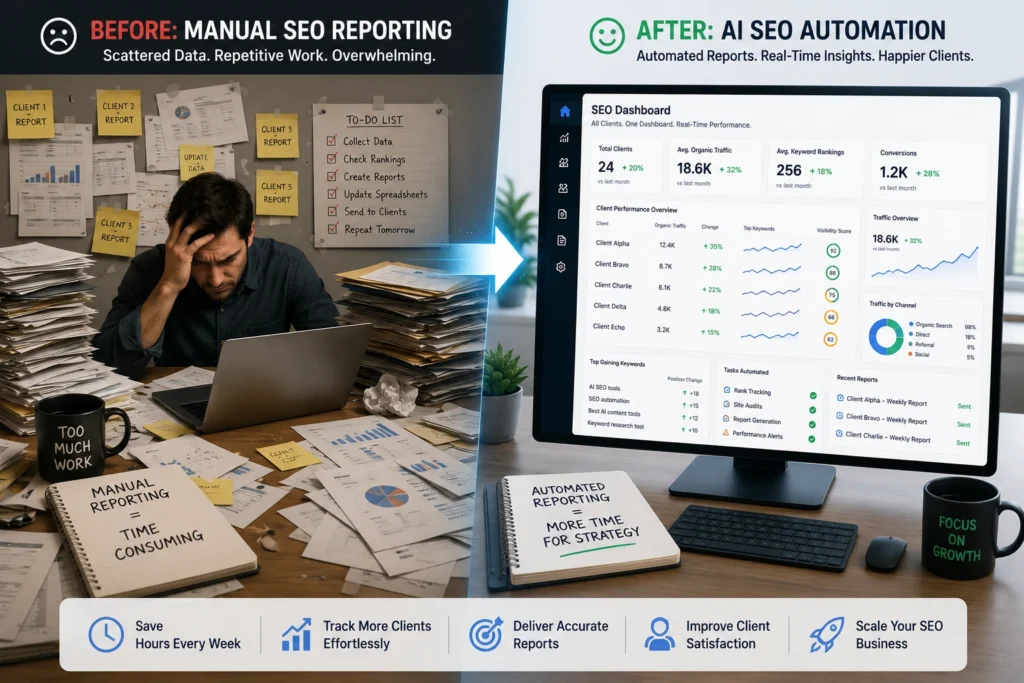
AI SEO Automation vs. Manual SEO: A Comparison
Before deciding how much to automate, it helps to see the practical differences side by side.
| Factor | Manual SEO Process | AI SEO Automation |
|---|---|---|
| Keyword research | Done in spreadsheets, updated occasionally | Continuously updated, automatically clustered |
| Content briefs | Written individually by strategists | Generated automatically from research data |
| Technical audits | Scheduled monthly or quarterly | Run continuously, flagged in real time |
| Reporting | Compiled manually before meetings | Generated automatically, updated live |
| Issue detection speed | Delayed until the next scheduled check | Often within hours |
| Scalability | Limited by team size | Scales without proportional headcount growth |
| Human oversight required | High, at every step | Moderate, focused on review and strategy |
As the table shows, the goal isn’t removing people from SEO entirely. Rather, it’s removing the manual handoffs that slow everything down.
Common AI SEO Automation Mistakes
A few recurring mistakes tend to undermine otherwise solid automation efforts.
Automating Everything at Once
Teams that attempt a full overhaul in one step often struggle to catch issues before they compound. A phased rollout, one stage at a time, tends to work far better.
Removing Human Review Too Early
Unedited AI output, whether content or technical fixes, can contain errors or sound generic. Keep a review step in place, especially for anything customer-facing or affecting site structure.
Ignoring Data Quality
Automation is only as good as the data feeding it. If keyword data is outdated or analytics tracking is broken, automation simply scales those problems faster instead of catching them.
Choosing Tools That Don’t Integrate Well
A tool with impressive features isn’t useful if it can’t pass data to the next stage of your workflow. Prioritize integration over standalone feature lists.
Forgetting to Reassess the Workflow Over Time
Search engines, AI platforms, and your own site all change over time. A workflow that worked well a year ago may need adjusting as these factors evolve.
AI SEO Automation Best Practices
Following these practices helps you capture real value without introducing unnecessary risk.
Start With Monitoring Before Full Automation
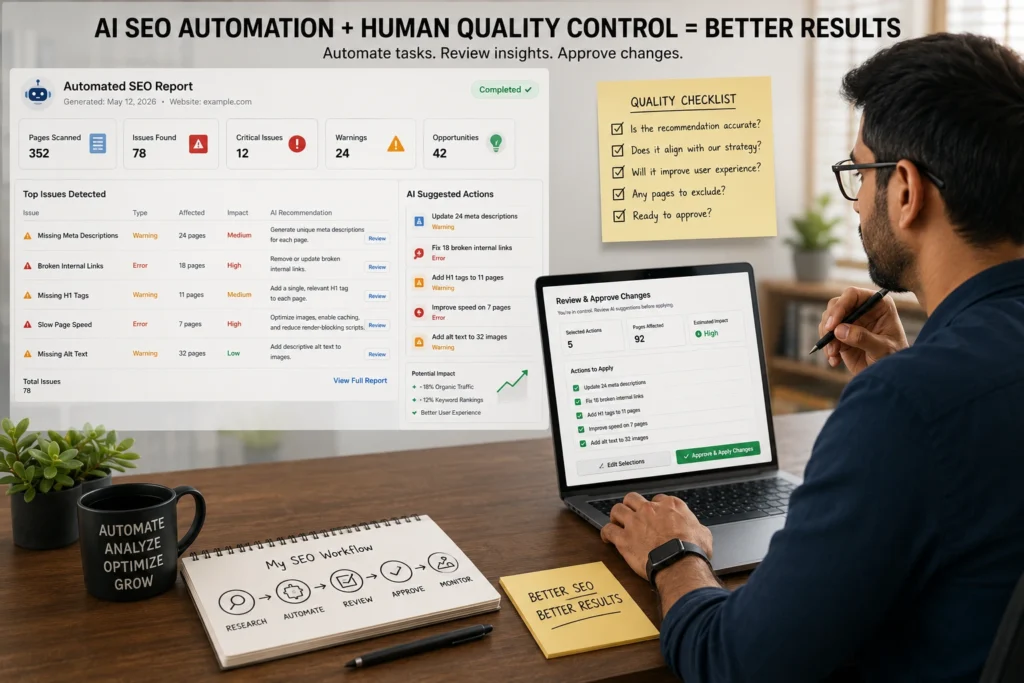
Begin by using AI tools to flag issues, rather than automatically implementing every fix. This builds trust in the system’s accuracy before granting it more autonomy.
Combine AI Speed With Human Judgment
Use automation to detect and prioritize work quickly, but keep a specialist reviewing anything before it goes live. This combination captures speed without sacrificing quality control.
Document What Gets Automated and Why
As more tasks shift to automated systems, keep a simple internal reference showing which processes run automatically and which still require manual review. This prevents accidental gaps in oversight.
Revisit Your Setup Regularly
Periodically review your overall automation strategy rather than assuming it will keep working indefinitely without adjustment. Site changes, algorithm updates, and new AI platforms all affect what needs attention.
Train Your Team on Reviewing Automated Output
Automation still needs people who know what good output looks like. Investing a little time in training your team to spot weak AI-generated content or misjudged technical recommendations pays off far more than treating automation as fully hands-off.
Frequently Asked Questions About AI SEO Automation
What is AI SEO automation?
AI SEO automation is the use of artificial intelligence to handle SEO tasks, including keyword research, content creation, technical audits, and reporting, with minimal manual intervention. It works by connecting these tasks into one continuous workflow instead of treating them as separate jobs.
How do I automate SEO with AI as a beginner?
Start small. Automate a single repetitive task, like rank tracking or technical audits, before expanding further. Define clear goals first, then map your existing workflow to identify where automation will save the most time, rather than trying to automate everything simultaneously.
Is AI SEO automation only useful for large sites?
No. Smaller sites often benefit just as much, since they typically lack the staff to handle repetitive tasks manually. Many tools offer scalable pricing that makes automation genuinely accessible for smaller teams and solo operators too.
Does AI SEO automation replace the need for an SEO specialist?
No. It removes repetitive manual work, but strategic decisions, brand voice, and quality review still require human expertise and judgment at every meaningful step. The specialist’s role shifts toward oversight rather than disappearing entirely.
What’s the biggest risk of automating SEO tasks?
The biggest risk is publishing AI-generated content or technical changes without human review. Skipping that step can lead to factual errors, generic content, or unintended site changes going live unnoticed, sometimes for weeks before anyone catches the problem.
Final Thoughts: Making AI SEO Automation Work for You
AI SEO automation isn’t about removing people from the process entirely. Instead, it’s about removing the repetitive manual work that keeps skilled people from focusing on strategy and genuine creative decisions. Teams that automate thoughtfully, one stage at a time, tend to see the strongest and most sustainable results.
Start small. Pick one part of your SEO process, automate it, and measure the impact before expanding further. Over time, those connected stages become a genuine competitive advantage, not just a collection of separate tools running independently.
Whether you’re managing a single site or SEO across a dozen client accounts, the underlying principle stays the same. The goal isn’t handing everything over to a machine. It’s freeing up the time and attention your team needs to make the strategic decisions that actually move the needle, while automation quietly handles everything else in the background.
Ready to put this into practice? Check out our guide on AI SEO Agents and Automation Tools to see how autonomous tools can power each stage of your workflow, from research to reporting.



Pingback: AI SEO for Local Business: Complete Guide 2026
Pingback: AI SEO Prompt Library: 200+ ChatGPT Prompts