

“How AI SEO agents are automating SEO in 2026, and how to use one without losing your edge.”If you manage search rankings for a living, you’ve probably noticed something strange happening over the past year. The tools you used to click through manually — keyword research, content briefs, technical audits, rank tracking — are starting to run themselves. Welcome to the age of the AI SEO agent.
Unlike the chatbot-style AI tools that simply answer questions when prompted, an AI SEO agent works more like a digital teammate. It can research keywords, draft content briefs, monitor rankings, flag technical issues, and even publish updates, often with minimal human input. For marketing teams stretched thin and agencies juggling dozens of clients, this shift toward AI SEO automation isn’t just a nice-to-have anymore. It’s becoming table stakes.
In this guide, you’ll learn what AI SEO agents actually do, how they differ from traditional SEO software, which tasks they handle best (and where humans still matter), how to choose one, and what the future of autonomous search optimization looks like heading into the rest of 2026. Whether you’re a solo blogger or run SEO for a growing SaaS company, by the end you’ll have a clear framework for deciding whether an AI SEO agent belongs in your workflow.
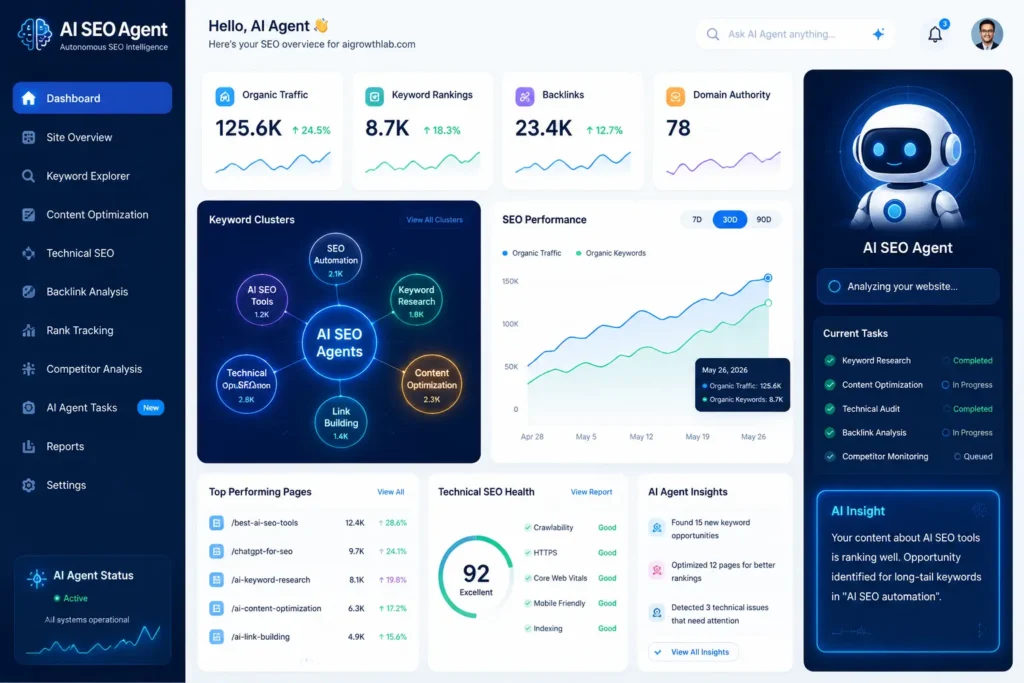
What Is an AI SEO Agent?
An AI SEO agent is a software system that uses artificial intelligence, typically large language models combined with automation frameworks, to independently perform search engine optimization tasks. Instead of waiting for a marketer to type in a query and act on the output, the agent can plan a sequence of steps, execute them, check the results, and adjust its approach, much like a junior SEO analyst would, but running continuously in the background.
That said, most agents on the market today still work best as capable assistants under human supervision rather than fully unsupervised operators. The technology is evolving quickly, but oversight still matters, especially for anything customer-facing or tied to revenue.
Key Capabilities of an AI SEO Agent
Most tools marketed as AI SEO agents combine several capabilities:
- Keyword and topic research pulled from live search data
- Content brief generation, including recommended headings, word counts, and semantic keywords
- On-page optimization suggestions, such as meta tags, internal links, and schema markup
- Technical SEO auditing, flagging crawl errors, broken links, or slow-loading pages
- Rank tracking and competitor monitoring, updated automatically instead of manually
- Reporting, translating raw data into summaries stakeholders can actually understand
The defining trait isn’t any single feature. It’s the agent’s ability to chain these tasks together and act with a degree of autonomy, rather than requiring a person to run each tool separately.
Why AI SEO Automation Is Gaining Momentum in 2026
A few converging trends explain why so many teams are adopting AI SEO automation right now.
Search Itself Is Becoming AI-Driven
Search engines are increasingly generating AI-powered summaries directly in results pages, which changes how content gets discovered. Google’s AI Overviews and similar features from Bing and other engines mean that ranking well now often requires optimizing for how AI systems parse and summarize content, not just how human eyes scan a results page. Naturally, many teams have concluded that fighting AI-driven search with manual, human-only workflows is a losing battle. According to Search Engine Journal’s ongoing coverage of AI Overviews, publishers are already adjusting content structure specifically to earn citations in these AI-generated summaries (Search Engine Journal).
Content Demands Have Outpaced Team Capacity
Consistent publishing is still one of the strongest predictors of organic growth, but most in-house teams simply don’t have the bandwidth to research, write, optimize, and update content at the pace search engines seem to reward. An AI SEO agent can absorb the repetitive parts of that workload, freeing strategists to focus on ideas, brand voice, and judgment calls that AI still handles poorly.
The Cost of Manual SEO Work Keeps Climbing
Hiring a full SEO team is expensive, and freelance rates for specialized technical audits or content optimization have risen steadily. Automation offers a way to stretch existing budgets further, particularly for small businesses and startups that can’t justify a five-person marketing department.

How AI SEO Agents Actually Work
Understanding the mechanics helps you evaluate tools more critically instead of getting swept up in marketing hype.
Step 1: Data Collection
The agent connects to data sources such as search console accounts, keyword databases, competitor websites, and crawl data. This gives it a real-time picture of where a site currently stands.
Step 2: Analysis and Planning
Using AI models trained on SEO patterns, the agent identifies gaps, such as underperforming pages, missing keyword clusters, or technical errors, and builds a prioritized action plan. This is where large language models genuinely shine: synthesizing large, messy datasets into a coherent set of recommendations.
Step 3: Execution
Depending on permissions granted, the agent might draft content, update meta descriptions, suggest internal links, or even push changes directly to a CMS. More cautious setups keep a human reviewer in the loop before anything goes live, which is generally the safer approach for anything published publicly.
Step 4: Monitoring and Iteration
After changes are made, the agent tracks the impact- whether rankings improved, whether traffic shifted, whether bounce rate changed- and refines its next set of recommendations accordingly. This feedback loop is what separates an agent from a static tool: it learns from outcomes rather than just producing a one-time report.
AI SEO Agent vs. Traditional SEO Tools: A Comparison
It’s worth being precise about what actually changes when you move from conventional SEO software to an autonomous agent. The table below breaks down the core differences.
| Feature | Traditional SEO Tools | AI SEO Agent |
|---|---|---|
| Task execution | Manual, one tool per task | Multi-step, often chained automatically |
| Data updates | Scheduled reports, usually static | Continuous or near real-time monitoring |
| Content creation | Templates and suggestions only | Drafts full content, briefs, and optimizations |
| Decision-making | Human interprets all data | Agent proposes and can act on recommendations |
| Learning over time | Minimal, rule-based logic | Adapts based on performance feedback |
| Best suited for | Teams wanting full manual control | Teams needing scale and speed |
| Human oversight needed | High | Moderate (recommended, not optional) |
As the table shows, the shift isn’t about replacing SEO tools altogether. It’s about layering autonomous decision-making on top of the data those tools already collect.
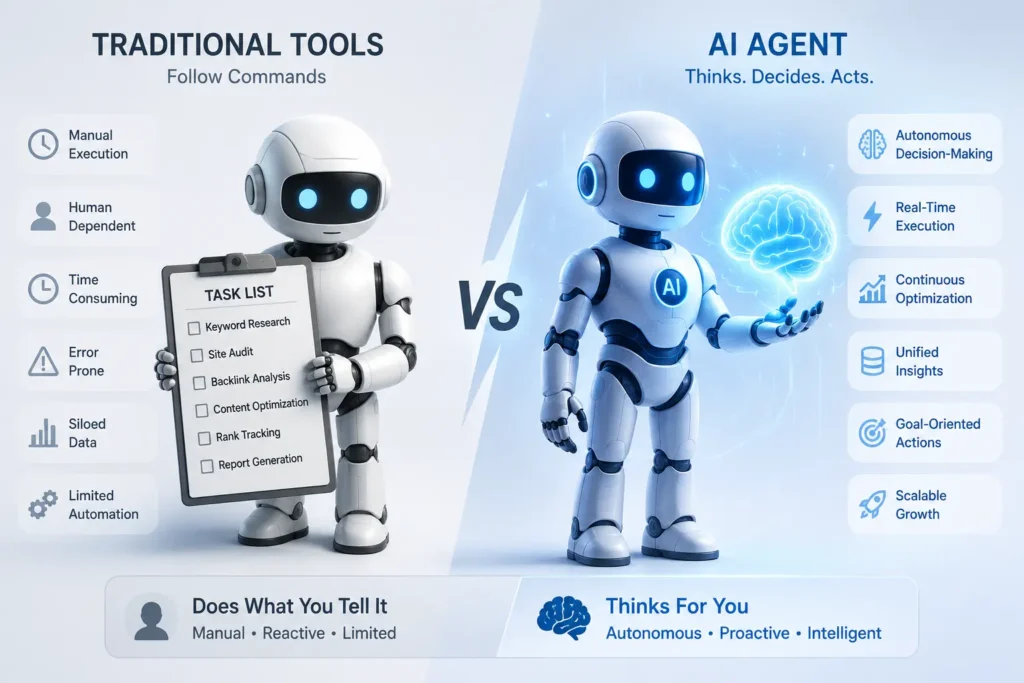
Infographic comparing traditional SEO tools to an AI SEO agentTop Use Cases for AI SEO Agents
Not every SEO task benefits equally from automation. Here’s where AI SEO agents tend to deliver the strongest results.
Content Gap Analysis and Topic Clustering
Manually mapping out every content gap across a competitive niche can take days. An agent can scan hundreds of competitor pages, cluster related topics, and surface underserved keywords in a fraction of the time, giving content teams a prioritized roadmap instead of a spreadsheet of raw keyword data.
Technical SEO Audits at Scale
For large sites with thousands of pages, spotting broken links, duplicate content, or crawl errors manually is impractical. Agents can continuously scan a site and flag issues the moment they appear, rather than waiting for a quarterly audit.
Local SEO Monitoring
Businesses with multiple locations often struggle to keep listings, reviews, and location pages consistent. An AI SEO agent can track local pack rankings, monitor citation accuracy, and alert teams when a competitor gains ground in a specific area, which is especially useful for franchises or multi-location service businesses.
Content Refreshes
Older blog posts often lose rankings simply because they go stale. Agents can identify which pages have declined in traffic, suggest updated statistics or examples, and even draft revised sections, helping teams squeeze more value out of existing content instead of only chasing new posts.
Reporting and Stakeholder Communication
Turning raw analytics into a clear narrative for executives is a task AI genuinely handles well. Agents can auto-generate monthly reports that highlight wins, flag risks, and recommend next steps in plain language.
Choosing the Right AI SEO Agent for Your Team
With dozens of tools now branding themselves as “AI SEO agents,” it helps to have a clear evaluation framework rather than picking based on marketing claims alone.
Look for Transparent Data Sources
A trustworthy agent should clearly state where its keyword and ranking data comes from. Vague claims about proprietary data with no verification path are a red flag.
Check for Human-in-the-Loop Controls
The best tools let you set approval checkpoints, especially before content gets published or technical changes go live. Full autonomy sounds appealing, but for anything customer-facing, a review step protects your brand from AI mistakes slipping through unnoticed.
Evaluate Integration Depth
An agent is only as useful as the systems it connects to. Confirm it integrates cleanly with your CMS, analytics platform, and search console rather than requiring constant manual data exports.
Test Its Content Quality Firsthand
Don’t take demo videos at face value. Run a real test with your own topic and evaluate whether the output sounds natural, accurate, and aligned with your brand voice, or whether it reads like generic AI filler that needs heavy editing.
Consider Pricing Against Time Saved
Some agents charge per task, others by monthly subscription. Calculate the actual hours your team would save and weigh that against cost before committing to an annual plan.
(For a deeper breakdown of specific automation workflows, see our related guide on [building an SEO content calendar with AI tools] — internal link opportunity.)
The Limitations of AI SEO Agents (What They Still Get Wrong)
It would be misleading to present AI SEO agents as flawless. A few limitations are worth understanding before you hand over control.
They can misjudge search intent. AI models are good at pattern matching but can misread nuanced intent, especially for ambiguous or emerging queries where historical data is thin.
They can produce generic content without strong prompting. Left unsupervised, agents sometimes generate technically correct but bland copy that lacks the specific insights, anecdotes, or expertise that actually build trust with readers, and increasingly, with search engines evaluating E-E-A-T signals.
They can’t fully replace strategic judgment. Decisions like which markets to prioritize, how to position a brand against competitors, or when to sacrifice short-term rankings for long-term reputation still require human context AI doesn’t have access to.
They depend on data quality. If the underlying keyword or ranking data is outdated or incomplete, the agent’s recommendations will be too. Garbage in, garbage out still applies, even with sophisticated AI wrapped around it.
Because of these limits, most experienced SEO practitioners treat AI SEO agents as force multipliers rather than replacements, a way to move faster on repetitive work while keeping strategic decisions firmly in human hands.
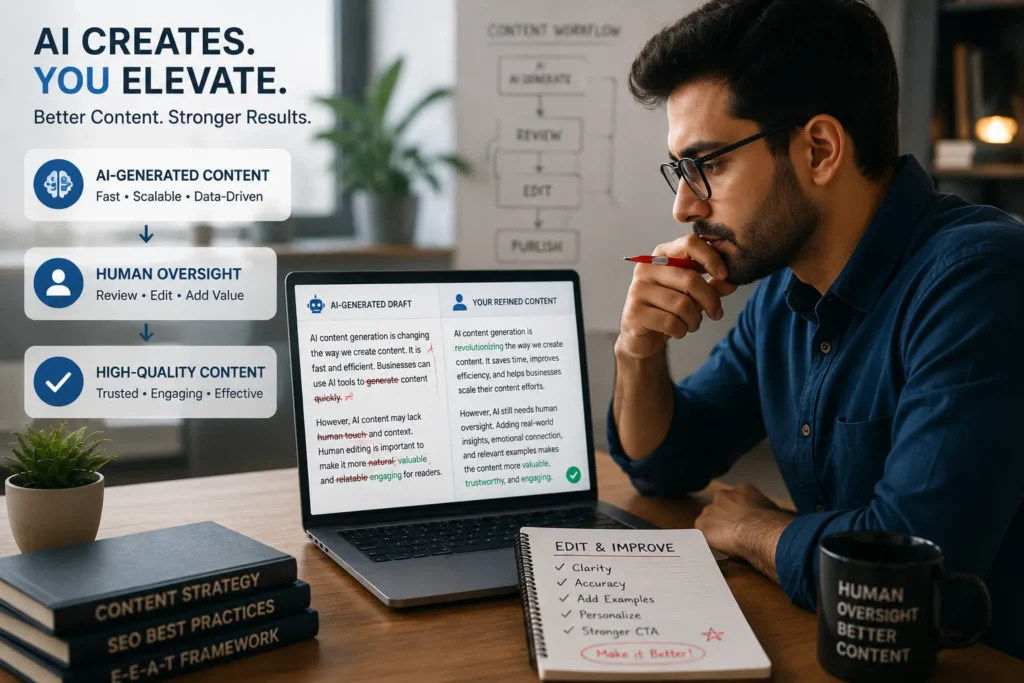
Marketer reviewing AI-generated SEO content for accuracy and qualityHow to Get Started With AI SEO Automation This Year
If you’re ready to bring an AI SEO agent into your workflow, a phased approach tends to work better than diving in headfirst.
- Start with one workflow. Pick a single repetitive task, such as content briefs or technical audits, rather than automating everything at once.
- Set clear approval checkpoints. Decide upfront what the agent can do autonomously versus what needs human sign-off.
- Measure before and after. Track time saved and output quality over a 30- to 60-day period before expanding usage.
- Train the team on prompting and review. Even autonomous agents perform better when the humans overseeing them know how to give clear direction and spot weak output.
- Scale gradually. Once one workflow proves reliable, extend automation to adjacent tasks like reporting or rank tracking.
This measured approach helps teams capture the benefits of automation without the risk of publishing unreviewed content or making technical changes that backfire.
Frequently Asked Questions About AI SEO Agents
Is an AI SEO agent the same as ChatGPT?
Not quite. A general chatbot responds to prompts one at a time and has no memory of your site’s ongoing performance. An AI SEO agent is typically connected to your actual SEO data, such as search console, analytics, and crawl reports, and can carry out multi-step tasks autonomously, rather than just answering isolated questions.
Can AI SEO agents replace an SEO team?
Generally, no. They’re best used to handle repetitive, data-heavy tasks like audits and reporting, freeing human strategists to focus on judgment calls, creative direction, and relationship-building that AI still can’t replicate well.
Will content from an AI SEO agent get penalized by Google?
Google has stated that its focus is on content quality, not whether AI was involved in producing it. Google’s own guidance on AI-generated content confirms that well-researched, helpful content is treated the same regardless of how it was created, but thin, unedited AI output that lacks originality or accuracy can still underperform or get flagged for low quality (Google Search Central).
How much does an AI SEO agent typically cost?
Pricing varies widely, from free tiers with limited features to enterprise plans costing several hundred dollars per month, depending on the number of tasks, integrations, and data sources included.
Do I still need to review AI-generated SEO content manually?
Yes. Even the most advanced agents benefit from human review, both to catch factual errors and to make sure the content genuinely reflects your brand’s expertise and voice, not just generic phrasing.
Final Thoughts: Should You Adopt an AI SEO Agent?
AI SEO agents aren’t a passing trend. They reflect a broader shift toward autonomous, data-driven marketing at a time when search itself is becoming more AI-influenced. Used thoughtfully, with clear oversight and realistic expectations, an AI SEO agent can save your team dozens of hours a month while keeping your site more technically sound and your content more consistently published.
That said, the teams that get the most value aren’t the ones handing over full control. They’re the ones using AI SEO automation to handle the repetitive heavy lifting, while keeping strategy, editing, and final judgment calls in human hands.
If you’re ready to explore what AI SEO automation could look like for your own site, start small: automate one workflow, measure the results, and build from there. The teams that master this balance now will have a meaningful head start as AI-driven search continues to reshape how people find information online.
Ready to see how an AI SEO agent could fit into your content strategy? Explore our [SEO automation tools comparison guide] to find the right fit for your team’s size and goals.




Pingback: AI Link Building: The Complete Guide to Backlinks - AI Growth Lab