


AI for GEO Optimization is how brands get cited in ChatGPT and AI Overviews. Search doesn’t look like it used to. Increasingly, people ask ChatGPT, Perplexity, or Google’s AI Overview a question. Instead of ten blue links, they get one synthesized answer. If your content isn’t part of that answer, it’s effectively invisible to a growing share of searchers. That’s the shift AI for GEO optimization addresses.
GEO stands for generative engine optimization. Unlike traditional SEO, which competes for a ranking position, GEO competes for a citation inside an AI-generated response. However, doing this well by hand is slow. You’d need to test dozens of prompts across multiple AI platforms, track which sources get cited, and adjust content accordingly. That’s exactly the kind of repetitive, data-heavy work AI tools speed up well.
This AI for GEO optimization guide covers what generative engine optimization actually means, and how AI tools make the process faster and more accurate. We’ll also look at which specific tactics move the needle in 2026. Additionally, we’ll walk through a comparison table, a practical workflow, common mistakes, and the questions people ask most often about ranking in AI search. By the end, you’ll have a clear, actionable path toward getting your content cited, not just ranked.
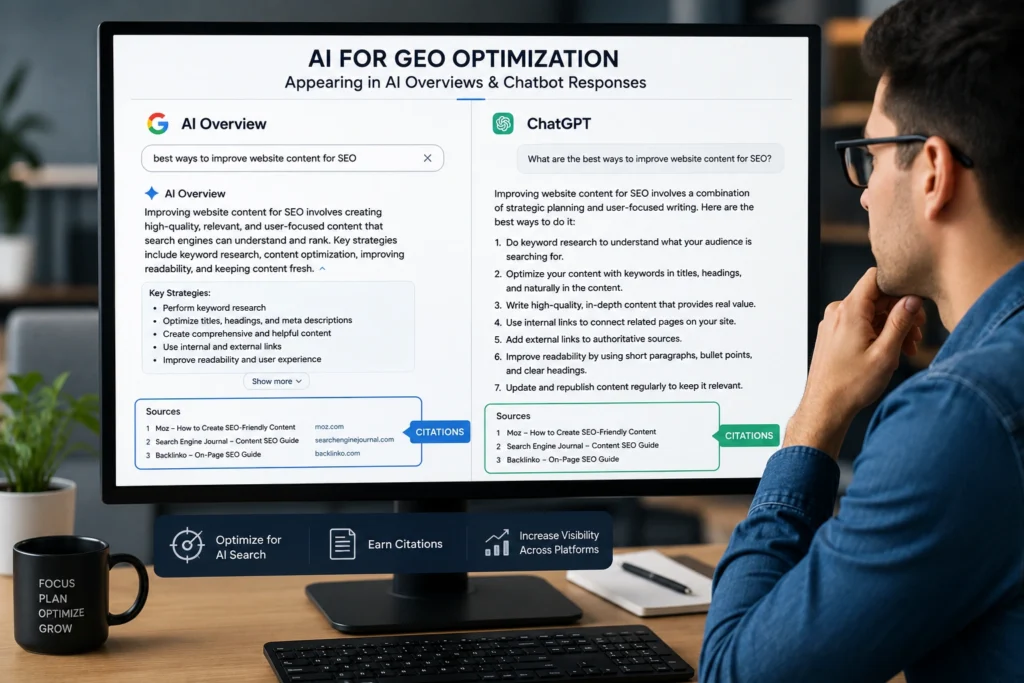
What Is AI for GEO Optimization?
AI for GEO optimization means using artificial intelligence tools to analyze, structure, and refine content. The goal is getting generative AI engines like ChatGPT, Perplexity, Gemini, and Google AI Overviews to cite that content in their answers. Instead of manually testing how a page performs across multiple AI platforms, these tools can simulate queries, track citation patterns, and flag exactly what’s missing.
Developers built traditional SEO tools to measure things like ranking position and click-through rate. GEO tools measure something different: how often, and how prominently, your brand or content shows up inside an AI-generated response. This is often called “share of model,” a citation-tracking metric that plays a similar role to rank tracking in classic SEO. According to Search Engine Land’s guide to generative engine optimization, GEO is fundamentally about earning a place among the handful of sources large language models pull from when generating a single response. That’s a different goal than competing for one of ten search result positions.
At a basic level, most AI tools built for GEO handle a few core tasks:
- Simulating AI search queries to see which sources get cited for a given topic
- Analyzing citation patterns across ChatGPT, Perplexity, and AI Overviews
- Scoring content for “extractability” — how easily an AI system can pull a clear, standalone fact or definition from a page
- Flagging structural gaps like missing statistics, unclear entity definitions, or thin sourcing
Consequently, the goal isn’t just to write well. It’s to write in a way that gives an AI system something concrete and quotable to work with. That’s the core premise behind every tactic covered in this AI for GEO optimization guide.
GEO vs. Traditional SEO: Why AI Tools Matter Here
It helps to understand how GEO differs from classic SEO before diving into the tools themselves. Traditional SEO optimizes for a ranking position in a results page. A user sees your link, and they may or may not click it. GEO, on the other hand, optimizes for inclusion inside a generated answer. The user might never visit your site at all. Yet they may still walk away associating your brand with the answer they received.
This distinction changes what “good content” looks like. SEO rewards comprehensive coverage of a topic. It also rewards strong keyword targeting throughout a page. GEO rewards something more granular instead: individual facts, statistics, and definitions that can stand alone and be extracted cleanly by an AI system. A vague claim like “we’re an industry leader” gives a generative engine nothing to cite. A specific claim, backed by a number or a named source, gives it exactly what it needs.
This is precisely why AI tools matter so much for GEO work. Testing extractability and citation likelihood by hand would mean manually querying multiple AI platforms with dozens of prompt variations. Then you’d have to track which sources appear each time. AI-powered GEO tools automate that entire loop instead, which makes iterating on content dramatically faster than doing it manually ever could be.
This doesn’t mean SEO work becomes irrelevant. In fact, the opposite is closer to true. Search engines and generative AI systems often draw on overlapping signals, including backlinks, site authority, and technical health. A site with weak SEO fundamentals rarely performs well in GEO either. Generative engines still lean on many of the same underlying quality signals when deciding what to trust and cite.
How AI Improves the GEO Optimization Process
AI doesn’t just make GEO faster. It makes an entirely new category of testing and measurement possible.
Simulating AI Search Behavior at Scale
A person can manually type a handful of prompts into ChatGPT or Perplexity and see what gets cited. AI-powered GEO tools, however, can run hundreds of prompt variations automatically. They then aggregate the results into a clear citation pattern. This reveals which competitors are consistently cited for a given topic, and which specific phrasing or structure seems to correlate with getting picked up.
Tracking Share of Model Over Time
Just as rank tracking shows movement in traditional search results, share-of-model tracking shows whether your citation frequency is improving or declining across AI platforms. Consequently, AI tools that automate this tracking give teams an actual metric to manage toward, instead of guessing based on occasional manual checks.
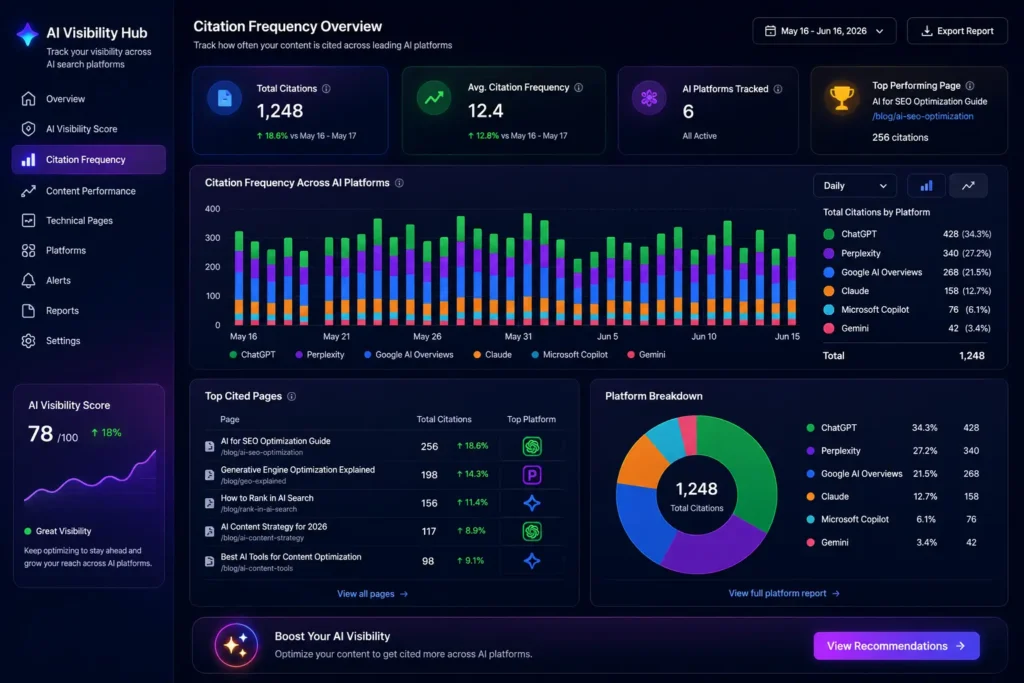
Identifying Extractability Gaps
AI tools can scan a page and flag exactly where a claim is too vague to be citation-worthy. For example, a tool might highlight a sentence that makes a broad claim without a specific number, date, or named source. This is a level of granular, sentence-by-sentence analysis that would take a human reviewer far longer to complete manually.
Comparing Against Cited Competitors
Sometimes a competitor consistently gets cited for a topic, and you don’t. When this happens, AI tools can analyze what structural or factual elements their content includes that yours may be missing. Often, this comes down to things like clearer entity definitions, more specific statistics, or better-structured FAQ sections that an AI system can lift directly.
Monitoring Structured Data and Technical Signals
Generative engines rely partly on structured data and clean technical signals to understand what a page is actually about. AI tools can audit schema markup, heading structure, and entity clarity across a site. In doing so, they flag technical gaps that might be limiting how easily an AI system can parse and cite the content.
Altogether, this is how AI improves GEO optimization in practice. It turns a discipline that would otherwise require constant manual testing into something genuinely measurable and repeatable.
Best AI Tools for GEO Optimization in 2026
There’s no single tool that covers every aspect of GEO. Instead, most teams combine a few categories to cover the full picture.
Dedicated AI Visibility and Citation Tracking Platforms
These tools are purpose-built for GEO. They simulate AI search queries across multiple platforms, track citation frequency, and report on share of model over time. They’re the closest equivalent GEO has to a traditional rank tracker. As a result, they tend to be the most direct way to measure whether your GEO efforts are working.
What to look for: how many AI platforms the tool actually tracks, since coverage varies significantly between providers.
AI Content Extractability Analyzers
These tools focus specifically on whether individual sentences and claims within your content are structured clearly enough for an AI system to extract and cite. They flag vague language, missing statistics, and unclear entity references at a granular level.
What to look for: whether the tool gives specific, sentence-level suggestions, or only a generic overall score.
AI-Enhanced Structured Data and Schema Tools
Structured data helps AI systems understand and parse content more reliably. Because of this, tools that audit and generate schema markup have become part of the standard GEO toolkit. Many now include AI-assisted suggestions for FAQ schema, organization markup, and entity relationships.
What to look for: integration with your existing CMS, so structured data updates can be deployed without a lengthy development cycle.
General AI Assistants for Content Testing
General-purpose AI chat tools themselves can double as a manual testing ground. Running your own prompts through ChatGPT or Perplexity, and checking whether your brand or content appears, gives a useful sanity check alongside more automated platforms. Naturally, this manual spot-checking works best paired with a dedicated tracking tool rather than as your only method.
What to look for: consistency across repeated tests, since AI responses can vary between sessions even for the same prompt.
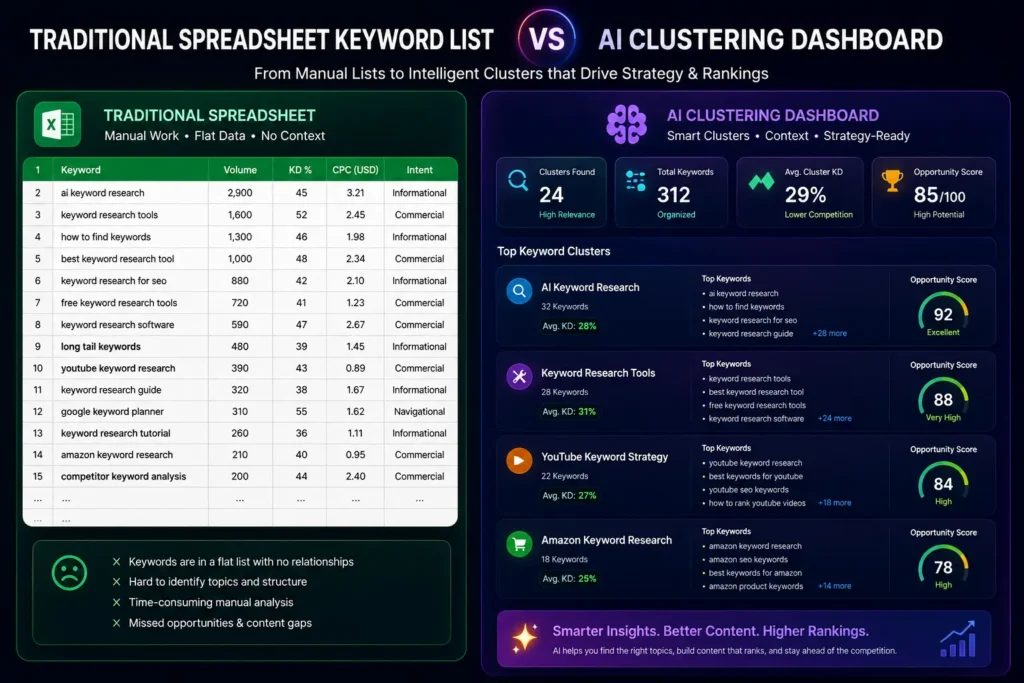
Comparison Table: AI Tools for GEO Optimization by Category
| Tool Category | Best For | Key AI Feature | Ideal User | Learning Curve |
|---|---|---|---|---|
| AI Visibility & Citation Tracking Platforms | Measuring share of model over time | Automated query simulation across AI engines | Marketing teams and agencies | Moderate |
| AI Content Extractability Analyzers | Sentence-level content refinement | Flags vague or non-citable claims | Writers and content strategists | Low to moderate |
| AI-Enhanced Schema and Structured Data Tools | Technical GEO readiness | AI-assisted schema and entity markup | Technical SEO specialists | Moderate |
| General AI Assistants for Manual Testing | Quick sanity checks and spot testing | Direct prompt testing across chat interfaces | Any team member, as a supplement | Low |
Note: This is a fast-moving category, and tool capabilities change frequently. Test any platform against your own content before committing to a long-term contract.
How to Build an AI-Powered GEO Optimization Workflow
Owning the right tools matters less than using them inside a consistent, repeatable process. Here’s a practical workflow to follow.
Step 1: Identify Your Priority Topics and Queries
Start by listing the questions and topics where you most want to be cited. These should reflect real buyer or user questions, not just keywords you’d traditionally target in SEO. Prioritize topics where an AI-generated answer is likely to appear at all, since not every query triggers a synthesized response yet.
Step 2: Simulate Queries and Establish a Baseline
Run your priority queries through an AI visibility tool to see who’s currently being cited. This baseline shows you exactly where you stand before making any changes. It also highlights which competitors are already winning citation share.
Step 3: Audit Your Content for Extractability
Run your existing pages through an extractability analyzer. Look specifically for vague claims, missing statistics, and unclear definitions that an AI system would struggle to lift cleanly. This step often reveals more actionable gaps than a traditional SEO audit would.
Step 4: Strengthen Claims with Specific, Sourced Facts
Replace vague statements with specific numbers, dates, and named sources wherever possible. For instance, instead of writing “many businesses have seen results,” specify an actual figure or a named study. This single change tends to have an outsized impact on citation likelihood.
Step 5: Improve Structured Data and Entity Clarity
Use your schema and structured data tools to ensure your content’s entities, organization details, and FAQ sections are clearly marked up. This gives AI systems a cleaner technical signal to work from, in addition to well-written prose.
Step 6: Re-Test and Track Share of Model Over Time
After making changes, re-run your priority queries and compare results against your baseline. Consequently, tracking this consistently over weeks and months shows whether your GEO efforts are actually moving citation share in the right direction.
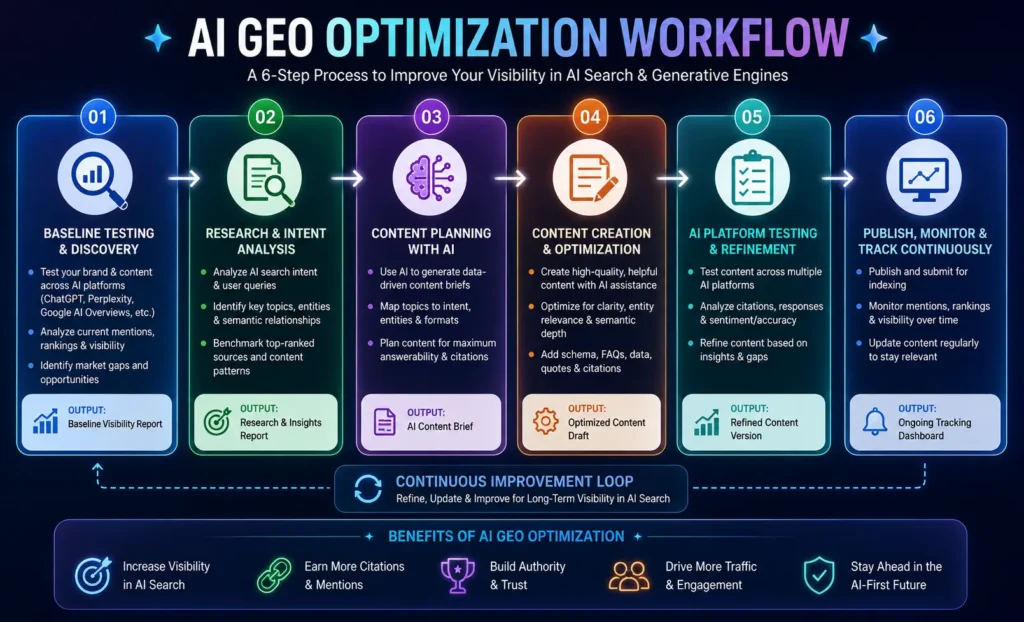
A Practical Example: AI for GEO Optimization in Action
Consider a B2B software company that noticed competitors were consistently cited in ChatGPT responses about their industry. Meanwhile, their own brand rarely appeared at all. Using an AI visibility tool, the team discovered their blog content made broad claims without much specific data attached.
After auditing their top pages with an extractability analyzer, they found the issue clearly. Sentences like “our platform improves efficiency significantly” offered nothing concrete for an AI system to cite. The team rewrote key sections with specific figures from their own product data. They also added clearer FAQ sections marked up with schema.
Within two months of re-testing, the company’s citation frequency across simulated queries increased noticeably. Their brand began appearing in AI-generated comparisons where it hadn’t before. The underlying lesson mirrors what worked in traditional SEO: specificity and clear structure consistently outperform vague, generic claims.
Common Mistakes to Avoid With AI GEO Optimization Tools
A handful of habits can undercut even a well-intentioned GEO strategy.
Treating GEO as a replacement for SEO. GEO builds on strong SEO foundations rather than replacing them. Sites with weak technical SEO or thin content rarely see strong GEO results either, since the same underlying quality signals matter to both.
Optimizing for citations at the expense of accuracy. Never inflate a statistic or fabricate a source just to appear more citable. Beyond the ethical problem, doing so risks real damage to credibility if the underlying claim doesn’t hold up under scrutiny.
Ignoring how differently each AI platform behaves. ChatGPT, Perplexity, and Google’s AI Overviews don’t all cite sources the same way. A tool that only tracks one platform can give an incomplete, sometimes misleading, picture of your actual visibility.
Chasing every AI platform equally. Not every platform matters equally for every business. It’s usually smarter to prioritize the one or two platforms most relevant to where your actual audience searches. Spreading effort thin across all of them rarely pays off.
Forgetting the human review step. AI tools can flag what’s missing. A knowledgeable human still needs to verify that added statistics and sources are accurate before publishing anything.
Local and Niche Considerations for AI GEO Optimization
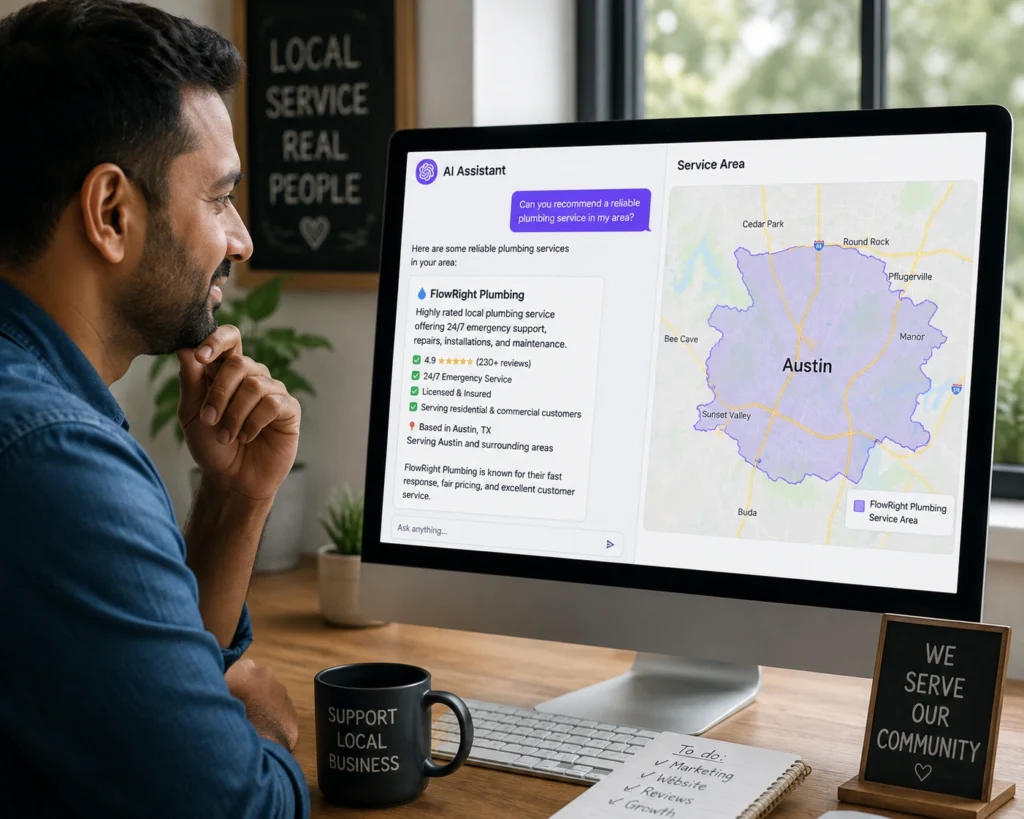
AI for GEO optimization isn’t limited to large national or global brands. Local businesses and niche industries can benefit as well, particularly as more people start asking AI assistants location-specific or highly technical questions directly.
For local businesses, this might mean ensuring service details, pricing ranges, and service-area information are stated clearly. That level of specificity is what an AI system needs to cite you when someone asks a location-based question. For niche B2B or technical industries, GEO often rewards content that includes precise, specialized data points that broader competitors haven’t bothered to publish. Specificity in a narrow niche can be easier to achieve than in a highly competitive market, after all.
The underlying principles stay consistent regardless of scale. What changes is the volume of AI-driven queries relevant to a given niche, and how much competitive citation share is realistically up for grabs.
Featured Snippets, AI Overviews, and GEO Optimization
Featured snippets and AI Overviews share a lot of DNA with generative engine optimization, since both reward content that answers a specific question clearly and concisely. However, GEO extends further than either. A citation in a conversational AI response doesn’t require the same structured snippet format that traditional search results do.
AI tools built for GEO can flag which of your existing questions and answers are already well-structured for snippet capture. They can also flag which additionally have the specific, sourced detail needed for a broader AI citation. Often, the same content improvements serve both goals: a direct answer near the top of a section, followed by supporting specifics and sourcing.
This overlap means teams already investing in snippet optimization have a head start on GEO. The work isn’t wasted. It simply needs an added layer of specificity and sourcing to fully translate into AI citation success.
Measuring E-E-A-T Signals Within a GEO Strategy
Generative engines don’t just look for extractable facts. They also weigh signals of trustworthiness before deciding what to cite, much the way traditional search ranking systems do. Google’s own guidance on creating helpful, people-first content emphasizes experience, expertise, authoritativeness, and trust as core evaluation criteria. Generative engines built on similar underlying signals tend to weigh these factors too.
Practically, this means author bylines, clear sourcing, and demonstrated firsthand experience still matter within a GEO strategy. A page with strong extractability but no credible backing behind its claims is a weaker citation candidate than one that pairs specificity with clear expertise signals.
AI tools can help here too, by flagging pages that lack author information, external sourcing, or clear organizational credentials. Addressing these gaps strengthens both traditional SEO performance and GEO citation potential at the same time. The underlying trust signals largely overlap between the two disciplines.
How to Measure ROI from AI GEO Optimization Efforts
Proving the value of GEO work can feel tricky at first, since a citation inside an AI answer doesn’t always generate a click the way a search result does. Even so, there are practical ways to tie GEO activity back to business outcomes.
Start by tracking share of model for your priority topics over time, using the same baseline approach covered earlier in this guide. A rising trend line is a direct sign that your GEO efforts are working, even before any downstream traffic or lead impact shows up.
Beyond citation frequency, watch for branded search volume increases. When people see your brand mentioned inside an AI answer, some will search for your company directly afterward, even without clicking through from the AI platform itself. This shows up as a lift in branded search traffic that wouldn’t otherwise have occurred.
Finally, where AI platforms do link out to sources, monitor referral traffic from those platforms in your analytics. This is still a relatively small traffic source for most sites in 2026, but it’s growing quickly. Having it broken out separately makes it easier to demonstrate GEO’s contribution as the channel matures.
Frequently Asked Questions About AI for GEO Optimization
What does GEO mean in AI search optimization?
GEO stands for generative engine optimization. It refers to structuring and optimizing content so that AI-powered platforms like ChatGPT, Perplexity, and Google AI Overviews cite it directly in their generated answers. That’s a different goal than simply ranking it in a traditional results page.
How is AI for GEO optimization different from traditional SEO tools?
Traditional SEO tools measure ranking position and click-through rate within search results pages. AI GEO tools instead measure citation frequency and share of model across generative AI platforms. The underlying content quality principles overlap significantly, but the specific metrics and tactics differ.
Which AI platforms should I prioritize for GEO?
This depends on where your audience actually searches. ChatGPT and Google AI Overviews currently see the broadest usage across most industries, while Perplexity tends to attract a research-oriented audience. Testing your own priority queries across a few platforms will show you where citation opportunities are strongest for your specific business.
Can small businesses realistically compete in GEO optimization?
Yes. Since GEO often rewards specific, well-sourced content over sheer domain authority, smaller and niche businesses can compete effectively. This is particularly true in narrower topics where larger competitors haven’t published detailed, citable data.
How long does it take to see results from GEO optimization efforts?
Most teams see measurable shifts in citation frequency within two to three months of consistent effort, though this varies by platform and topic competitiveness. Ongoing tracking matters more than a single optimization pass, since AI platforms update their citation patterns regularly.
Final Thoughts: Making AI for GEO Optimization Part of Your Strategy
AI for GEO optimization isn’t a passing trend. It reflects a genuine shift in how people find information. The businesses building strong GEO practices now are positioning themselves for the search landscape that’s already taking shape. The teams seeing real results are pairing strong SEO fundamentals with the specific, sourced, citation-friendly content that generative engines actually reward.
Start with one priority topic, establish a baseline using an AI visibility tool, and make one round of targeted improvements. Then track whether citation frequency actually shifts before expanding the approach across your broader content library. This AI for GEO optimization guide gives you the framework. The consistent follow-through is what actually moves the needle.
Ready to see where your brand currently stands in AI-generated search results? Get in touch with our team for a free GEO visibility audit, and we’ll show you exactly where the citation opportunities are hiding.




Pingback: AI SEO Trends 2026: What Every Marketer Needs to Know - AI Growth Lab %