

AI SEO for local business has quietly become the deciding factor in who wins a customer’s call. When someone searches “plumber near me” or “best bakery in town,” what shows up first usually wins the job. Google’s local algorithm now weighs real-world engagement, review activity, and AI-generated summaries as heavily as traditional ranking signals. A newer business with strong engagement can outrank an established one that hasn’t kept its profile active.
This shift matters because most small business owners still manage their online presence manually. That work often happens in a few minutes here and there, squeezed between running the actual business. That approach worked reasonably well a few years ago. It doesn’t hold up as well now. In this guide, you’ll learn what AI SEO for local business actually involves and why it matters more in 2026. You’ll also see how to use AI for local SEO step by step. Beyond that, you’ll find which tools are genuinely worth adopting and common mistakes that quietly hurt local visibility.
What Is AI SEO for Local Business?
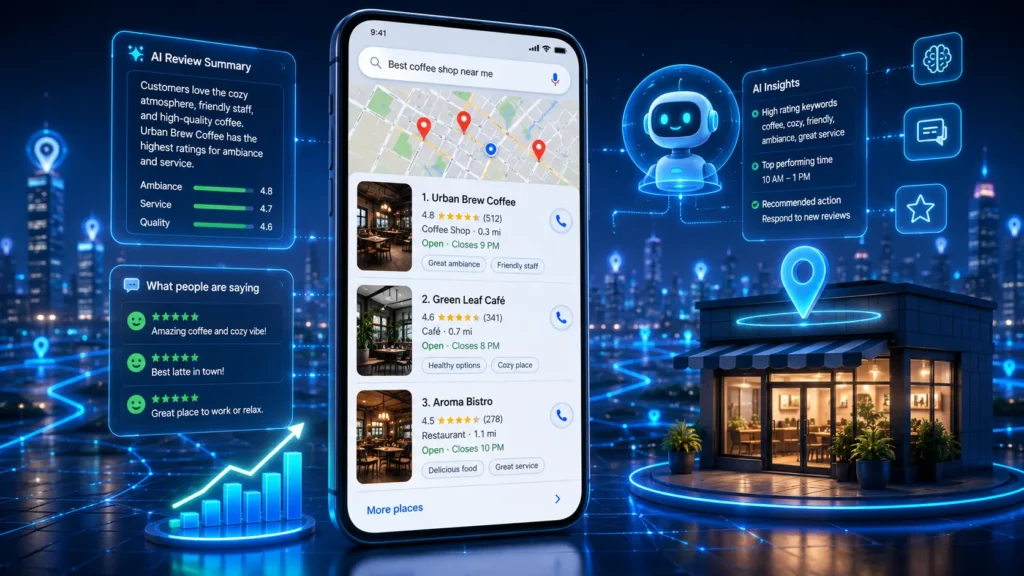
AI SEO for local business refers to using artificial intelligence to improve how a business appears in local search results, Google Maps, and AI-generated answers. This includes optimizing a Google Business Profile, managing reviews, and tracking local rankings. Increasingly, it also means ensuring AI systems can accurately describe a business when someone asks a location-based question.
Instead of manually updating a profile every few weeks, AI tools can monitor performance continuously. They flag missing information, draft review responses, and suggest posts based on what’s actually working for similar businesses nearby.
How This Differs From Traditional Local SEO
Traditional local SEO focused heavily on citation consistency, basic profile completion, and a handful of manual tasks repeated periodically. This still matters. However, it no longer covers the full picture.
AI SEO for local business adds a newer layer on top of these fundamentals. It accounts for how AI Overviews and voice assistants pull directly from Business Profile data to answer local questions. This matters just as much now as how a listing ranks in a traditional results page.
A Simple Example in Practice
Consider a small bakery in a mid-sized city. The owner used to update their Google Business Profile a few times a year, mostly when hours changed. Competitors nearby started using AI tools differently. They posted updates twice weekly, responded to every review within hours, and kept their profile data fully complete.
Within a few months, those competitors began appearing more consistently in the local map pack. This happened even though the bakery’s food and reviews were just as good. The gap wasn’t quality. It was consistency and engagement, exactly what AI tools are built to help maintain without demanding hours of manual attention every week.
Why This Matters Even for Well-Established Businesses
It’s tempting to assume a business with years of positive reviews and strong brand recognition is automatically safe from this shift. That assumption is increasingly risky. Google’s local algorithm now weighs recent engagement more heavily than historical reputation alone. A business that stops posting or responding to reviews can see its visibility decline within months, regardless of how strong its reputation was previously.
Why AI SEO for Local Business Matters in 2026
A few converging trends explain why this topic deserves serious attention this year.
Google’s Local Algorithm Has Shifted
Google’s local ranking system still relies on relevance, distance, and prominence. However, the definition of prominence has changed. Real-world engagement signals, like review frequency and profile interaction, now carry more weight than they used to relative to pure domain authority.
AI Overviews Now Pull From Business Profiles Directly
When someone asks a local question, Google’s AI-generated summaries often synthesize information straight from Business Profiles, reviews, and website content. This means a profile’s data quality directly shapes what an AI system tells a potential customer. It’s no longer just about where a listing ranks.
Consumer Discovery Habits Are Shifting Too
A growing share of consumers now discover local businesses through AI-generated recommendations rather than scrolling through a traditional list of results. Businesses optimized for this shift capture that traffic. Those relying on outdated, infrequent updates tend to lose visibility to competitors who adapted sooner.
Manual Management Doesn’t Scale for Small Teams
Most local businesses don’t have a dedicated marketing person handling this work full time. As a result, tasks like review responses and profile updates often get delayed or skipped entirely. This quietly hurts visibility over time, even when the underlying business is performing well.
The Gap Between Adopters and Non-Adopters Is Widening
Businesses that started using AI tools for local SEO earlier now have a measurable head start in profile completeness, review response speed, and consistent posting history. Every month a competitor delays adoption widens that gap slightly further, making catch-up harder later.
This Applies Well Beyond Major Metro Areas
It’s easy to assume these shifts mostly affect businesses in large, competitive cities. In reality, local search competition has intensified in smaller towns and secondary markets too, as more businesses everywhere start adopting these same tools. A shop in a smaller city competing for a handful of nearby customers benefits just as much from consistent profile activity as one competing in a major metro area, sometimes more, since the local pack there has fewer listings to begin with.

Benefits of Using AI for Local SEO
Understanding the concrete benefits helps justify bringing these tools into a small business’s routine.
Consistent Profile Activity Without Constant Effort
AI tools can schedule and draft posts automatically, keeping a profile active without requiring an owner to remember to log in every week. Consistency itself has become a meaningful ranking signal.
Faster, More Personalized Review Responses
Rather than delaying responses during busy periods, AI can draft replies quickly, tailored to each review’s tone and content. Fast responses tend to improve both trust and customer satisfaction.
Better Visibility Into Local Ranking Performance
AI-powered rank trackers show exactly which neighborhoods or search areas a business performs well in, and where it’s falling behind. This level of detail was difficult to get manually before these tools existed.
Stronger Citation Consistency
AI tools can scan dozens of directories at once, flagging inconsistent business information across the web. Inconsistent name, address, or phone details across platforms have always hurt local rankings. Catching these errors manually is genuinely tedious, especially for businesses that have moved or rebranded.
Improved Chances of Being Cited in AI-Generated Answers
Since AI Overviews increasingly pull from Business Profile data, keeping that information complete and current improves the odds of being accurately represented. This matters when a customer asks an AI assistant a local question directly.
More Time Back for Actually Running the Business
Perhaps the most underrated benefit is simply reclaimed time. Owners who once spent evenings catching up on reviews and profile updates can redirect that time toward the business itself, while automation handles the routine, repetitive parts of local visibility.
(For a broader look at how this fits into a larger SEO strategy, see our related guide.) It covers AI SEO Workflow Automation and how these pieces connect.
Best AI Tools for Local SEO
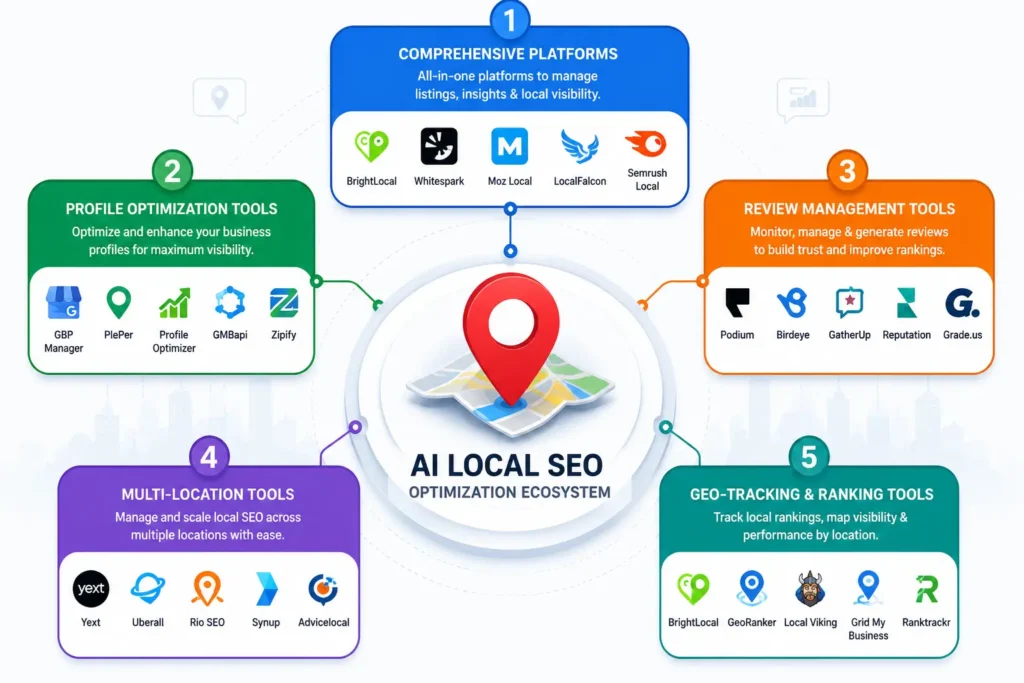
Rather than naming a single winner, it helps to understand the categories of tools available and what each one solves.
Comprehensive Local SEO Platforms
This category combines rank tracking, citation building, and review management into one connected system. BrightLocal is a well-known example, offering a geo-grid rank tracker that shows exactly which neighborhoods a business ranks well in.
Profile Optimization and Auditing Tools
These tools scan a Business Profile and highlight what’s missing or weak, often including a manual editor for direct updates. This category tends to suit business owners who want clear, prioritized guidance rather than a full suite of features.
Review Management and Response Tools
Some platforms focus specifically on review generation and response drafting. They help businesses request reviews at the right moment and reply consistently. Fast, thoughtful responses across every review are hard to maintain manually, especially for busier locations.
Multi-Location Management Tools
For businesses with several locations, tools built for bulk profile management make coordinated updates possible without repeating the same task location by location. Semrush’s listing management features fall into this category, distributing business data to numerous directories from one submission.
Geo-Specific Rank Tracking Tools
Local Falcon and similar tools specialize in geo-grid tracking, showing precisely where a business ranks across a map rather than a single average position. This detail helps identify specific underperforming areas worth targeting.
How to Choose the Right Combination
A single-location business rarely needs the same depth as a multi-location franchise. Start with a profile audit tool to identify immediate gaps. From there, add rank tracking and review management as the business’s needs grow.
How to Use AI for Local SEO Step by Step
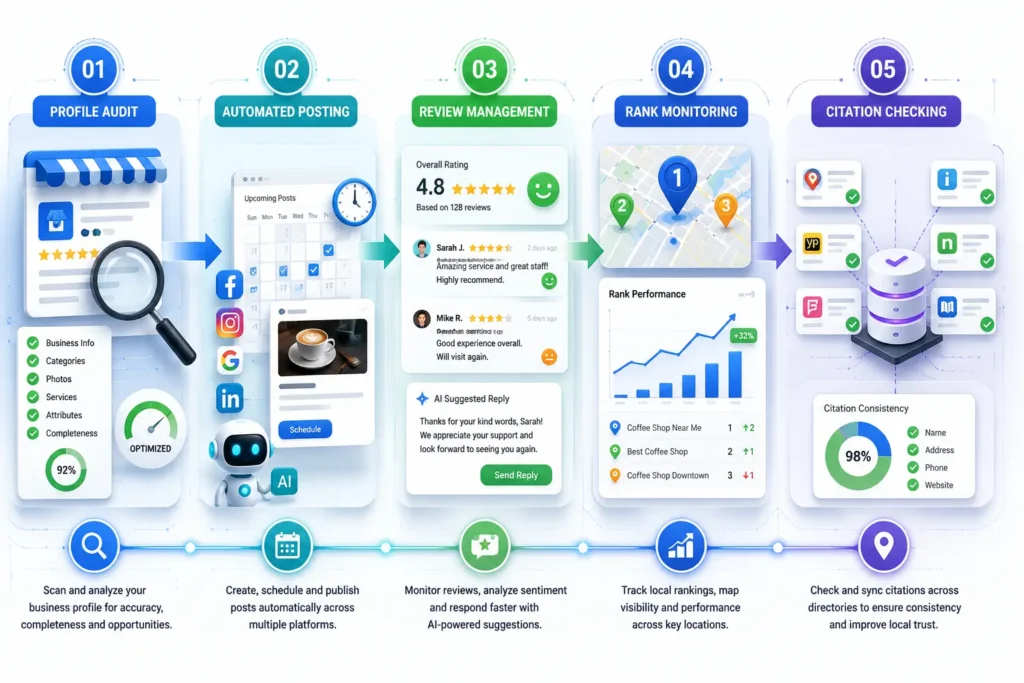
Knowing how to use AI for local SEO starts with a clear process rather than adopting every tool at once.
Step 1: Audit Your Current Business Profile
Before adding any tool, run a full audit of your existing Google Business Profile. Identify missing categories, outdated hours, or incomplete service descriptions that AI tools can help you fix immediately.
Step 2: Automate Profile Posting
Set up scheduled posts using AI-generated content based on your services and target keywords. Aim for one to two posts per week to maintain consistent activity signals without demanding daily attention.
Step 3: Set Up AI-Assisted Review Management
Configure a system to request reviews automatically after each completed service or sale. Use AI to draft personalized responses. Start in approval mode for review before publishing, then move to a more automated setup once you trust the tool’s tone.
Step 4: Monitor Local Rankings by Area
Use a geo-grid rank tracker to see how visibility varies across different neighborhoods, not just a single citywide average. This reveals specific areas worth targeting with localized content or additional citations.
Step 5: Check Citation Consistency Regularly
Run periodic scans of major directories to catch inconsistencies in business information before they accumulate. Small discrepancies add up over time and quietly erode trust signals that local rankings depend on.
(For official guidance on setting up and verifying a profile correctly, see Google’s Business Profile Help Center.)
A Real-World Example of AI SEO for Local Business in Action
To make this concrete, consider how a small home services company might approach adopting these tools for the first time.
AI SEO for local business: The Starting Problem
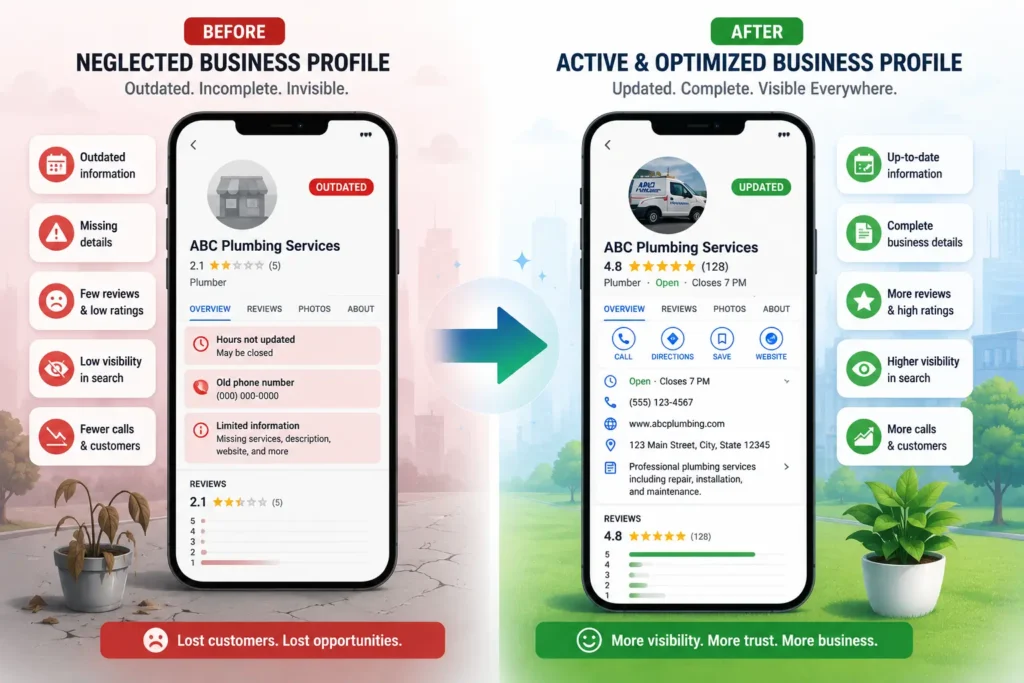
Imagine a family-owned electrical services business with a decent reputation but a neglected online profile. Reviews sit unanswered for weeks. The last profile post went up over a year ago. Despite solid word-of-mouth referrals, online visibility has been slowly declining.
AI SEO for local business: Starting With a Profile Audit
The owner runs an AI-powered audit and discovers several gaps immediately. The service list is incomplete, several photos are outdated, and the business description hasn’t been updated since the profile was first created years earlier.
AI SEO for local business: Automating the Routine Work
After fixing the immediate gaps, the owner sets up automated posting twice a week and configures review request messages sent automatically after each completed job. AI drafts response templates for reviews, which the owner quickly approves before they go live.
AI SEO for local business: The Outcome
Within two months, review response time drops from weeks to hours. Profile activity becomes consistent for the first time in years. The business starts appearing in the local map pack for searches it hadn’t ranked for previously, particularly in neighborhoods slightly outside its original core service area.
AI SEO for Local Business vs. Traditional Local SEO: A Comparison
Before deciding how much to automate, it helps to see the practical differences side by side.
| Factor | Traditional Local SEO | AI SEO for Local Business |
|---|---|---|
| Profile updates | Manual, often infrequent | Scheduled and automated |
| Review responses | Delayed during busy periods | Drafted quickly, often within hours |
| Ranking visibility | Single average position | Geo-grid tracking by neighborhood |
| Citation management | Manually checked across directories | Automatically scanned and flagged |
| AI Overview readiness | Rarely considered | Actively optimized for |
| Time required weekly | Several hours, if done consistently | Minutes of review and approval |
| Consistency across locations | Difficult to maintain manually | Standardized through bulk tools |
As the table shows, the goal isn’t replacing the personal touch that makes a local business feel local. It’s removing the manual burden that often causes that personal touch to slip during busy weeks.
Common AI SEO for Local Business Mistakes
A few recurring mistakes tend to undermine otherwise solid local SEO efforts.
Publishing AI-Generated Content Without Review
Automated posts and review responses can occasionally sound generic or miss local context entirely. A quick review before publishing helps keep content genuinely reflective of the business’s actual voice.
Neglecting the Profile Once Automation Is Set Up
Automation reduces manual work, but it doesn’t eliminate the need for oversight. Periodically check that automated posts and responses still sound right. Confirm that nothing important has changed, like new services or updated hours.
Ignoring Geo-Specific Performance Data
Looking only at an overall ranking average hides meaningful differences between neighborhoods. A business might rank well citywide while performing poorly in a specific, valuable area worth targeting directly.
Letting Citation Inconsistencies Accumulate
Small businesses often accumulate inconsistent listings over years, especially after moving locations or changing phone numbers. Left unchecked, these inconsistencies quietly erode the trust signals local rankings depend on.
Treating All AI Tools as Interchangeable
Different tools specialize in different tasks. Assuming one platform covers everything can leave gaps, particularly around geo-specific tracking or multi-location management that more general tools handle less effectively.

AI SEO for Local Business Best Practices
Following these practices helps small businesses get genuine value from AI tools without losing what makes them feel local.
Keep a Human Review Step for Anything Public-Facing
AI-drafted posts and review responses should get a quick human glance before publishing. This matters especially early on, while building trust in the tool’s tone and accuracy.
Prioritize Profile Completeness First
Before investing in advanced tracking or automation, make sure the basics are covered. Accurate categories, complete hours, current photos, and a genuinely helpful business description all come before anything more advanced.
Respond to Every Review, Not Just Negative Ones
Positive reviews deserve a thoughtful response too, not just damage control on negative ones. Consistent engagement across all reviews signals genuine activity to both customers and ranking systems.
Track Performance by Location, Not Just Overall
If you manage more than one location, review geo-specific data for each rather than relying on a single blended average. That average can hide underperforming areas that deserve direct attention.
Revisit Your Local SEO Setup Periodically
Local search continues evolving, and a strategy that worked well a year ago may need adjusting. AI Overviews and consumer discovery habits keep shifting, which means today’s setup deserves a fresh look every few months.
Don’t Neglect Your Website Alongside Your Profile
It’s easy to focus entirely on the Business Profile since that’s often where the most visible results show up. However, a genuinely helpful, well-structured website still supports local rankings and gives AI systems additional context beyond what a profile alone provides. Treat the two as complementary pieces of the same strategy rather than choosing one over the other.
Frequently Asked Questions About AI SEO for Local Business
What is AI SEO for local business?
AI SEO for local business is the use of artificial intelligence to improve how a business appears in local search results, Google Maps, and AI-generated answers. This includes automating profile management, reviewing responses, and tracking local rankings.
How do I use AI for local SEO as a small business owner?
Start by auditing your Google Business Profile for gaps, then automate posting and review responses. From there, add geo-grid rank tracking and citation monitoring as your comfort with these tools grows over time.
Does AI SEO replace the need to manage my Google Business Profile personally?
No. AI handles repetitive tasks like posting and drafting responses, but genuine oversight still matters, especially for anything public-facing. A quick review before publishing keeps content authentic to your business.
How much does AI local SEO software typically cost?
Pricing varies widely, from affordable single-location plans to more expensive platforms built for multi-location franchises. Many tools offer tiered pricing based on the number of locations and features included.
Can AI SEO tools help a brand-new business compete with established ones?
Yes, often significantly. Since Google’s local algorithm now weighs engagement heavily, a newer business with strong, consistent profile activity can outrank an established competitor. This holds even when that competitor has a stronger website but a neglected profile.
Is AI SEO for local business worth it for a single-location shop?
Generally, yes, especially given how much time these tools save relative to their cost. Even a single-location business benefits from consistent posting, faster review responses, and clearer visibility into which nearby searches it’s actually winning or losing.
Final Thoughts: Making AI SEO for Local Business Work for You
AI SEO for local business isn’t about replacing the personal relationships that make a local business succeed. Instead, it’s about removing the repetitive manual work- posting, responding, tracking- that too often gets skipped during busy weeks. That neglect quietly costs visibility over time, even for businesses doing genuinely good work.
Start with a profile audit, automate one task at a time, and keep a human review step for anything customer-facing. Over time, this combination of AI efficiency and genuine local expertise becomes a real competitive advantage, especially against competitors still managing everything by hand.
Whether you run a single storefront or manage several locations, the underlying principle stays the same. Consistency, accuracy, and genuine engagement drive local visibility now more than ever, and AI simply makes maintaining all three far more manageable for a small team.
Ready to build this into a broader SEO strategy? Check out our guide on AI SEO Workflow Automation to see how local optimization fits into a fully connected, automated approach.