

An AI SEO workflow is quickly becoming the backbone of modern search strategy. If your team still handles keyword research, content briefs, and technical audits as separate manual tasks, you’re likely spending hours on work that automation can now do in minutes. That gap only grows wider every quarter.
This guide walks through what an AI SEO workflow actually looks like in practice. You’ll learn how to automate the repetitive parts of SEO without losing quality or control. We’ll cover keyword research, content creation, technical audits, and reporting. Along the way, you’ll see where SEO workflow automation genuinely helps, and where human judgment still matters most. By the end, you’ll have a practical framework for building your own workflow, not just a list of tools to try.
What Is an AI SEO Workflow?
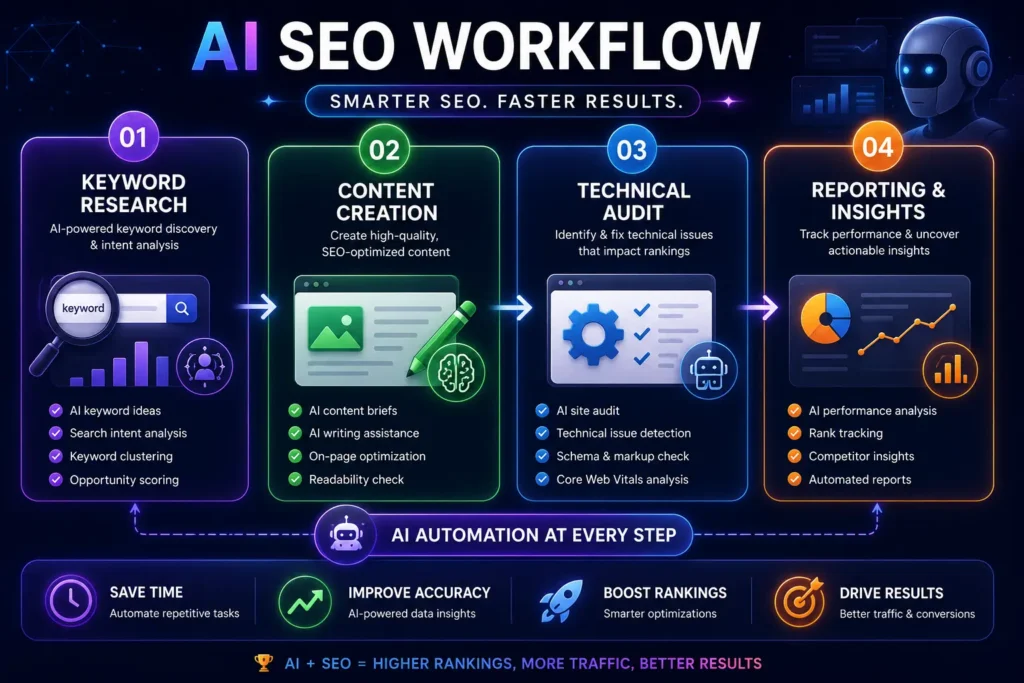
An AI SEO workflow is a connected sequence of SEO tasks, powered partly or fully by AI tools, that runs with minimal manual intervention. Instead of jumping between five different tools for five different tasks, a workflow links them together. As a result, data flows from one stage to the next automatically.
First, think of it like an assembly line. Keyword research feeds directly into content briefs. Next, Content briefs feed into drafts. After that, Drafts get optimized and checked for technical issues. Specifically, each stage still allows for human review, but the handoffs between stages happen automatically instead of manually.
Why This Matters More Than a Single AI Tool
Plenty of teams already use AI tools individually. For example, they might use one tool for keyword research and a separate chatbot for drafting content. That’s helpful, but it’s not the same as a true workflow. Because without connections between tools, someone still has to manually move data from one stage to the next. Consequently, that person becomes the bottleneck.
A proper AI SEO workflow removes that bottleneck. In other words, it treats SEO as one continuous process instead of a series of disconnected tasks.
Why Teams Are Adopting SEO Workflow Automation in 2026
A few forces are pushing teams toward automation this year, and none of them are going away anytime soon.
Content Demands Keep Rising
Search engines and AI platforms both reward sites that publish consistently and comprehensively. However, Most teams simply don’t have the headcount to keep pace manually. SEO workflow automation lets a small team produce at a scale that used to require a much larger staff.
Search Itself Has Gotten More Complex
Ranking well today involves more than keywords. Because of this, it requires technical health, topical authority, structured data, and visibility inside AI-generated answers. Juggling all of that manually, task by task, is genuinely difficult to sustain at scale.
The Cost of Manual Work Adds Up Fast
Freelance SEO specialists and in-house hires are expensive. Even a modest content and technical SEO program can run into high monthly costs when handled entirely by hand. Automation doesn’t eliminate the need for skilled people, but it stretches their time much further.
Building an AI SEO Workflow: The Core Stages
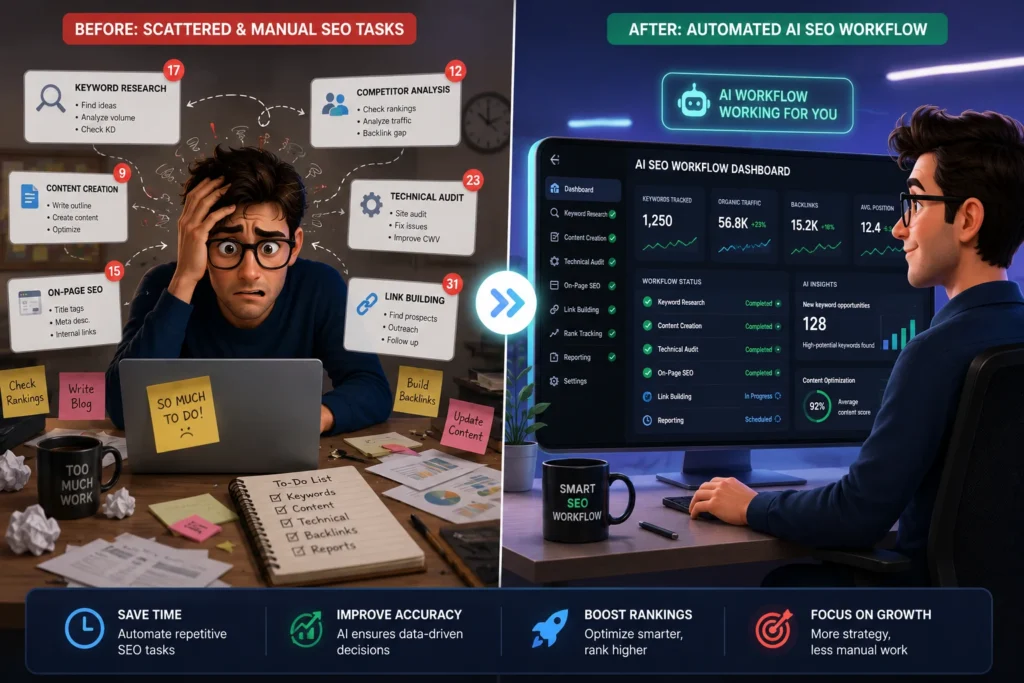
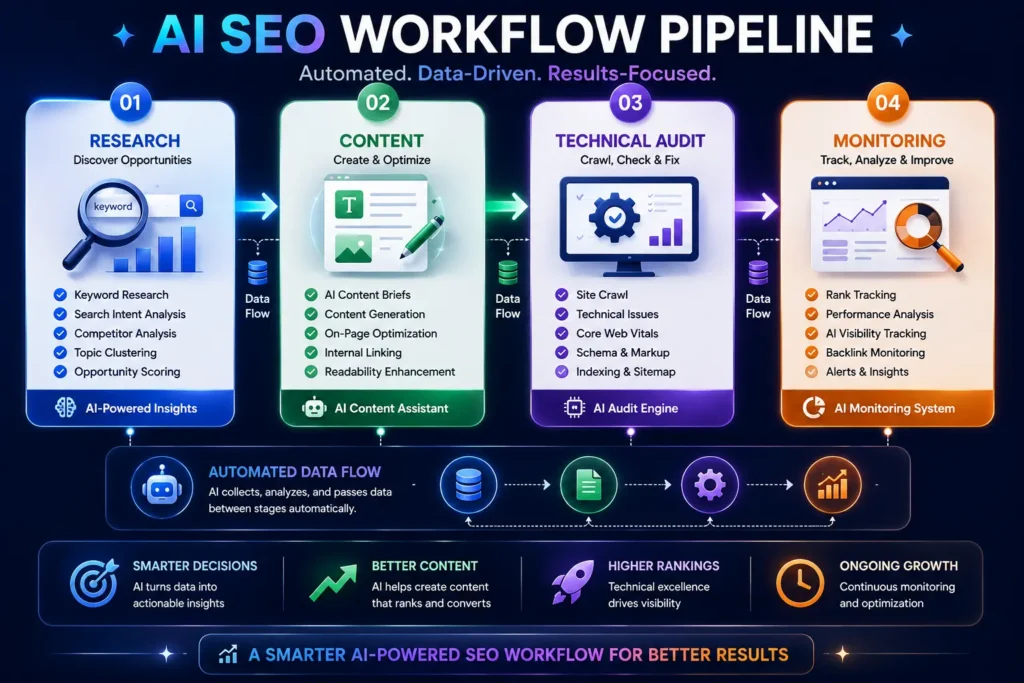
A well-designed AI SEO workflow generally moves through four connected stages. Here’s how each one works, and how AI fits into it.
Stage 1: Automated Keyword and Topic Research
The workflow starts with data collection. AI tools pull keyword volume, competition data, and related questions from live search data. Rather than manually exporting spreadsheets, the workflow can automatically cluster related keywords into topics.
This stage should also flag content gaps. Good tools compare your existing content against competitors and highlight what’s missing. That output becomes the input for the next stage.
Stage 2: AI-Assisted Content Briefs and Drafts
Once topics are identified, the workflow generates structured content briefs automatically. A solid brief includes target word count, recommended headings, semantic keywords, and internal linking suggestions.
From there, AI can produce a first draft. This isn’t the finished product. It’s a strong starting point that a human writer or editor refines with real expertise, examples, and brand voice. Skipping that human step is where a lot of AI SEO workflow automation goes wrong.
Stage 3: Technical SEO and On-Page Checks
Before anything publishes, the workflow should run automated technical checks. This includes meta tag length, keyword placement, internal links, image alt text, and page speed. Many of these checks used to require a separate manual pass. Now they can run automatically as part of the same workflow.
Stage 4: Publishing, Monitoring, and Reporting
The final stage handles publishing and ongoing monitoring. Once content goes live, the workflow tracks rankings, traffic, and technical health continuously. Instead of waiting for a monthly report, teams get alerts when something changes, whether that’s a ranking drop or a new technical error.
AI SEO Workflow vs. Manual SEO Process: A Comparison
It helps to see the practical differences side by side before deciding how much to automate.
| Factor | Manual SEO Process | AI SEO Workflow |
|---|---|---|
| Keyword research | Done in separate spreadsheets, updated occasionally | Continuously updated, automatically clustered |
| Content briefs | Written individually by strategists | Generated automatically from research data |
| Technical audits | Scheduled monthly or quarterly | Run continuously, flagged in real time |
| Handoffs between tasks | Manual, often causing delays | Automated, with minimal human bottlenecks |
| Reporting | Compiled manually before meetings | Generated automatically, updated live |
| Scalability | Limited by team size | Scales without proportional headcount growth |
| Human oversight required | High, at every step | Moderate, focused on review and strategy |
As the table shows, the goal of an AI SEO workflow isn’t to remove people from the process. It’s to remove the manual handoffs that slow everything down.
Choosing the Right Tools for Your AI SEO Workflow
Not every tool marketed for SEO automation actually connects well with others. Here’s what to look for.
Integration Matters More Than Features
A tool with an impressive feature list isn’t useful if it can’t pass data to the next stage of your workflow. Prioritize tools that integrate directly with your CMS, analytics platform, and other SEO tools over standalone products that require manual exports.
Look for Adjustable Automation Levels
The best platforms let you choose how much autonomy to grant. Some tasks, like technical audits, are safe to fully automate. Others, like publishing new content, usually deserve a human approval step before anything goes live.
Test Output Quality Before Committing
Demo videos rarely tell the full story. Run a real test using your own topics and your own site data. Evaluate whether the output actually sounds like your brand, or whether it needs heavy editing every time.
Factor In Total Time Saved, Not Just Price
A more expensive tool that saves ten hours a week might be a better investment than a cheaper one that only saves two. Calculate actual time saved before comparing sticker prices.
(For a deeper look at one piece of this puzzle, see our related guide on [AI SEO agents and automation tools] — internal link opportunity.)
Common Mistakes When Automating an SEO Workflow
Automation done poorly can cause more problems than it solves. These are the mistakes worth avoiding.
Removing Human Review Too Early
The biggest mistake is treating AI output as finished work. Unedited AI drafts often sound generic and can contain factual errors. Keep a review step in place, especially for anything customer-facing.
Automating Without Clear Goals
Automation should serve a specific outcome, like faster publishing or better technical health. Automating tasks just because you can, without a clear goal, often creates more noise than value.
Ignoring Data Quality
An AI SEO workflow is only as good as the data feeding it. If your keyword data is outdated or your analytics tracking is broken, automation will simply scale those problems faster.
Trying to Automate Everything at Once
Teams that attempt a full workflow overhaul in one step often struggle to catch issues before they compound. A phased rollout, one stage at a time, tends to work far better.
How to Roll Out an AI SEO Workflow Step by Step
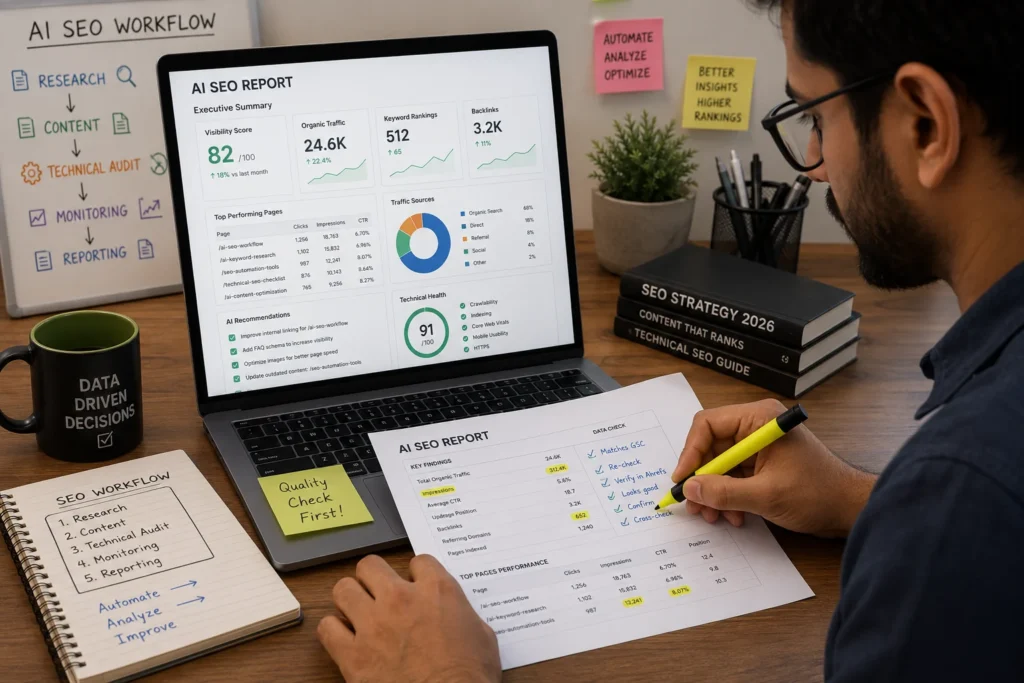
If you’re ready to start, a gradual rollout reduces risk and builds trust in the system.
- Start with one stage. Automate keyword research or technical audits first, since these carry lower risk than automating published content.
- Set clear approval checkpoints. Decide exactly what can run without review, and what always needs a human sign-off.
- Measure results for 30 to 60 days. Track time saved, error rates, and content quality before expanding further.
- Train your team on reviewing AI output. Automation still needs skilled people who know what good output looks like.
- Expand one stage at a time. Once one part of the workflow proves reliable, connect the next stage rather than automating everything simultaneously.
This measured approach helps teams capture real efficiency gains without the risk of publishing errors or losing brand voice along the way.
Common Pain Points With AI SEO Workflow Automation
A few challenges come up repeatedly as teams adopt this approach.
“Will Automation Make Our Content Sound Generic?”
Only if you skip the human editing stage. Keep writers and strategists involved in refining drafts, adding real examples, and injecting brand voice. Automation should speed up the first draft, not replace the final one.
“How Do We Know What to Automate First?”
Start with the most repetitive, lowest-risk tasks. Technical audits and keyword research are usually safest, since errors there are easy to catch before they affect published content.
“Is This Too Expensive for a Small Team?”
Many tools offer scalable pricing based on usage, making automation accessible even for small teams. Calculate the hours saved against the cost before assuming it’s out of reach.
Frequently Asked Questions About AI SEO Workflow
What is an AI SEO workflow?
An AI SEO workflow is a connected system of SEO tasks, including keyword research, content creation, technical audits, and reporting, that runs with AI automation instead of separate manual steps.
Is SEO workflow automation only for large companies?
No. Many tools offer flexible pricing, and small teams often see the biggest relative time savings, since they have the least spare capacity for manual, repetitive work.
Does an AI SEO workflow replace the need for an SEO strategist?
No. It removes repetitive manual work, but strategic decisions, brand voice, and quality review still require human expertise and judgment.
How long does it take to set up an AI SEO workflow?
Most teams can automate one stage, like keyword research, within a few weeks. A fully connected workflow across all stages typically takes a few months to build and refine properly.
What’s the biggest risk of automating SEO tasks?
The biggest risk is publishing AI-generated content or technical changes without human review. Skipping that step can lead to factual errors, generic content, or unintended site changes going live.
Final Thoughts: Building an AI SEO Workflow That Actually Works
An effective AI SEO workflow isn’t about removing people from the process. It’s about removing the repetitive manual work that keeps skilled people from focusing on strategy. Teams that automate thoughtfully, one stage at a time, tend to see the strongest results.
Start small. Pick one stage of your SEO process, automate it, and measure the impact before expanding further. Over time, those connected stages become a genuine competitive advantage, not just a collection of separate tools.
Ready to build your own AI SEO workflow? Explore our guide on [AI SEO agents and automation tools] to see how autonomous tools can power each stage of your process, from research to reporting.