

Introduction
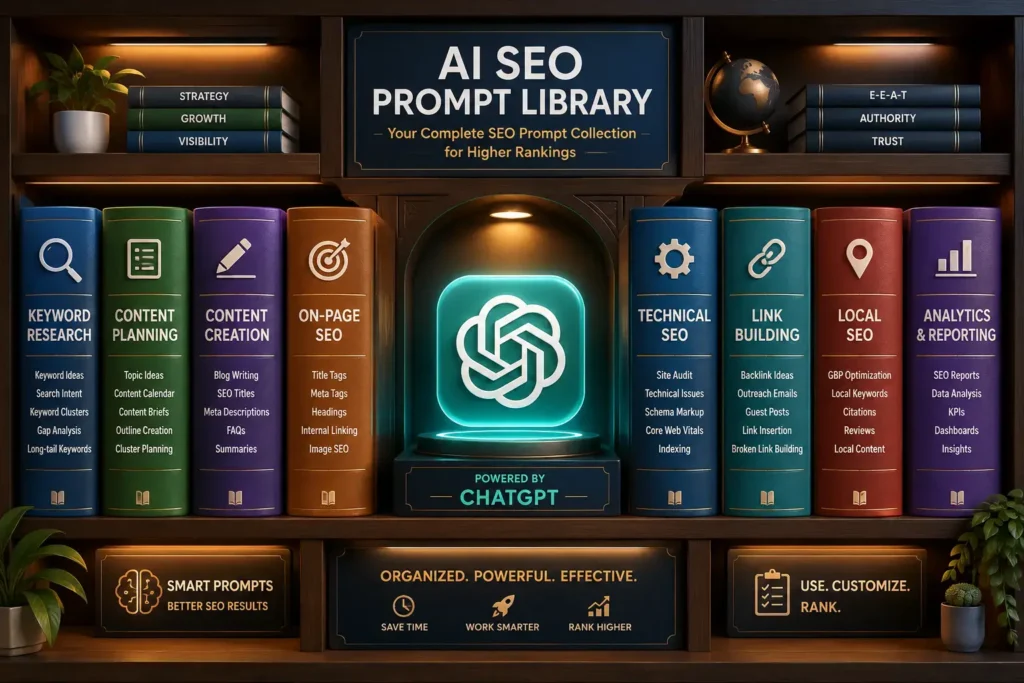
Most people ask ChatGPT for SEO help in a vague way, such as “help me with keywords” or “write an SEO blog post.” As a result, the output is usually generic, forgettable, and not something you would want to publish. This AI SEO prompt library is designed to solve that problem. In particular, every prompt below gives ChatGPT a clear role, real context, and a specific output format, which makes it much more likely to produce useful results.
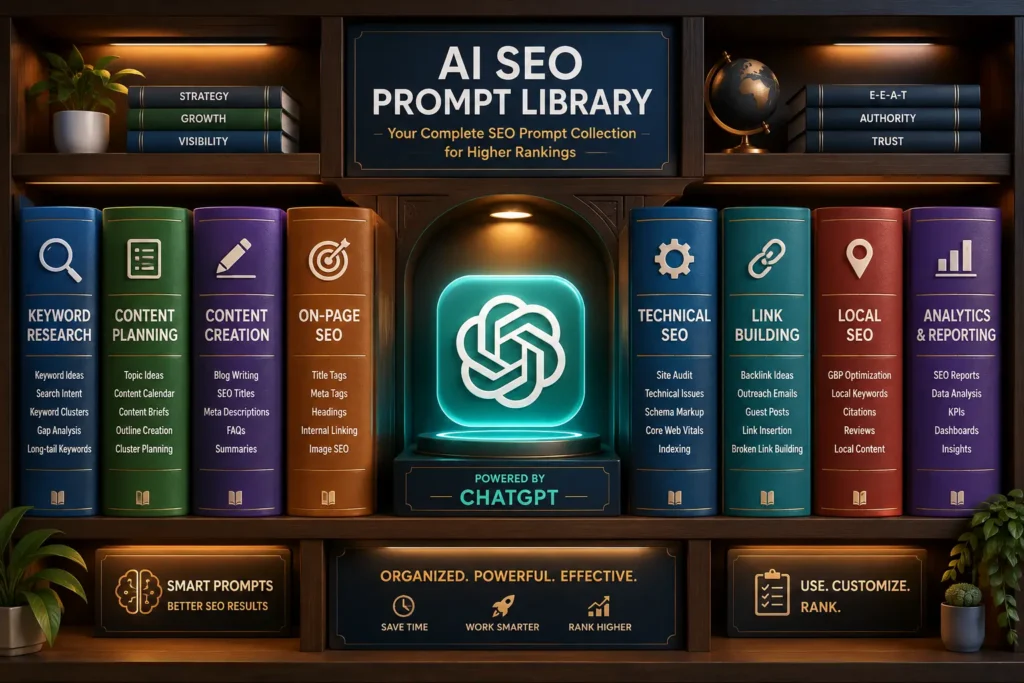
That difference matters more than many people realize. For example, a well-written prompt can turn ChatGPT from a basic chatbot into a much stronger research and drafting assistant. In this guide, you’ll find over 200 ChatGPT SEO prompts organized into 13 practical categories, covering everything from keyword research to AI Overview optimization. In addition, you’ll get a bonus set of 50 advanced prompt templates, a comparison of generic versus specialized prompting, and answers to common questions about using AI responsibly.
How to Get the Most Out of This AI SEO Prompt Library
Before diving into the prompts themselves, a few quick notes make a real difference in output quality. Even a well-written prompt can fall flat without the right context, so these notes are worth reading first, rather than skipping straight to the list below.
Always Add Your Own Context First
Every prompt below uses bracketed placeholders like [your keyword] or [your industry]. Therefore, replace these with real specifics before running the prompt. The more detail you provide upfront- brand voice, target audience, competitor names- the better the output tends to be.
Treat Every Output as a Draft, Not a Final Answer
ChatGPT doesn’t have access to live search volume data, your analytics, or your Search Console. Therefore, validate keyword suggestions, technical claims, and competitive data using dedicated SEO tools before acting on anything it generates.
Iterate Instead of Accepting the First Response
If an output feels generic, don’t abandon the prompt. Add more context, specify a tone, or ask ChatGPT to revise a specific section. According to OpenAI’s guidance on prompt engineering, refining a prompt based on the initial response is a normal and expected step toward better results (OpenAI Help Center).
(For a broader look at how prompting fits into a full automated process, see our related guide on AI SEO Workflow Automation.)
AI SEO Prompt Library for Keyword Research
Keyword research is often where people get the least value from generic prompting. However, these prompts are built to go deeper. As a result, they push ChatGPT toward specific, usable output rather than a generic list of guesses.
- Act as an SEO strategist. Generate 20 long-tail keyword ideas for “[seed keyword],” grouped by search intent.
- List 15 question-based keywords people ask about “[topic]” that would work well as FAQ content.
- Suggest 10 keyword variations for “[keyword]” that reflect how a beginner versus an expert would phrase the same search.
- Create a table of 15 keywords related to “[topic]” with columns for likely intent and a matching content format.
- Identify 10 low-competition keyword angles within the broader topic of “[industry].”
- Suggest seasonal keyword variations for “[topic]” that could support a content calendar throughout the year.
- Generate 10 comparison-style keywords relevant to “[product category],” like “X vs Y” formats.
- List 10 keywords that suggest strong commercial intent within “[niche].”
- Suggest 10 local keyword variations for “[service]” in “[city or region].”
- Identify 10 keyword gaps a beginner in “[topic]” might not think to target.
- Generate a list of 10 keyword modifiers, like “best,” “cheap,” and “guide,” that fit naturally with “[core keyword].”
- Suggest 10 keywords a voice search user might use when asking about “[topic]” conversationally.
- Create 10 keyword ideas targeting people in the awareness stage of “[buyer journey]” who are not ready to purchase yet.
- List 10 keywords likely to appear in an AI-generated answer for “[topic],” based on how people phrase questions.
- Suggest 10 keyword ideas that pair well with a comparison table format for “[product type].”
As a result, once you’ve generated a solid list, remember to validate the promising ones in a dedicated keyword tool before building content around them.
AI SEO Prompts for Content Planning
Once keywords are identified, these prompts help turn them into an organized content plan. Instead of jumping straight to drafting, this stage helps you decide what to write and why it matters before you commit any real writing time.
- Act as a content strategist. Build a 12-week content calendar around the topic of “[core topic],” including a mix of formats.
- Cluster these keywords into logical content groups and suggest one blog topic per cluster: [insert keyword list].
- Suggest 10 blog post ideas that would support topical authority around “[main subject].”
- Identify content gaps by comparing this list of my published topics against common questions in “[industry]”: [insert list].
- Suggest a pillar page structure for “[broad topic],” including 8 supporting subtopics.
- Recommend the best content format — list, guide, comparison, or case study — for the keyword “[keyword],” with reasoning.
- Suggest 10 evergreen content ideas for “[niche]” that won’t need frequent updates.
- Identify which of these topics are best suited for a listicle format versus an in-depth guide: [insert topics].
- Suggest 5 content series ideas that could position my site as an authority on “[topic].”
- Recommend a publishing priority order for these 10 topics based on likely business impact: [insert topics].
- Suggest internal linking opportunities between these existing articles: [insert article titles].
- Identify which stage of the buyer’s journey each of these topics targets: [insert topics].
- Suggest 5 content ideas specifically designed to earn citations in AI-generated answers about “[topic].”
From here, these outputs feed naturally into the writing prompts in the next section.
AI SEO Prompts for Blog Writing
These prompts help with drafting, not replacing the editorial judgment a strong post still needs. Rather, they’re meant to get a rough draft moving faster, so you can spend more time refining and less time staring at a blank page.
- Act as an experienced writer in “[industry].” Draft an introduction for a blog post about “[topic]” that hooks the reader in the first two sentences.
- Write a detailed outline for a blog post targeting “[keyword],” including H2 and H3 subheadings.
- Draft three alternative opening paragraphs for an article about “[topic],” each with a different hook style.
- Expand this outline point into a full paragraph with specific, concrete examples: [insert outline point].
- Suggest 5 real-world examples that would strengthen a section about “[subtopic].”
- Rewrite this paragraph to sound more conversational without losing accuracy: [insert paragraph].
- Draft a conclusion for an article about “[topic]” that ends with a clear, specific call to action.
- Suggest 5 statistics or data points I should verify and include to support claims about “[topic].”
- Write a short author bio establishing expertise in “[field]” for E-E-A-T purposes.
- Draft 3 alternative headlines for an article about “[topic],” each targeting a slightly different angle.
- Suggest transition sentences to connect these two sections smoothly: [insert both sections].
- Identify any claims in this draft that need a citation or source: [insert draft text].
Once a draft feels solid, move on to the on-page prompts below to tighten the structural details.
AI SEO Prompts for On-Page Optimization
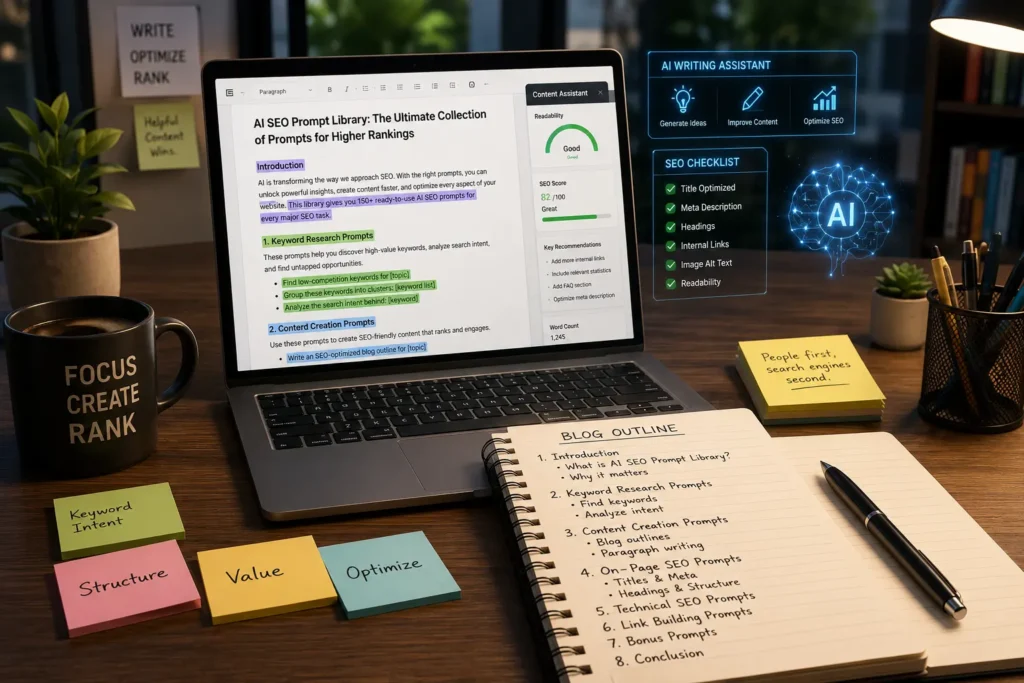
Use these once a draft exists and needs structural and technical polish. At this stage, the goal shifts from generating new content to tightening what’s already there, so the remaining prompts focus on refinement instead of creation.
- Write 3 title tag options for this article, each under 60 characters, targeting “[keyword]”: [insert article summary].
- Write a meta description under 155 characters for an article about “[topic]” that includes “[keyword]” naturally.
- Suggest 5 alternative H2 subheadings for this section that include keyword variations: [insert section topic].
- Review this paragraph for keyword stuffing and suggest a more natural rewrite: [insert paragraph].
- Suggest 5 internal linking opportunities within this article based on the topics it covers: [insert article summary].
- Write descriptive alt text for an image showing “[image description]” that naturally fits the topic.
- Suggest a URL slug for an article about “[topic]” targeting the keyword “[keyword].”
- Identify sections in this draft that could be reformatted as a bulleted or numbered list for readability: [insert draft].
- Suggest 3 featured-snippet-optimized answers for the question “[question],” each under 50 words.
- Review this content for readability and suggest where sentences could be shortened: [insert paragraph].
With on-page details handled, the next set of prompts shifts toward the technical side of the site.
AI SEO Prompts for Technical SEO Audits
ChatGPT can’t crawl your site, but it can help you interpret and prioritize data you provide. Therefore, these prompts work best paired with a real crawl report or Search Console export, rather than as a replacement for either.
- Act as a technical SEO specialist. Review this list of crawl errors and suggest a priority order for fixing them: [insert error list].
- Explain in plain language what a soft 404 error is and why it matters for a non-technical stakeholder.
- Suggest a checklist for auditing Core Web Vitals issues on an ecommerce site.
- Review this robots.txt file and flag anything that looks like it could block important pages: [insert file content].
- Suggest questions to ask a developer about why a specific page isn’t getting indexed.
- Explain the difference between a 301 and a 302 redirect and when each should be used, for a client email.
- Summarize this technical audit report into 5 plain-language bullet points for a non-technical client: [insert report].
- Suggest a prioritized list of technical fixes based on this data, ranked by likely traffic impact: [insert issue list].
- Draft an email explaining a recent crawl budget issue to a client, without technical jargon.
- Suggest 5 questions to include in a quarterly technical SEO review checklist.
Since local businesses face a distinct set of challenges, the next section shifts toward that specific context.

AI SEO Prompts for Local SEO
These prompts help with the specific language and structure local businesses need. That said, unlike broader content prompts, these are built around a single location or service area, so they tend to need less customization once you’ve filled in the basics.
- Write a Google Business Profile description for a “[business type]” in “[city],” under 750 characters.
- Draft 5 Google Business Profile post ideas for a “[business type]” to publish over the next month.
- Write 3 review response templates for a “[business type],”: one for a positive review, one for a neutral one, and one for a negative one.
- Suggest 10 local keyword variations combining “[service]” with nearby neighborhoods in “[city].”
- Draft a local landing page outline for “[service]” targeting customers in “[city or region].”
- Suggest 5 ways a “[business type]” could naturally mention its location within blog content.
- Write an FAQ section addressing common questions customers ask a “[business type]” before booking.
- Suggest a review request message template to send customers after a completed “[service].”
- Draft a short “About Us” section for a local business emphasizing community involvement in “[city].”
- Suggest 5 local partnership or citation opportunities relevant to a “[business type]” in “[industry].”
Naturally, strong local visibility often depends on backlinks too, which the next section covers directly.
AI SEO Prompts for Link Building
Use these to speed up research and outreach drafting, always with human review before sending anything. Meanwhile, even a strong draft benefits from a final personal touch, since outreach that reads as templated tends to get ignored.
- First, suggest 10 types of websites likely to link to a resource about “[topic].”
- Next, draft a personalized outreach email requesting a link from a site about “[their topic],” referencing their recent content.
- Then, suggest 5 data-driven content angles likely to earn organic backlinks in “[industry].”
- Now, draft a follow-up email for an outreach campaign that hasn’t received a response after one week.
- Suggest 5 broken-link building opportunities I could search for on “[niche]” websites.
- Write a pitch for a guest post on the topic of “[topic],” aimed at a site in “[industry].”
- Suggest 5 ways to naturally vary anchor text for a page about “[topic]” to avoid an unnatural link profile.
- Draft a short bio to include with a guest post pitch, establishing expertise in “[field].”
- Suggest 5 resource page types likely to accept a submission about “[topic].”
- Lastly, draft an email thanking a site for linking to my content and offering to reciprocate where relevant.
Beyond traditional links, visibility inside AI-generated answers has become its own distinct goal, covered next
AI SEO Prompts for AI Overviews & GEO
These prompts specifically target visibility inside AI-generated search summaries, not just traditional rankings. Then, as search continues shifting in this direction, this category will likely matter more with each passing quarter, not less.
- First, rewrite this paragraph to directly answer “[question]” in the first two sentences, optimized for an AI-generated summary: [insert paragraph].
- Next, suggest 5 subtopics I should cover to make this article more comprehensive and citation-worthy for “[topic].”
- Then, identify which parts of this article read as vague versus specific enough for an AI system to cite confidently: [insert draft].
- Now, draft a concise, quotable definition of “[term]” suitable for a featured snippet or AI summary.
- Then, suggest a structure for this article that makes it easier for an AI crawler to extract clear, standalone answers: [insert outline].
- Again, rewrite this section to state the key takeaway first, then explain the reasoning afterward: [insert section].
- After that, suggest 5 questions this article should explicitly answer to improve its chances of AI citation.
- Finally, identify any claims in this draft that need clearer sourcing to build AI trust signals: [insert draft].
Meanwhile, understanding what competitors are doing well often sharpens these efforts further.

AI SEO Prompts for Competitor Analysis
ChatGPT can’t pull live competitor data, but it can help you organize and interpret what you’ve already gathered. Instead of manually spotting patterns across a dozen open tabs, these prompts help surface them faster.
- First, compare these two competitor content outlines and identify what mine is missing: [insert both outlines].
- Next, summarize the likely content strategy behind this competitor’s blog based on these 10 titles: [insert titles].
- Then, suggest 5 content gaps based on comparing my site’s topics against this competitor’s topics: [insert both lists].
- Again, identify patterns in these competitor title tags that could inform my own approach: [insert titles].
- Then, suggest 5 differentiation angles for content on “[topic]” that most competitors seem to be missing.
- Now, summarize the tone and style differences between these two competing articles: [insert both excerpts].
- After that, suggest questions to ask when evaluating whether a competitor’s backlink profile is genuinely strong or inflated.
- Finally, draft a positioning statement explaining how my content on “[topic]” differs from this competitor’s: [insert competitor summary].
Similarly, trust signals matter just as much as positioning, which the next section addresses directly.
AI SEO Prompts for E-E-A-T Optimization
These help strengthen the experience, expertise, authoritativeness, and trustworthiness signals search engines look for. Since these signals are inherently about genuine substance, treat every output here as a starting point that still needs real detail added.
- First, suggest 5 ways to add firsthand experience to this article about “[topic],” beyond general research: [insert draft summary].
- Next, draft an author bio that clearly establishes credentials relevant to “[field].”
- Then, identify sections in this draft that read as generic and could benefit from a specific example or case study: [insert draft].
- Now, suggest 5 credible source types I should cite when writing about “[topic].”
- Then, draft a short “how this article was researched” note to add transparency to a piece about “[topic].”
- Finally, suggest questions a genuine expert in “[field]” would likely be asked, to help shape a more authoritative article.
From here, structured data offers another, more technical way to reinforce credibility, covered next.
AI SEO Prompts for Schema Markup
Use these to draft schema language faster, with a developer confirming implementation. Because schema errors can be easy to miss, this final review step matters even when the drafted content itself looks correct.
- First, explain in plain language what FAQ schema does and when it makes sense to use it.
- Next, draft the question-and-answer pairs needed for FAQ schema based on this article’s content: [insert article summary].
- Then, explain the difference between Article schema and BlogPosting schema for a non-technical stakeholder.
- Now, suggest which schema types would benefit a “[business type]” website most.
- After that, draft the review snippet content needed for Review schema based on these customer testimonials: [insert testimonials].
- Finally, explain what breadcrumb schema is and why it might help a site with deep category structures.
Once new content and technical details are in place, older content still deserves periodic attention, which the next section covers.
AI SEO Prompts for Content Refreshing
These help identify what an older piece of content needs before republishing it. However, rather than rewriting from scratch, these prompts focus specifically on what’s changed since the original publish date.
- First, compare this older article against current best practices for “[topic]” and suggest what’s outdated: [insert article].
- Next, suggest 5 subtopics likely missing from this article that competitors are now covering: [insert article summary].
- Then, rewrite this outdated statistic reference to prompt me to verify and update it with current data: [insert sentence].
- Now, suggest a new introduction for this article that reflects how “[topic]” has changed since it was published: [insert old intro].
- After that, identify sections of this article that could be expanded into standalone posts: [insert article outline].
- Finally, suggest 5 updated examples to replace outdated ones in this section: [insert section].
Finally, all of this work eventually needs to be communicated clearly, which brings us to reporting.

AI SEO Prompts for SEO Reporting
These help translate raw data into language stakeholders actually want to read. Ultimately, a report that no one understands is far less valuable than a shorter one that actually gets read and acted on.
115. First, rewrite this technical finding in plain language suitable for a non-SEO stakeholder: [insert technical note].
116. Next, summarize this month’s ranking and traffic data into 5 plain-language bullet points for a client: [insert data].
117. Then, draft an executive summary explaining this quarter’s SEO performance, based on the following numbers: [insert data].
118. Now, suggest 3 ways to visually present this ranking data in a report, based on what it shows: [insert data summary].
119. After that, draft a brief explanation of why traffic may have declined despite stable rankings, for a client update: [insert context].
120. Finally, suggest 5 next-step recommendations based on this month’s performance data: [insert data summary].
Generic ChatGPT Prompts vs. Specialized AI SEO Prompts: A Comparison
However, before jumping into the bonus templates, it helps to see why structure matters so much in prompting.
| Factor | Generic Prompt | Specialized AI SEO Prompt |
|---|---|---|
| Example | “Write an SEO article about coffee” | “Act as a content strategist. Draft an outline for a comparison article on ‘best coffee makers under $100,’ targeting buyers in the consideration stage.” |
| Output specificity | Vague, generic phrasing | Structured, targeted to a defined audience and intent |
| Editing required | Heavy rewriting usually needed | Still needs review, but far less rework |
| Role definition | None | Clearly assigned (strategist, writer, auditor) |
| Output format | Unpredictable | Specified in advance (table, list, word count) |
| Reusability | Rarely reusable as-is | Easy to reuse with new bracketed inputs |
As the table shows, the difference isn’t the tool. It’s the structure behind the request.
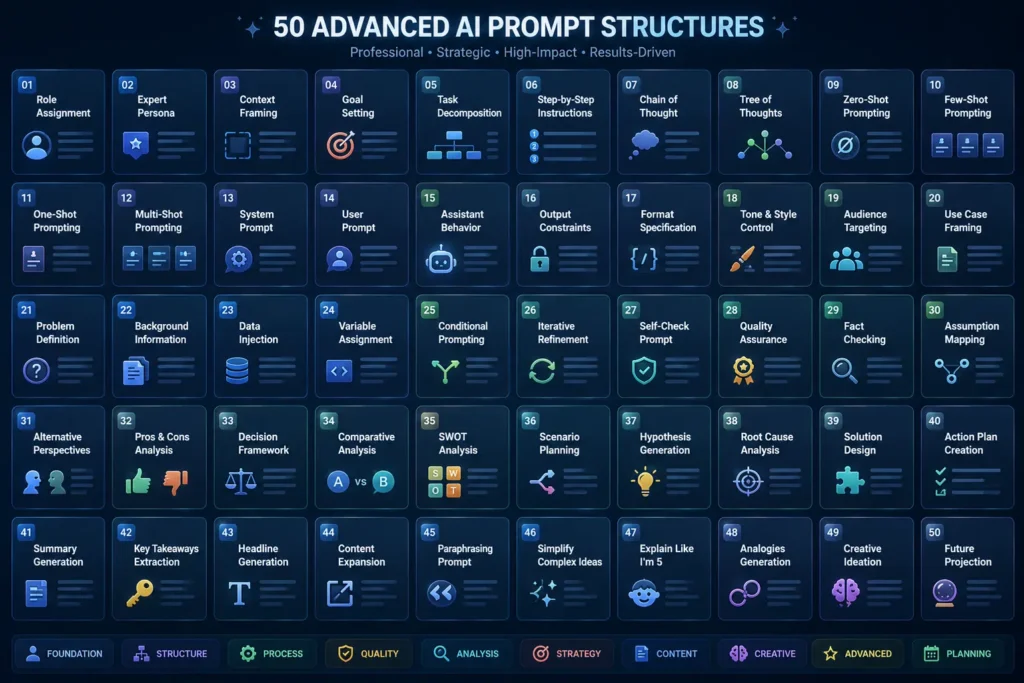
Bonus: 50 Advanced AI SEO Prompt Templates
These combine role, context, and format into flexible templates you can adapt across almost any SEO task. Therefore, instead of memorizing 200 separate prompts, you can internalize these underlying patterns and reuse them indefinitely.
AI SEO Prompt Library: Research & Strategy
121. First, Act as [role]. Given [context], generate [number] [output type] for [goal].
122. Next, compare [item A] and [item B] and summarize the key differences relevant to [specific goal].
123. Then, identify the top 5 risks in this SEO plan and suggest a mitigation for each: [insert plan].
124. Now, suggest a prioritized 90-day SEO roadmap for a site focused on “[industry],” starting from scratch.
125. After that, identify which of these initiatives would likely have the highest impact for the lowest effort: [insert list].
AI SEO Prompt Library: Content Creation
126.First, Act as a [role] writing for [audience]. Draft [content type] about [topic] in a [tone] tone.
127. Next, rewrite this section to match a [tone] voice while keeping the same information: [insert section].
128.Then,suggest 3 different angles for covering “[topic],” each suited to a different audience segment.
129. Now, draft a content brief for a writer, including target audience, tone, and key points to cover for “[topic].”
130. Finally, suggest a title, meta description, and 3 H2 headings for an article about “[topic],” all in one response.
AI SEO Prompt Library: Optimization
131. First, review this content against the keyword “[keyword]” and flag anything that reads as forced or unnatural: [insert content].
132. Next, suggest 5 semantically related terms to include naturally throughout this article about “[topic].”
133. Then, identify passages in this draft likely to trigger AI detection tools and suggest more natural phrasing: [insert draft].
134. Now, suggest a more scannable structure for this dense paragraph, using subheadings or bullets: [insert paragraph].
135. Finally, rewrite this sentence to be under 20 words without losing meaning: [insert sentence].
AI SEO Prompt Library: Technical & Structural
136. First, explain [technical concept] in one paragraph, written for someone with no SEO background.
137. Next, suggest a logical URL structure for a site covering “[broad topic]” with multiple subcategories.
138.Then,draft a plain-language explanation of why “[technical issue]” matters, for a client unfamiliar with SEO.
139. Now, suggest 5 questions to ask when troubleshooting why a page isn’t ranking despite strong content.
140. Finally, identify potential cannibalization risks between these two page topics: [insert both topics].
AI SEO Prompt Library: Competitive & Market Research
141. First, summarize the likely target audience for this competitor based on their content: [insert content summary].
142. Next, suggest 3 positioning angles that differentiate my content from typical coverage of “[topic].”
143. Then, identify recurring themes across these competitor headlines: [insert headline list].
144. Now, suggest questions to evaluate whether a market gap in “[niche]” is genuinely underserved or simply low-demand.
145. Finally, draft a SWOT-style summary of my content strategy based on this description: [insert strategy summary].
AI SEO Prompt Library: Local & Multi-Location
146.First, draft location-specific variations of this page for “[list of cities],” keeping the core structure consistent: [insert page summary].
147. Next, suggest 5 ways to make this local landing page feel genuinely specific to “[city],” not generic.
148. Then, draft a script for requesting reviews from customers after a “[service type]” appointment.
149. Next, suggest local content ideas that would resonate with residents of “[city or region]” specifically.
150. Finally, draft a template for consistent business descriptions across multiple location listings.
AI SEO Prompt Library: Link Building & Outreach
151. First, Draft 3 subject line variations for an outreach email pitching “[content piece]” to site owners.
152. Next, suggest a follow-up sequence, with timing, for an outreach campaign that received no initial response.
153. Then, draft a short pitch explaining why “[content piece]” would be a valuable addition to a resource page.
154. Then, suggest 5 ways to make an outreach email feel personalized rather than templated.
155. Lastly, Draft language for a broken link outreach email, referencing the specific broken link found: [insert link context].
AI SEO Prompt Library: AI Search & GEO
156. First, suggest how to restructure this answer to be more directly quotable by an AI system: [insert answer].
157. Then, draft a concise, standalone definition of “[term]” that could function well inside an AI-generated summary.
158. Next, identify which parts of this FAQ section are too vague for confident AI citation: [insert FAQ].
159. Now, suggest 5 questions an AI system might be asked about “[topic]” that this content doesn’t yet answer.
160. After that, rewrite this paragraph so the main point appears in the first sentence rather than the last: [insert paragraph].
EAI SEO Prompt Library: -E-A-T & Trust
161. First, suggest how to restructure this answer to be more directly quotable by an AI system: [insert answer].
162. Next, draft a concise, standalone definition of “[term]” that could function well inside an AI-generated summary.
163. Then, identify which parts of this FAQ section are too vague for confident AI citation: [insert FAQ].
164. Now, suggest 5 questions an AI system might be asked about “[topic]” that this content doesn’t yet answer.
165. After that, rewrite this paragraph so the main point appears in the first sentence rather than the last: [insert paragraph].
Reporting & Communication
166. First, suggest 5 ways to demonstrate firsthand experience in an article about “[topic]” without exaggerating credentials.
167. Next, Draft language disclosing methodology for a data-driven article about “[topic].”
168. Then, suggest credible source types appropriate for supporting claims about “[topic].”
169. Now, draft an “updated on” note explaining what changed in a recently refreshed article about “[topic].”
170. After that, suggest 5 questions a skeptical reader might ask about this article’s credibility: [insert draft summary].
Workflow & Efficiency
171. First, suggest a checklist for reviewing AI-generated content before publishing it.
172. Next, draft a standard operating procedure for how my team should review AI SEO suggestions before implementing them.
173. Then, suggest 5 tasks in my current SEO process that could be automated without sacrificing quality.
174. Now, identify which of these recurring tasks would benefit most from a reusable prompt template: [insert task list].
175. After that, draft a simple onboarding note explaining how to use this prompt library to a new team member.
Advanced Combination Prompts
176.First, Act as [role]. Given [context], produce [output] in [format], optimized for [specific goal], and flag any assumptions you made.
177. Secondly, critique this draft as if you were a skeptical editor, then suggest 3 specific improvements: [insert draft].
178. Thirdly, generate 3 versions of this content at different reading levels: general audience, intermediate, and expert.
179. Then, suggest what’s missing from this content brief before it goes to a writer: [insert brief].
180. Finally, Act as a devil’s advocate. Identify the weakest argument in this article and suggest how to strengthen it: [insert article].
Testing & Iteration
181. First, suggest 3 alternative phrasings for this prompt that might produce more specific output: [insert original prompt].
182. Next, identify what additional context I should provide to get a more useful answer to this question: [insert question].
183. Then, suggest how to break this complex request into smaller, sequential prompts: [insert complex request].
184Now,.Review this prompt and flag anything likely to produce a vague or generic response: [insert prompt].
185. After that, suggest a follow-up prompt that would help refine this initial output: [insert output summary].
Miscellaneous Practical Prompts
186. First, draft a short glossary entry explaining “[SEO term]” in plain language.
187. Next, suggest 5 ways to repurpose this blog post into other content formats, like social posts or an email.
188. Then, draft a one-paragraph summary of this article suitable for a newsletter.
189. Now, suggest 3 discussion questions based on this article that could prompt reader engagement.
190. Finally, draft a short internal note explaining why this page’s strategy changed, for future reference.
Final Set: Big-Picture Prompts
191. First, suggest 3 realistic SEO goals for a site in “[industry]” over the next 6 months, given limited resources.
192. Then, identify the single biggest bottleneck in this SEO process based on this description: [insert process summary].
193. Next, suggest how priorities should shift if traffic from AI-generated answers continues growing relative to traditional clicks.
194. Now, draft a one-page summary explaining this SEO strategy to a new stakeholder unfamiliar with the details.
195. Then, suggest 3 questions worth revisiting every quarter to keep an SEO strategy from going stale.
196. After that, identify assumptions in this strategy that haven’t been tested yet: [insert strategy summary].
197. Next, suggest how this strategy should differ for a site targeting local customers versus a national audience.
198. Then, draft a short case for why “[specific tactic]” deserves more investment, based on this context: [insert context].
199. Now, suggest 3 ways to measure success for a content refresh project beyond traffic alone.
200. Finally, Act as a mentor reviewing my overall SEO approach. Ide
Frequently Asked Questions About This AI SEO Prompt Library
What is an AI SEO prompt library?
An AI SEO prompt library is a curated collection of prewritten ChatGPT prompts designed for specific SEO tasks, such as keyword research, content planning, or technical audits. As a result, it saves time compared to writing effective prompts from scratch for every new task.
Can ChatGPT actually replace SEO tools like Ahrefs or Semrush?
No. ChatGPT doesn’t have access to live search volume, ranking data, or your site’s analytics. Instead, it works best as a drafting and interpretation assistant, while dedicated SEO tools remain necessary for verifying actual data.
Do I need ChatGPT Plus to use these prompts effectively?
Not necessarily. Many of these prompts work well with free versions of ChatGPT. However, paid tiers with more advanced models may produce more nuanced, better-structured output for complex tasks.
How do I customize these prompts for my specific business?
Instead, replace every bracketed placeholder with your actual details — including industry, keyword, and audience — and then add extra context about your brand voice or goals. Therefore, the more specific the input, the more useful the output tends to be.
Is content generated from these prompts safe to publish as-is?
No. Every output should go through human review and editing before publishing, both to verify accuracy and to ensure it genuinely reflects your brand’s voice and expertise, rather than just AI-generated phrasing.
Final Thoughts: Using This AI SEO Prompt Library Effectively
This AI SEO prompt library isn’t meant to replace strategic thinking or genuine expertise. Instead, it’s meant to remove the blank-page problem — the moment where you know what you need from ChatGPT but aren’t sure how to ask for it clearly.
Start with the categories most relevant to your current workload, whether that’s content planning, technical audits, or reporting. Then customize the bracketed placeholders with real context, and treat every output as a strong first draft rather than a finished product. Over time, you’ll likely start adapting these templates into your own variations, which is exactly the point.
Ready to connect prompting into a broader system? Check out our guide on AI SEO Workflow Automation to see how these prompts fit into a fully connected, automated SEO process.