
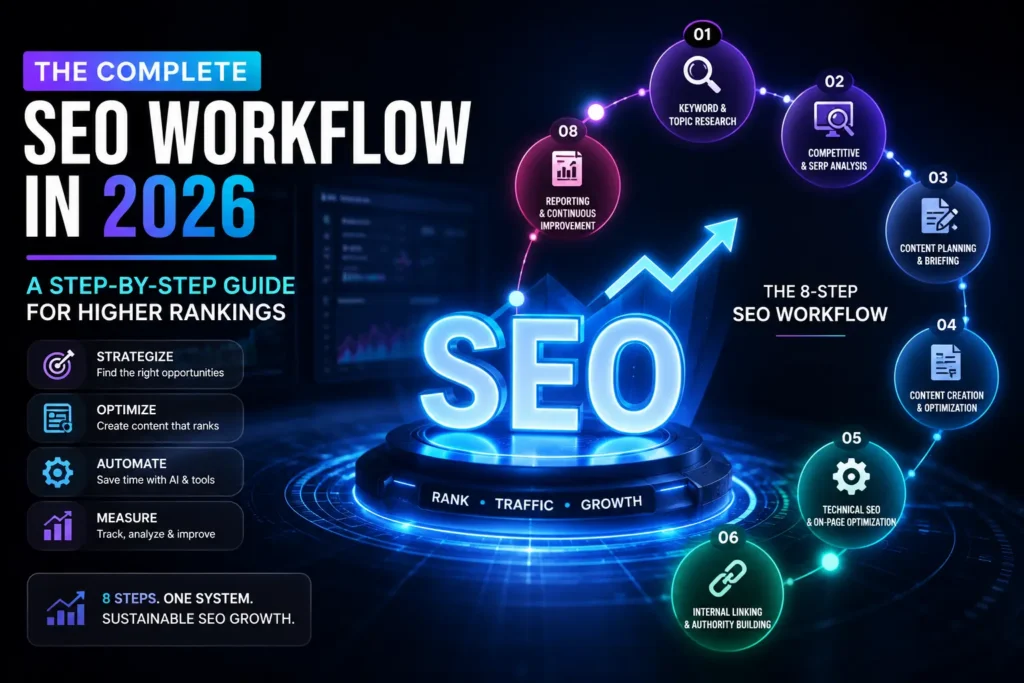

Most teams don’t struggle with SEO because they don’t understand it. Instead, they struggle because their process lives entirely in someone’s head. It changes depending on who’s doing the work that week. It falls apart the moment that person goes on vacation. A documented SEO workflow fixes this. It turns SEO from a collection of one-off tasks into a repeatable system that produces consistent results, regardless of who’s running it.
This matters because SEO has grown more complex every year, while most in-house processes have barely changed. In this guide, you’ll learn exactly what an SEO workflow is and how it differs from strategy. You’ll walk through a complete 8-step process covering everything from keyword research to reporting. You’ll also see how AI and automation change each step, plus a full comparison of manual versus automated approaches. By the end, you’ll have a clear, practical framework you can actually implement, not just another list of tips.
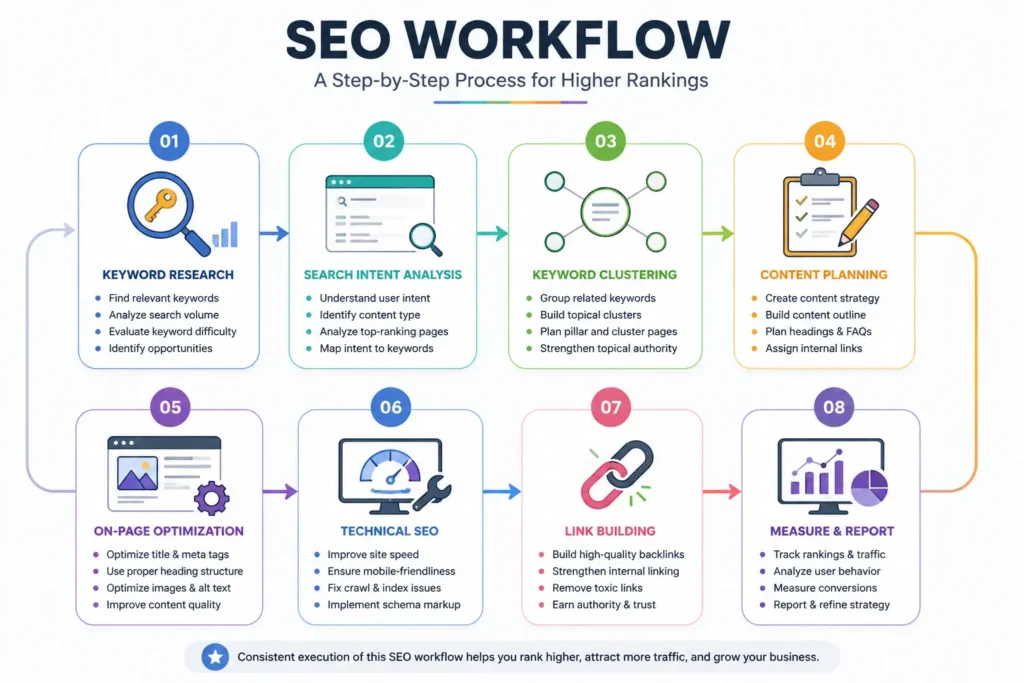
Eight connected stages of an SEO workflow, from keyword research through reportingWhat Is an SEO Workflow?
An SEO workflow is a documented, repeatable sequence of steps a team follows. It covers researching, creating, optimizing, and monitoring content and technical elements that affect search visibility. Unlike a one-time project, it runs continuously, with each step feeding into the next in a predictable order.
In short, a strong SEO workflow answers a simple question for anyone on the team. Given this task, what exactly happens next, and who owns it?
A Simple Example of Why This Matters
Consider two agencies handling similar client work. The first has no documented process. Every account manager approaches keyword research, content briefs, and reporting slightly differently, based on their own habits and preferences. The second agency has a written workflow that every team member follows, with clear templates for each stage. When a team member leaves the first agency, institutional knowledge walks out the door with them. At the second agency, a new hire can review the documentation and start contributing meaningfully within days, not months.
What a Documented Workflow Actually Looks Like
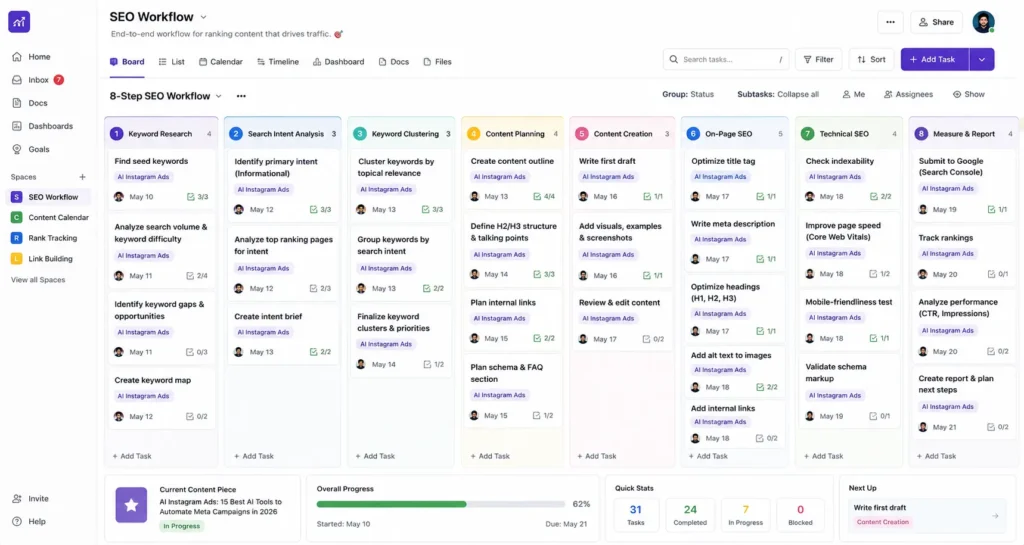
In practice, this doesn’t need to be an elaborate system. A shared document outlining each of the 8 steps below, with a template for content briefs and a checklist for technical review, covers the essentials for most teams. The goal isn’t bureaucratic complexity. It’s making sure the same quality bar applies regardless of which team member is handling a given task that week.
SEO Workflow vs. SEO Strategy
These terms get used interchangeably, but they mean different things. Strategy is the big-picture plan. It covers which markets to target, what topics matter most, and how SEO supports broader business goals. A workflow, on the other hand, is the operational process that actually executes that strategy day to day.
Think of strategy as the destination and workflow as the route you take to get there. You can have a brilliant strategy and still fail if the underlying workflow is inconsistent or undocumented.
Why Every Website Needs a Documented Workflow
Without a documented process, quality varies wildly. It depends entirely on who’s doing the work and how much time they have that week. Tasks get skipped, especially the unglamorous ones like technical audits or content refreshes. New team members also take far longer to ramp up, since there’s no clear reference for how things are actually supposed to be done.
A documented workflow ensures consistency regardless of who executes each step. As a result, nothing gets quietly dropped or overlooked. New hires also have something concrete to follow from day one.
Traditional SEO vs. AI-Powered SEO Workflow
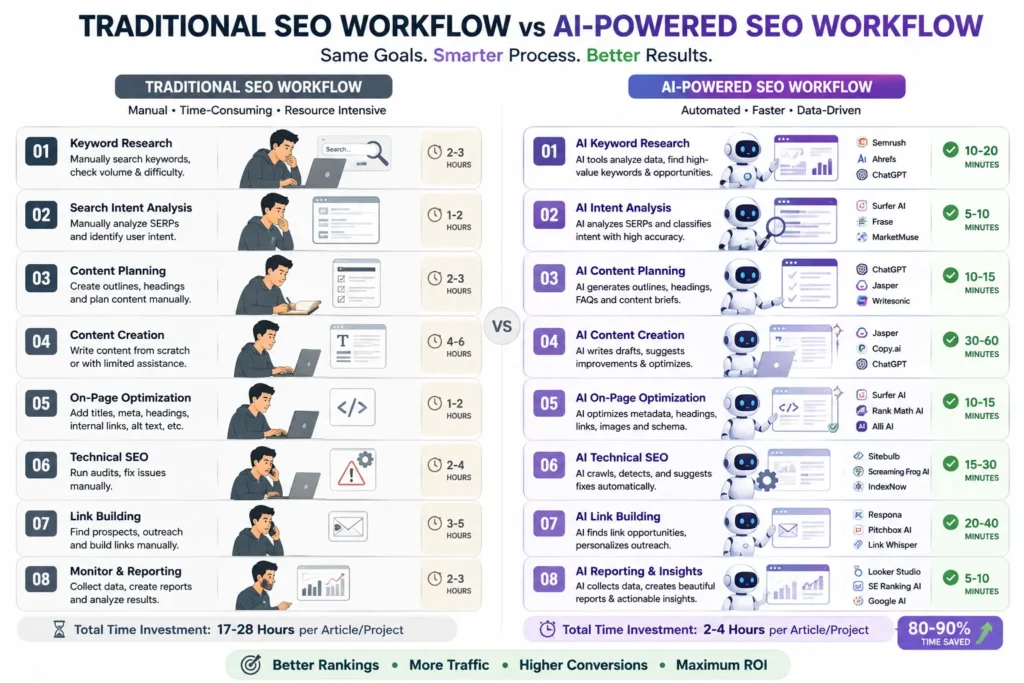
Traditional SEO workflows rely almost entirely on manual research, drafting, and auditing, with a specialist personally touching every stage. This works, but it’s slow. It also scales poorly as a site grows past a handful of pages.
An AI-powered SEO workflow keeps the same underlying stages: research, creation, optimization, and monitoring. However, it layers automation onto the repetitive parts. Instead of manually checking hundreds of pages for technical issues, an AI-powered crawler flags them automatically. Instead of drafting a content brief from scratch, an AI tool generates a starting structure that a strategist then refines. The stages don’t change. What changes is how much manual effort each stage requires.
The 8-Step SEO Workflow
This is the core process every site, regardless of size, should follow in some form. Each step feeds directly into the next.
Step 1: Keyword and Topic Research
Everything starts here. This step involves identifying what your audience is actually searching for. It also means grouping related terms by intent and prioritizing which topics deserve content first. Skipping or rushing this step tends to undermine everything that follows. Even excellent content targeting the wrong keyword won’t perform. A good research phase typically produces a prioritized list of 10 to 20 topics, ranked by search volume, competition, and how well they align with actual business goals.
Step 2: Competitive and SERP Analysis
Once target keywords are identified, review what’s currently ranking for them. This reveals the format, depth, and angle that search engines currently reward for a given query. It also highlights gaps competitors haven’t addressed yet. Pay particular attention to content length, structure, and any recurring subtopics that appear across multiple top-ranking pages, since these often signal what search engines expect comprehensive coverage to include.
Step 3: Content Planning and Briefing
Turn research into an actionable brief. Include the target keyword, search intent, recommended structure, word count range, and internal linking opportunities. A clear brief prevents a writer from guessing at what’s actually needed. The strongest briefs also note the specific angle or differentiator identified during competitive analysis, so the resulting content offers something genuinely new rather than repeating what’s already ranking.
Step 4: Content Creation and On-Page Optimization
This is where the actual writing happens, followed immediately by on-page optimization. Title tags, meta descriptions, heading structure, and natural keyword placement throughout the body all matter here. Treating these as one connected step, rather than optimization as an afterthought, produces stronger results. Waiting until after publishing to optimize often means these details get rushed or skipped entirely once attention has already moved to the next task.
Step 5: Technical SEO Audit
Before or shortly after publishing, confirm the page is technically sound. Check crawlability, page speed, mobile usability, and structured data. Technical issues can quietly suppress even genuinely excellent content, so this step shouldn’t be treated as optional. Even a single page audit takes only a few minutes with the right tools, making this one of the easiest steps to build into a standard pre-publish checklist.
Step 6: Internal Linking and Site Architecture
Connect new content to relevant existing pages. Then, update older pages to link to the new one where it makes sense. Strong internal linking helps both users and search engines understand how your content relates. It also distributes authority across your site more evenly. Aim for at least two to three genuinely relevant internal links per new page, rather than forcing links to unrelated content just to hit an arbitrary number.
Step 7: Monitoring and Rank Tracking
Once content is live, track how it performs over time, including rankings, organic traffic, and click-through rate. This step is often neglected. However, it’s what actually tells you whether the previous six steps worked. Set a specific check-in point, often around six to eight weeks after publishing, since rankings for new content typically need that much time to stabilize before a fair assessment is possible.
Step 8: Reporting and Iteration
Summarize performance data into a clear report. From there, use those insights to decide what needs refreshing, what deserves more internal links, and what topics to prioritize next. This closes the loop, feeding directly back into Step 1 for the next cycle. Treating this as a genuine analysis step, not just a data dump, is what actually turns one article’s performance into insight for the next ten.
Why the Order of These Steps Matters
It’s tempting to treat these steps as a flexible checklist rather than a strict sequence, but the order genuinely matters. Publishing before completing a technical audit risks launching content search engines can’t fully crawl. Skipping competitive analysis before briefing means a writer might duplicate an angle that’s already been covered exhaustively elsewhere. Each step exists specifically to inform the one that follows it, which is exactly why treating this as a true workflow, not a loose collection of tasks, produces more consistent results over time.
(For a deeper look at how audits fit into this process specifically, see our related guide.) It covers AI SEO Audits in full depth.
AI SEO Workflow: How Automation Changes Every Step
Layering AI onto this 8-step process doesn’t replace any stage. Instead, it changes how much manual effort each one requires. Here’s how that plays out across the four stages where AI currently makes the biggest difference.
AI Tools for Keyword Research
Tools like Semrush and Ahrefs already use AI to cluster keywords by intent and surface related questions automatically. This cuts research time significantly compared to manual spreadsheet sorting. ChatGPT adds another layer here. It helps brainstorm long-tail variations or group a raw keyword list into logical content themes within minutes. Combined, these tools can turn a task that once took an afternoon into something completed before a first coffee break ends.
AI Content Optimization
Rather than manually checking keyword placement, heading structure, and readability by eye, AI-powered optimization tools score a draft against top-ranking competitors and flag specific gaps. ChatGPT can also draft a first-pass outline or suggest alternative phrasing for an awkward paragraph. That said, a human editor should always refine the final version, since these tools can miss nuance around brand voice or industry-specific context that only a person familiar with the business would catch.
AI Technical SEO Auditing
Screaming Frog’s 2026 release added direct AI integration through the Model Context Protocol. This lets an AI assistant like Claude run crawls, summarize issues, and answer plain-language questions about a site’s technical health, all without manually clicking through menus. This turns a task that once required deep technical fluency into something a broader team can interpret and act on, which matters especially for smaller teams without a dedicated technical specialist on staff.
(For a full breakdown of this specific stage, see our related guide.) It covers AI Technical SEO in more depth.
AI Reporting and Analytics
Instead of manually pulling data into spreadsheets every month, tools like Looker Studio connect directly to Search Console, Google Analytics, and crawl data sources. They refresh dashboards automatically once configured. Pairing this with an AI summary layer means a report that once took hours to compile can now generate itself. A human simply reviews the output and adds commentary. For agencies managing several client accounts, this shift alone can reclaim a meaningful chunk of a team’s monthly workload, since reporting is often one of the most time-consuming, least strategic tasks on the calendar.
(For a broader look at this shift, see our related guide on AI SEO Workflow Automation.) This covers the full automated process in more depth.
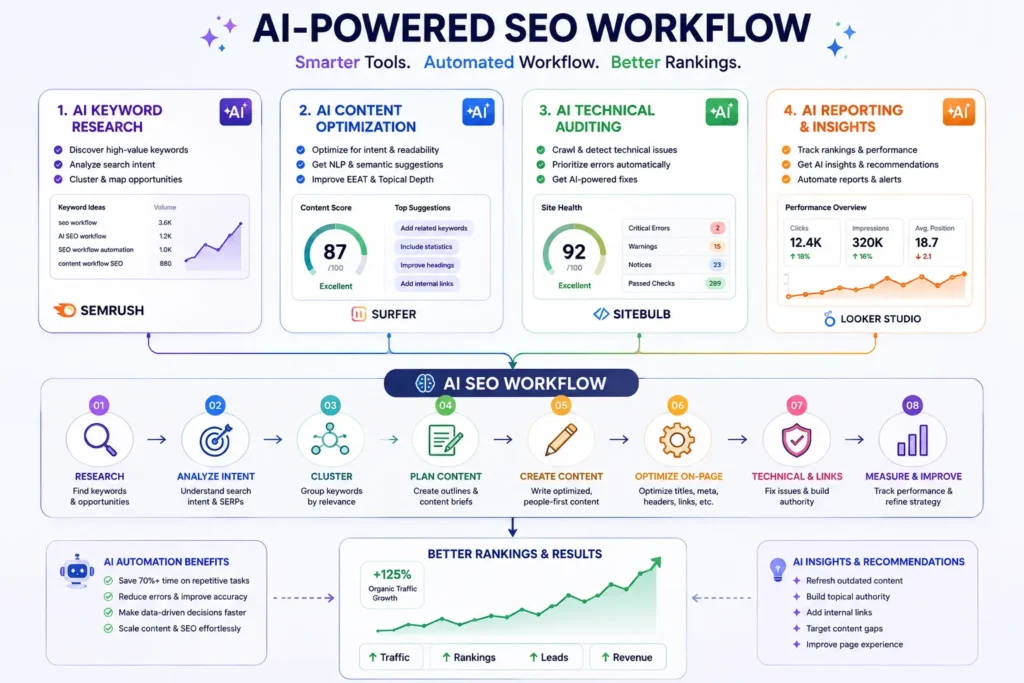
SEO Workflow Automation: Building a Connected System
Beyond individual AI tools, real efficiency comes from connecting these stages into one automated system rather than treating each as a separate manual task. This is where the biggest time savings actually live.
Automated Keyword Research Workflow
Instead of manually exporting keyword data every month, set up a recurring pull from Ahrefs or Semrush. This automatically updates a shared keyword tracker. Pairing this with a scheduled ChatGPT prompt that clusters new keywords by intent removes the manual sorting step almost entirely. A strategist then reviews and prioritizes, rather than building the list from scratch. Many teams find this alone saves several hours a month, time that can shift toward analyzing which clusters deserve the next content push.
Automated Content Optimization Workflow
Many content platforms now support automatic optimization scoring the moment a draft is saved. This flags missing subheadings or thin sections before a human ever opens the document for review. It shifts the editor’s role too. Instead of manually checking a list of requirements, they review flagged issues and make judgment calls on what to fix. This works especially well for teams publishing frequently, where a consistent, automated first pass catches basic gaps before an editor’s time gets spent on genuinely substantive feedback.
Automated Rank Tracking Workflow
Rather than manually checking rankings weekly, most platforms now support scheduled tracking with automatic alerts when a page’s position shifts significantly. This catches both wins and problems faster than a manual check ever could. The system flags changes the moment they happen, rather than waiting for the next scheduled review. Setting sensible alert thresholds matters here, since overly sensitive alerts can create noise that trains a team to start ignoring notifications altogether.
Automated Reporting Workflow
Connecting Screaming Frog’s scheduled crawl exports to a Looker Studio dashboard creates a genuinely automated technical health report. It refreshes on its own schedule, pulling in Search Console and PageSpeed data alongside crawl results. Once configured, this removes the need to manually rebuild a report from scratch every single month, freeing that time for actual analysis and strategic recommendations instead of data compilation.
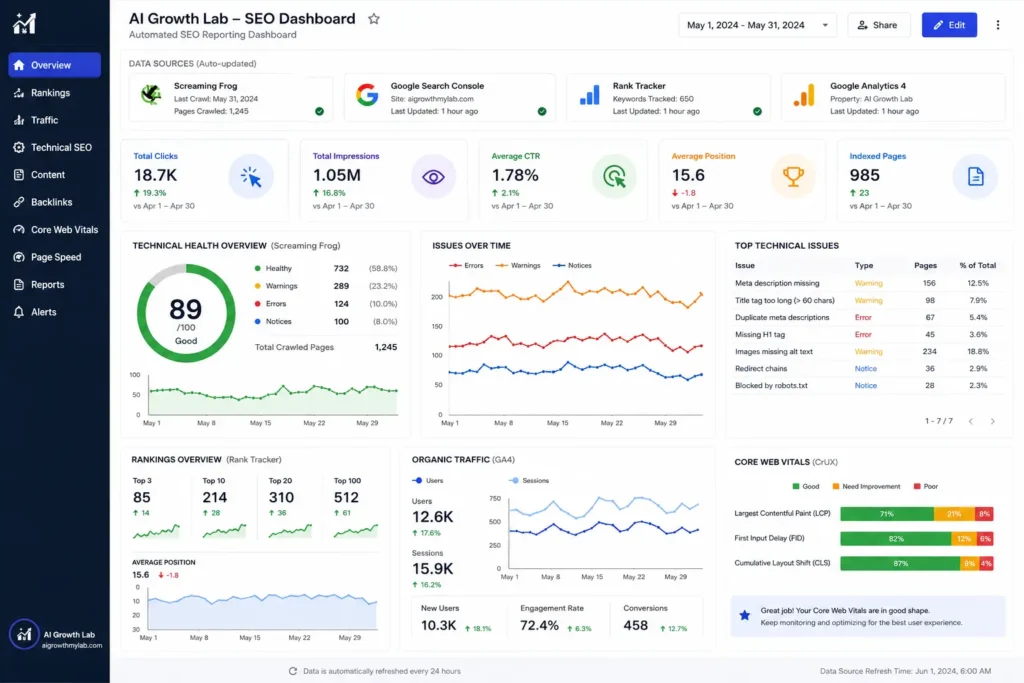
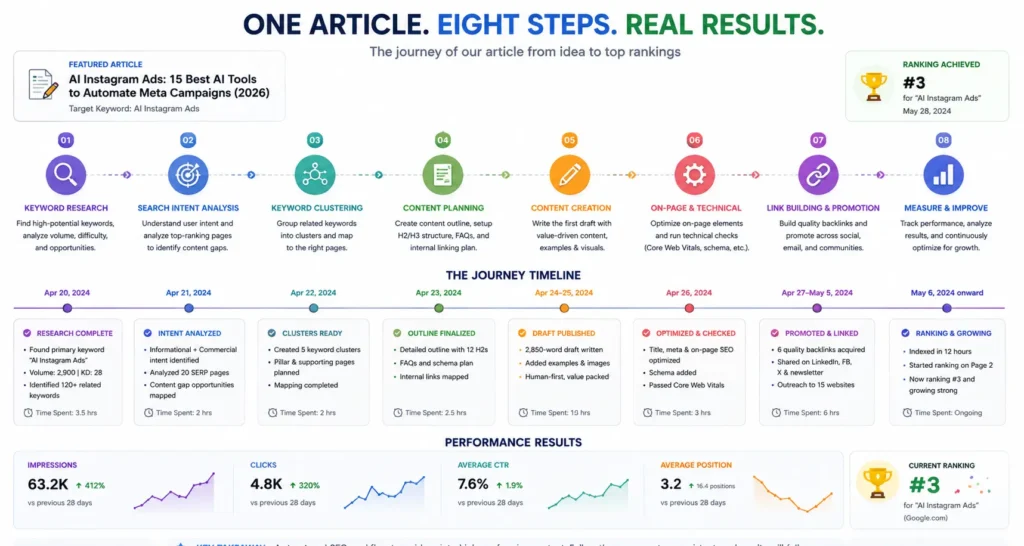
A Real-World Example of an SEO Workflow in Action
To make this concrete, consider how a mid-sized content team might apply this 8-step process to a single new article.
Starting With Research and Planning
The team identifies a target keyword during Step 1, then reviews the top-ranking pages for that term during Step 2. They notice every top result covers pricing, but none address a common objection their own sales team hears regularly. That gap becomes the differentiating angle for the brief built in Step 3.
Moving Through Creation and Technical Review
A writer drafts the article following that brief, and an editor optimizes the on-page elements during Step 4. Before publishing, a quick technical check in Step 5 catches a missing alt tag and an overly long title that would have been cut off in search results.
Closing the Loop
After publishing, the team adds internal links from three related articles during Step 6, then tracks rankings weekly during Step 7. Six weeks later, the article ranks on page one for its target term. The monthly report in Step 8 captures this win and flags two related keywords worth targeting next, feeding directly back into Step 1 for the next article.
Manual SEO Workflow vs. Automated SEO Workflow: A Comparison
Before deciding how much to automate, it helps to see the practical differences side by side.
| Stage | Manual SEO Workflow | Automated SEO Workflow |
|---|---|---|
| Keyword research | Manually exported, sorted in spreadsheets | Recurring pulls, AI-clustered automatically |
| Content briefs | Written individually by a strategist | AI-generated draft, human-refined |
| On-page optimization | Manually checked against a checklist | Scored automatically against competitors |
| Technical audits | Scheduled quarterly, run manually | Continuous, AI-summarized |
| Rank tracking | Checked weekly by hand | Automatic alerts on significant shifts |
| Reporting | Rebuilt each month manually | Live dashboard, refreshes automatically |
| Human oversight needed | High, at every single stage | Moderate, focused on review and strategy |
As the table shows, automation doesn’t remove the need for a skilled strategist. Rather, it shifts their time away from repetitive manual checking and toward the decisions that genuinely require judgment.
Common Mistakes When Building an SEO Workflow
A few recurring mistakes undermine otherwise solid workflows.
Treating Each Stage as Independent Instead of Connected
When keyword research, content creation, and technical review happen in separate silos with no shared documentation, work gets duplicated and gaps go unnoticed. Each stage should feed directly into the next, not operate as an isolated task.
Automating Before the Manual Process Is Solid
Automating a broken or inconsistent process just makes mistakes happen faster. Document and refine the manual workflow first. Only then should you automate the stages that are already working reliably.
Skipping the Reporting and Iteration Step
Many teams treat publishing as the finish line, when it’s really the midpoint. Without Step 8, reporting and iteration, a workflow never actually improves over time. Nobody’s reviewing what worked and what didn’t.
Letting AI Output Skip Human Review
Whether it’s an AI-generated content brief or an automated technical audit summary, unreviewed AI output occasionally misses context specific to your site. A quick human check before acting on any AI-generated recommendation remains essential.
Building a Workflow Too Complex to Actually Follow
Some teams overcorrect by documenting an elaborate 20-step process nobody has the discipline to follow consistently. A workflow that’s genuinely used beats a comprehensive one that gets abandoned within a month. Start simple, then add detail as the team proves it can stick to the basics.
Forgetting to Train the Whole Team on the Workflow
Documenting a process doesn’t automatically mean everyone follows it. Without a proper walkthrough when onboarding new team members, or a refresher when the workflow changes, even well-designed documentation quietly falls out of use. Building a short training session into onboarding pays off far more than the documentation alone.
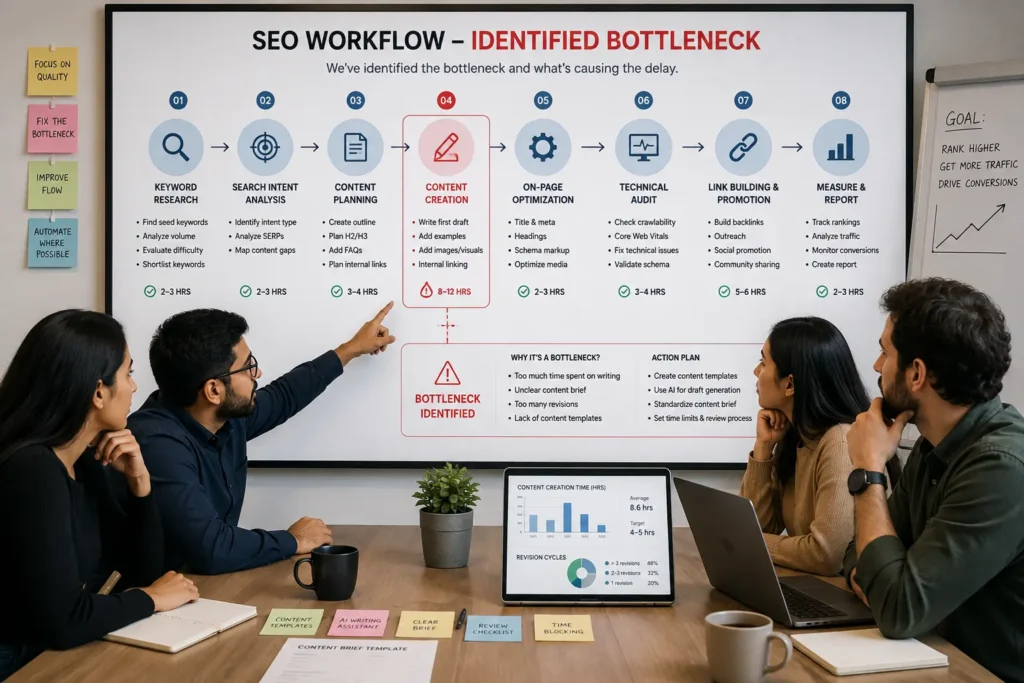
SEO Workflow Best Practices for 2026
A few practices consistently separate workflows that actually stick from ones that quietly fall apart within a few months.
Document Everything in One Shared Location
A workflow that lives only in one person’s head isn’t really a workflow. Keep documentation, briefs, and process notes in a shared, accessible location the whole team can reference.
Assign Clear Ownership for Each Stage
Ambiguity about who owns a given step is one of the fastest ways for tasks to quietly fall through the cracks. Every stage in your workflow should have one clearly responsible person, even if multiple people contribute.
Review and Refine the Workflow Quarterly
Search engines change, tools improve, and team capacity shifts. A workflow that worked perfectly a year ago may need adjusting today. Build in a regular review rather than assuming it’ll stay effective indefinitely.
Start Automation With the Most Repetitive Tasks First
Rank tracking and reporting tend to be the easiest, lowest-risk places to introduce automation. Save more judgment-heavy stages, like content strategy, for continued human ownership.
Keep a Simple Change Log
As the workflow evolves, note what changed and why in a brief, ongoing log. This helps new team members understand the reasoning behind current practices, rather than just inheriting rules with no context for where they came from.
Frequently Asked Questions About SEO Workflow
What is an SEO workflow?
An SEO workflow is a documented, repeatable sequence of steps a team follows to research, create, optimize, and monitor content and technical elements that affect search visibility. It ensures consistent execution regardless of who’s doing the work.
How is an SEO workflow different from an SEO strategy?
Strategy defines the big-picture goals and priorities, like which markets or topics to target. A workflow is the operational process that actually executes that strategy on a day-to-day basis.
Do I need AI tools to have an effective SEO workflow?
No. A well-documented manual workflow can be genuinely effective. AI and automation simply reduce the time each stage takes, which matters most as a site or team scales beyond what manual processes can reasonably keep up with.
What’s the most commonly skipped step in an SEO workflow?
Reporting and iteration, Step 8, gets skipped most often, since publishing often feels like the natural finish line. Skipping this step means the workflow never actually improves, since nobody’s reviewing what worked.
How often should an SEO workflow be reviewed and updated?
Quarterly reviews work well for most teams. This gives enough time to see meaningful results while still catching outdated steps before they cause real problems. Faster-moving industries may benefit from more frequent check-ins.
Can a small business realistically follow an 8-step SEO workflow?
Yes. The process scales down naturally. A solo marketer might spend less time on each stage. Even so, following the same sequence, even informally, produces far more consistent results than skipping steps entirely.
Final Thoughts: Building Your Own SEO Workflow
A strong SEO workflow isn’t about following every step perfectly from day one. Instead, it’s about building a documented, repeatable process that gets refined over time. Clear ownership at every stage and a genuine feedback loop back to Step 1 make the difference.
Start by writing down your current process, even if it’s messy. From there, identify the most repetitive, lowest-risk tasks to automate first. Google’s own documentation on how search works offers a solid foundation for anything you build on top of it (Google Search Central). Over time, this combination of clear documentation and thoughtful automation becomes a genuine competitive advantage, not just a process improvement.
Whether you’re running SEO solo or coordinating a full team, the underlying principle stays the same. A workflow that’s documented, connected, and reviewed regularly will consistently outperform brilliant strategy paired with inconsistent execution. The teams that struggle most aren’t usually missing knowledge. They’re missing the discipline of a repeatable process that survives beyond any single person’s memory.
Ready to go deeper on the automation side specifically? Check out our guide on AI SEO Workflow Automation for a complete breakdown of building a fully connected, automated system.