
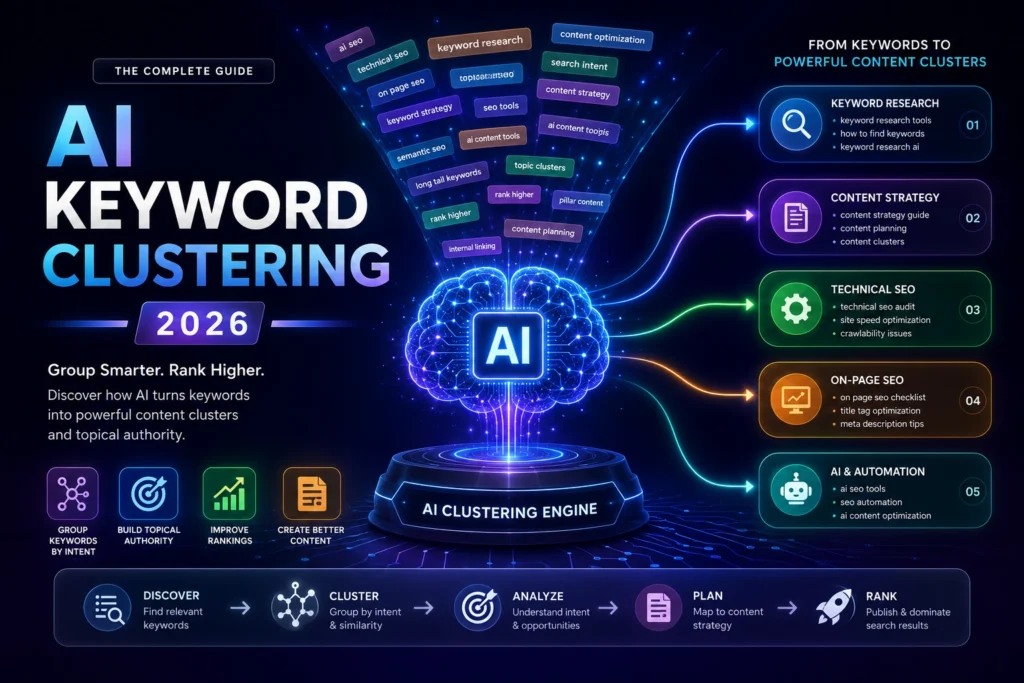

A spreadsheet with 500 keywords doesn’t tell you what to write. It just tells you what people search for. AI Keyword Clustering solves the gap between raw keyword data and an actual content plan. It groups related terms by shared search intent, so you know exactly which keywords belong on the same page and which need their own.
This matters because Google doesn’t rank isolated keywords anymore. It rewards sites that demonstrate comprehensive coverage of a topic, what’s commonly called topical authority. In this guide, you’ll learn what AI keyword clustering actually is and how it compares to manual grouping. You’ll walk through a complete five-step workflow, then see a real example turning 100 keywords into 12 content clusters. You’ll also get a comparison of the best tools available, common mistakes to avoid, and answers to the questions people ask most about this process.
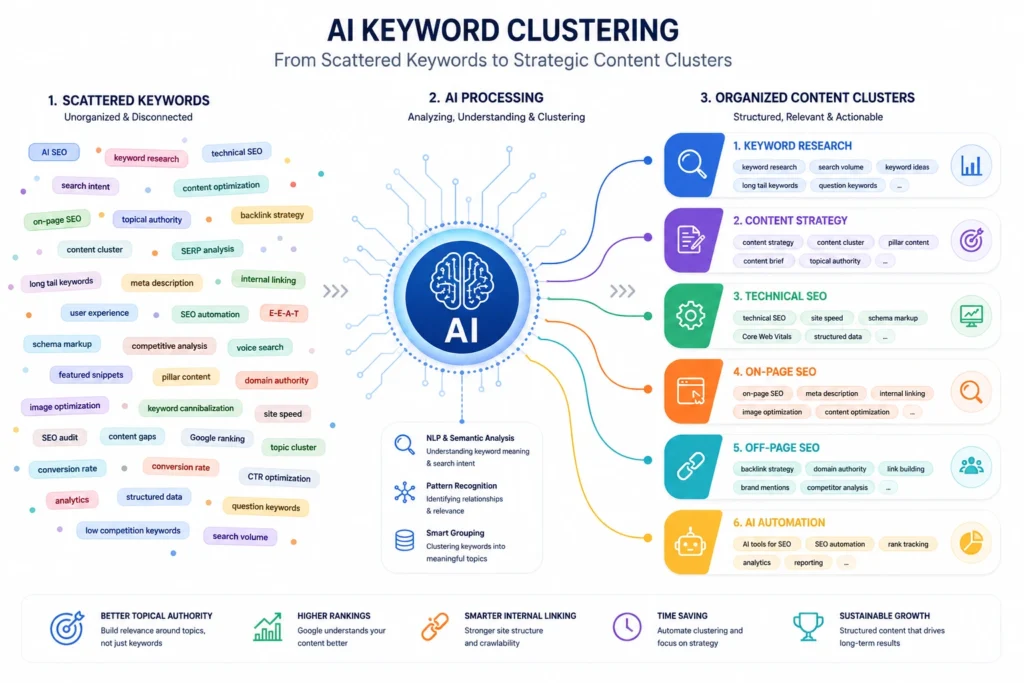
Scattered keyword tags being organized by AI into labeled, color-coded content clustersWhat Is AI Keyword Clustering?
AI keyword clustering is the process of using machine learning to group related keywords by shared search intent and semantic meaning. This works differently from surface-level word matching. Instead of manually deciding whether “best running shoes” and “top running shoes 2026” belong together, AI analyzes search behavior and SERP overlap to make that call automatically.
In short, keyword clustering exists because Google ranks pages for topics, not individual keywords in isolation. A single well-structured page can rank for dozens, sometimes hundreds, of related terms. This happens when the page comprehensively covers the underlying topic those terms represent.
Search Intent and Semantic Relationships, Explained Simply
Two keywords can look nearly identical on paper and still deserve separate pages. “Buy running shoes” signals someone ready to purchase. “How to choose running shoes” signals someone still researching. These represent different intents, even though the topic overlaps. Semantic relationships work similarly. Keywords don’t need matching words to belong in the same cluster. They just need to represent the same underlying question a searcher is trying to answer.
Why Google Rewards Topical Authority Over Isolated Keywords
Search engines increasingly evaluate whether a site demonstrates depth on a subject. It’s not just about whether a single page happens to match a query. A site with ten thin, disconnected pages about running shoes generally performs worse than a site with three comprehensive, well-clustered pages covering the same ground. This is precisely why clustering has become a foundational step, not an optional one, in modern SEO planning.
A Quick Way to Spot Whether Two Keywords Belong Together
A practical test cuts through most of the guesswork here. Search both keywords and compare the top five results. If the same pages show up for both, Google has effectively already told you they represent the same topic. If the results look completely different, treat them as separate clusters, even if the keywords themselves look similar on paper. This single check often resolves disagreements that would otherwise require a longer debate about intent.
(For a broader look at how this fits into a complete process, see our related guide.) It covers The SEO Workflow in full depth.
AI Keyword Clustering vs. Traditional Keyword Grouping
Before adopting AI tools, it helps to understand what manual clustering actually involves and where it tends to fall short.
AI Keyword Clustering: Manual Clustering
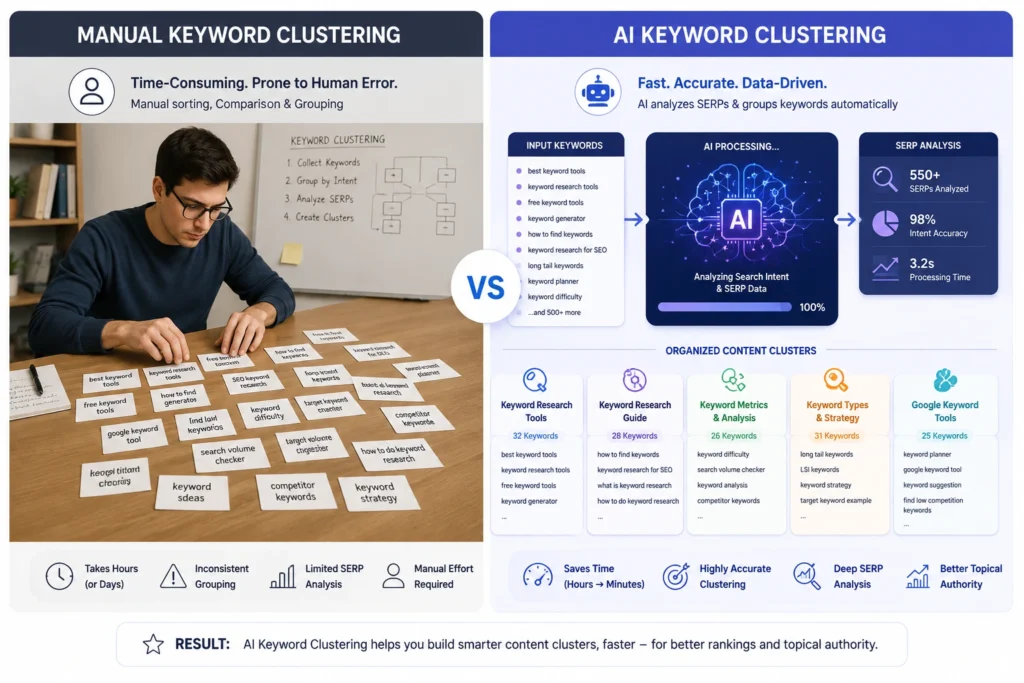
Manual clustering means a strategist reviews a keyword list by eye. They group terms based on shared words or personal judgment about intent. This works reasonably well for small lists, a few dozen keywords. However, it becomes genuinely impractical past a few hundred terms. Human reviewers also tend to group keywords by surface similarity rather than actual search intent. This can quietly create the exact cannibalization problem clustering is supposed to prevent.
AI-Powered Clustering
AI-powered clustering analyzes live SERP data, semantic relationships, and search intent signals simultaneously. It processes thousands of keywords in minutes rather than hours. Instead of relying on shared words, these tools check which keywords already share top-ranking URLs. That’s a strong signal that Google itself treats them as the same topic.
Which Method Is More Accurate?
Neither approach works perfectly alone. SERP-based AI clustering tends to produce more accurate groupings than either manual review or purely semantic AI matching. This is because it reflects what Google is actually doing in live search results, rather than a theoretical model of language similarity. However, AI-generated clusters still benefit from human review. Automated systems occasionally group keywords that share SERP overlap but genuinely deserve separate treatment for business reasons. The most reliable workflow in 2026 typically combines SERP-based clustering for the core grouping, then applies human judgment and AI-assisted intent labeling on top.
A person manually sorting keyword cards versus an AI system processing the same keywords via SERP analysisWhy Keyword Clustering Matters for SEO in 2026
A few concrete benefits explain why this step deserves real investment, rather than being treated as a quick pre-writing task.
Improves Topical Authority
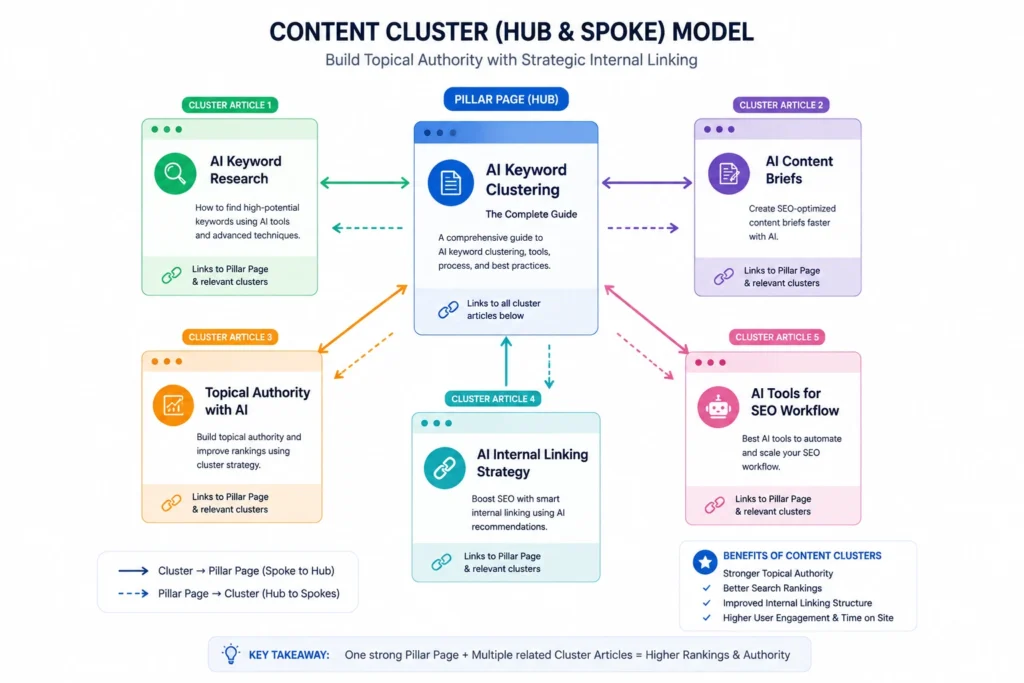
Clustering related keywords into a single, comprehensive page, or a pillar page supported by related articles, signals depth to search engines. Scattered, thin content simply can’t do the same. This depth is increasingly what separates sites that rank consistently from sites that rank sporadically for individual terms.
Reduces Keyword Cannibalization
Without clustering, teams often accidentally create multiple pages targeting nearly identical intent. This forces those pages to compete against each other in search results, instead of ranking together. Proper clustering catches this before content gets written, not after two competing pages have already gone live.
Creates Better Internal Linking
Once keywords are grouped into clear clusters, the internal linking structure practically builds itself. Supporting articles link naturally to their pillar page, and related clusters link to each other. This creates the kind of interconnected site architecture that both users and search engines navigate more easily.
A hub-and-spoke diagram showing a pillar page connected to five supporting cluster articlesStep-by-Step AI Keyword Clustering Workflow
Here’s the complete process, from a raw keyword export to a finished content plan.
Step 1: Collect Keywords
Start by exporting a broad keyword list from a research tool like Ahrefs or Semrush. Aim for several hundred terms covering your core topic and its related subtopics. Cast a wide net at this stage. It’s easier to filter out irrelevant keywords later than to discover a missing angle after clustering is already complete. Include question-based keywords and long-tail variations alongside the obvious head terms, since these often reveal subtopics a narrower list would miss entirely.
Step 2: Identify Search Intent
Before clustering, tag or review keywords for likely intent, informational, commercial, transactional, or navigational. This step matters because two keywords with high semantic similarity can still need separate pages if their underlying intent differs, as with the running shoes example earlier. Many teams do this quickly by scanning the SERP for each keyword, since the type of content already ranking usually signals intent clearly.
Step 3: Let AI Create Clusters
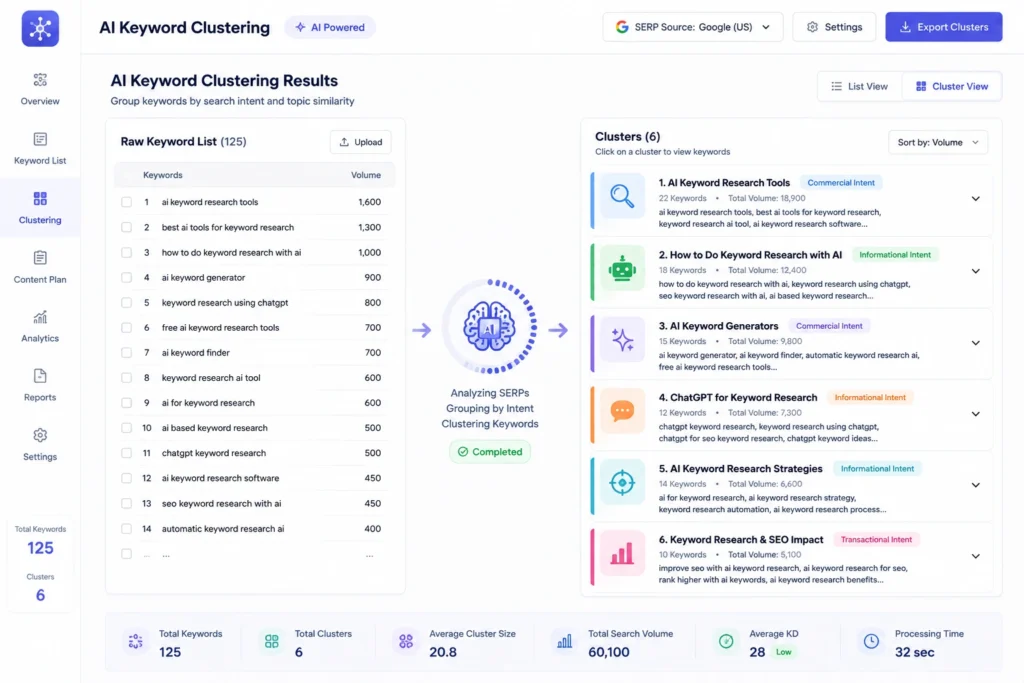
Feed the cleaned keyword list into an AI clustering tool. It groups terms based on SERP overlap and semantic relationships. Most tools return clusters within minutes, often labeling each one with a suggested primary keyword and estimated search volume. At this stage, resist the urge to immediately start writing; the raw output still needs a review pass before it’s genuinely ready to act on.
Step 4: Review and Refine
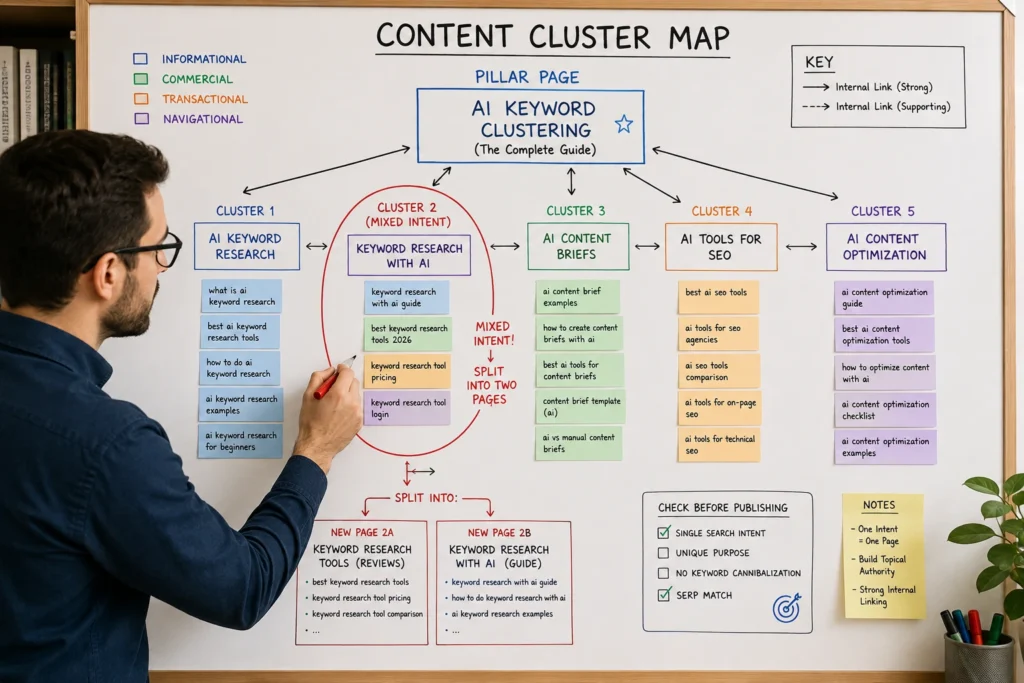
Never treat AI output as final. Review each cluster for genuine coherence. Check that grouped keywords truly share the same intent, and that no cluster is either too broad or artificially narrow. This step is where human judgment adds the most value in the entire process. Split any cluster that feels like it’s forcing two different questions into one page, and merge clusters that turn out to be near-duplicates of each other.
Step 5: Build Content Silos
Turn each refined cluster into a content plan. Build one comprehensive pillar page per major cluster, supported by narrower articles targeting related subtopics that link back to that pillar. This structure is what actually translates clustering work into published, interconnected content. Document this plan somewhere the whole team can reference, so future content decisions stay consistent with the cluster map rather than drifting back toward ad hoc topic selection.
Best AI Keyword Clustering Tools
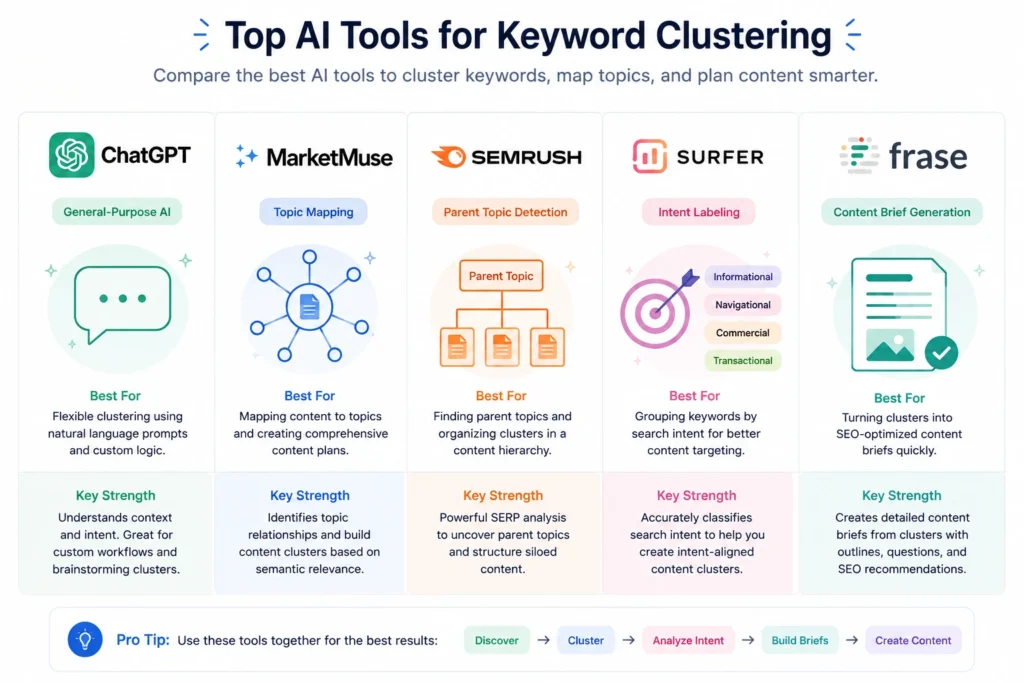
Rather than naming a single winner, it helps to understand what each tool actually does well.
ChatGPT
ChatGPT can cluster smaller keyword lists reasonably well when given clear instructions. This makes it a genuinely useful free starting point. However, it relies on semantic pattern matching rather than live SERP data. So, its groupings are less reliable than purpose-built tools once a list grows past a couple hundred keywords.
Semrush
Semrush’s Topic Research and Keyword Strategy Builder tools generate visual maps of subtopics and questions around a pillar topic. They now include AI-assisted content brief generation once clusters are set. This suits teams already using Semrush for rank tracking, since clustering becomes an added capability rather than a separate subscription.
Ahrefs
Ahrefs’ Keywords Explorer includes parent topic clustering. This groups keyword ideas by identifying which terms share the same top-ranking URL, a genuinely strong SERP-based signal. This works well for teams already relying on Ahrefs for backlink and keyword research, adding clustering without switching tools entirely.
Keyword Insights
Keyword Insights specializes specifically in clustering. It uses live SERP data to group thousands of keywords by shared intent, while also labeling each cluster as informational, commercial, or transactional. Its focus on catching subtle intent differences between semantically similar keywords makes it particularly effective at preventing cannibalization before content ever gets written.
Surfer SEO
Surfer SEO focuses less on the clustering step itself and more on what happens after. It turns finalized clusters into detailed content briefs and optimization guidance. This makes it a strong complement to a dedicated clustering tool, rather than a full replacement for one.
Comparing AI Keyword Clustering Tools
Before choosing, it helps to see how these tools differ side by side.
| Tool | Best For | Data Source | Ideal Team Size |
|---|---|---|---|
| ChatGPT | Small lists, quick starts | Semantic pattern matching | Solo or small teams |
| Semrush | Teams already on Semrush | Topic maps, AI briefs | Small to mid-size |
| Ahrefs | Backlink and keyword research users | Parent topic SERP overlap | Small to mid-size |
| Keyword Insights | Large lists, cannibalization prevention | Live SERP + intent labeling | Mid-size to enterprise |
| Surfer SEO | Turning clusters into briefs | Content optimization data | Any, as a second tool |
As the table shows, no single tool covers every stage perfectly. Many teams pair a discovery tool like Ahrefs with a dedicated clustering tool like Keyword Insights, then finish with Surfer SEO for content briefs.
Real Example: From 100 Keywords to 12 Content Clusters
To make this concrete, here’s a simplified look at how a raw keyword export might transform into an actual content plan for a site covering home coffee brewing.
| Sample Raw Keywords | AI Cluster | Suggested Article Title |
|---|---|---|
| pour over coffee, best pour over method, pour over ratio | Pour-Over Brewing | The Complete Guide to Pour-Over Coffee |
| french press vs pour over, best french press | French Press Comparison | French Press vs. Pour-Over: Which Should You Choose? |
| espresso machine for beginners, best budget espresso machine | Beginner Espresso Machines | 7 Best Espresso Machines for Beginners in 2026 |
| how to grind coffee beans, best grind size for drip | Coffee Grinding | How to Grind Coffee Beans for Every Brew Method |
| coffee bean storage, how long do coffee beans stay fresh | Coffee Freshness | How to Store Coffee Beans to Keep Them Fresh |
Across the full 100-keyword list, this same process typically produces somewhere around 10 to 15 distinct clusters. The exact number depends on how broad or narrow the original topic is. Each cluster becomes one pillar article. Any remaining narrower keywords inside that cluster become supporting subtopics within the same piece, or a closely linked companion article.
Why This Example Matters Beyond Coffee
The same logic applies regardless of industry. A software company researching keywords around “project management” would go through an identical process, ending up with clusters like “task management tools,” “project management methodologies,” and “team collaboration software,” each becoming its own pillar page. The specific topic changes, but the underlying pattern, raw list to intent-based groups to a structured content plan, stays consistent across virtually every niche.
(For guidance on turning these clusters into optimized pages, see our related guide.) It covers AI On-Page SEO in more depth.
Common Mistakes to Avoid
A few recurring mistakes undermine otherwise solid clustering work.
Mixing Different Search Intents Into One Cluster
Grouping “buy” and “how to choose” keywords together because they share vocabulary, rather than intent, tends to produce a page that serves neither audience well. Always double-check intent alignment within a cluster, even when a tool has already labeled it.
Over-Grouping Unrelated Keywords
Some tools, especially less sophisticated ones, can bundle loosely related keywords into a single oversized cluster to simplify their output. A cluster that’s too broad results in a page trying to cover too much ground. This dilutes its focus and, ultimately, its ranking potential for any single term.
Ignoring What’s Actually Ranking in the SERPs
Semantic similarity alone doesn’t guarantee two keywords belong together. Checking actual search results for overlap remains the most reliable signal. It reflects what Google itself has already decided about a topic’s boundaries.
Creating Duplicate or Near-Duplicate Pages
Without proper clustering, it’s easy to accidentally publish two pages that target nearly the same intent, weeks or months apart. The overlap often goes unnoticed until rankings suffer. A documented cluster map prevents this by giving the whole team one clear reference for what’s already been covered.
Treating the Cluster Map as a One-Time Exercise
Search behavior shifts over time, and new keywords emerge as a topic evolves. Teams that build a cluster map once and never revisit it eventually end up with gaps and outdated groupings, even if the original work was solid.
A strategist reviewing a cluster map on a whiteboard, with a mixed-intent cluster circled in redFrequently Asked Questions About AI Keyword Clustering
What is AI keyword clustering?
AI keyword clustering is the process of using machine learning to group related keywords by shared search intent and semantic meaning. It relies on signals like SERP overlap, rather than purely shared words or manual judgment.
How is keyword clustering different from keyword grouping?
The terms are often used interchangeably. However, “clustering” typically implies a more data-driven, intent-based approach, especially when powered by AI, while “grouping” can refer to simpler, manual categorization based on shared words or themes.
Do I need a paid tool for keyword clustering, or can ChatGPT do it?
ChatGPT works reasonably well for smaller keyword lists and basic clustering, especially as a free starting point. However, it lacks access to live SERP data. So, purpose-built tools like Keyword Insights or Ahrefs tend to produce more accurate results at scale.
How many keywords should be in one cluster?
There’s no fixed number, but most well-formed clusters contain somewhere between 5 and 30 related keywords. The right size depends on the topic’s overall search volume and how granular the underlying subtopics are.
Can keyword clustering help prevent keyword cannibalization?
Yes, significantly. Clustering surfaces overlapping intent before content gets written. This is precisely the point where cannibalization is easiest and cheapest to prevent, rather than trying to fix it after two competing pages already exist.
How often should I redo my keyword clusters?
Revisiting clusters every six to twelve months makes sense for most sites, since search behavior and SERP results shift over time. Faster-moving industries or highly competitive niches may benefit from more frequent reviews.
Final Thoughts: Turning Keywords Into a Real Content Strategy
AI keyword clustering isn’t about generating a prettier spreadsheet. It’s about turning a flat list of search terms into an actual content plan. That plan builds genuine topical authority, instead of a scattered collection of pages competing against each other. Google’s own guidance on creating helpful, well-organized content reinforces this same principle. Comprehensive, well-structured coverage of a topic consistently outperforms thin, disconnected pages (Google Search Central).
Start with a clean keyword export, let AI handle the heavy lifting of initial grouping, and always apply a human review pass before building out content silos. Over time, this combination of AI speed and human judgment produces a site structure that’s genuinely easier for both readers and search engines to navigate.
Whether you’re planning content for a small blog or a large multi-topic site, the underlying principle stays the same. Clustering first, writing second, keeps a content strategy organized around real search intent rather than a loosely connected pile of individual articles.
Ready to put these clusters into optimized content? Check out our guide on AI On-Page SEO for a complete breakdown of turning a content plan into pages that actually rank.