

Backlinks are still one of the strongest ranking signals in SEO. However, the manner in which teams build them has changed dramatically. AI link building now touches nearly every stage of the process, from finding opportunities to drafting outreach emails. As a result, what used to take a full-time outreach specialist weeks to accomplish can now happen in a fraction of the time.
However, speed alone does not guarantee quality. In fact, Google has specifically cracked down on AI-generated link networks and mass-produced guest posts built purely to manipulate rankings.
Therefore, the real question is not whether to use AI for link building. Instead, it is how to use it responsibly, in a way that earns genuine authority rather than triggering a penalty.
In this guide, you will learn what AI link building looks like in practice. You will also see which AI link building tools are worth adopting, which tactics to avoid, and how to build a backlink profile that holds up under Google’s increasingly sophisticated spam detection. By the end of this session, you will have a clear and practical framework for using AI without compromising your website’s integrity.
What Is AI-Powered Link Building, Exactly?
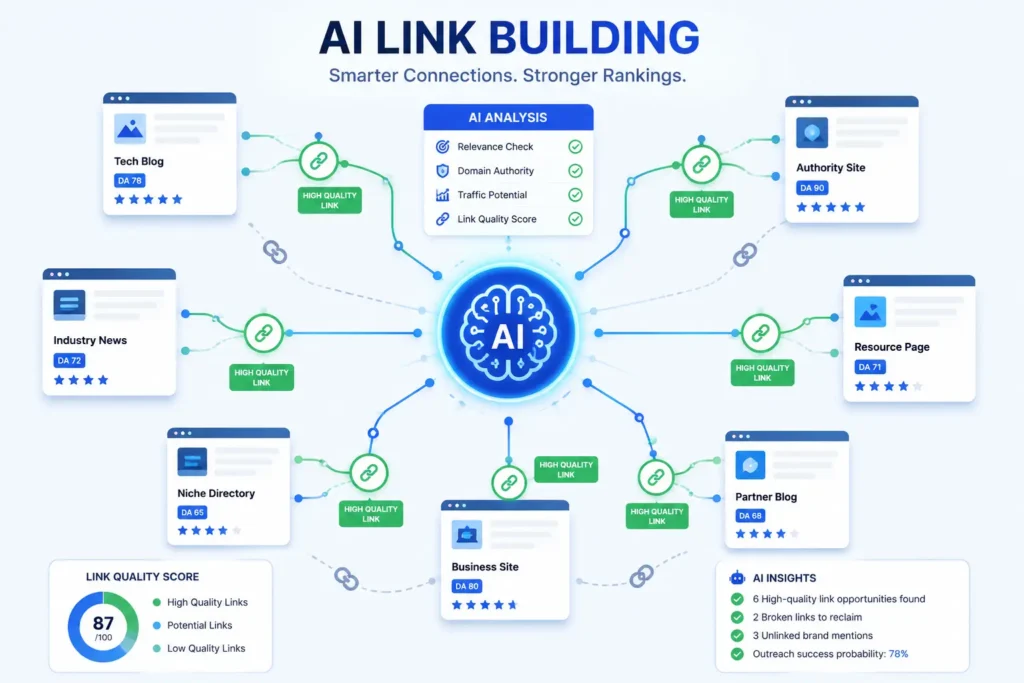
AI link building refers to using artificial intelligence tools to support any stage of the backlink acquisition process. This includes finding relevant sites, identifying broken link opportunities, drafting personalized outreach emails, and analyzing which links are worth pursuing.
Importantly, AI link building is not a single tactic. Rather, it is a layer of automation and intelligence applied on top of traditional link-building strategies that already work, such as guest posting, digital PR, and resource page outreach.
What AI Link Building Is Not
It is worth being direct about this. AI link building is not a shortcut to mass-producing spammy backlinks. Google’s spam detection systems, particularly its SpamBrain system, have become significantly more effective at identifying AI-generated content farms built purely to house paid links. Therefore, treating AI as a way to scale low-quality tactics faster is likely to backfire, not help.
Why AI Backlink Building Matters More in 2026
Several shifts explain why this topic deserves fresh attention this year.
An AI Link Building Reality: Google Rewards Quality Over Quantity
Google’s core ranking systems have shifted meaningfully away from rewarding link volumes. Instead, quality and topical relevance now carry much more weight.
According to Google’s own spam policies, link schemes intended to manipulate rankings, including large-scale link exchanges and content built solely to house backlinks, are explicitly against its guidelines (Google Search Central). Consequently, the bar for what counts as a “good” backlink has risen substantially.
Why AI Link Building Spam Networks Are Now a Specific Target
Because many teams have attempted to use AI to scale content-for-links schemes, Google’s enforcement has specifically targeted this pattern. Large networks of thin, machine-generated guest posts built purely to embed backlinks are now treated as a distinct violation category.
This matters because it draws a clear line: AI can support research and outreach, but it should not replace genuine editorial judgment.
Why AI Link Building Helps When Manual Outreach No Longer Scales
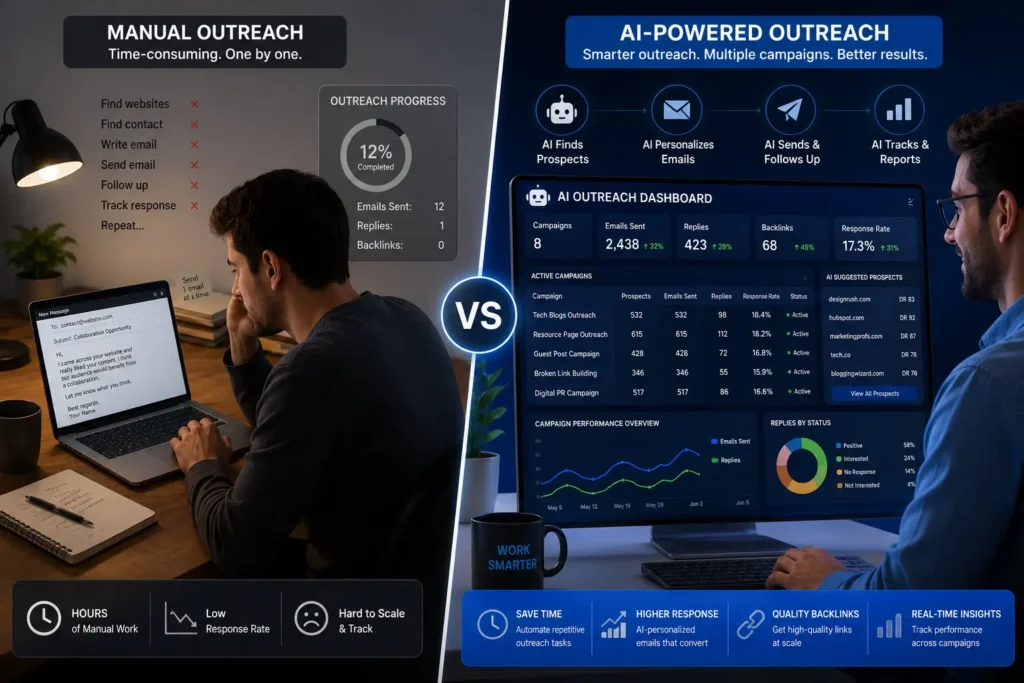
However, manual link building has not become obsolete. It is simply too slow. Between prospecting, vetting, and personalizing outreach, a single link-building campaign can consume dozens of hours of work. AI link-building tools can compress much of that research and drafting time, freeing strategists to focus on relationship building and quality control.
How AI Link Building Tools Actually Work
Understanding the mechanics helps you use these tools more effectively rather than treating them as a black box.
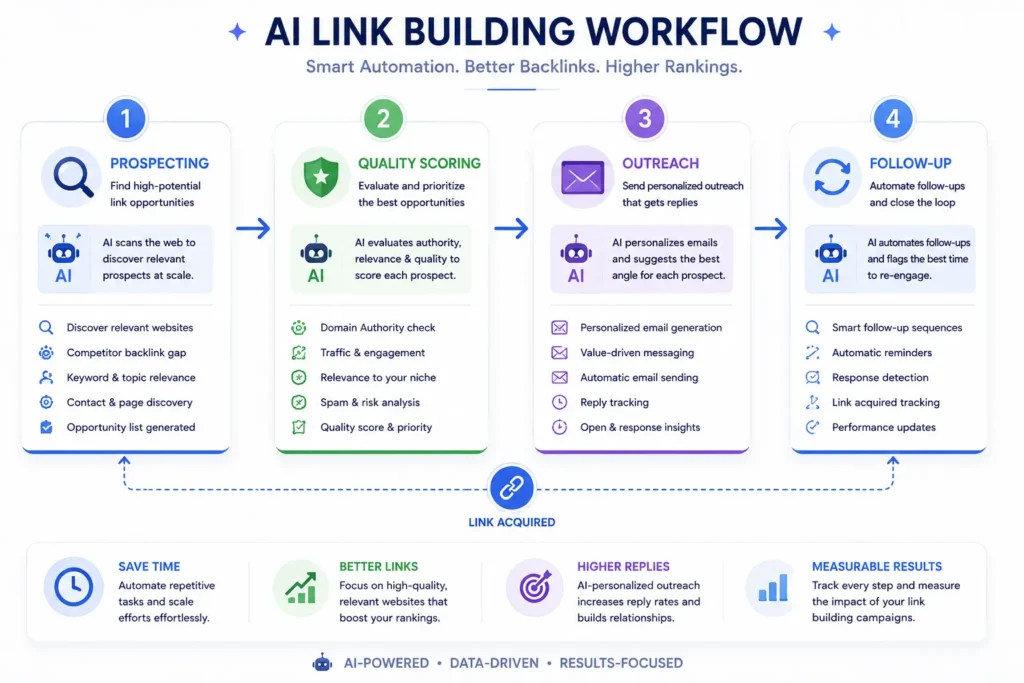
Step 1: Prospecting and Opportunity Discovery
AI tools scan large volumes of websites to identify link opportunities that match the niche. This includes resource pages, competitor backlinks, broken links, and unlinked brand references. Instead of manually searching site by site, the tool surfaces a prioritized list based on relevance and authority signals.
Step 2: Relevance and Quality Scoring
Not every opportunity is worth pursuing. Good AI link-building tools score prospects based on topical relevance, traffic patterns, and spam risk. This step matters enormously, since pursuing irrelevant or low-quality sites can do more harm than good to your backlink profile.
Step 3: Personalized Outreach at Scale
Once prospects are identified, AI can draft personalized outreach emails referencing specific details about each site. This is not the same as generic mail-merge outreach. Instead, well-built tools pull real context, such as a recent article or a specific gap in the site’s content, to make each email feel genuinely relevant.
Step 4: Relationship Tracking and Follow-Up
Finally, AI tools can manage follow-up sequences and track response rates across a campaign. This keeps outreach organized at scale, without losing the personal touch that earns replies.
AI Link Building vs. Traditional Link Building: A Comparison
This helps to see the practical differences side by side before deciding how much to automate.
| Factor | Traditional Link Building | AI Link Building |
| Prospecting speed | Manual research, site by site | Automated, scans thousands of sites quickly |
| Outreach personalization | Written individually by a specialist | AI-drafted, human-reviewed before sending |
| Quality vetting | Based on specialist judgment alone | AI scoring combined with human review |
| Volume of outreach | Limited by team capacity | Higher volume, if quality controls are maintained |
| Risk of spam-like patterns | Lower, but slower results | Higher if left unsupervised, lower with review |
| Best suited for | Deep relationship-building campaigns | High-volume prospecting and initial outreach |
As the table shows, the safest approach usually combines both. AI handles repetitive research and drafting, while human judgment handles final quality decisions.
Best Tools for Building Backlinks
Rather than naming a single “best” tool, it is more useful to understand the categories available and what each one solves.
Prospecting and Opportunity Discovery Tools
This category of AI link-building tools scans the web to surface relevant sites, broken links, and unlinked mentions of your brand. They save enormous time compared to manual searching, although the results still require human review before outreach begins.
Outreach Personalization Platforms
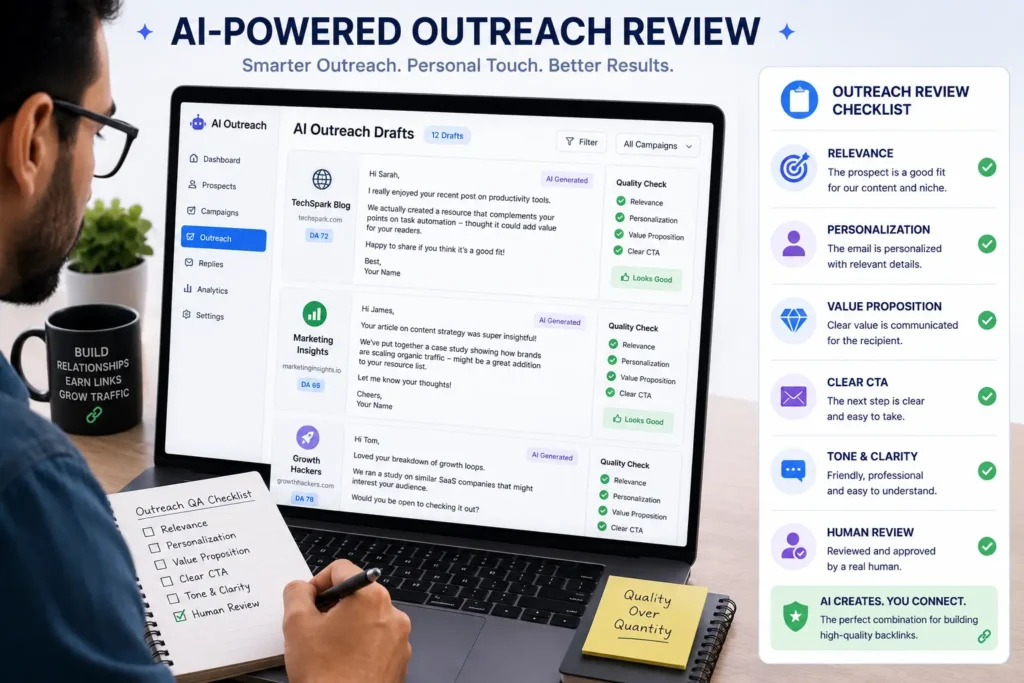
These tools draft outreach emails using AI, pulling real details from the target site to avoid generic-sounding messages. However, the best practice is always to review and lightly edit each draft before sending, both to catch errors and to add a genuinely human touch.
Backlink Auditing and Monitoring Tools
This category focuses on ongoing health rather than its acquisition. AI-powered auditing tools flag toxic or spammy backlinks pointing to your site, track new links as they appear, and monitor whether existing links are still active.
Content Gap and Digital PR Research Tools
Some AI tools specialize in identifying data-driven story angles or content gaps that are likely to generate organic editorial links. This supports a more sustainable long-term strategy than direct outreach alone, as a genuinely link-worthy asset tends to attract backlinks without ongoing manual efforts.
(For a broader look at how these tools fit into a larger workflow, see our related guide on AI SEO Agents and Automation Tools.)
Best Practices for AI-Assisted Backlink Building
Using AI responsibly is what separates a durable backlink profile from one that is eventually penalized.
Always Keep a Human Review Step
AI-drafted outreach and AI-identified prospects should never be unreviewed. A quick human check catches irrelevant sites, awkward phrasing, and factual errors before they damage your outreach reputation.
Prioritize Relevance Over Volume
A single relevant authoritative backlink is worth far more than dozens of low-quality backlinks. Therefore, it is important to resist the temptation to blast outreach at every site an AI tool surfaces. Instead, it focuses on genuine topical fit.
Avoid AI-Generated Content Built Purely for Links
Guest posts and resource pages still need real value for readers, not just a vehicle for backlinks. Thin, AI-written content produced solely to house links is exactly the pattern Google’s spam systems are trained to catch.
Diversify Your Anchor Text Naturally
A backlink profile dominated by exact-match keyword anchors is a recognized spam signal. A natural profile includes a healthy mix of branded, generic, and partial-match anchors alongside exact-match anchors.
Monitor Your Backlink Profile Regularly
Even with careful outreach, toxic links can appear over time. Regular audits help you catch and disavow harmful links before they affect your rankings.
Common Mistakes in AI Link Building
A few recurring mistakes tend to cause significant damage.
Sending Outreach Without Any Personalization
Even AI-assisted outreach can feel generic if the drafts are not reviewed and refined. Generic-sounding emails are ignored, or worse, marked as spam, which can hurt your sender reputation over time.
Chasing Volume Instead of Relevance
More outreach is not automatically better. Sending hundreds of emails to loosely related sites tends to produce a low response rate and, occasionally, low-quality links that do more harm than good.
Treating AI Tools as Fully Autonomous
Allowing an AI tool to identify prospects and send outreach without any human oversight is risky. Even well-built tools can misjudge relevance or site quality; therefore, a review step remains essential.
Ignoring Google’s Spam Policies
Some AI link building services quietly repackage old link-scheme tactics as “content marketing.” Regardless of the label, if the underlying pattern involves manufactured links or thin content built solely for backlinks, it carries a real penalty risk.
Common Pain Points With AI Link Building
A few challenges have been repeatedly encountered by teams adopting these tools.
“Will AI-Assisted Outreach Feel Too Generic?”
Only if you skip the review step. Good AI link-building tools pull real, specific details from target sites, but a quick human pass makes the difference between a passable email and one that actually gets a reply.
“How Do I Know If a Link Opportunity Is Actually Safe?”
Look for genuine topical relevance, real traffic, and editorial context, not just a high authority score from a third-party tool. If a site’s only value is offering a place to insert a link, it is a red flag.
“Is AI Link Building Risky for My Site’s Rankings?”
It can be used to scale manipulative tactics. However, used to speed up research and drafting while keeping human judgment in the loop, it is a legitimate and increasingly common part of modern SEO.
Frequently Asked Questions About AI Link Building
What is AI link building?
AI link building involves the use of artificial intelligence tools to support backlink acquisition, including prospecting, quality scoring, outreach drafting, and ongoing profile monitoring, typically alongside human review.
Are AI link-building tools safe to use?
Generally, yes, when used to support research and outreach rather than mass-produce spammy content or manipulate rankings at scale. Google’s spam systems specifically target AI-generated link networks built purely to house backlinks.
What are the best AI link-building tools to start with?
Start with a prospecting and opportunity discovery tool, as it typically saves the most time. Subsequently, add an outreach personalization and backlink auditing tool as your process matures.
Can AI replace human link-building specialists?
No. Although AI can automate research and drafting, relationship-building, quality judgment, and strategic decisions still require human expertise, especially for high-value partnerships and digital PR opportunities.
How can I determine whether a backlink is of high quality?
A high-quality backlink comes from a topically relevant, genuinely active site, appears within real editorial content rather than a footer or sidebar, and was not paid for or manufactured through a link scheme.
Final Thoughts: Using AI Link Building the Right Way
AI link building is not going away, and it shouldn’t. Used thoughtfully, it saves significant time on repetitive parts of the process- prospecting, drafting, and monitoring- while freeing up human attention for what actually earns trust: genuine relationships and quality content.
That said, the teams that succeed with this approach are not the ones automating everything and hoping for the best. Instead, they are the ones using AI to move faster while still applying real judgment at every step, especially before anything goes out under their brand’s name.
Are you ready to build a smarter link-building process? Check out our guide on AI SEO Agents and Automation Tools to see how autonomous tools can support your broader SEO strategy, from research to reporting.