
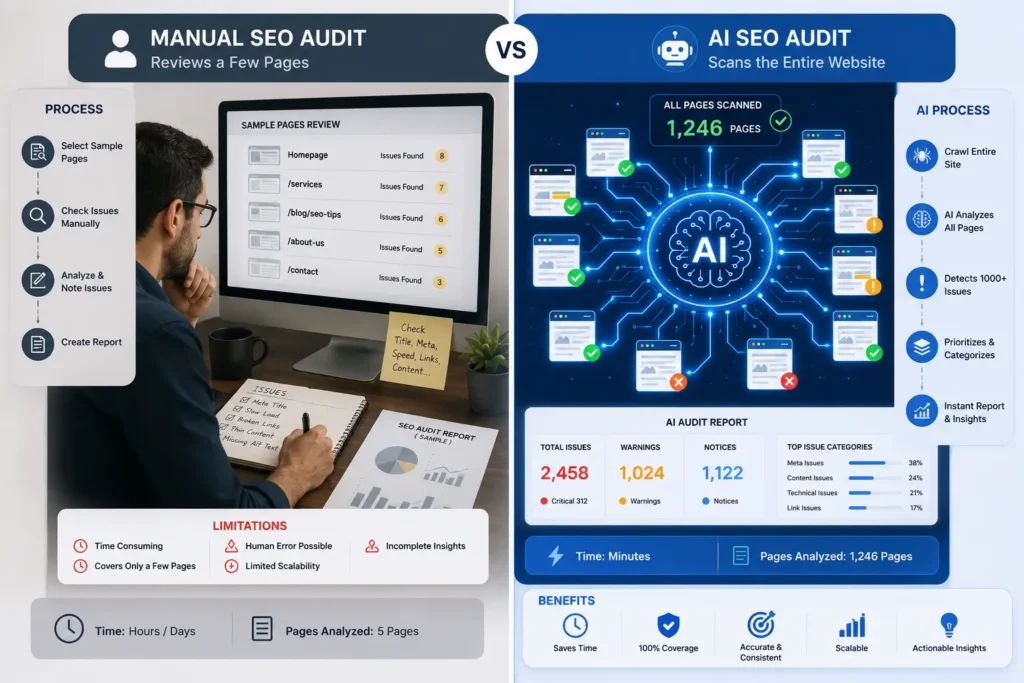

A site audit used to mean blocking off a few days, exporting spreadsheets, and manually checking page after page for issues. That approach still works, but it’s slow. Slow doesn’t hold up well against how fast search changes now. AI SEO audits have changed the pace entirely. Instead of days, a full site scan can surface prioritized issues within minutes.
This matters because technical problems, thin content, and structural issues can quietly drag down rankings for weeks. Often, nobody notices until traffic has already dropped. In this guide, you’ll learn what an AI SEO audit actually involves and why it matters more in 2026. You’ll also see which AI SEO audit tools are genuinely worth using. Beyond that, you’ll get a step-by-step process, common mistakes to avoid, and best practices for running audits that lead to real improvements, not just longer to-do lists.
What Is an AI SEO Audit?
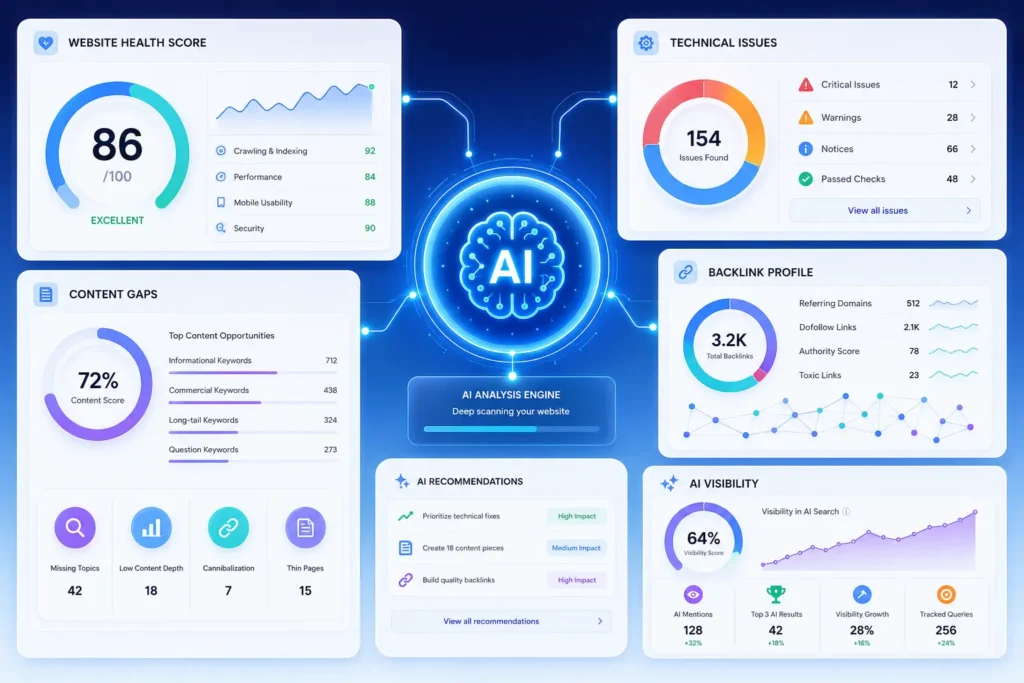
An AI SEO audit uses artificial intelligence to scan a website and identify issues affecting its search performance. This includes technical problems, on-page gaps, backlink quality, and increasingly, how well AI systems like ChatGPT and Perplexity can access and understand a site’s content.
Instead of a specialist manually checking each page, AI tools crawl the entire site at once. They analyze dozens or even hundreds of ranking factors simultaneously. From there, they generate a prioritized list of issues. This often comes with a clear health score, rather than a raw data dump someone still has to interpret manually.
How This Differs From a Traditional SEO Audit
A traditional audit relies heavily on a specialist’s manual review, often sampling a portion of pages rather than checking every single one. This works reasonably well for smaller sites. However, it becomes impractical quickly as a site grows past a few hundred pages.
AI SEO audits, by contrast, can scan every page rather than a sample. Because of this, issues that a manual sampling approach might miss entirely get caught just as reliably as problems on a site’s most visible pages. A handful of broken links buried deep in an old category page is a common example. This kind of comprehensive scanning is exactly what makes the approach worth adopting for growing sites.
A Simple Example of an AI SEO Audit in Practice
Consider a site with 5,000 pages built up over several years. A manual audit might realistically sample a few hundred pages and extrapolate patterns from there. An AI-powered audit tool works differently. It can crawl the entire site, flagging every duplicate title tag and every page returning a soft 404. It also catches every missing alt text attribute, without needing to guess at what a sample might have missed.
The specialist’s job then shifts. Instead of hunting for problems, they review a prioritized list and decide what to fix first. That shift alone often saves teams days of manual work per audit cycle.
Why AI SEO Audits Matter in 2026
A few converging trends explain why this topic deserves fresh attention this year.
Search Has Grown More Complex to Evaluate
Ranking well today depends on more than keywords and backlinks. It involves technical health, structured data, Core Web Vitals, and visibility inside AI-generated search summaries. Manually evaluating all of these factors across a growing site is genuinely difficult to sustain.
AI Crawlers Are Now Part of the Equation
It’s not just Googlebot crawling your site anymore. AI platforms send their own crawlers to retrieve content for generated answers. Therefore, a thorough audit today needs to check whether these AI crawlers can actually access your pages. That matters just as much as whether Google can.
The Market Has Shifted Toward Continuous Monitoring
AI SEO audit tools increasingly run on a schedule rather than as a one-time event. They send alerts the moment something changes. This reflects a broader shift away from periodic, calendar-based audits toward ongoing, automatic oversight.
Manual Reviews Miss More Than They Catch
Manual audits that rely on page sampling tend to catch only a fraction of the issues a full AI-powered crawl surfaces. For larger sites especially, this gap between what gets checked and what actually needs checking has become too significant to ignore.
Core Web Vitals Still Carry Real Weight
Page experience signals, including loading speed and visual stability, remain part of how sites get evaluated. Tracking these manually across hundreds of pages is tedious. AI-powered audits catch regressions far sooner than a scheduled quarterly check would.
This Isn’t Just an Enterprise Concern
Smaller sites often benefit just as much from this approach, sometimes more. They typically lack a dedicated specialist to catch issues manually. A small business with a modest site can use these tools to compete more effectively against larger, better-resourced competitors.
Benefits of AI SEO Audits
Understanding the concrete benefits helps justify bringing these tools into a regular workflow.
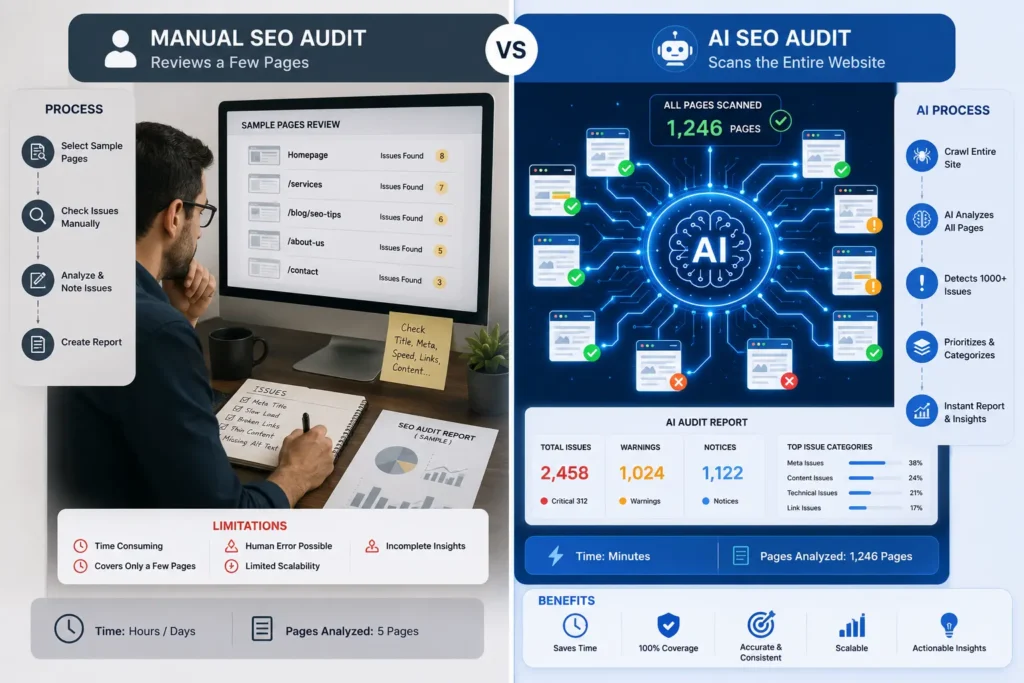
Comprehensive Coverage, Not Just Sampling
Rather than checking a subset of pages and assuming the rest follow the same pattern, AI tools can realistically scan an entire site. This matters enormously for larger sites, where issues often hide in older, less-visited sections.
Faster Turnaround
What used to take days of manual review can now happen in minutes or hours. As a result, teams can run audits more frequently. This helps catch problems before they compound, instead of waiting for the next scheduled review.
Smarter Prioritization
Not every issue deserves equal urgency. Good tools rank problems by likely impact on rankings and traffic. This helps teams focus on what actually matters, instead of working through an unsorted list.
Better Visibility Into AI Search Readiness
Since AI platforms now crawl and cite content directly, audits increasingly check whether a site is genuinely accessible to these systems. This is a newer benefit that traditional, purely technical audits often overlooked entirely.
Easier Reporting for Stakeholders
Many tools generate plain-language summaries automatically, explaining what’s wrong and why it matters. This saves specialists from manually translating technical findings into language non-technical stakeholders can actually use.
More Consistent Results Across Reviewers
A manual audit can vary significantly depending on who performs it and how much time they have that week. AI tools apply the same evaluation criteria every time. This makes results easier to compare across multiple audit cycles.
Faster Recovery From Site Changes
Migrations, redesigns, and template updates are common sources of technical regressions. Frequent AI-powered scans catch these issues within days. That’s much faster than waiting for the next scheduled manual review to notice a traffic drop already underway.
(For a broader look at the technical side of this topic, see our related guide.) It covers AI Technical SEO in more depth.
AI SEO Audits: Best AI SEO Audit Tools
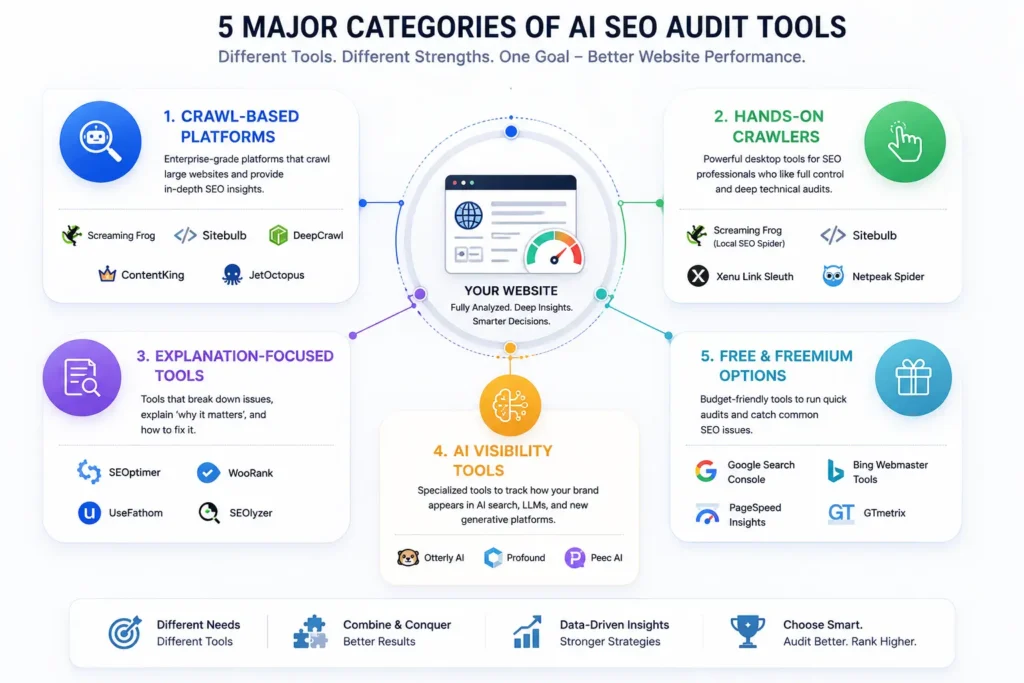
Rather than naming a single winner, it helps to understand the categories of tools available and what each one solves.
AI SEO Audits: Comprehensive Crawl-Based Platforms
This category runs full-site crawls, checking well over a hundred ranking factors and returning a clear health score. Semrush is a widely used example here. It combines deep technical and backlink scans with content gap analysis based on what competitors are covering.
AI SEO Audits: Hands-On Crawler Tools
For teams that want more granular, URL-level control, tools like Screaming Frog offer flexible custom extractions. They let specialists classify issues at scale. This category suits power users who want to turn crawl output directly into development tickets.
AI SEO Audits: Explanation-Focused Auditing Tools
Some tools go beyond simply listing issues. They offer context on why a problem matters and what to fix first. Sitebulb is a known example, presenting findings alongside visualizations designed to help a specialist explain technical issues to non-technical stakeholders.
AI SEO Audits: AI Visibility and Agentic Readiness Tools
A newer category focuses specifically on how well AI crawlers and agents can access a site’s content. It checks structured data, JavaScript rendering, and machine readability. This addresses a genuinely different question than traditional technical audits. It’s not just “can Google crawl this,” but “can an AI system understand and cite this.”
AI SEO Audits: Free and Entry-Level Options
Several free AI SEO audit tools now offer genuinely useful technical scans, particularly for smaller sites with limited budgets. These tend to cover the fundamentals well. Paid platforms typically provide deeper competitive analysis and more comprehensive reporting.
AI SEO Audits: How to Choose Among These Options
Start by considering your site’s size and your team’s technical comfort level. A small blog rarely needs the same depth as a large ecommerce catalog. Test a tool on a real audit before committing, since clear, actionable recommendations matter more than an impressive list of features.
What an AI SEO Audit Actually Checks
Understanding the specific areas covered helps set realistic expectations for what an audit will surface.
Technical Health and Crawlability
This includes broken links, redirect chains, duplicate content, and crawl errors. It also covers whether important pages are accidentally blocked from indexing. These issues often go unnoticed for months without regular scanning.
On-Page Elements
Title tags, meta descriptions, heading structure, and keyword usage all get evaluated against best practices. Often, they’re also checked against what’s currently ranking for similar topics.
Site Speed and Core Web Vitals
Page loading speed and visual stability affect both rankings and user experience. AI tools flag slow-loading pages automatically, often prioritizing high-traffic pages where speed issues matter most.
Backlink Profile Quality
A thorough audit reviews incoming links for relevance and quality. It flags potentially toxic or spammy links that could be dragging down overall site trust.
AI Crawler and Agent Accessibility
Increasingly, audits check whether AI crawlers can successfully access and parse a site’s content. This includes structured data quality and how well JavaScript-rendered content displays to non-traditional crawlers.
A Real-World Example of an AI SEO Audit in Action
To make this concrete, consider how a small business site might benefit from running its first AI-powered audit.
The Starting Problem
Imagine a local service business with a 300-page website that hasn’t been reviewed in over two years. Rankings have quietly declined, but nobody on the team has the technical background to diagnose why. A manual audit feels overwhelming given the team’s limited time and expertise.
Running the Audit
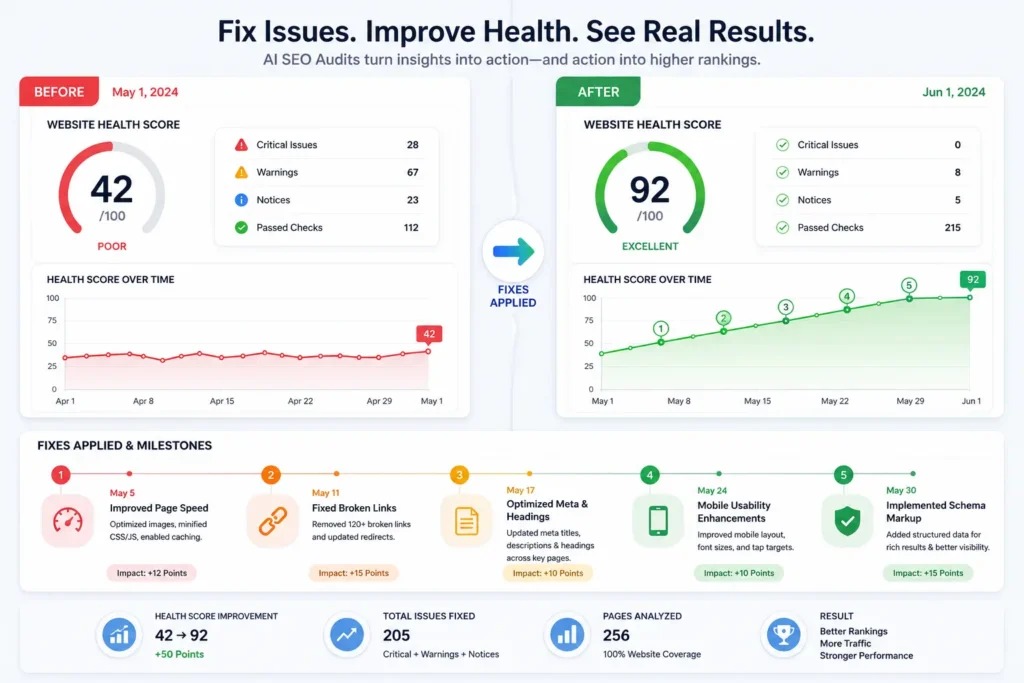
An AI SEO audit tool scans the entire site within an hour. It surfaces a cluster of broken internal links pointing to discontinued service pages. It also flags several duplicate title tags left over from an old site migration, plus a handful of high-traffic pages with slow-loading images.
Prioritizing and Fixing
Rather than tackling all 40-plus flagged issues at once, the team focuses first on the high-traffic pages with speed problems, since those represent the biggest opportunity. The broken links get fixed next, followed by the duplicate titles.
The Outcome
Within a few weeks, the team notices rankings stabilizing on the pages they prioritized first. The audit didn’t just list problems. It told them which ones actually mattered, which made the fix list manageable instead of overwhelming.
AI SEO Audits vs. Manual Audits: A Comparison
Before deciding how much to automate, it helps to see the practical differences side by side.
| Factor | Manual SEO Audit | AI SEO Audit |
|---|---|---|
| Coverage | Often limited to page sampling | Can scan an entire site |
| Turnaround time | Days to weeks | Minutes to hours |
| Issue prioritization | Based on specialist judgment alone | AI-ranked by likely impact |
| AI crawler visibility | Rarely evaluated | Explicitly checked alongside Googlebot |
| Consistency | Varies by reviewer and available time | Standardized across every audit run |
| Frequency | Usually quarterly or annual | Can run continuously or on demand |
| Human oversight required | High, at every stage | Moderate, focused on review and fixes |
As the table shows, AI SEO audits don’t eliminate the need for expertise. Rather, they shift where that expertise gets applied. Specialists move from manually finding issues to deciding which ones genuinely matter.
How to Run an AI SEO Audit Step by Step
Knowing the process helps you get real value from these tools, rather than just generating a long list of unaddressed issues.
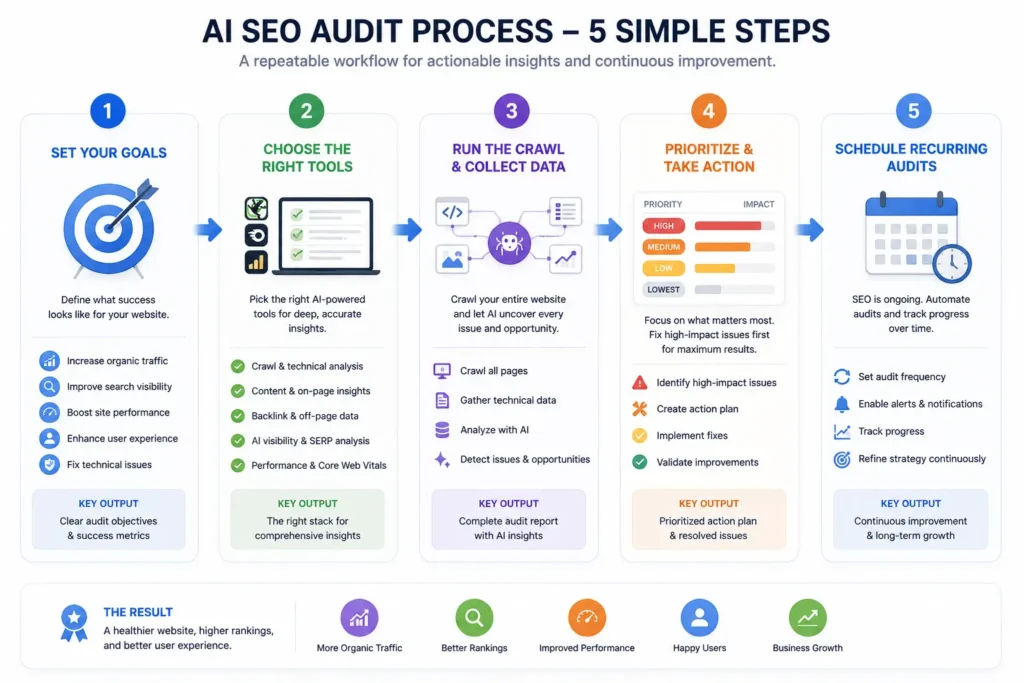
Step 1: Set Clear Goals Before Starting
Before running any audit, decide what you’re actually trying to improve. A goal like reducing crawl errors or improving Core Web Vitals scores helps you interpret results with the right priorities in mind.
Step 2: Choose a Tool That Matches Your Site’s Scale
A small blog and a large ecommerce catalog have different needs. Choose a tool that genuinely fits your site’s size and your team’s technical comfort level, rather than picking based on name recognition alone.
Step 3: Run the Full Crawl and Review the Results
Let the tool complete a full scan rather than stopping early. Once finished, review the prioritized issue list. Pay particular attention to anything flagged as high-impact or affecting high-traffic pages.
Step 4: Address High-Priority Issues First
Rather than working through the list top to bottom without context, tackle issues most likely to affect rankings or user experience first. This usually means starting with critical technical errors and high-traffic page problems.
Step 5: Schedule Recurring Audits
A one-time audit provides a snapshot, not ongoing protection. Set up recurring scans, whether weekly, monthly, or continuous. New issues then get caught soon after they appear, rather than months later.
(For a broader look at how audits fit into an ongoing process, see our related guide.) It covers AI SEO Workflow Automation and how these pieces connect.
Common AI SEO Audit Mistakes
A few recurring mistakes tend to undermine otherwise solid audit efforts.
Treating Every Flagged Issue as Equally Urgent
AI tools can surface hundreds of issues on a large site, and not all of them matter equally. Chasing every minor flag before addressing high-impact problems wastes time. That time could go toward fixes that actually move rankings.
Running an Audit Once and Never Again
A single audit only reflects a site’s condition at that moment. Without recurring checks, new issues introduced by content updates or site changes go unnoticed. Sometimes this continues for months until the next audit.
Ignoring AI Crawler Accessibility
Many teams still focus purely on Googlebot, overlooking whether AI crawlers can access their content at all. As AI-driven search grows, this blind spot increasingly limits visibility in AI-generated answers.
Applying Fixes Without Understanding Root Causes
A quick fix that doesn’t address why an issue happened in the first place often leads to the same problem recurring later. A brief root-cause review, even for automated fixes, saves time over the long run.
Skipping Human Review of Recommendations
AI tools occasionally misjudge a site’s specific context or setup. Treat every recommendation as a starting point for review, not an automatic instruction to implement without judgment.
AI SEO Audit Best Practices
Following these practices helps you extract real value from audits, rather than just generating longer to-do lists.
Combine Automated Scanning With Human Judgment
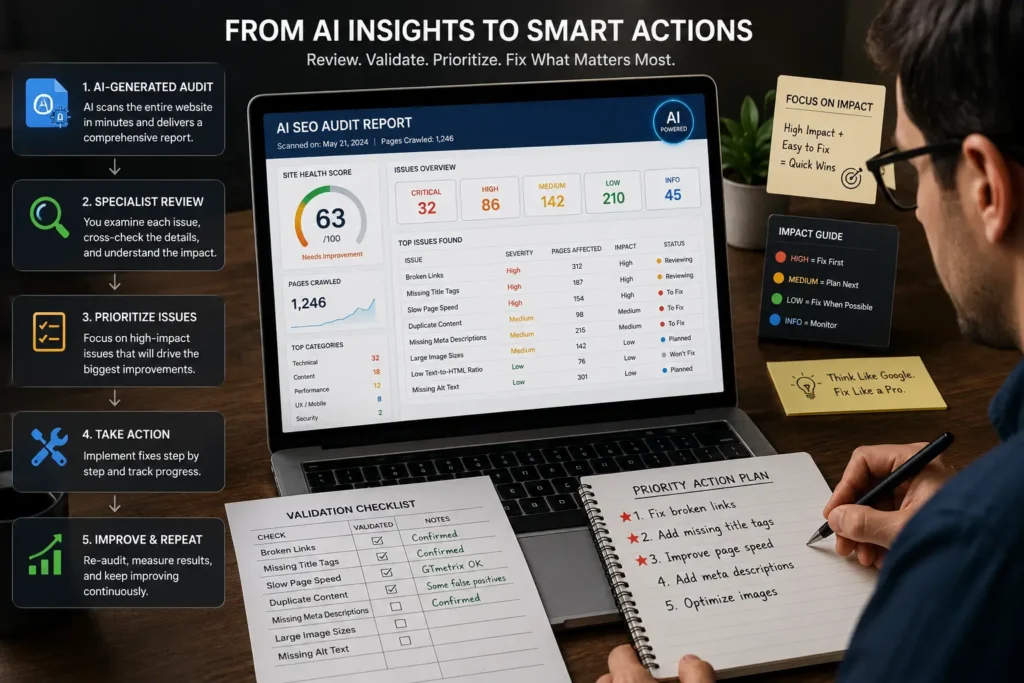
Use AI tools to detect and prioritize issues quickly, but keep a specialist reviewing anything before major changes go live. This combination captures speed without sacrificing quality control.
Focus on Business Impact, Not Just Issue Volume
A single problem on a high-traffic page often matters more than dozens of minor issues on low-traffic pages. Good tools help rank issues this way, but final prioritization should still account for business context.
Keep AI Crawler Access in Mind
As AI-driven search continues to grow, confirm that relevant crawlers can access the content you want indexed and cited. Overlooking this entirely may quietly limit visibility beyond traditional search results.
Document Your Audit Process
Keeping a simple record of what gets checked, how often, and who reviews the findings helps maintain consistency. This matters especially as team members change over time.
Revisit Your Audit Strategy Periodically
Site architecture, competitor behavior, and AI crawler patterns all evolve. A strategy that worked well a year ago may need adjusting as these factors continue to shift.
Train Your Team to Interpret Results Confidently
A long list of flagged issues can feel overwhelming to anyone unfamiliar with reading these reports. Spending a little time helping the whole team understand how to read a health score and prioritize fixes pays off, especially as more people end up touching the process over time.
Frequently Asked Questions About AI SEO Audits
What is an AI SEO audit?
An AI SEO audit uses artificial intelligence to scan a website and identify technical, on-page, and backlink issues affecting search performance. It typically generates a prioritized list of fixes based on likely impact, rather than a raw, unsorted report someone still has to interpret manually.
How is an AI SEO audit different from a manual audit?
AI SEO audits can scan an entire site rather than a sample. They complete in minutes rather than days, and increasingly check AI crawler accessibility alongside traditional technical factors. Manual reviews have always covered the basics, but rarely at this scale or speed.
How often should I run an AI SEO audit?
For most sites, monthly audits strike a reasonable balance between staying current and avoiding alert fatigue. Larger or fast-changing sites may benefit from continuous monitoring, while smaller, stable sites might be fine with quarterly checks instead.
Do AI SEO audit tools replace the need for an SEO specialist?
No. These tools handle detection and prioritization efficiently, but a specialist should still review findings and understand root causes. Judgment still matters when deciding which fixes genuinely deserve attention first.
Are free AI SEO audit tools good enough for small sites?
Often, yes. Free tools generally cover core technical fundamentals well, which is usually sufficient for smaller sites with limited budgets. Larger or more competitive sites typically benefit from the deeper analysis and reporting paid platforms provide.
Final Thoughts: Making AI SEO Audits Part of Your Routine
AI SEO audits aren’t about replacing the judgment that goes into fixing a website properly. Instead, they’re about catching issues faster and more comprehensively than a manual review realistically can. This frees specialists to focus on decisions that actually require human expertise.
Start with a single full audit, prioritize the highest-impact fixes, and set up recurring scans. That way, new issues get caught early rather than months later. Whether you’re managing a small site or a large, complex one, this shift from occasional manual reviews to ongoing, AI-assisted oversight tends to become a genuine advantage over time.
The goal isn’t a perfect score or an empty issue list, since that’s rarely realistic for any active website. Instead, it’s steady, informed progress, fixing what matters most first and catching new problems before they have time to quietly compound.
Ready to build this into a broader process? Check out our guide on AI SEO Workflow Automation to see how audits fit into a fully connected, automated SEO strategy.