


Publishing more content used to be the whole game. Write enough pages, target enough keywords, and rankings would eventually follow. That approach barely works anymore. Search engines and AI-powered search experiences now reward depth, trust, and genuine expertise over sheer volume. As a result, an AI SEO content strategy built around old-school output alone tends to stall out fast.
The good news is that AI hasn’t made content strategy harder. Instead, it’s changed what a smart strategy actually looks like. Rather than guessing which topics matter or drafting blind, AI content strategy tools help you research faster, structure more clearly, and spot gaps competitors have missed. Used well, AI becomes the research assistant and structural backbone behind content that still carries a real human voice and real expertise.
This guide walks through what an AI SEO content strategy actually involves. We’ll cover how to build one step by step, and which mistakes tend to derail otherwise solid plans. Additionally, we’ll look at a comparison table, common questions, and a practical example along the way. By the end, you’ll have a clear framework for building content that ranks well in 2026, without losing the substance that makes it worth reading in the first place.

What Is an AI SEO Content Strategy?
An AI SEO content strategy is a content planning approach. It uses artificial intelligence to guide research, structure, and optimization decisions. Meanwhile, human writers and editors handle the actual craft, voice, and judgment. It’s not a system that generates finished articles on its own. Instead, it’s a framework where AI handles the repetitive analysis, and people handle everything that requires genuine expertise.
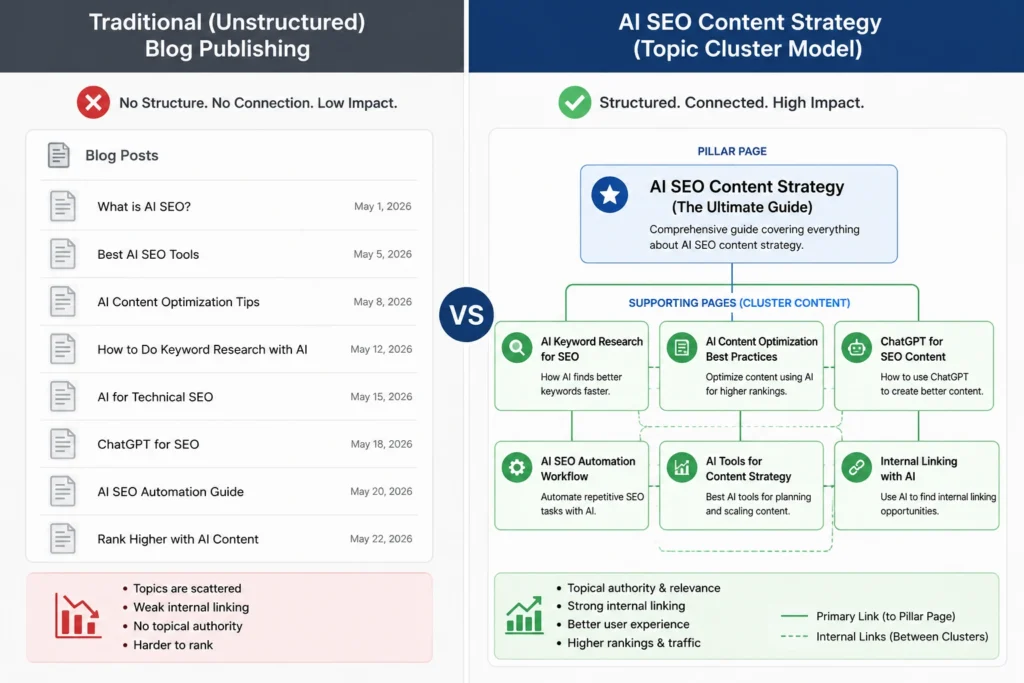
Traditional content strategy relied heavily on manual keyword spreadsheets and gut instinct about what topics might perform well. An AI content strategy replaces much of that guesswork with data. For instance, AI tools can scan hundreds of competing pages in minutes. They can flag which subtopics show up repeatedly, and highlight where your own content library has gaps worth filling.
At its core, a solid AI SEO content strategy typically includes:
- Topic and keyword research informed by AI-driven clustering and intent analysis
- Content briefs generated from competitive analysis, not guesswork
- Structured publishing calendars built around topical authority rather than random topics
- Ongoing optimization using AI tools to flag underperforming or outdated content
- E-E-A-T reinforcement through human review, real examples, and credible sourcing
Consequently, the strategy becomes less about publishing as much as possible. Instead, it’s about publishing the right things, backed by real substance.
AI Content Strategy vs. Traditional Content Planning
It helps to see these two approaches side by side. Traditional content planning relies on a human researcher pulling keyword data manually and deciding, largely by instinct, which topics deserve coverage. This works, but it’s slow. It’s also easy to miss patterns buried across dozens of competing pages.
An AI content strategy automates that pattern-spotting step. However, it doesn’t remove the need for a skilled strategist entirely. Instead, it shifts their time toward judgment calls rather than manual research. A strategist using AI tools might spend twenty minutes validating a topic cluster that would have taken hours to build by hand.
There’s a tradeoff worth understanding, too. AI tools are only as good as the data feeding them. Occasionally, they’ll flag a “gap” that isn’t actually relevant to your specific audience. Human judgment still matters for catching those false positives. The strongest strategies combine both: AI for speed and pattern recognition, human review for nuance and voice.
Why AI SEO Content Strategy Matters More in 2026
Search has changed shape. AI Overviews, conversational search assistants, and increasingly selective ranking algorithms have raised the bar for what counts as genuinely useful content. Thin, keyword-stuffed articles rarely perform well anymore, regardless of how many of them you publish.
At the same time, competition for attention has intensified. Nearly every industry now has agencies and in-house teams using AI to speed up their own content production. Consequently, simply using AI isn’t a competitive advantage on its own anymore. The advantage comes from using it strategically, paired with genuine expertise most competitors skip.
Search Engines Reward Depth Over Volume
Comprehensive, well-researched content tends to outperform thinner competing pages. This holds true even when those thinner pages target the same keyword. AI tools help identify exactly how deep “comprehensive” needs to be for a given topic, based on what’s already ranking.
AI-Generated Search Results Demand Clearer Structure
AI Overviews and chatbot-based search increasingly pull specific facts, statistics, and definitions from source content. Content structured with clear headings, direct answers, and well-sourced claims has a real advantage here. It’s simply easier for these systems to extract and cite cleanly.
E-E-A-T Standards Keep Rising
Google’s guidance on creating helpful, people-first content continues to emphasize experience, expertise, authoritativeness, and trust as core evaluation signals. An AI SEO content strategy that skips this in favor of pure automation tends to underperform. Generic AI output alone rarely demonstrates genuine firsthand experience.
Content Refreshes Matter as Much as New Publishing
Older pages that once ranked well can slip as competitors update their own content. AI tools make it far easier to spot which existing pages need a refresh, rather than treating every piece of content as a one-and-done project.
How to Build an AI SEO Content Strategy Step by Step
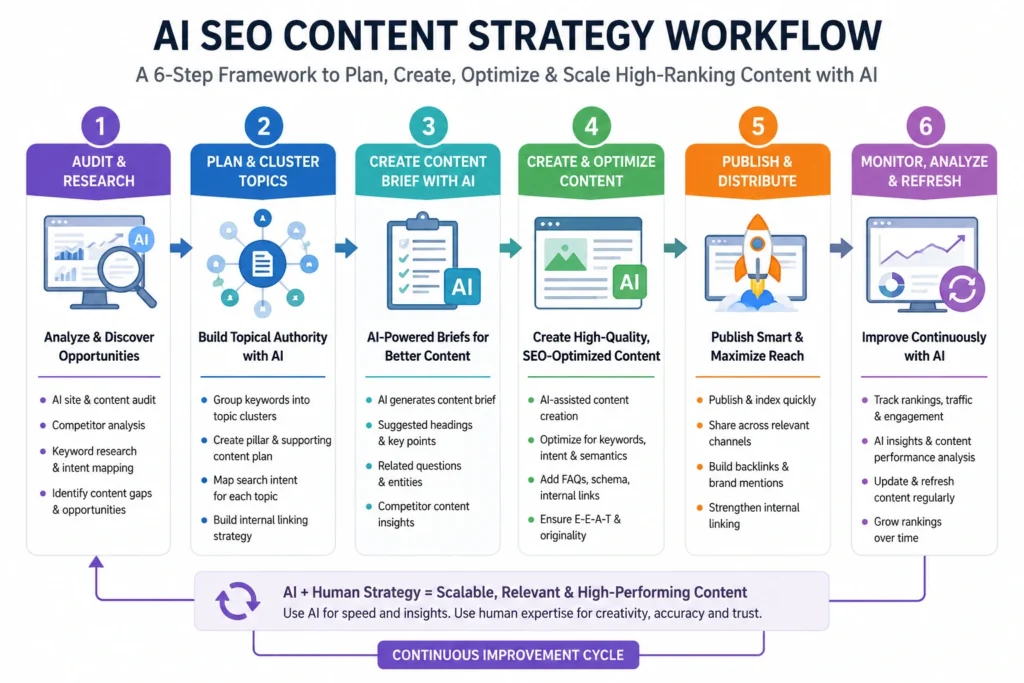
Owning the right tools matters less than following a consistent, repeatable process. Here’s a practical framework for building one.
Step 1: Audit Your Existing Content
Before creating anything new, review what you already have. AI-powered audit tools can quickly flag underperforming pages, outdated statistics, and topics you’ve covered too thinly compared to competitors. Often, this step reveals easier wins than starting from scratch.
Step 2: Research Topics and Build Clusters
Use AI keyword research tools to identify topic opportunities. Then group related keywords into clusters rather than treating them as a flat list. This clustering approach naturally supports a pillar-and-supporting-page structure, which tends to build topical authority more effectively than scattered, unrelated articles.
Step 3: Generate Data-Backed Content Briefs
For each priority topic, generate a brief that reflects what’s actually ranking well. Include recommended subtopics and questions to answer. Treat the brief as a starting point, though, not a rigid script your writers must follow exactly.
Step 4: Draft with Human Expertise at the Center
Writers should use the brief as a guide while bringing their own knowledge, examples, and voice to the piece. This is where an AI content strategy earns its value. The AI narrows down what to cover, while the human writer determines how to cover it well.
Step 5: Optimize and Strengthen E-E-A-T Signals
Before publishing, run the draft through an optimization tool to check topic coverage and readability. Additionally, review it specifically for E-E-A-T signals. Does it include real examples, credible sourcing, and a demonstrated understanding of the topic beyond surface-level facts?
Step 6: Publish, Monitor, and Refresh on a Schedule
Once live, track performance regularly. Revisit older content every few months using the same AI tools. Check whether competing pages have moved ahead, or whether your own statistics and examples have gone stale.
Best AI Tools to Support Your Content Strategy
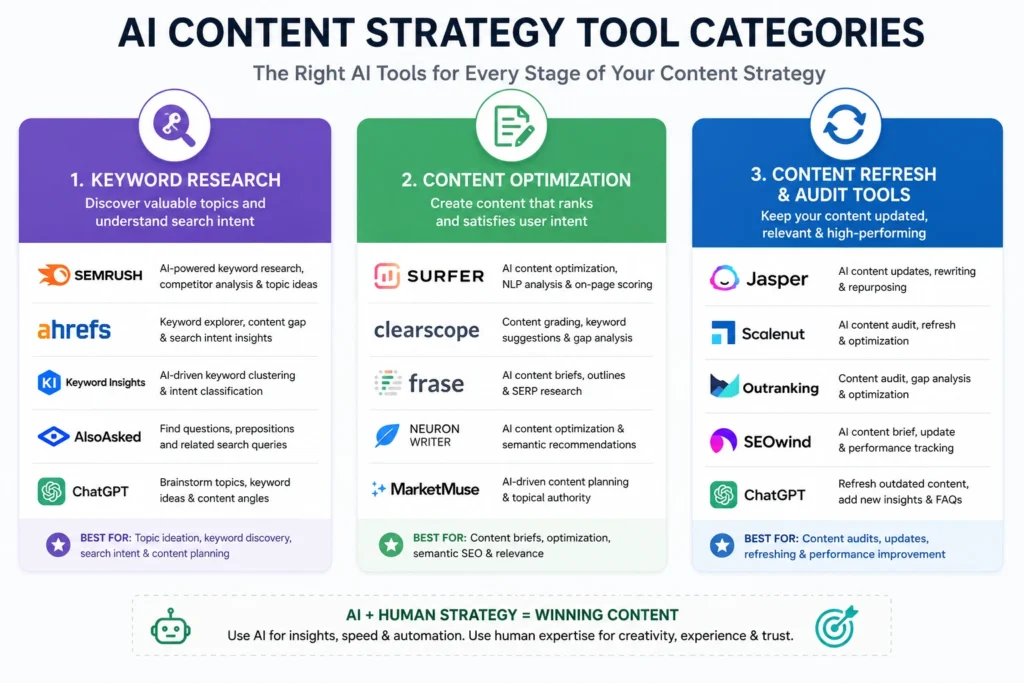
There’s no single tool that covers every part of a content strategy. Most teams combine a few categories to cover the full picture.
AI Keyword and Topic Research Tools
These tools identify keyword opportunities and cluster them by search intent. This helps structure a content calendar around genuine topical authority, rather than scattered, disconnected articles.
What to look for: how clearly the tool explains its clustering logic, since a black-box grouping is hard to validate against your own judgment.
AI Content Optimization Platforms
These score drafts against top-ranking competitors, flagging missing subtopics and readability issues before publishing. They’re especially useful for catching gaps a writer might not think to check manually.
What to look for: whether the tool’s suggestions push toward genuine depth, or simply toward hitting a keyword count.
AI Content Audit and Refresh Tools
These scan your existing content library, flagging pages that have slipped in rankings or gone stale compared to newer competing pages. This category tends to be underused. Refreshing old content is often faster and higher-value than publishing something new.
What to look for: whether the tool prioritizes pages by traffic or revenue potential, not just by age.
Comparison Table: AI Tools for an AI SEO Content Strategy
| Tool Category | Best For | Key AI Feature | Ideal Team | Learning Curve |
|---|---|---|---|---|
| AI Keyword & Topic Research Tools | Building topic clusters and pillar pages | Automated intent clustering | Content strategists and SEO teams | Low to moderate |
| AI Content Optimization Platforms | Improving draft quality before publishing | Competitive content scoring | Writers and editors | Low |
| AI Content Audit & Refresh Tools | Maintaining an existing content library | Automated performance and freshness flags | Agencies managing large sites | Moderate |
Note: Tool capabilities and pricing shift frequently in this space. Testing a platform against your own content is more reliable than comparing feature lists alone.
A Practical Example: AI SEO Content Strategy in Action
Consider a mid-size home services company with a blog that grew organically over several years, with little structure behind it. Using AI audit tools, the team discovered dozens of overlapping articles competing against each other for similar keywords. They also found several outdated guides still ranking for outdated pricing information.
Rather than publishing new content immediately, the team consolidated overlapping articles into stronger pillar pages. They refreshed outdated statistics and used AI clustering to identify genuine content gaps. Only then did they begin producing new content, targeting topics the audit had confirmed were missing entirely.
Within four months, organic traffic to the reorganized section increased noticeably. Several previously stagnant pages moved up several ranking positions after their refresh. The team also noted an unexpected benefit: consolidating overlapping articles reduced internal competition between their own pages for the same search terms, which had likely been holding back rankings even before the refresh began.
The lesson mirrors what tends to hold across most successful AI content strategies: cleanup and structure often outperform simply adding more content on top of an unorganized foundation. Before investing heavily in new production, it’s worth asking whether your existing content library has similar overlap or decay worth addressing first.
Common Mistakes to Avoid With an AI SEO Content Strategy
A handful of habits tend to undercut otherwise solid strategies.
Treating AI output as a finished product. AI-generated drafts and briefs need human review, fact-checking, and genuine expertise layered in before publishing. Skipping this step is one of the fastest ways to produce thin, generic content that underperforms.
Chasing keyword density instead of genuine coverage. A page stuffed with keyword variations reads unnaturally and rarely serves readers well. Aim for natural language that happens to cover a topic thoroughly, not language engineered around a density target.
Ignoring existing content in favor of only publishing new pages. Refreshing and consolidating existing content is often faster and more valuable than starting from scratch. Even so, many strategies skip this step entirely.
Skipping E-E-A-T signals. Comprehensive topic coverage matters, but so does demonstrating real expertise. According to Search Engine Land’s coverage of generative engine optimization, specificity and credible sourcing increasingly separate content that gets cited from content that gets ignored. This holds both in traditional search and AI-generated answers.
Automating the entire workflow end to end. The strongest strategies use AI for research, structure, and optimization. Meanwhile, they keep a human firmly in charge of judgment, voice, and final quality control.
Local and Niche Considerations for AI Content Strategy
An AI SEO content strategy isn’t only useful for large content operations. Local businesses and niche industries benefit just as much, particularly since manual research in smaller markets often turns up thin, unreliable data.
For local businesses, AI clustering can help identify neighborhood-specific or service-area content opportunities that a manual search might miss. For niche B2B industries, AI tools can highlight highly specific technical subtopics competitors haven’t bothered covering. A narrower audience often means less competitive saturation to work through, which makes specificity easier to achieve.
The underlying framework doesn’t change based on scale. What shifts is the volume of content worth producing, and how much weight to place on demonstrating specific, credible expertise within a smaller, more specialized audience.

How AI Content Strategy Supports Featured Snippets and AI Overviews
One underrated benefit of a well-structured AI SEO content strategy is how naturally it supports featured snippet and AI Overview visibility. Both formats reward content that answers a specific question clearly, usually within the first few sentences of a section, rather than burying the answer under several paragraphs of preamble.
AI content strategy tools can flag which of your planned topics are likely to trigger these formats, since question-based phrasing patterns are relatively easy for AI systems to detect at scale. Once identified, the fix is straightforward: lead each relevant section with a direct, concise answer, then follow with supporting detail, examples, and sourcing.
This overlap matters practically. Teams already building content around clear, well-structured answers for their own audience tend to have a head start on snippet and AI Overview visibility, without needing an entirely separate optimization effort. The same structural habits that make content genuinely easier to read also make it easier for AI systems to extract and cite.
Measuring Whether Your AI Content Strategy Is Working
An AI SEO content strategy is only as good as the results it produces, so it’s worth tracking a few specific signals beyond simple rankings.
Watch organic traffic trends for your priority topic clusters over time, not just for individual pages. Because clusters build authority collectively, a rising trend across the whole cluster often matters more than any single page’s ranking. Additionally, track how often older content gets refreshed versus how often new pages get published. A healthy strategy usually balances both activities rather than leaning entirely on new production.
Finally, keep an eye on engagement metrics like time on page and scroll depth for AI-assisted content specifically. If AI-assisted pages show notably weaker engagement than fully human-drafted pieces, that’s a signal your review process may need a firmer editorial pass before publishing.
Frequently Asked Questions About AI SEO Content Strategy
What is an AI SEO content strategy?
An AI SEO content strategy uses AI tools to guide research, structure, and optimization decisions throughout a content plan. Human writers and editors handle the actual writing, voice, and expertise. It combines AI-driven efficiency with genuine human judgment, rather than relying on either alone.
How is AI content strategy different from traditional content planning?
Traditional content planning relies heavily on manual keyword research and instinct about what topics might perform well. AI content strategy replaces much of that guesswork with data. AI tools cluster keywords, analyze competing content, and flag gaps far faster than a manual process would allow.
Can AI tools replace a content strategist entirely?
No. AI tools handle repetitive research and analysis exceptionally well. However, strategic judgment, brand voice, and genuine subject-matter expertise still require a human strategist. The strongest results come from combining both, rather than choosing one over the other.
How often should I refresh content within an AI-driven strategy?
Most content benefits from a review every three to six months, since competing pages and search patterns shift over that timeframe. High-priority or highly competitive pages may warrant more frequent checks, particularly after a major algorithm update.
Does using AI in a content strategy hurt E-E-A-T signals?
Not inherently. AI use only hurts E-E-A-T when it replaces genuine expertise rather than supporting it. Content that pairs AI-assisted research and structure with real examples, credible sourcing, and human review tends to maintain strong E-E-A-T signals throughout.
Is a comparison table like the one above necessary for every content piece?
Not every piece needs one. Comparison tables work particularly well for topics involving multiple tools, options, or approaches, since they help readers scan differences. They also often improve a page’s chances of featured snippet placement.
Final Thoughts: Making AI Part of a Genuinely Strong Content Strategy
An AI SEO content strategy works best when it’s treated as an accelerator for research and structure, not a replacement for expertise. The teams seeing the strongest results are pairing AI-driven efficiency with real human judgment, credible sourcing, and a genuine understanding of their audience’s needs.
Start by auditing what you already have. Then build a clear topic cluster plan around genuine gaps rather than guesses. From there, let AI handle the repetitive research and scoring, while your team focuses on the parts that actually require expertise.
Ready to build a smarter, more structured content strategy for your site? Reach out to our team for a free content audit, and we’ll show you exactly where the biggest opportunities are hiding.