

Rankings used to be the whole scoreboard. Check your position, check your traffic, done. That’s no longer enough. AI SEO analytics now needs to account for a second, less visible layer. This layer tracks whether your brand shows up inside AI-generated answers on platforms like ChatGPT, Perplexity, and Google’s AI Overviews. Missing that layer means missing a growing share of how people actually find information.
This shift matters for a simple reason. A page can lose clicks even while gaining visibility if it’s being cited inside an AI summary instead of driving a traditional click-through. Without the right analytics, that shift looks like a decline rather than a change in where visibility actually shows up. In this guide, you’ll learn what AI SEO analytics actually measures and why it matters more in 2026. You’ll also see which AI SEO analytics tools are genuinely worth using. Beyond that, you’ll learn how to interpret this data, common mistakes to avoid, and a clear framework for building measurement into your regular reporting.
What Is AI SEO Analytics?
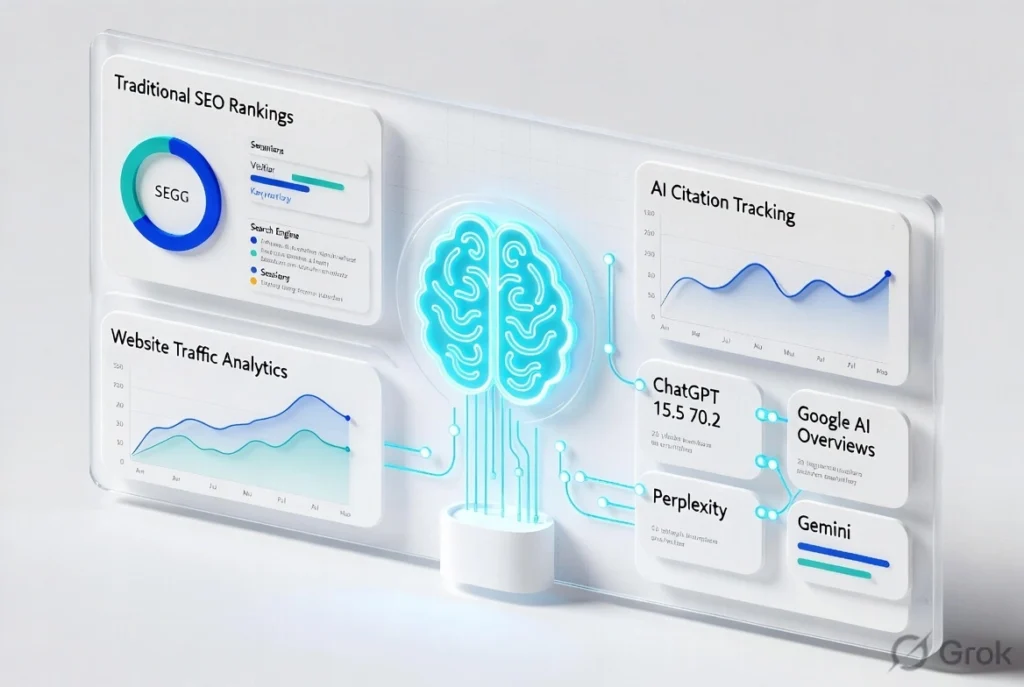
AI SEO analytics refers to measuring search performance across both traditional rankings and AI-generated search results. This includes classic metrics like keyword rankings and organic traffic. It also includes newer metrics like citation frequency and sentiment inside AI answers.
Instead of relying solely on a rank tracker and Google Analytics, these tools also monitor something new. They track how often a brand gets mentioned by ChatGPT, Gemini, or Google’s AI Overviews for relevant queries. From there, they surface patterns. This includes which competitors get cited more often, or which content types earn AI citations most reliably.
How This Differs From Traditional SEO Analytics
Traditional SEO analytics focuses on a fairly stable set of metrics: rankings, clicks, impressions, and conversions. These numbers still matter enormously. However, they don’t capture what happens when a user gets a complete answer from an AI summary and never clicks through at all.
AI SEO analytics fills that gap. It tracks visibility inside the answer itself, not just the traditional results beneath it. This gives a more complete picture of where a brand actually shows up.
A Simple Example in Practice
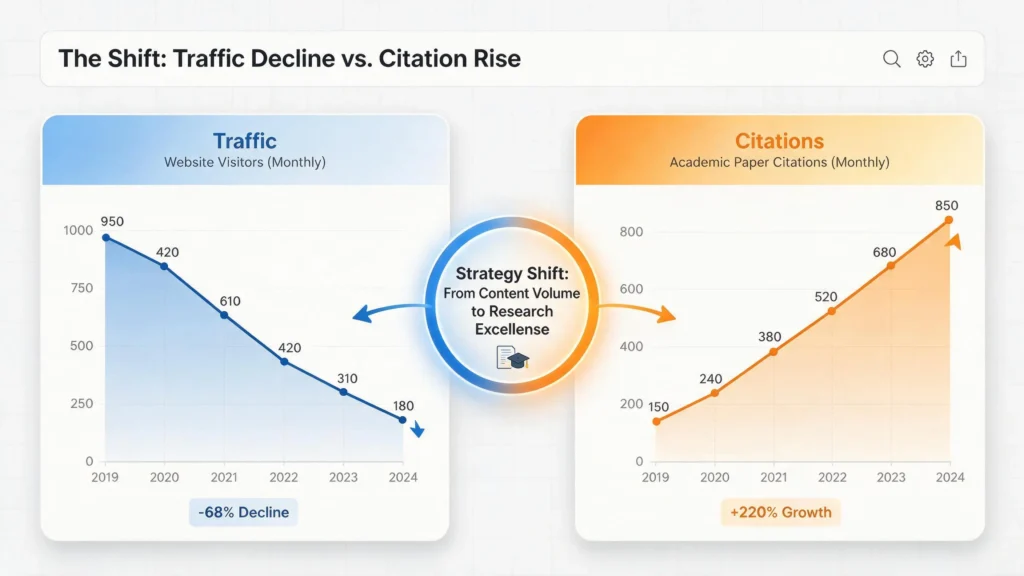
Consider a company that notices its organic clicks for a popular query have dropped over the past quarter. A traditional dashboard would simply show declining traffic, with no obvious explanation. AI SEO analytics tools reveal the missing context. The brand is now being cited prominently inside an AI Overview for that exact query. That citation is likely absorbing clicks that used to go to the website directly.
This distinction matters enormously for how a team interprets performance. A drop in clicks paired with a rise in AI citations tells a very different story. Compare that to a drop in clicks paired with declining rankings across the board, which signals a genuine problem instead.
Why This Gap Was Easy to Miss Until Recently
For years, a decline in organic clicks almost always meant one thing: something had gone wrong. Teams would immediately check for ranking drops, technical issues, or lost backlinks. AI-generated answers have quietly broken that assumption. Now, strong performance and declining clicks can happen at the same time, which is exactly why this newer layer of analytics has become necessary rather than optional.
Why AI SEO Analytics Matters in 2026
A few converging trends explain why this topic deserves serious attention this year.
AI-Generated Answers Are Absorbing More Clicks
Search results increasingly open with an AI-generated summary before a single traditional listing appears. As a result, click-through rates on top organic positions have declined, even as overall search volume continues rising. Ignoring this shift means misreading what’s actually happening to a site’s visibility.
Brands Need to Know Where They’re Being Cited
Unlike traditional rankings, AI citations aren’t visible through a normal search results page. A brand could be mentioned frequently inside ChatGPT responses without anyone on the team realizing it. Often, that’s simply because nobody was tracking that channel until recently.
Competitive Benchmarking Has Gotten More Complex
It’s no longer enough to know how you rank against competitors in traditional search. Teams increasingly need to know which competitors get cited more often inside AI answers, and why. That reveals gaps a traditional rank comparison would miss entirely.
Stakeholders Are Starting to Ask About AI Visibility
As awareness of AI-driven search grows, executives and clients increasingly ask whether a brand shows up in tools like ChatGPT. Having genuine analytics to answer that question, rather than a guess, has become a meaningful credibility signal for SEO teams.
This Trend Is Still Accelerating
Adoption of AI-driven search features has grown steadily since these tools first became widely available. Every quarter that passes without tracking this layer represents a larger blind spot than the previous quarter, simply because more of the total search landscape now runs through these AI-generated summaries.

Benefits of AI SEO Analytics
Understanding the concrete benefits helps justify bringing these tools into a regular reporting process.
AI SEO Analytics: A More Complete Picture of Visibility
Rather than relying on rankings alone, teams get a fuller view that includes both traditional search and AI-generated answers. This prevents misreading a shift in where clicks originate as a genuine decline in overall visibility.
AI SEO Analytics: Better Competitive Intelligence
Seeing which competitors get cited most often inside AI answers, and for which specific queries, reveals something valuable. It surfaces content and authority gaps that traditional competitor analysis often misses entirely.
AI SEO Analytics: Improved Content Strategy Decisions
Data on which content formats and structures earn AI citations most reliably helps teams prioritize what to create next. This grounds content planning in real evidence rather than assumptions.
AI SEO Analytics: Clearer Stakeholder Reporting
Being able to show concrete AI visibility metrics helps SEO teams demonstrate value more clearly. This resonates with stakeholders increasingly curious about this newer channel, not just traditional rankings.
AI SEO Analytics: Early Detection of Visibility Shifts
Since AI platforms and their citation patterns change frequently, ongoing monitoring catches shifts sooner than a quarterly manual check would. A sudden drop in citation frequency is a good example of something worth catching early.
AI SEO Analytics: A Stronger Case for Continued Investment
When teams can point to rising AI citation frequency alongside traditional metrics, it becomes easier to justify continued investment in SEO. This is especially true when leadership is questioning whether traditional search still matters as much as it used to.
(For a broader look at how this fits into a full technical strategy, see our related guide.) It covers AI Technical SEO and the infrastructure side of this topic.
Best AI SEO Analytic Tools
Rather than naming a single winner, it helps to understand the categories of tools available and what each one solves.
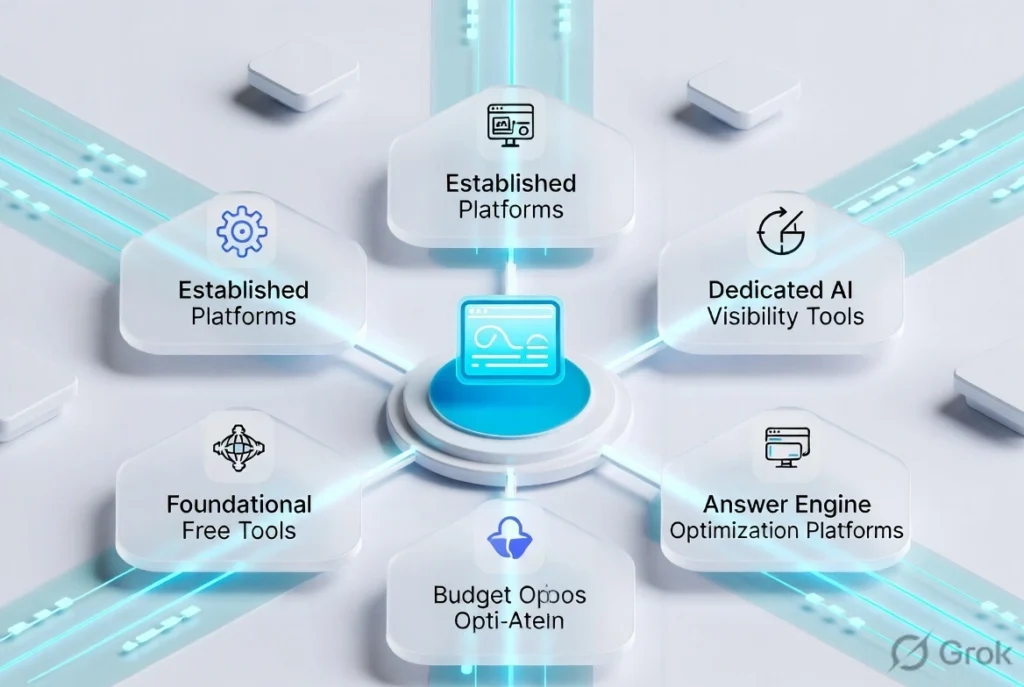
Established SEO Platforms With AI Visibility Features
Some familiar names have added AI visibility tracking directly into their existing platforms. Ahrefs, for example, offers a brand monitoring feature. It tracks how a brand appears across major AI chatbots, combining this with the platform’s existing traffic and ranking data.
Dedicated AI Visibility Platforms
This category focuses specifically on AI search analytics rather than traditional SEO metrics. Tools like Peec AI specialize in tracking prompt-level visibility and citation frequency. They also track competitor mentions across AI platforms, without the broader feature set of a traditional SEO suite.
Answer Engine Optimization Platforms
Some tools go beyond simple tracking. They evaluate how a brand appears in response to real, user-style prompts across engines like ChatGPT and Gemini. These platforms often combine visibility tracking with actionable content and technical recommendations, rather than just reporting numbers.
Budget-Friendly Entry Points
For teams testing the waters before committing to a larger platform, more affordable options exist. These cover the fundamentals of AI mention tracking and tend to suit smaller teams or those still evaluating whether deeper investment makes sense.
Foundational Free Tools
Google Search Console and Google Analytics remain genuinely essential, even in an AI-focused analytics stack. Pairing this foundational data with a dedicated AI visibility tool tends to give the most complete picture without unnecessary overlap.
How to Choose the Right Combination
Most effective setups combine an existing SEO platform for traditional metrics with a dedicated AI visibility tool for citation tracking. Start by defining which AI platforms and competitors actually matter to your business before comparing specific tools.
What to Look for Beyond the Feature List
Feature lists can make every tool look similar on paper, but a few practical differences matter more once you’re actually using one. Check how frequently the tool refreshes its data, since some platforms update citation tracking daily while others run on a weekly cycle. Also look at how the tool defines and tracks the specific prompts or queries relevant to your business, since generic, broad tracking tends to produce less actionable insights than tracking built around your actual audience’s real questions.
Pricing also varies considerably across this category, from affordable entry-level plans to enterprise tools costing several hundred dollars a month. Rather than choosing based on price alone, weigh the cost against how much clearer your reporting becomes and how much time it saves compared to trying to piece this picture together manually.
Key Metrics in AI SEO Analytics
Understanding which metrics actually matter helps teams avoid drowning in data without clear direction.
Traditional Ranking and Traffic Metrics
Keyword rankings, organic traffic, click-through rate, and conversions remain foundational. These metrics still form the backbone of most SEO reporting, even as new metrics get added alongside them.
Citation Frequency
This measures how often a brand gets mentioned or cited within AI-generated answers for relevant queries. A rising citation frequency generally signals growing authority and trust in a given topic area.
Mention Sentiment
Beyond simply appearing in an answer, sentiment analysis reveals whether a brand is described positively, neutrally, or unfavorably. This adds important context that a raw mention count alone doesn’t capture.
Competitor Visibility Comparison
Tracking how often competitors get cited for the same queries reveals where a brand is losing ground or gaining it. Traditional rank tracking alone wouldn’t reveal this kind of shift.
AI-Originated Traffic
Some tools now specifically track traffic arriving from AI platforms as a referral source, distinct from traditional organic search traffic. Google’s own documentation on traffic acquisition reporting explains that Google Analytics groups this kind of traffic under referral sources by default, which is often the starting point before layering on more specialized AI visibility tools (Google Analytics Help). This is a newer metric worth adding to regular reporting as AI referral volume continues growing.
Content Type Performance
Beyond individual metrics, some platforms break down which content formats, like comparison pages, how-to guides, or product pages, earn AI citations most reliably. This helps teams understand not just whether they’re being cited, but which types of content are actually doing the work.
A Real-World Example of AI SEO Analytics in Practice
To make this concrete, consider how a mid-sized software company might use these tools to interpret a confusing traffic pattern.
The Starting Problem
Imagine a company noticing that organic traffic to its main comparison page has declined steadily over several months. This happens despite the page maintaining a strong position in traditional rankings. The marketing team can’t explain the gap using their existing analytics setup.
Adding AI Visibility Tracking
The team adopts an AI SEO analytics tool that tracks citation frequency across major AI platforms. Within the first reporting cycle, they discover something important. Their content is being cited frequently inside AI Overviews and ChatGPT responses for the exact queries driving less traffic than before.
Reframing the Story
Rather than treating this as a failure, the team realizes their content has become a trusted source. AI systems now summarize it directly. Traffic didn’t disappear; a meaningful share simply shifted from clicks to citations.
The Outcome
Armed with this context, the team adjusts their strategy. They focus on earning even stronger citations. At the same time, they optimize other pages specifically to capture clicks that AI summaries are less likely to fully satisfy on their own.
AI SEO Analytics vs. Traditional Analytics: A Comparison
Before deciding how to structure your reporting, it helps to see the practical differences side by side.
| Factor | Traditional SEO Analytics | AI SEO Analytics |
|---|---|---|
| Primary focus | Rankings, clicks, and conversions | Rankings plus AI citation and mention data |
| Visibility scope | Traditional search engine results only | Search engines and AI-generated answers |
| Competitor insight | Ranking position comparison | Citation frequency and sentiment comparison |
| Data sources | Search Console, Google Analytics, rank trackers | Adds dedicated AI visibility platforms |
| Interpreting traffic drops | Often assumes ranking loss | Can reveal a shift from clicks to citations |
| Reporting maturity | Well established, widely understood | Still evolving, fewer standardized benchmarks |
| Best suited for | Baseline performance tracking | Understanding the full modern visibility picture |
As the table shows, AI SEO analytics doesn’t replace traditional metrics. Rather, it adds a necessary layer that traditional tools alone can’t capture.
Common AI SEO Analytics Mistakes
A few recurring mistakes tend to undermine otherwise solid measurement efforts.
Relying Only on Traditional Metrics
Teams that track rankings and traffic alone risk misreading genuine visibility shifts as pure declines. Adding AI citation tracking often reveals a more complete, and sometimes more encouraging, story.
Treating AI Citation Data as Fully Precise
AI visibility tools estimate citation patterns based on sampled prompts. They don’t provide exhaustive, real-time monitoring of every possible query. Treat this data as directionally useful rather than perfectly precise.
Ignoring Sentiment in Favor of Raw Mention Counts
A high citation count doesn’t automatically mean positive visibility. Reviewing sentiment alongside frequency prevents misreading unfavorable mentions as a win simply because the brand appeared at all.
Not Connecting AI Metrics to Business Outcomes
Tracking citation frequency without tying it back to actual business goals risks becoming a vanity metric. Connect these numbers to outcomes stakeholders genuinely care about, like leads or conversions.
Overhauling Reporting Too Quickly
Replacing an entire reporting process overnight can confuse stakeholders used to familiar metrics. Introduce AI visibility data gradually, alongside existing reports, rather than replacing everything at once.
Assuming Every AI Platform Behaves the Same Way
Different AI platforms pull from different sources and weigh signals differently when deciding what to cite. Treating ChatGPT, Gemini, and Google’s AI Overviews as interchangeable can lead to strategies that work well for one platform but do little for the others.
AI SEO Analytics Best Practices
Following these practices helps you build measurement that genuinely informs strategy rather than just generating more numbers.
Combine Traditional and AI Metrics in One Report
Rather than maintaining separate reports, integrate AI visibility data alongside traditional rankings and traffic. This gives stakeholders a single, complete picture instead of two disconnected data sources.
Focus on Trends, Not Isolated Snapshots
A single citation count or ranking position tells you little on its own. Track these metrics over time to understand genuine trends, rather than reacting to normal week-to-week fluctuations.
Prioritize the AI Platforms That Matter Most to Your Audience
Not every AI platform deserves equal attention. Focus tracking efforts on the platforms your actual audience is most likely to use, rather than monitoring everything equally.
Revisit Your Measurement Strategy Regularly
AI platforms and their citation behavior continue evolving quickly. A measurement approach that worked well six months ago may need adjusting as these systems change.
Keep Stakeholders Informed as This Space Matures
Since AI visibility reporting is still relatively new, take time to explain what these metrics mean and how confident the data actually is. Presenting numbers without context tends to create more confusion than clarity.
Build a Simple Glossary for Your Team
New metrics come with new terminology, and not everyone on a team will be familiar with terms like citation frequency or mention sentiment right away. A short internal glossary, even just a few sentences per term, helps keep everyone interpreting the data the same way and prevents miscommunication during reporting meetings.
Frequently Asked Questions About AI SEO Analytics
What is AI SEO analytics?
AI SEO analytics is the practice of measuring search performance across both traditional rankings and AI-generated answers. It includes metrics like citation frequency, mention sentiment, and AI-originated traffic, alongside classic SEO data teams already track.
How is AI SEO analytics different from traditional SEO analytics?
Traditional analytics focuses on rankings, clicks, and conversions within search engine results. AI SEO analytics adds visibility tracking inside AI-generated answers, capturing a layer of performance traditional tools simply can’t see on their own.
Do I need a dedicated AI visibility tool, or can I rely on existing platforms?
It depends on your needs. Many established SEO platforms now include AI visibility features, which may be sufficient for smaller teams. Larger or more competitive brands often benefit from a dedicated AI visibility platform for deeper tracking.
How accurate is AI citation tracking data?
These tools estimate citation patterns based on sampled prompts rather than monitoring every possible query in real time. Treat the data as directionally useful for spotting trends, rather than as a perfectly precise count of every mention.
Why did my traffic drop even though my rankings stayed strong?
This often signals that AI-generated answers are now satisfying searchers directly, sometimes citing your content in the process. AI SEO analytics tools can confirm whether this is happening by tracking citation frequency for the affected queries.
How long does it take to see meaningful data from AI visibility tracking?
Most tools need at least a few weeks of consistent tracking before patterns become genuinely reliable, since AI-generated answers can vary somewhat from query to query. Give any new tool at least one full reporting cycle before drawing firm conclusions from the data it surfaces.
Final Thoughts: Making AI SEO Analytics Part of Your Reporting
AI SEO analytics isn’t about replacing the metrics that have always mattered. Instead, it’s about adding missing context. It explains what’s actually happening to visibility in a search landscape that includes AI-generated answers alongside traditional results.
Start by adding AI citation tracking alongside your existing reports, rather than overhauling everything at once. Over time, this fuller picture helps teams make better decisions. It also helps tell a more accurate story to stakeholders who are increasingly asking about AI visibility anyway.
Whether you’re reporting to a single client or an entire executive team, the underlying goal stays the same. Good measurement should explain what’s really happening, not just what’s easy to count. As AI-driven search continues reshaping how people find information, that fuller explanation is quickly becoming part of what good SEO reporting actually requires.
Ready to build this into a broader strategy? Check out our guide on AI SEO Workflow Automation to see how analytics fits into a fully connected, automated SEO process.