
Introduction
If you run AI tools for SEO agencies in 2026, you already know the game has changed. Clients expect faster turnarounds, deeper insights, and results they can track in a dashboard within weeks, not months. Manually building keyword lists, auditing hundreds of pages, and writing briefs one by one no longer scales. It slows your team down and makes profitability harder to maintain.
That’s why AI tools for SEO agencies have become essential. Over the last few years, these tools have moved from “nice to have” to a core part of the agency workflow. They do not replace strategists, editors, or SEO specialists. Instead, they handle the repetitive heavy lifting, such as analyzing data, spotting patterns, generating first drafts, and speeding up research. This gives your team more time for strategy, client communication, and higher-value work.
In this guide, we’ll break down this agency SEO software guide, explain how AI improves agency SEO workflow tools for agencies, and show what a modern AI-powered process looks like. Whether you run a boutique SEO agency or a larger team managing dozens of clients, this guide will help you understand where AI fits, where it adds the most value, and where human expertise still matters most.
Why AI Tools for SEO Agencies Matter in 2026
AI is no longer a side tool for SEO agencies. It is now part of the daily workflow for research, optimization, reporting, and content production. Agencies that use AI well can move faster, reduce repetitive work, and spend more time on strategy and client results.
What AI tools actually help SEO agencies do
AI tools can speed up keyword research, content briefs, on-page optimization, reporting, competitor analysis, and technical SEO reviews. Instead of doing every task manually, your team can automate repetitive work and focus on decision-making.
Why manual SEO workflows no longer scale
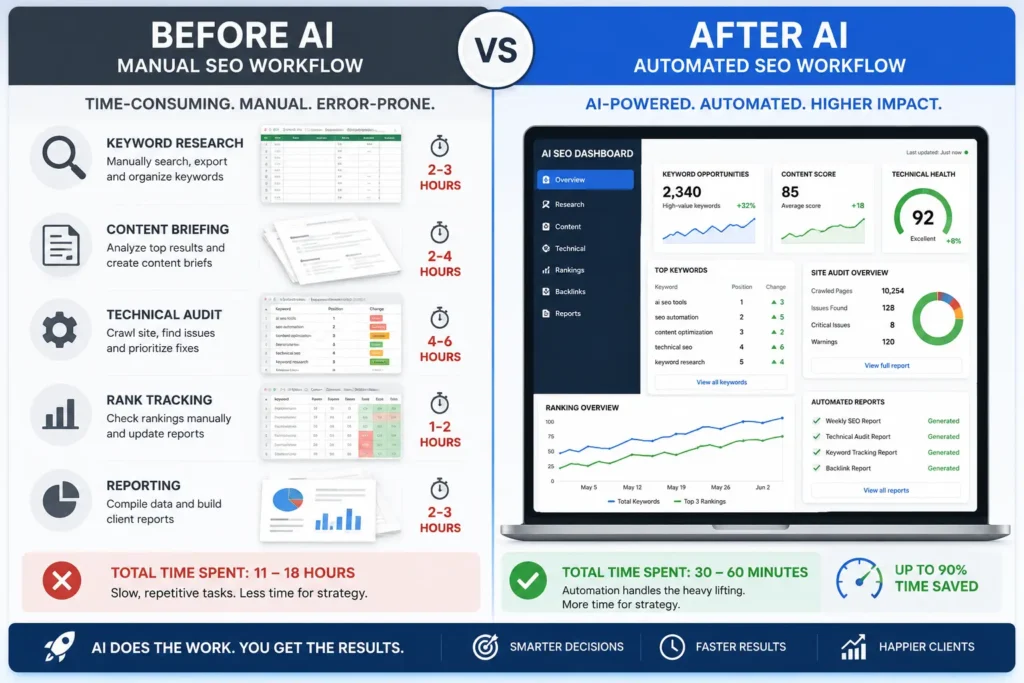
As client demands grow, manual SEO processes become harder to manage. Pulling keyword lists, reviewing content page by page, and building reports from scratch takes too much time. It also slows down delivery. AI helps agencies handle larger workloads without increasing team stress or reducing quality.

What Are AI Tools for SEO Agencies?
AI tools for SEO agencies are software platforms built to speed up SEO work. They use machine learning, natural language processing, and predictive analytics to automate repetitive tasks. Instead of a strategist manually
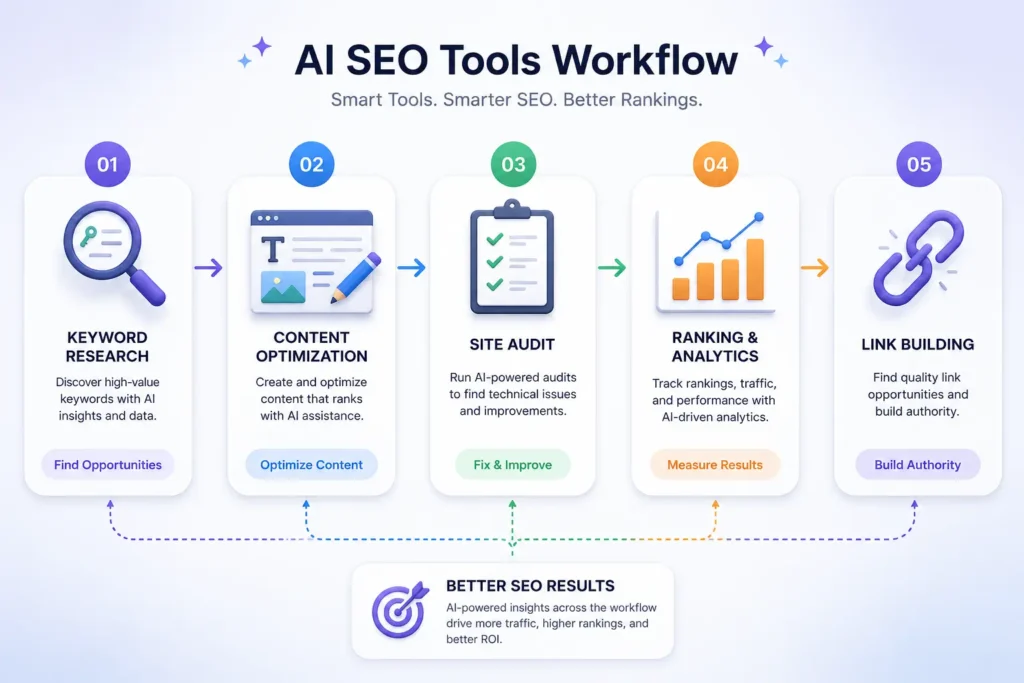
These tools generally fall into a few buckets:
- Keyword research and content strategy tools that identify opportunities and gaps
- Content generation and optimization platforms that help draft and refine copy
- Technical SEO and site audit tools that crawl websites and flag issues automatically
- Reporting and analytics tools that turn raw data into client-ready insights
- Link building and outreach tools that streamline prospecting and personalization
The common thread across all of them is speed. What used to take a junior SEO analyst a full day now takes an AI tool a few minutes. That doesn’t mean the human element disappears — it means your team spends less time on grunt work and more time on the decisions that actually move rankings.
How AI Improves SEO for Agencies
This is the question most agency owners are really asking: does AI actually make a measurable difference, or is it just another buzzword? Based on how agencies are using these tools today, the answer is a clear yes — but the value shows up in specific, practical ways rather than as some vague productivity boost.
Faster Keyword and Topic Research
Traditional keyword research takes time. Teams often pull data from multiple tools, compare search volume and difficulty, and then cluster terms manually. AI tools can do this clustering automatically, grouping hundreds of related keywords into content themes in minutes. This means your strategists can build a quarter’s worth of content plans in the time it used to take to plan a single month.
Smarter Content Briefs
Instead of a writer guessing what “comprehensive” content looks like, AI-powered content tools analyze top-ranking pages for a target keyword. Then they build a brief with suggested word count, subtopics, important questions, and competitor gaps. This alone can cut brief-writing time by more than half.
Automated Technical Audits
Crawling a 10,000-page website used to mean hours of waiting and manual review. Modern AI crawlers find broken links, duplicate content, and crawl errors. More importantly, they prioritize the issues most likely to affect rankings, so your team can fix the right problems first.
Predictive Performance Insights
Some of the more advanced platforms now use historical ranking data to predict how a page might perform before it’s even published, or forecast how long it will take a new page to reach page one. This helps agencies set realistic client expectations instead of relying on gut feel.
Streamlined Reporting
Client reporting is often the most time-consuming, least strategic part of an agency’s month. AI-generated reports can summarize performance trends in plain language and flag unusual changes. They can also draft the client-friendly explanation of what those results actually mean.
Better Competitive Intelligence
Understanding what competitors are doing used to mean manually checking their site every so often and hoping you caught meaningful changes. AI-powered competitive monitoring tools now track competitor content updates, backlink acquisitions, and ranking movements continuously, then surface only the changes that matter. For an agency juggling ten or fifteen client accounts, this kind of always-on monitoring simply isn’t feasible without automation.
Scaling Personalization Across Clients
One of the hardest parts of running an agency is delivering personalized strategy at scale. A boutique shop with three clients can give each one deeply custom attention. An agency with thirty clients often can’t, at least not without AI support. Tools that can quickly adapt keyword research, content briefs, and technical recommendations to each client’s specific industry and competitive landscape make it possible to maintain quality without proportionally growing headcount.
Taken together, these efficiencies are exactly how AI improves SEO for agencies — not by replacing expertise, but by compressing the time between insight and action.
How AI Improves SEO for Agencies
AI can make a real difference for SEO agencies. However, the value comes from solving practical workflow problems, not from replacing strategy. In most cases, AI helps agencies work faster, reduce repetitive tasks, and improve consistency across deliverables.
Instead of spending hours on manual research, reporting, or content prep, teams can use AI to speed up the first draft of the work. As a result, strategists and editors get more time for analysis, decision-making, and client communication.
Faster Keyword and Topic Research
Keyword research is one of the biggest time drains in agency SEO. Teams often pull data from several tools, compare search volume and difficulty, and then group keywords manually. That process works, but it takes time.
AI tools make this faster. They can analyze thousands of search queries in minutes, cluster related terms by topic, and identify search intent patterns automatically. Because of that, agencies can build content plans faster and uncover opportunities they might miss with a manual workflow.
Better Content Briefs and Optimization
AI also improves how agencies create content briefs. Instead of starting with a blank page, teams can use AI SEO tools to analyze top-ranking pages and identify the topics, questions, and headings that need to be covered.
This creates a better starting point for writers. It also makes editing easier because the draft is already aligned with search intent and on-page SEO goals. In addition, some tools suggest internal links, content gaps, and optimization ideas while the article is being written.
Smarter Technical SEO Reviews
Technical SEO is another area where AI can save a lot of time. Large websites often contain broken links, duplicate pages, metadata issues, crawl problems, and indexing errors. Reviewing all of that manually is slow, especially for agencies handling multiple client sites.
AI-powered audit tools speed up the process. They crawl sites quickly, highlight major issues, and help prioritize what should be fixed first. Therefore, your team can focus on high-impact changes instead of wasting time on minor warnings that do not affect performance.
Faster Reporting and Client Updates
Reporting is necessary, but it can consume hours every month. Agencies often spend too much time exporting data, summarizing performance, and turning dashboards into client-friendly updates.
AI helps simplify that work. For example, reporting tools can summarize ranking changes, traffic patterns, and campaign performance in plain language. They can also surface unusual trends and suggest talking points for client meetings. As a result, reporting becomes faster and easier to scale.
More Scalable SEO Operations
The biggest long-term advantage of AI is scalability. Agencies do not just need to work faster. They need systems that help them handle more clients without lowering quality or overloading the team.
That is where AI becomes especially useful. It can support research, brief creation, optimization, reporting, and technical reviews at scale. Meanwhile, human team members stay focused on strategy, quality control, and client relationships. In other words, AI does not replace SEO expertise. It gives your team more leverage.
Top AI Tools for SEO Agencies in 2026
Let’s get into the tools themselves. There’s no single “best” tool for every agency — it depends on your team size, client mix, and budget. Below is a breakdown of categories and the kinds of platforms agencies are relying on.
AI-Powered Keyword Research and Strategy Tools
These platforms go beyond basic search volume data. They use AI to cluster keywords by search intent, identify content gaps against competitors, and suggest topic clusters that build topical authority over time. Agencies managing multiple clients benefit most here because the tools can process large keyword sets across different niches simultaneously.
What to look for: intent classification accuracy, integration with your existing SEO platform, and how well the clustering matches how search engines actually group topics.
AI Content Optimization Platforms
Content optimization tools analyze the top-ranking pages for any given keyword and generate a data-backed scoring system for your draft — covering things like topic coverage, readability, and structural elements like headers and internal links. Many now include AI writing assistance directly inside the editor, so writers can draft and optimize in the same workflow instead of switching between tools.
What to look for: how the tool balances SEO scoring with actual readability, since over-optimizing for a score can produce stiff, unnatural content that readers (and increasingly, search engines) can tell was written for a machine rather than a person.
AI Technical SEO and Site Audit Tools
These crawl entire websites, identify indexing issues, broken links, page speed problems, and structured data errors, then prioritize fixes by potential impact. Some now use AI to detect patterns across large sites that would be nearly impossible to spot manually — like a template issue affecting thousands of product pages at once.
What to look for: crawl depth limits, how frequently the tool re-crawls, and whether it integrates with your CMS for one-click fixes.
AI-Driven Reporting and Analytics Tools
Client reporting tools that use AI can pull data from multiple sources — Google Search Console, analytics platforms, rank trackers — and generate narrative summaries automatically. Instead of a wall of charts, clients get a plain-English explanation of what changed and why it matters.
What to look for: customization options for white-labeling, since agencies need reports that reflect their own branding, not the tool’s.
AI Link Building and Outreach Tools
Prospecting for backlinks used to mean hours of manual research and cold outreach. AI tools now help identify relevant, high-authority sites, personalize outreach emails at scale, and even predict which prospects are most likely to respond based on historical outreach data.
What to look for: deliverability tracking and how well the personalization actually reads — generic AI outreach emails get ignored just as fast as generic human ones.
AI Content Repurposing and Multi-Format Tools
With search increasingly spanning video, voice, and AI overviews, some tools now help agencies repurpose a single piece of content into multiple formats — turning a blog post into social snippets, FAQ schema, or video scripts — all optimized for their respective platforms.
Comparison Table: Best AI Tools for SEO Agencies
| Tool Category | Best For | Key AI Feature | Ideal Agency Size | Learning Curve |
|---|---|---|---|---|
| AI Keyword & Strategy Tools | Content planning at scale | Automated intent clustering | Small to large agencies | Low to moderate |
| AI Content Optimization Platforms | Writers and content teams | Real-time SEO scoring while drafting | Agencies with in-house writers | Low |
| AI Technical Audit Tools | Technical SEO specialists | Automated issue prioritization | Mid-size to enterprise agencies | Moderate |
| AI Reporting & Analytics Tools | Client communication | Auto-generated narrative reports | All agency sizes | Low |
| AI Link Building Tools | Outreach and PR teams | Predictive response scoring | Agencies with dedicated outreach | Moderate to high |
| AI Repurposing Tools | Content and social teams | Multi-format content generation | Agencies offering full-funnel services | Low |
Note: Specific pricing and feature sets vary by provider and update frequently, so it’s worth requesting a demo or trial before committing to an annual contract.
How to Build an AI-Powered Workflow With AI Tools for SEO Agencies
Having the right tools is only half the equation. The agencies seeing the biggest gains are the ones that have actually restructured their workflow around AI, rather than just bolting a tool onto their old process. Here’s a practical framework.
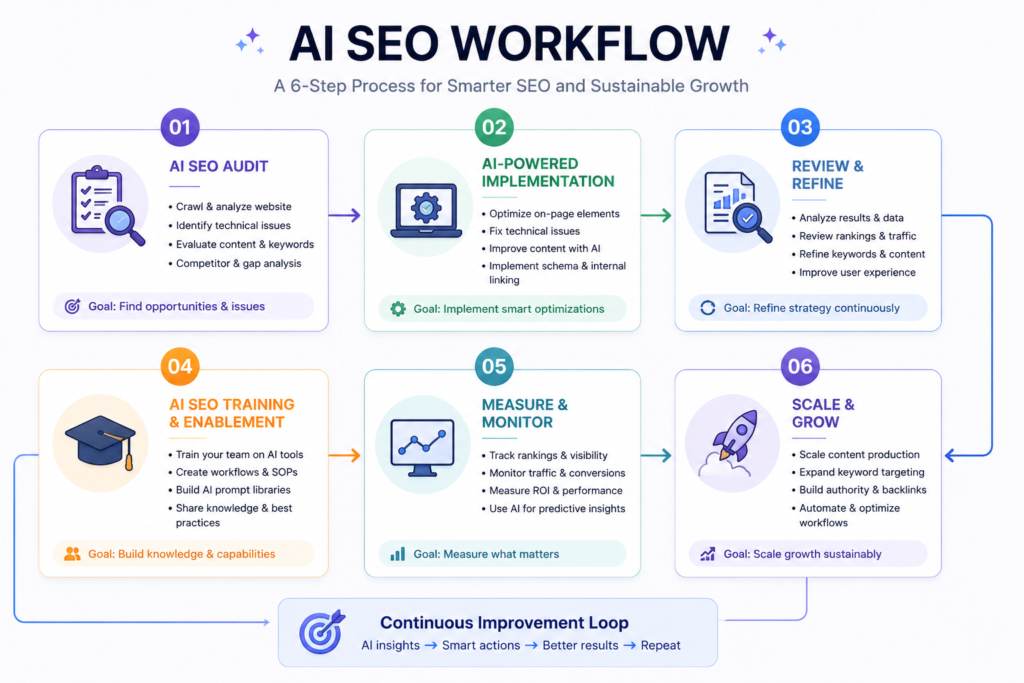
Step 1: Audit Your Current Workflow
Before adding any AI tool, map out where your team’s time actually goes. Most agencies find that research, first-draft content, and reporting eat up a disproportionate share of billable hours compared to strategy and client communication. These are your best candidates for AI assistance.
Step 2: Start with One High-Impact Use Case
Don’t try to overhaul everything at once. Pick the workflow stage causing the most bottlenecks — often content briefs or technical audits — and implement an AI tool there first. This gives your team time to build trust in the output before expanding usage.
Step 3: Build a Human Review Layer
AI output, whether it’s a content brief, a drafted paragraph, or a prioritized fix list, should never go straight to a client without a human checking it. Set up a lightweight review process: someone on your team validates the AI’s suggestions against actual client context and brand voice before anything ships.
Step 4: Train Your Team on Prompting and Tool Use
The quality of AI output depends heavily on how it’s used. Invest a little time training your strategists and writers on how to give better inputs — clearer briefs in, better content out. This is often the difference between an agency that finds AI genuinely useful and one that gets mediocre, generic results and gives up.
Step 5: Measure the Impact
Track time saved per task and, more importantly, whether client results actually improved. It’s easy to assume a tool is helping just because it’s faster — make sure the faster output is also better, or at least equally good.
Step 6: Scale Gradually Across Clients and Services
Once a workflow proves itself with one or two clients, roll it out more broadly. Different clients may need different levels of AI involvement depending on their industry, content complexity, and risk tolerance around AI-generated material.
Build an AI Workflow That Supports Your Team
The goal is not to replace your SEO team with automation. The goal is to remove repetitive tasks so your team can focus on strategy, analysis, and client communication. When AI tools are added carefully, they can make agency operations faster, more scalable, and more profitable without sacrificing quality.
Common Challenges With AI Tools for SEO Agencies (And How to Solve Them)
No tool is a magic fix, and it’s worth being upfront about the friction points agencies run into.
Generic-sounding content:
AI drafts can feel bland or repetitive if used without heavy editing. The fix is treating AI output as a first draft, not a final product — always layer in brand voice, real examples, and a human editing pass.
Over-reliance on AI scores:
Chasing a perfect optimization score can lead to content that reads awkwardly or feels stuffed with keywords, which can actually hurt user experience and, over time, rankings. Balance the score with a genuine readability check.
Data accuracy concerns:
Not every AI tool pulls from equally reliable data sources. Cross-check important findings, especially technical issues that could affect a large site, before making sweeping changes for a client.
Client skepticism about AI-generated work:
Some clients are wary of AI involvement in their content or strategy. Be transparent about where and how you use AI tools, and frame it as a way to deliver better results faster — not as a replacement for your team’s expertise.
Tool overload:
With so many platforms available, agencies can end up paying for five tools that all do similar things. Periodically audit your tech stack and consolidate where you can.
Choosing the Right AI Tools for SEO Agencies
With so many options on the market, picking the right stack comes down to a few practical questions:
- What’s actually slowing your team down right now? Start there rather than chasing every new tool that launches.
- Does it integrate with your existing stack? A tool that doesn’t play well with your CMS, analytics platform, or project management system creates more friction than it saves.
- Can it scale across multiple clients and niches? Agencies need tools flexible enough to handle a local plumber’s site and an enterprise SaaS client without constant reconfiguration.
- What’s the real cost, including training time? The cheapest tool isn’t always the best value if your team never fully adopts it.
- Does the vendor keep up with search engine changes? SEO evolves constantly, and tools that don’t update their models and data sources regularly can quickly become less useful.
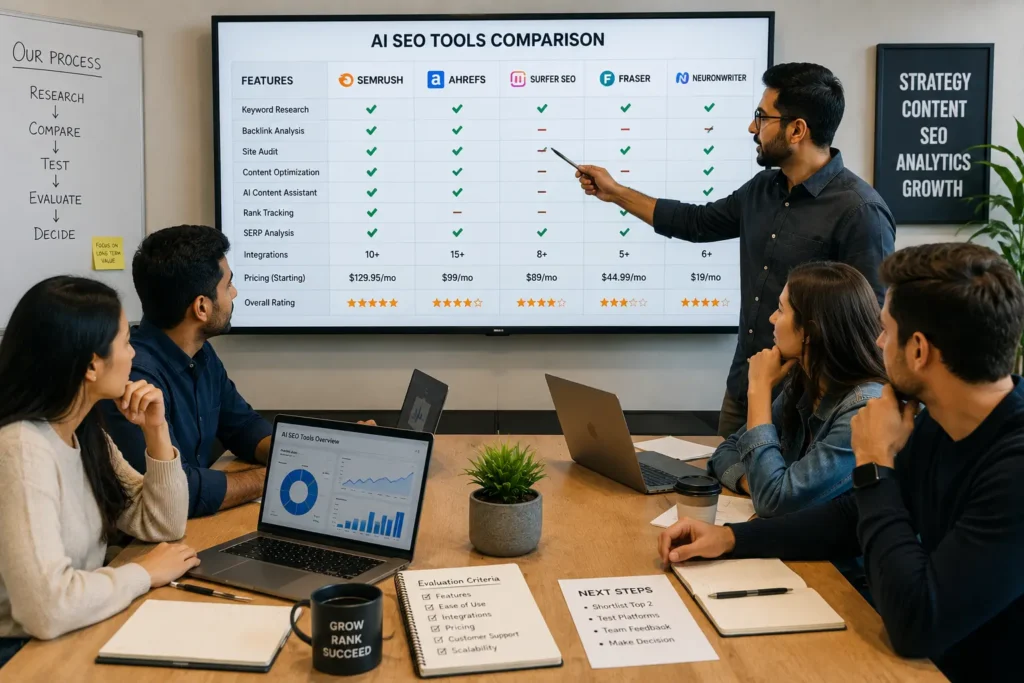
A good approach is to run a 30-day trial with a single client before rolling a new tool out agency-wide. This gives you real performance data instead of relying on the vendor’s marketing claims.
A Realistic Example: AI Tools for SEO Agencies in Action
To make this less abstract, consider a mid-size agency managing 20 clients across e-commerce, local services, and B2B SaaS. Before adopting AI tools, their content team could produce roughly 15 optimized blog briefs per week across all clients, and technical audits were run quarterly because of how long a full manual crawl and review took.
After restructuring their workflow around AI tools, the same team was producing closer to 40 briefs per week, with strategists spending their freed-up time on deeper competitive analysis and client strategy calls instead of manual research. Technical audits moved from quarterly to monthly, since the AI crawler could flag and prioritize issues automatically instead of requiring a full manual review each time.
The lesson here isn’t that AI magically triples output with no effort. It’s that when an agency identifies its actual bottlenecks — in this case, research time and audit frequency — and applies the right AI tool to that specific bottleneck, the gains are real and measurable. The agency didn’t reduce headcount; they redirected existing staff toward higher-value work, which improved both client retention and the agency’s capacity to take on new accounts.
AI Tools for SEO Agencies: Local and Regional Considerations
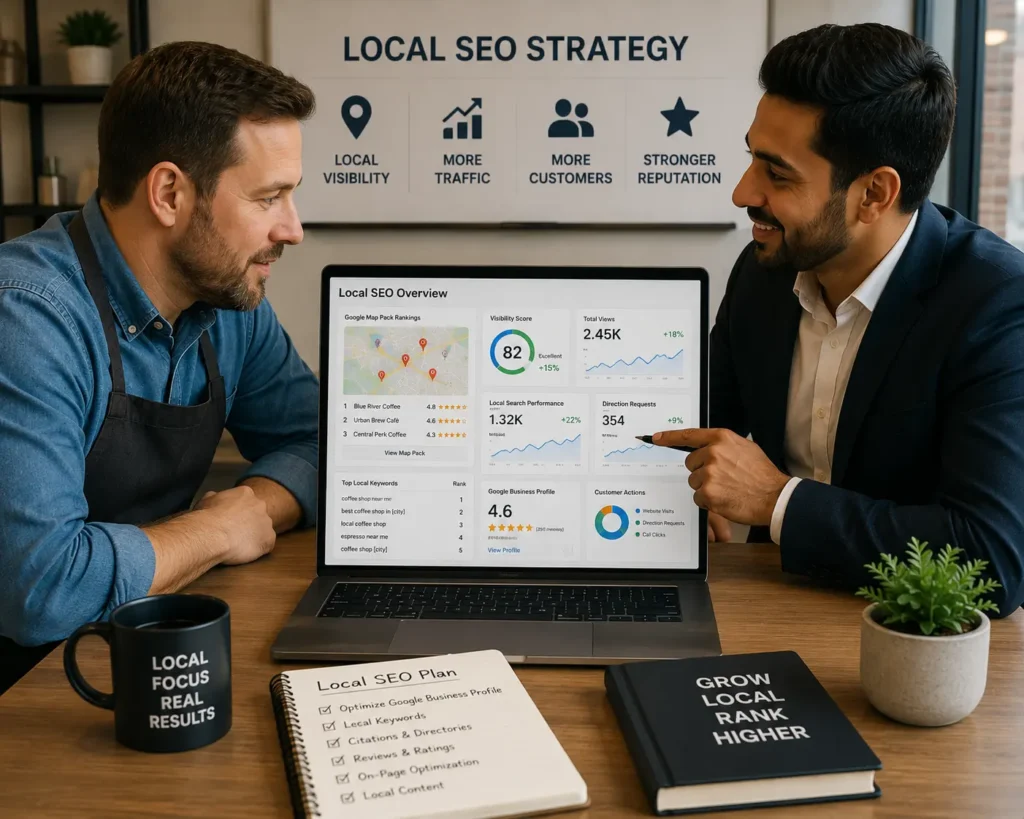
It’s also worth noting that AI tools aren’t just useful for large, multi-client agencies working across national or global markets. Smaller, regionally focused agencies — the kind serving local businesses, healthcare providers, or regional service companies — benefit just as much, sometimes more, because they often operate with leaner teams and can’t afford dedicated specialists for every SEO function.
For a local agency, AI tools can help identify location-specific keyword opportunities, generate location page content at scale for multi-location clients, and flag technical issues that specifically affect local pack visibility, like inconsistent NAP (name, address, phone number) data or missing local schema markup. This makes AI tools for SEO agencies just as relevant for a five-person shop serving a single city as for a national agency managing enterprise accounts.
FAQ Section: AI Tools for SEO Agencies: What Clients and Teams Often Ask
Beyond the core questions agencies have about adopting these tools, there are a few recurring concerns that come up in client conversations and internal team discussions alike. Addressing these upfront tends to smooth adoption considerably.
Clients often want reassurance that AI involvement won’t make their content sound robotic or hurt their brand’s authenticity. The honest answer is that it depends entirely on how the agency uses the tools — AI as a research and drafting accelerant, paired with strong human editing, produces content indistinguishable from fully human-written work. AI as a replacement for editing and strategy produces the generic, flat content that gives the whole category a bad reputation.
Internally, team members sometimes worry AI tools threaten their jobs. In practice, agencies that adopt AI well tend to need the same or more strategists and writers, just doing different, higher-value work. The roles shift from execution-heavy tasks toward oversight, strategy, and quality control.
Frequently Asked Questions About AI Tools for SEO Agencies
What are the best AI tools for SEO agencies in 2026?
The best AI tools for SEO agencies typically fall into five categories: keyword research and clustering platforms, content optimization tools, technical audit crawlers, reporting and analytics platforms, and link building outreach tools. The right combination depends on your agency’s size, client mix, and which tasks are currently taking up the most team time.
How does AI improve SEO for agencies specifically?
AI improves SEO for agencies by automating time-consuming tasks like keyword clustering, content brief creation, technical audits, and client reporting. This lets strategists and writers spend more time on high-value work like strategy and client relationships, while the AI handles data processing and pattern recognition at a scale humans can’t match manually.
Will AI tools replace SEO strategists and content writers?
Not in any meaningful sense right now. AI tools handle repetitive, data-heavy tasks well, but strategic judgment, brand voice, client relationships, and creative problem-solving still require human expertise. AI-powered SEO software: Agencies that combine AI efficiency with strong human oversight tend to outperform those relying on either extreme.
Are AI-generated SEO reports and content safe to send to clients directly?
It’s best practice to always have a human review AI-generated reports and content before sending them to clients. AI can produce factual errors, miss important context, or generate a tone that doesn’t match a specific client’s brand. A quick human review layer catches these issues before they become a client-facing problem.
How much do AI SEO tools typically cost for agencies?
Pricing varies widely depending on the tool (our recommended SEO tools), category, and the number of users, sites, or keywords tracked. Most agencies end up paying for a combination of tools rather than a single all-in-one platform, so it’s worth budgeting for a stack rather than one line item. Requesting demos and trials before committing to annual contracts is a smart way to avoid overspending on tools your team won’t fully use.
Final Thoughts: Building an AI-Ready SEO Agency
AI tools for SEO agencies aren’t going away, and the agencies that figure out how to use them well — without losing the human judgment that actually drives results — are the ones pulling ahead in 2026. The key isn’t adopting every new tool that launches. It’s identifying where AI genuinely saves time or improves quality in your specific workflow, testing it carefully, and scaling what works.
If you’re still running your agency the way you did in 2022, it’s worth taking a hard look at where AI could free up your team’s time this quarter. Start small, measure the results, and build from there.
Ready to see how an AI-powered SEO workflow could work for your agency? Reach out to our team for a free workflow audit, and we’ll show you exactly where AI tools could save your agency hours every week — without cutting corners on quality.
Ready to see how an AI-powered SEO workflow could work for your agency? Book a free workflow audit, and we’ll show you exactly where automation could save your team hours every week — without cutting corners on quality.



Pingback: AI SEO Agents: How Autonomous AI Is Changing SEO in 2026 - AI Growth Lab