


Introduction: AI content optimization strategies 2026
AI content optimization strategies 2026 are essential for anyone who wants to rank higher and attract meaningful traffic. Moreover, these strategies combine AI-powered analysis with editorial judgment to close content gaps, match user intent, and improve structure and readability.
In this guide, In this guide, you’ll learn practical AI content optimization strategies 2026, including tool comparisons, a step-by-step workflow, and a checklist you can use this week to turn insights into measurable traffic growth.
.
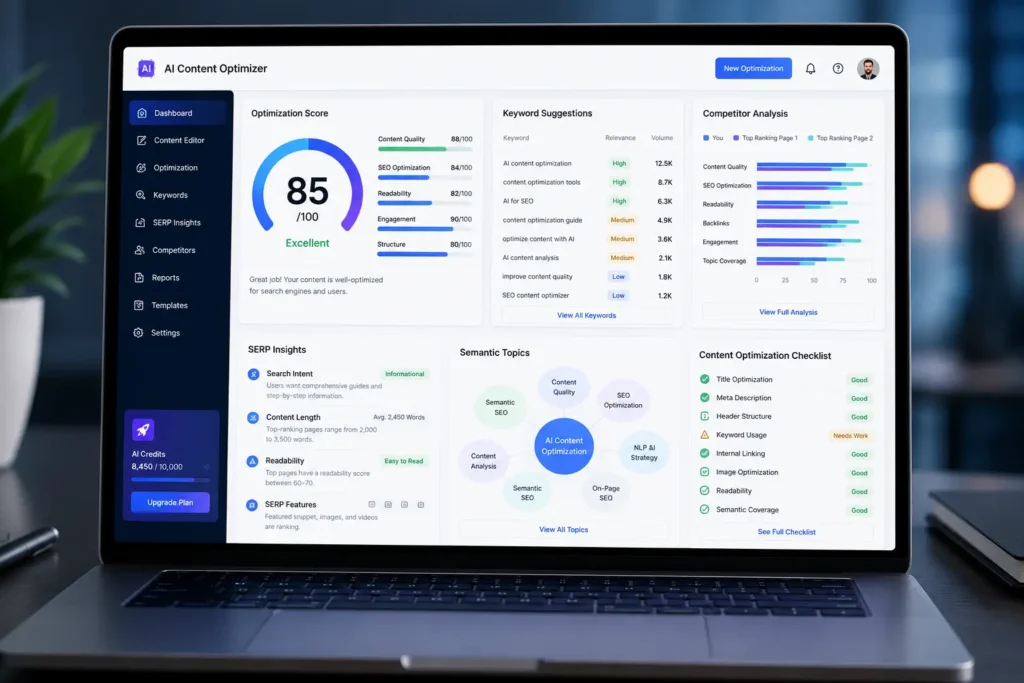
What are AI content optimization strategies 2026?
AI content optimization strategies 2026 combine machine learning, SERP analysis, and semantic topic mapping to recommend what to write, how to structure content, and which user intents to prioritize. In addition, rather than focusing solely on exact-match keywords, these strategies emphasize topic completeness, useful formatting, and direct answers to searcher questions.
In practical terms, In practical terms, the strategies integrate three capabilities:
- First, analyze the current SERP to find patterns in headings, formats (list, how-to, comparison), and on-SERP features like featured snippets.
- Second, map semantic topics so your article covers related subtopics and entities that search engines expect.
- Finally, provide real-time editing recommendations—about headings, paragraph length, and internal links—so your draft better matches competitive pages.
Why “strategies,” not just “tools”
Tools are useful, but strategy is the framework that turns tool output into results. For example, a tool might list 20 related keywords; however, a strategy decides which of those keywords align with your business goals and user intent. Therefore, you should combine automation with editorial judgment to create content that’s both optimized and authentic.
Why adopt AI content optimization strategies 2026?
Search engines are smarter than ever. In 2026, algorithms evaluate not only keywords but also content depth, topical completeness, and user satisfaction signals. Consequently, adopting AI content optimization strategies 2026 delivers measurable benefits:
- First, Faster research and briefs, saving editorial time.
- Second, a better chance of capturing featured snippets and other SERP features.
- In addition, Higher content relevance through semantic coverage.
- Finally, Scalable workflows for multi-writer teams.
For instance, a small ecommerce site in Guwahati that used AI-driven briefs to expand product pages saw clearer internal linking and a 20% uplift in organic sessions over three months. This shows the approach works for local businesses as well as large brands.
Benefits summarized
- Speed: generate briefs in minutes.
- Accuracy: find semantically relevant topics you would otherwise miss.
- Consistency: maintain quality across multiple writers.
- Scalability: produce more optimized pages without proportionally more labor.
How AI for Content Optimization Works: The Process
Understanding the process helps you use these tools more effectively. Here’s a typical workflow:
Step 1: Define Your Goal
Start by clarifying:
- What topic are you covering?
- Who is your target reader?
- What are you trying to achieve (traffic, leads, sales, brand awareness)?
AI tools often ask for a primary keyword or topic to begin analysis.
Step 2: Analyze Top-Ranking Content
The AI will:
- Pull data from the top 10–20 results for your keyword
- Extract common headings, word counts, and topics
- Identify patterns in how winners structure their content
This gives you a benchmark for what “good” looks like in your niche.
Step 3: Get a Content Brief
Based on the analysis, the tool generates:
- Recommended word count
- Suggested headings and subheadings
- List of focus keywords and related topics
- Notes on tone and style
This brief becomes your writing guide.
Step 4: Write and Optimize in Real Time
As you write (or paste your draft), the AI:
- Scores your content
- Highlights missing topics
- Suggests keyword placements
- Flags readability issues
You can then adjust your content before publishing.
Step 5: Compare with Competitors
After you’re done, the tool often lets you:
- Compare your article side-by-side with competitors
- See where you’re stronger or weaker
- Get a final “optimization score”
This helps you decide if you need more work before publishing
Top AI Content Optimization Tools in 2026
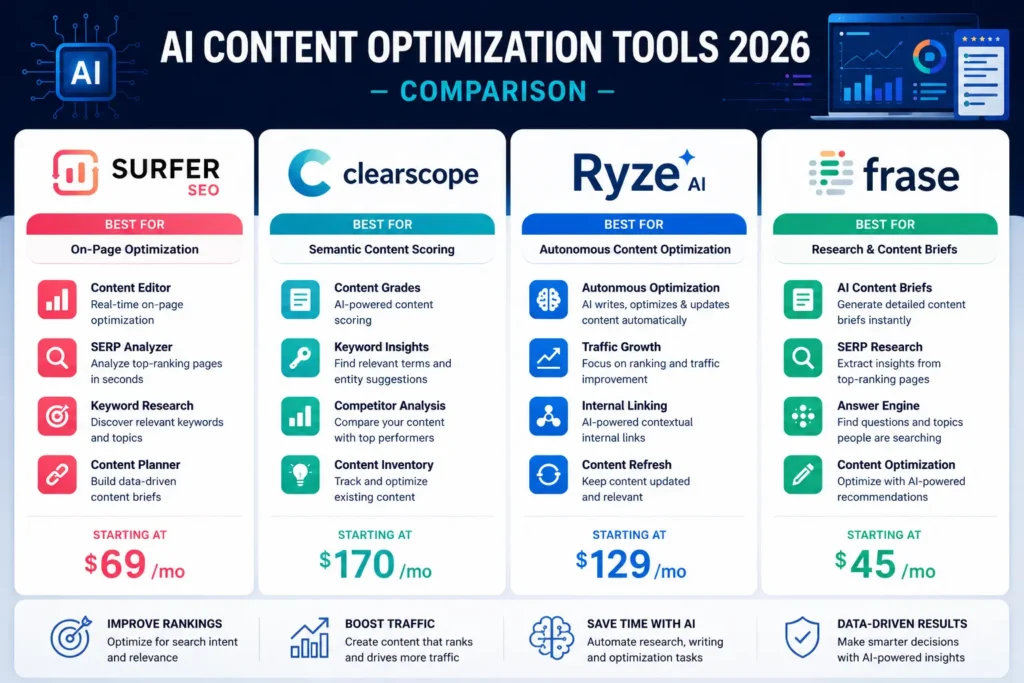
There are many tools on the market. Below is a comparison of the most popular AI content optimization tools in 2026, based on features, pricing, and use cases.
Comparison Table: AI Content Optimization Tools
| Tool | Best For | Key Features | Starting Price | Rating (approx.) |
|---|---|---|---|---|
| Ryze AI | Autonomous content optimization | Real-time optimization, competitor analysis, intent simulation | Flat fee | 4.9/5 |
| Surfer SEO | On-page optimization & content editor | SERP analyzer, content editor, audit tool, real-time scoring | $69/mo | 4.6/5 |
| Clearscope | Premium content optimization | Competitor benchmarking, semantic relevance, content scoring | $170/mo | 4.8/5 |
| Frase | Content briefs & AI writing | AI briefs, SERP analysis, writing assistant, optimization scoring | $45/mo | 4.4/5 |
| Jasper AI | AI content creation at scale | Draft generation, brand voice, templates, basic SEO | $49/mo | 4.3/5 |
| MarketMuse | Content strategy & planning | Topic planning, content gaps, authority building, strategy tools | $149/mo | 4.5/5 |
| Copy.ai | AI copywriting & optimization | Copy generation, SEO suggestions, tone control | $36/mo | 4.2/5 |
| Writesonic | AI content with SEO integration | AI drafts, SEO mode, keyword suggestions, optimization scoring | $19/mo | 4.3/5 |
| SEMrush WA | SEO content recommendations | Writing assistant, keyword suggestions, on-page SEO checks | $129/mo | 4.4/5 |
| Outranking | Content optimization suite | Briefs, optimization, competitor analysis, workflow features | $79/mo | 4.5/5 |
Step-by-Step: Using AI for Content Optimization to Rank Higher
Now let’s turn this into a practical process you can follow.
Step 1: Choose Your Target Keyword
Start with a specific keyword or topic:
- Use tools like Google Keyword Planner, Ahrefs, or SEMrush to find ideas
- Pick something with clear user intent (informational, how-to, comparison, etc.)
Write down your primary keyword and 2–3 related topics.
Step 2: Run a SERP Analysis
Use an AI content optimization tool (e.g., Surfer SEO, Clearscope, Ryze AI) to:
- Analyze the top 10–20 results for your keyword
- Extract common headings, word counts, and topics
- Note special elements like FAQs, tables, or step-by-step guides
This gives you a blueprint for what to build.
Step 3: Generate a Content Brief
From the analysis, create a brief that includes:
- Recommended word count
- Suggested headings and subheadings
- List of primary and secondary keywords
- Notes on tone (e.g., “friendly but authoritative”)
You can use the tool’s auto-generated brief or refine it manually.
Step 4: Write with AI Guidance
As you write:
- Paste your draft into the tool’s content editor
- Follow the real-time suggestions:
- Add missing topics
- Adjust heading structure
- Improve readability
- Keep the language natural and avoid forced keyword placement
Your goal is to create content that feels helpful, not robotic.
Step 5: Optimize for User Intent and Structure
Check that your article:
- Clearly answers the main question in the first 1–2 paragraphs
- Uses clear headings and subheadings
- Includes examples, steps, or data where relevant
- Has a logical flow from problem → solution → next steps
AI tools can flag issues like “missing FAQ section” or “weak intro”.
Step 6: Add Internal and External Links
To boost authority and usefulness:
- Add internal links to related articles on your site
- Include outbound links to reputable sources (studies, reports, official sites)
AI tools often suggest relevant internal link opportunities based on your site’s content.
Step 7: Final Review and Publish
Before publishing:
- Review the final optimization score
- Double-check that keywords are used naturally
- Ensure the article is easy to read on mobile
- Test your links and images
Then publish and monitor performance over time.
Common Mistakes When Using AI for Content Optimization
Even with powerful tools, mistakes can happen. Here are the most common pitfalls and how to avoid them.
1. Over-Optimizing for Keywords
Some writers try to hit exact keyword counts or force phrases into every sentence. This makes content feel unnatural.
Fix: Let the AI suggest keywords, but prioritize clarity and flow. Use synonyms and related terms instead of repeating the same phrase.
2. Ignoring User Intent
AI can analyze data, but you still need to understand what the reader actually wants.
Fix: Before optimizing, ask:
- What problem are they trying to solve?
- What tone do they expect?
- What format (list, guide, comparison) works best?
Align your content with that intent, not just the tool’s suggestions.
3. Treating AI as a Replacement, Not a Partner
AI is great for analysis and suggestions, but it shouldn’t replace human judgment.
Fix: Use AI to:
- Generate ideas and structure
- Spot gaps and issues
- Suggest improvements
Then use your own expertise to:
- Add nuance, stories, and examples
- Ensure brand voice and authenticity
4. Not Updating Content Over Time
Search trends and algorithms change. Content that was optimized in 2024 may not perform in 2026.
Fix: Periodically re-run your content through an AI content optimization tool and update:
- New data or statistics
- Fresh examples
- Updated headings or structures
This keeps your content relevant and competitive.
AI for Content Optimization vs. Traditional SEO: What’s the Difference?
It’s helpful to understand how AI for content optimization compares to traditional SEO aphttps://aigrowthmylab.com/ai-for-keyword-research/proaches.
| Aspect | Traditional SEO | AI for Content Optimization |
|---|---|---|
| Keyword Approach | Focus on exact keywords and density | Focus on topics, intent, and semantic relevance |
| Content Structure | Generic guidelines (e.g., 5 headings) | Data-driven, based on top-ranking pages |
| Optimization Speed | Manual, time-consuming | Faster, with real-time feedback |
| Competitor Insights | Limited or manual analysis | Deep, automated competitor benchmarking |
| Adaptability | Slow to adapt to algorithm changes | Quick adaptation using live SERP data |
Top AI content optimization tools for 2026
Below are popular tools that support AI content optimization strategies 2026. Each has strengths for different workflows, so pick one that matches your needs.
Surfer SEO — on-page optimization leader
Surfer SEO excels at on-page analysis and real-time editing. Moreover, it scans top-ranking pages and recommends headings, keywords, and word counts so you can match competitive structure. Use Surfer when you want precise, actionable guidance during the writing process.
Outbound link: https://surferseo.com
Clearscope — semantic relevance and quality scoring
Clearscope focuses on semantic relevance and content quality scoring. In addition, It’s ideal for editorial teams aiming for depth in competitive niches. If you prioritize authoritative, in-depth articles, Clearscope helps you ensure semantic completeness.
Outbound link: https://www.clearscope.io
Ryze AI — autonomous optimization
Ryze AI emphasizes automation and intent simulation. As a result, It can suggest broader content shifts and help with bulk updates. Consequently,Teams that want quicker, automated recommendations often use Ryze.
Outbound link: https://ryze.ai
Frase, MarketMuse, SEMrush Writing Assistant — other strong options
- Frase is great for generating briefs and content outlines quickly. (https://www.frase.io)
- MarketMuse focuses on topic modeling and strategic content planning. (https://www.marketmuse.com)
- SEMrush Writing Assistant integrates with the broader SEMrush platform for workflow alignment. (https://www.semrush.com)
Comparison table
| Tool | Best for | Key features | Starting price |
|---|---|---|---|
| Surfer SEO | On-page optimization | SERP analyzer, real-time editor, audits | $69/mo |
| Clearscope | Semantic quality scoring | Competitor benchmarking, semantic relevance | $170/mo |
| Ryze AI | Autonomous optimization | Intent simulation, automated recommendations | Varies |
| Frase | Content briefs and AI writing | Briefs, SERP analysis, writing assistant | $45/mo |
| MarketMuse | Strategy and planning | Topic modeling, content gaps, authority metrics | $149/mo |
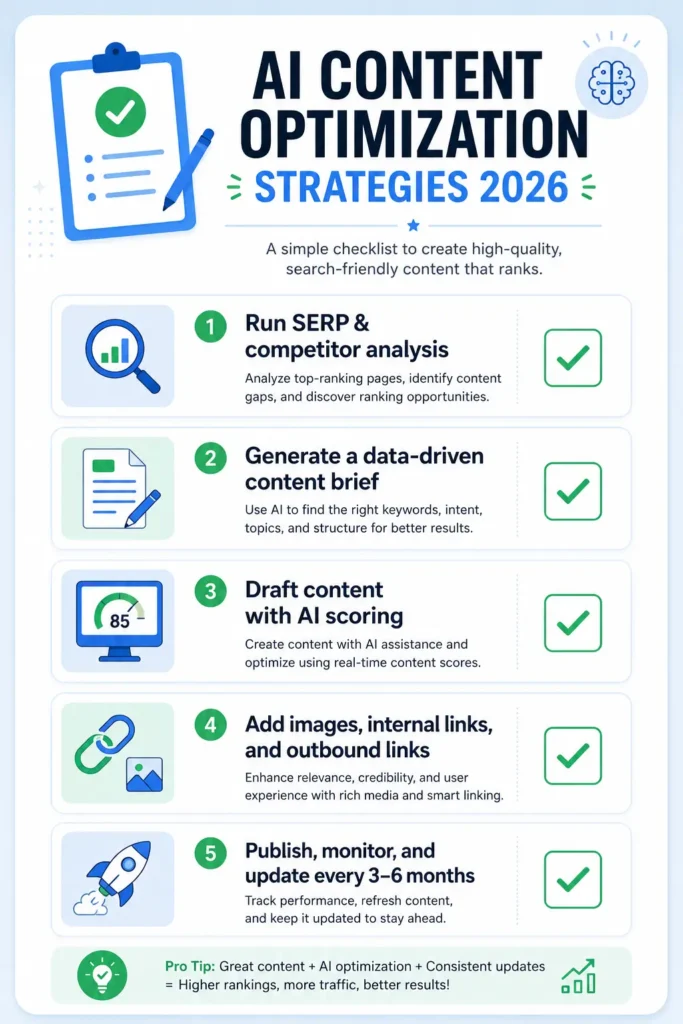
Step-by-step workflow: implement AI content optimization strategies 2026
This workflow turns tool output into improved rankings. Therefore, follow it for each priority page.
Step 1 — Set a clear goal and choose your target topic
Decide whether the page’s goal is traffic, leads, or conversions. Next, select a keyword/topic aligned to that goal. For example, a local service business in Assam might target “best digital marketing agency in Guwahati” with an intent to generate leads.
Step 2 — Run SERP and competitor analysis with an AI tool
Then, use your chosen tool to analyze the top 10–20 results. During this, note what formats succeed (e.g., listicles vs. long-form guides), which headings recur, and which on-SERP features appear. This gives you the blueprint to beat them.
Step 3 — Generate a data-driven content brief
Let the tool create a brief, but edit it: choose the headings that match your voice, add example sources, and remove items that don’t fit your audience. The brief should include: suggested headings, approximate word counts, primary and secondary keywords, and a list of topics to cover.
Step 4 — Draft content and use real-time scoring to fill gaps
As you write, paste drafts into the tool to get real-time feedback. The AI will flag missing topics, weak headings, and readability issues. Thus, use these prompts to add examples, data, or local references (e.g., mention relevant local resources in Guwahati).
Step 5 — Add images, internal links, and authoritative outbound links
Images with descriptive alt text help both accessibility and SEO. In addition, include at least three internal links to related pages and link out to reputable resources such as Google Search Central for best practices. these, Outbound links add credibility and context.
FAQ: Common Questions About AI for Content Optimization
1. What is AI for content optimization?
AI for content optimization is the use of artificial intelligence tools to analyze search data, competitor content, and user behavior, then provide recommendations to improve your content’s rankings and readability. These tools help you create content that matches what search engines and users expect.rankfender+1
2. Which AI content optimization tools are best in 2026?
Top AI content optimization tools in 2026 include:
- Ryze AI – for autonomous optimization
- Surfer SEO – for detailed on-page optimization
- Clearscope – for premium, semantic-focused content
- Frase, MarketMuse, SEMrush Writing Assistant – for strategy and workflow integrationget-ryze+1
The best tool depends on your budget, team size, and goals.
3. Can AI replace human writers?
No. AI can assist with research, structure, and suggestions, but it cannot fully replace human creativity, nuance, and brand voice. The most effective approach is to use AI for content optimization as a partner, not a replacement.digitalmarketinginstitute+1
4. How do I start using AI for content optimization?
To start:
- Choose a primary keyword or topic
- Use an AI tool to analyze top-ranking content
- Generate a content brief
- Write and optimize with real-time suggestions
- Compare with competitors and refine before publishingrankfender+1
Even one tool used consistently can significantly improve your results.
5. Is AI optimization safe for SEO?
Yes, when used correctly. AI optimization focuses on quality, relevance, and user intent, which aligns with modern SEO best practices. Avoid over-optimizing or forcing keywords, and always ensure your content feels natural and helpful.
Conclusion: Take Action with AI for Content Optimization Today
AI content optimization strategies 2026 are a practical, repeatable way to improve search visibility and user satisfaction. As search engines emphasize relevance and depth, relying on surface-level tactics is no longer enough. Instead, implement a workflow that blends tool-driven analysis with human editorial judgment.
First, pick a high-value page and run it through an AI tool to get a data-driven brief. Next, refine the brief with local examples, add missing topics the tool highlights, and polish readability. Then publish and monitor results.
Importantly, view AI as an amplifier: it speeds research, identifies gaps, and suggests structure, but it does not replace the credibility that human experts bring. Therefore, train writers to use AI outputs as guides, not scripts. Over time, this combination of data and editorial care will lead to measurable gains—higher rankings, better engagement, and more conversions.
If you want a fast test, pick one page that already attracts some traffic but underperforms in conversions or rankings. Then apply the top 5–10 recommendations from an AI tool this week: improve headings, add an FAQ, insert internal links, and include authoritative outbound links. Within a few weeks, you should start to see improvements in impressions and click-through rates.
Why This Matters for Your Business
Whether you run a small blog, a local business site, or a large marketing team, AI-driven optimization gives you:
- Better visibility in search results and AI-powered discovery
- Higher-quality content that actually answers what users are looking for
- Faster production cycles without sacrificing depth or clarity
- More consistent results across multiple writers and pages
Without these advantages, you’re at risk of losing traffic to competitors who are already using AI content optimization tools to outperform you in speed, relevance, and authority.
Call to action:
Ready to rank higher with smarter content? Pick an AI content optimization tool from the comparison table above, run your first optimization test this week, and see how much faster and more effectively you can create content that both search engines and real readers love.




Pingback: AI Tools for SEO Agencies – Best Tools and Workflow 2026 - AI Growth Lab
Стоимость услуг варьируется, но актуальная хрумер цена вполне доступна для большинства пользователей.