
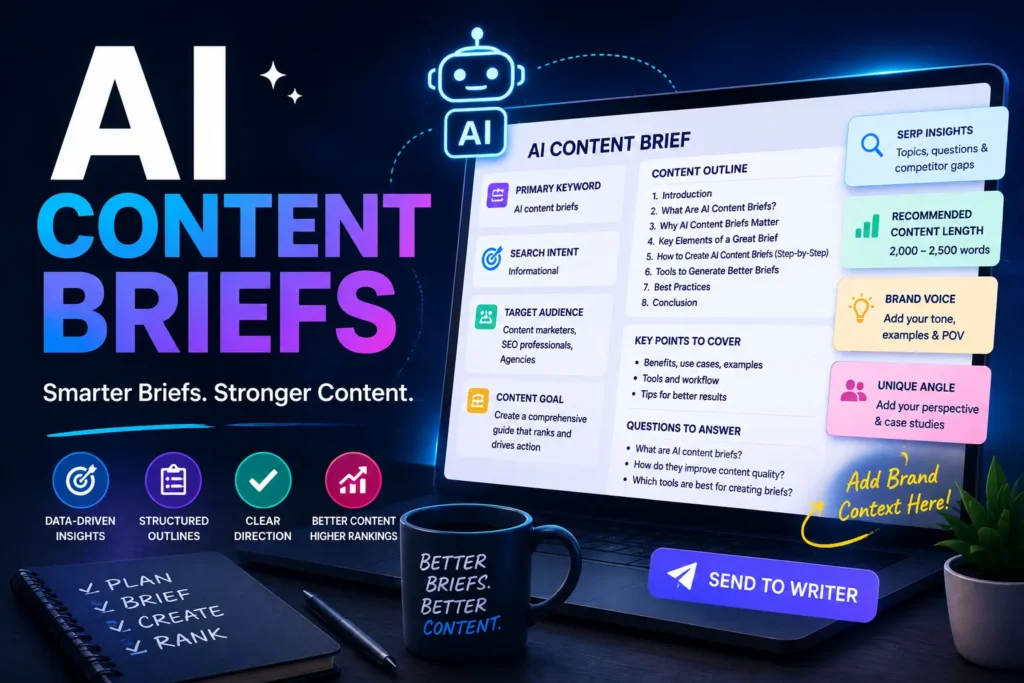

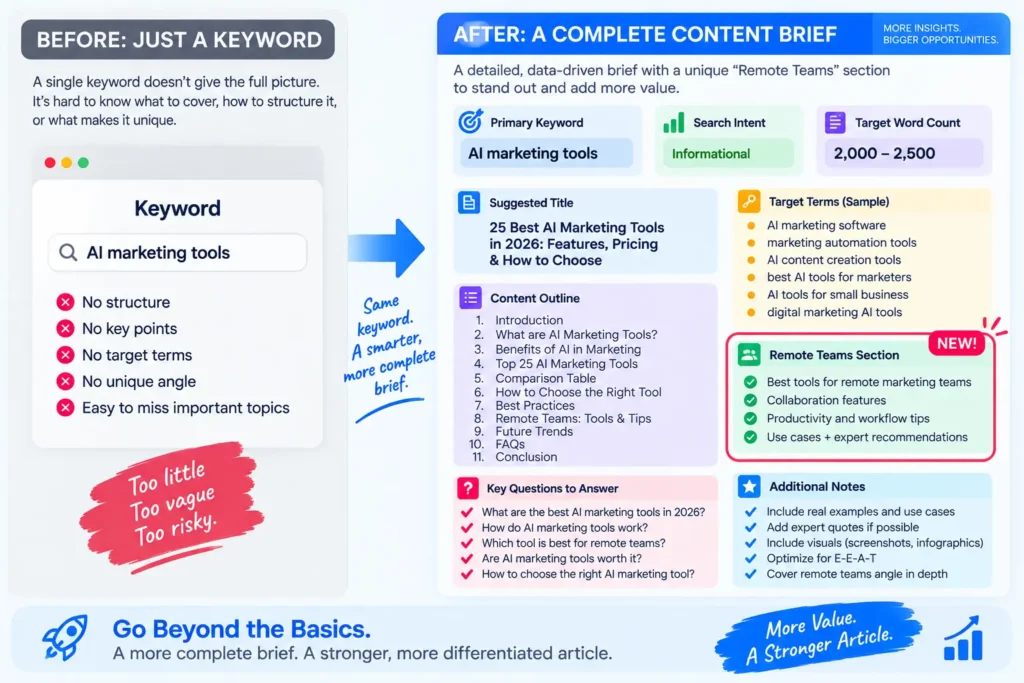
A writer handed a single keyword, and no other direction, will guess at everything else. Structure, depth, tone, and what questions to answer all get left to chance. That guesswork shows up in the final content, and it rarely produces something that ranks. AI Content Briefs close this gap. Instead of a writer starting from a blank page, a brief hands them a clear roadmap built from what’s already working in search results.
This matters because the brief, not the writing itself, is often where ranking potential gets decided. A brilliant writer working from a weak brief still produces thin, unfocused content. In this guide, you’ll learn exactly what an AI content brief is and why it matters more than ever in 2026. You’ll see what belongs in a genuinely useful brief, then walk through a step-by-step creation process. You’ll also compare the best AI content brief generator tools available, common mistakes to avoid, and the answers to the questions people most often ask about this process.
What Is an AI Content Brief?
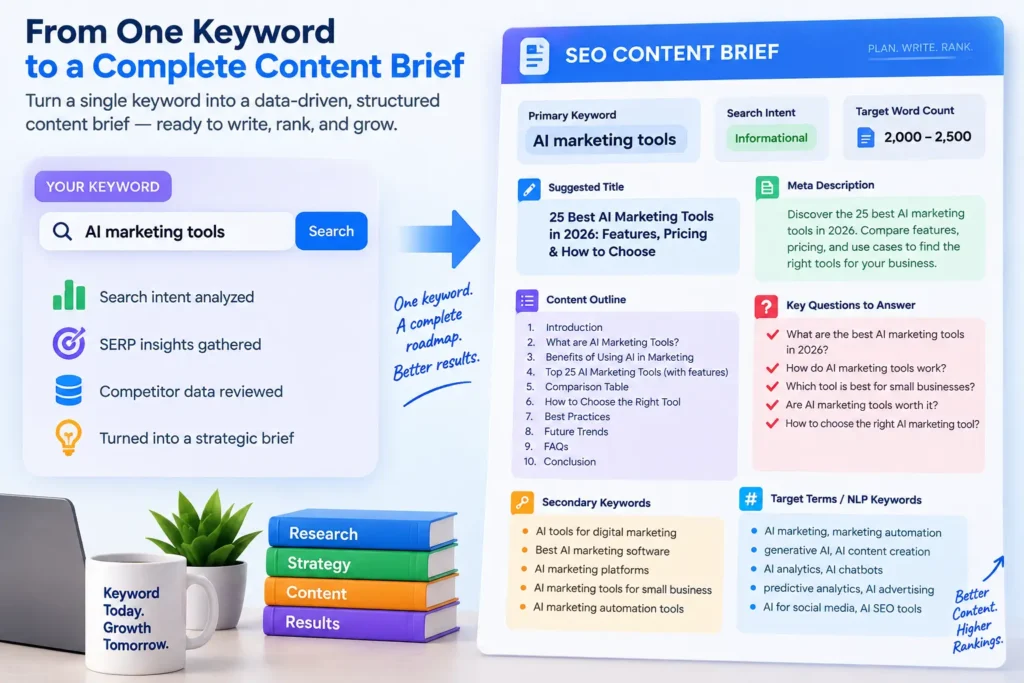
An AI content brief is a structured document, generated with the help of artificial intelligence, that outlines exactly what a piece of content needs to cover. This typically includes a recommended outline, target search terms, common questions to answer, and internal linking suggestions.
In short, a brief exists to answer one question before a single word gets written. What does this page actually need to include to genuinely compete with what’s already ranking?
How AI Content Briefs Actually Work
Most tools follow a similar process. First, they analyze the top-ranking pages for a target keyword. Then, they extract common patterns, shared subtopics, frequently asked questions, and semantic terms that appear across multiple results. Finally, they compile these findings into a structured document a writer can follow directly.
Why This Step Matters More Than It Looks
It’s tempting to treat brief-building as a quick pre-writing formality. In practice, it’s closer to a blueprint. A house built without blueprints might still stand, but it rarely turns out the way anyone intended. Content works the same way. Skipping or rushing the brief almost always shows up later. The content ends up missing obvious subtopics or duplicating what a dozen other pages already say.
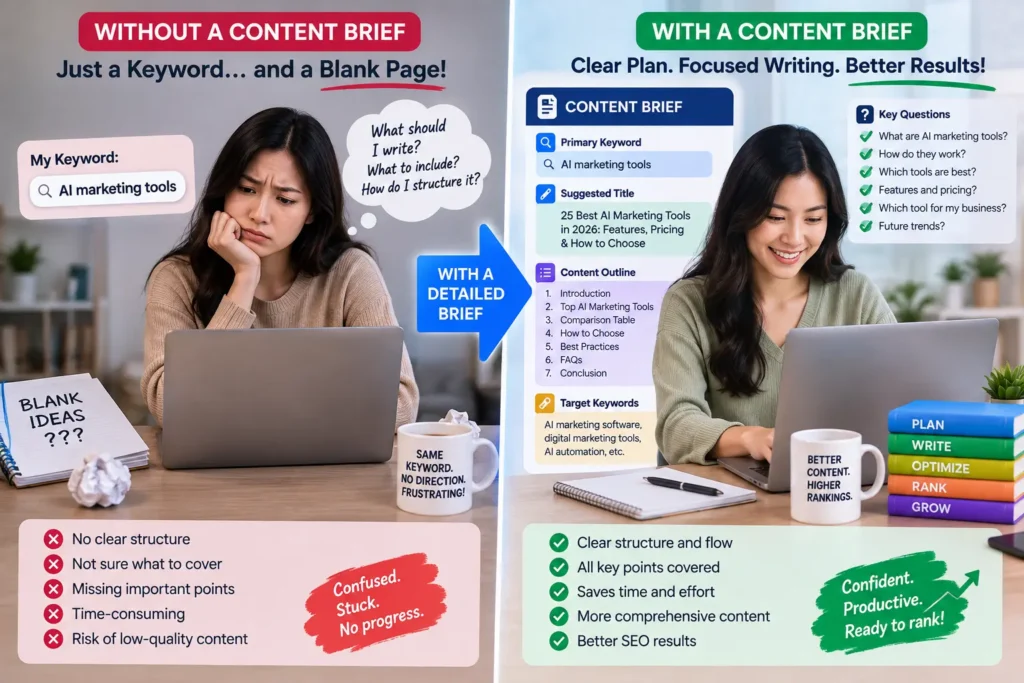
A Simple Example of the Difference a Brief Makes
Picture two writers assigned the same topic, “best coffee makers for small kitchens.” One gets just the keyword and a word count target. The other gets a full brief: an outline covering budget, space-saving features, and cleanup ease, a list of specific questions readers keep asking, and links to two related buying guides already on the site. The second writer starts working immediately, with a clear sense of what “done” looks like. The first writer spends the opening hour just deciding where to begin.
(For a look at the step that typically comes before briefing, see our related guide.) It covers AI Keyword Clustering in full depth.
Why AI Content Briefs Matter for SEO in 2026
A few converging trends explain why this deserves more attention than it used to get.
Content Volume Has Outpaced Manual Brief Writing
Publishing consistently remains one of the strongest predictors of organic growth. However, manually researching and writing a brief for every article takes real time. AI content brief generators compress that research phase from hours down to minutes. This lets teams maintain volume without sacrificing structure.
Search Engines Reward Comprehensive Coverage
Thin content that hits one keyword but misses the surrounding subtopics tends to underperform, even with decent targeting. A strong brief forces comprehensive coverage from the start. It doesn’t rely on hoping a writer happens to cover the right ground instinctively.
AI Visibility Adds a New Layer to Briefing
As AI-generated search summaries become a genuine discovery channel, some newer brief tools now score content for AI-visibility readiness alongside traditional SEO. This means a well-built brief increasingly considers whether an AI system could confidently cite the resulting page, not just whether Google would rank it.
Freelancers and Distributed Teams Need Clearer Direction
When a writer isn’t sitting in the same room as a strategist, a detailed brief becomes the primary communication tool between them. This matters increasingly as more content teams work with freelance or remote contributors. These contributors need clear direction without a lengthy back-and-forth.
What Goes Into a Great AI Content Brief
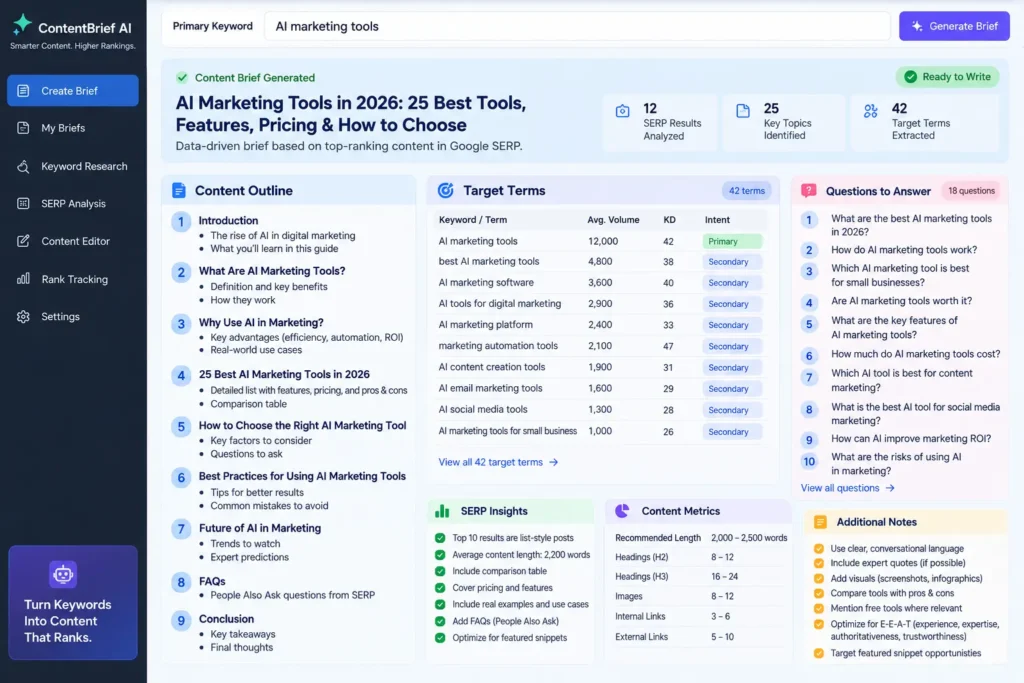
Not every brief is created equal. The strongest ones consistently include several core elements.
Target Keyword and Search Intent
Every brief should state the primary keyword clearly, along with the search intent behind it: informational, commercial, or transactional. This keeps the writer anchored to what the reader actually wants, not just the literal keyword.
A Suggested Outline With H2 and H3 Headings
A clear heading structure, based on what’s already ranking, gives a writer a skeleton to build from rather than a blank page. This alone eliminates much of the guesswork around what order to cover topics in.
Target Terms and Semantic Keywords
Beyond the primary keyword, a good brief lists related terms and phrases that top-ranking pages use naturally. This helps a writer cover a topic comprehensively without resorting to awkward, forced keyword repetition.
Questions to Answer
This section pulls directly from People Also Ask boxes and related search suggestions. It tells a writer exactly which reader questions the content should address, often verbatim enough to double as subheadings.
Internal Linking Targets
A strong brief also flags which existing pages the new content should link to. It notes which existing pages should link back to it once published. This turns internal linking from an afterthought into a planned part of the content itself.
Source and Fact-Checking Requirements
For anything involving pricing, statistics, or claims that could go stale, a good brief flags where a writer needs to verify current information. This matters more than relying on outdated training data or guesswork.
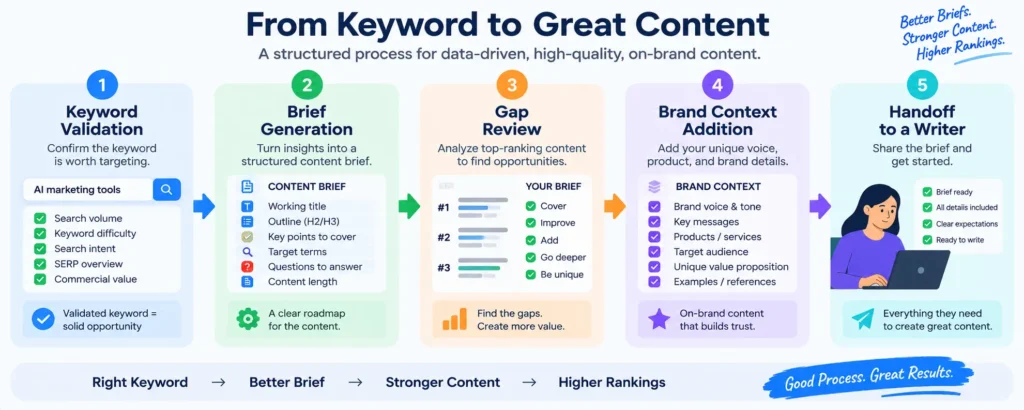
How to Create an AI Content Brief Step by Step
Here’s the practical process, from a target keyword to a brief ready for a writer.
Step 1: Start With a Validated Keyword
Before generating a brief, confirm the target keyword has already been through proper research and clustering. This way, you’re not building a brief for a keyword that duplicates existing content or targets the wrong intent entirely.
Step 2: Run the Keyword Through a Brief Generator
Feed the keyword into a tool like Frase, Surfer SEO, or Clearscope. Most tools return a full brief within a minute or two, pulling directly from live SERP data for that specific term.
Step 3: Review the Outline for Genuine Coverage Gaps
Compare the AI-generated outline against what you already know about the topic. Flag anything that seems missing or oddly prioritized before passing the brief along. Automated tools occasionally miss context specific to your audience or industry.
Step 4: Add Brand-Specific Context
Layer in details a generic AI tool wouldn’t know. This includes your brand voice, any proprietary data or case studies worth referencing, and specific internal pages to link. This is where a brief becomes genuinely useful, not just generic.
Step 5: Hand It Off With Clear Expectations
Share the finished brief with the writer, along with a quick note on tone and any non-negotiable requirements. A brief works best when it’s treated as a clear starting point. It shouldn’t be a rigid script that leaves no room for genuine expertise.
Best AI Content Brief Generator Tools
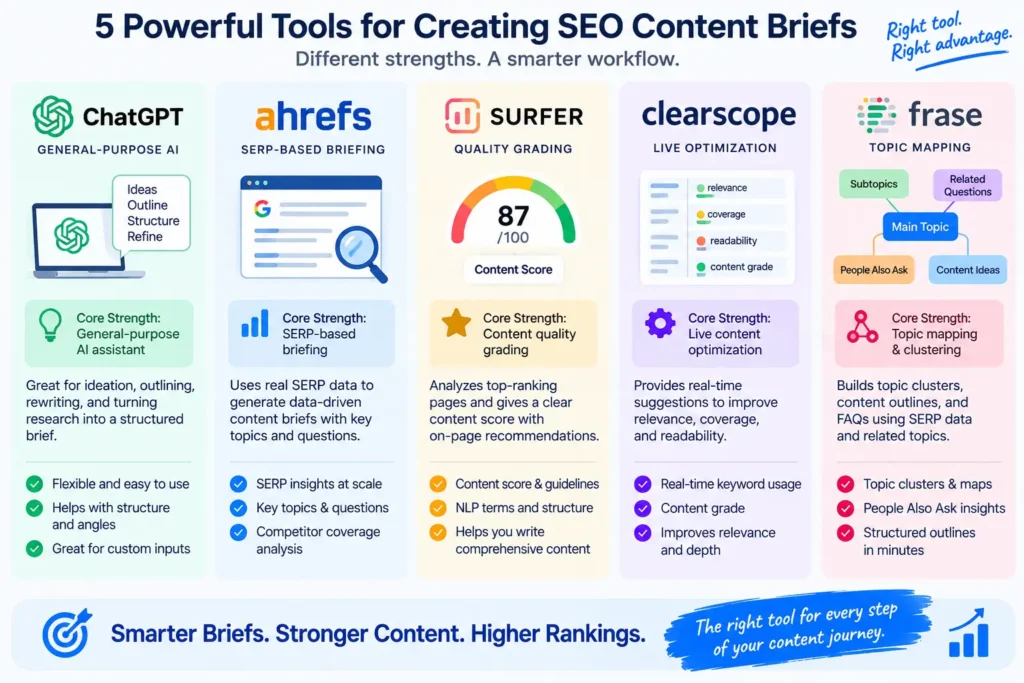
Rather than naming a single winner, it helps to understand what each tool does particularly well.
ChatGPT
ChatGPT can produce a reasonable brief when given detailed instructions and, ideally, a summary of top-ranking content pasted in manually. It works well as a free starting point. However, it lacks direct access to live SERP data unless paired with browsing or a connected search tool.
Frase
Frase remains one of the most commonly recommended tools specifically for brief generation. It automatically pulls outline structure, headings, People Also Ask questions, and statistics from top-ranking pages. Its lower price point makes it a strong starting option for solo writers and smaller teams.
Clearscope
Clearscope focuses on content quality and term coverage, generating a shareable brief alongside a real-time grading system writers use while drafting. It’s widely used by larger editorial teams. They tend to value a clean, simple A-to-F scoring system non-specialists can understand immediately.
Surfer SEO
Surfer SEO combines detailed brief generation with a live content editor, offering some of the most granular keyword and structural guidance available. This depth makes it powerful for advertisers who already understand SEO. It can feel overwhelming for a writer without that background, though.
MarketMuse
MarketMuse takes a broader view, mapping entire topic clusters and identifying content gaps across a whole site rather than just generating one brief at a time. This suits larger content operations planning dozens or hundreds of articles. Teams needing just a handful of indi
AI Content Briefs vs. Manual Content Briefs: A Comparison
Before deciding how much to automate, it helps to see the practical differences side by side.
| Factor | Manual Content Brief | AI Content Brief |
|---|---|---|
| Research time | Hours per brief | Minutes per brief |
| SERP analysis depth | Limited by reviewer’s time | Analyzes dozens of pages instantly |
| Consistency across writers | Varies by strategist | Standardized structure every time |
| Semantic term coverage | Based on strategist’s knowledge | Data-driven, pulled from live rankings |
| Scalability | Difficult past a handful weekly | Scales to dozens of briefs easily |
| Brand-specific nuance | Naturally strong | Requires manual addition afterward |
As the table shows, AI content briefs don’t eliminate the need for a strategist. Rather, they shift the strategist’s time. Instead of manual research, they focus on reviewing output and adding the brand context AI genuinely can’t supply on its own.
A Real-World Example of an AI Content Brief in Practice
To make this concrete, consider how a small marketing team might use this process for a single article.
The Starting Point
The team has already clustered their keywords and identified “how to choose a project management tool” as a priority topic. Rather than assigning a writer with just that phrase, they run it through Frase first.
Generating and Reviewing the Brief
Within a couple of minutes, Frase returns an outline covering pricing tiers, integration options, and team size considerations, along with a list of eleven common questions pulled from live search results. The strategist reviews it and notices a gap: none of the top-ranking pages mention remote team considerations, even though that’s a major factor for their own audience.
Adding What AI Couldn’t Know
The strategist adds a new section to the brief specifically addressing remote and distributed teams, along with a note to link to the company’s own remote work guide already published on the site. This single addition becomes the article’s genuine differentiator.
AI Content Briefs: The Outcome
The writer receives a brief that’s both data-driven and genuinely tailored, cutting research time significantly while still producing content with a real point of view. The finished article ends up covering ground competitors missed entirely.
Common Mistakes When Using AI Content Briefs
A few recurring mistakes reduce how useful these briefs actually turn out to be.
Treating the Brief as Final Without Review
AI-generated briefs occasionally include outdated context or miss nuance specific to your audience. A quick strategist review beforehand catches these gaps before they reach a writer.
Overloading the Brief With Every Possible Term
Some tools generate an overwhelming list of target terms. Forcing all of them into a single article produces exactly the kind of unnatural, keyword-stuffed writing search engines penalize. Prioritize the terms that genuinely matter, not every term a tool surfaces.
Skipping the Brand Context Layer
A brief built purely from generic SERP data will produce generic content. Someone needs to add brand voice, proprietary insight, or genuine expertise on top. This is the step that separates content that merely matches competitors from content that actually stands out.
Using the Same Brief Template for Every Content Type
A how-to guide, a comparison article, and a product page each need a genuinely different brief structure. Applying one rigid template across every content type produces briefs that fit some formats well and others poorly.

Best Practices for Getting More From These Tools
A few habits consistently separate teams that get genuine value from this process from those who don’t.
Build a Reusable Template for Each Content Type
Rather than starting from scratch every time, create separate baseline templates for how-to guides, comparisons, and product pages. Feed the AI-generated output into that structure, so every brief follows a consistent, familiar format regardless of who’s building it.
Keep a Running List of Brand-Specific Additions
Certain context, house style notes, preferred data sources, and standard internal links tend to repeat across nearly every brief. Keeping a running reference document speeds up Step 4 considerably, since the strategist isn’t reinventing brand context from scratch each time.
Involve Writers in Refining the Process
Writers often notice patterns in what makes a brief genuinely useful versus merely thorough. Asking for their feedback periodically tends to surface practical improvements a strategist working alone might miss entirely.
Frequently Asked Questions About AI Content Briefs
What is an AI content brief?
An AI content brief is a structured document generated with artificial intelligence that outlines what a piece of content needs to cover. It includes a suggested outline, target terms, common questions, and internal linking suggestions, based on analysis of top-ranking pages.
Is an AI content brief generator worth it for a small blog?
Often, yes, especially for solo bloggers who don’t have time for manual SERP research on every post. Even a lower-cost tool like Frase can meaningfully improve content structure compared to writing from a bare keyword alone.
Can AI write the entire article from the brief, or just the outline?
Most brief generators include an optional AI writing feature. However, the resulting draft typically needs significant human editing to sound genuinely on-brand and avoid generic phrasing. Treat AI-generated drafts as a starting point, not a finished piece.
How is an AI content brief different from a keyword cluster?
A keyword cluster groups related search terms by intent, deciding which keywords belong on the same page. A content brief takes one of those clusters and turns it into an actionable outline for a specific piece of content.
Do AI content briefs help with ranking in AI-generated search summaries?
Increasingly, yes. Some newer brief tools now score content for AI-visibility readiness alongside traditional SEO, since clear, well-structured answers tend to get cited more reliably by AI-generated search summaries.
How often should a content brief be updated after content is published?
Revisiting a brief makes sense whenever you plan to refresh older content, typically every six to twelve months. Search results and competitor coverage shift over that timeframe.
Final Thoughts: Making AI Content Briefs Part of Your Process
AI content briefs aren’t about removing the strategist from content planning. Instead, they remove the repetitive research work that used to consume hours before a single word got written. Manually reviewing dozens of competing pages no longer needs to happen by hand. According to Google’s own guidance on creating helpful content, pages that genuinely and comprehensively serve a reader’s needs consistently outperform those built around thin, surface-level coverage (Google Search Central). That’s exactly what a well-built brief is designed to produce.
Start by pairing a validated keyword with a genuine brief generator. Then, layer in the brand context and expertise no AI tool can supply on its own. Over time, this combination of AI speed and human judgment produces content that’s both efficient to plan and genuinely worth reading.
Whether you’re managing a solo blog or a full content team, the underlying principle stays the same. A brief that’s data-driven and genuinely tailored will consistently outperform either a bare keyword handoff or a generic, unreviewed AI template.
Ready to turn a finished brief into optimized content? Check out our guide on AI On-Page SEO for a complete breakdown of what happens after the brief, when the actual optimization begins.