
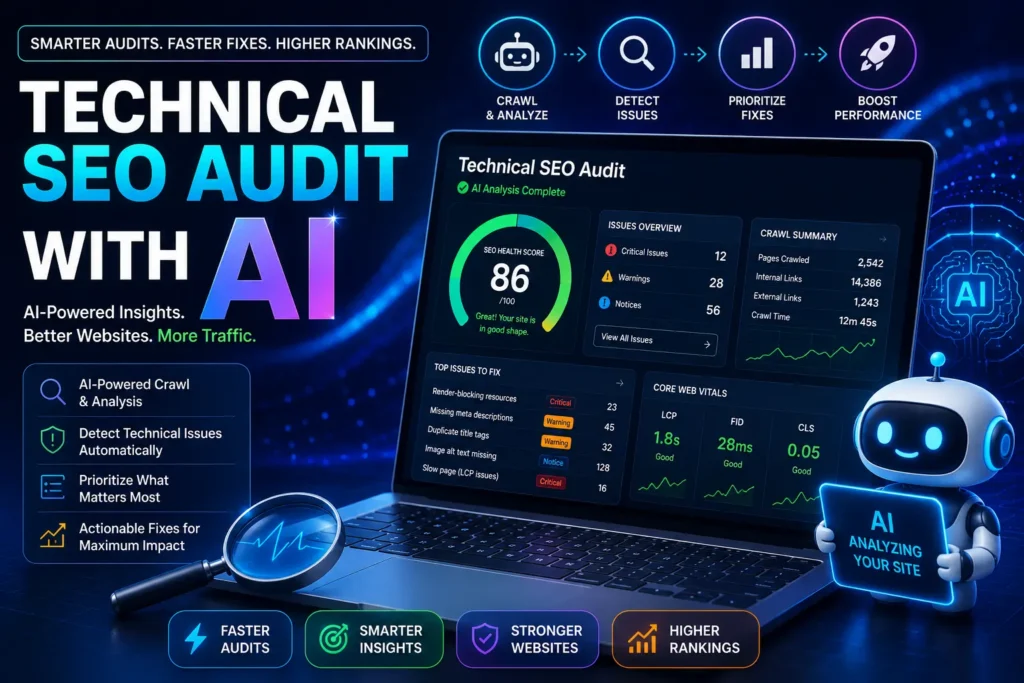

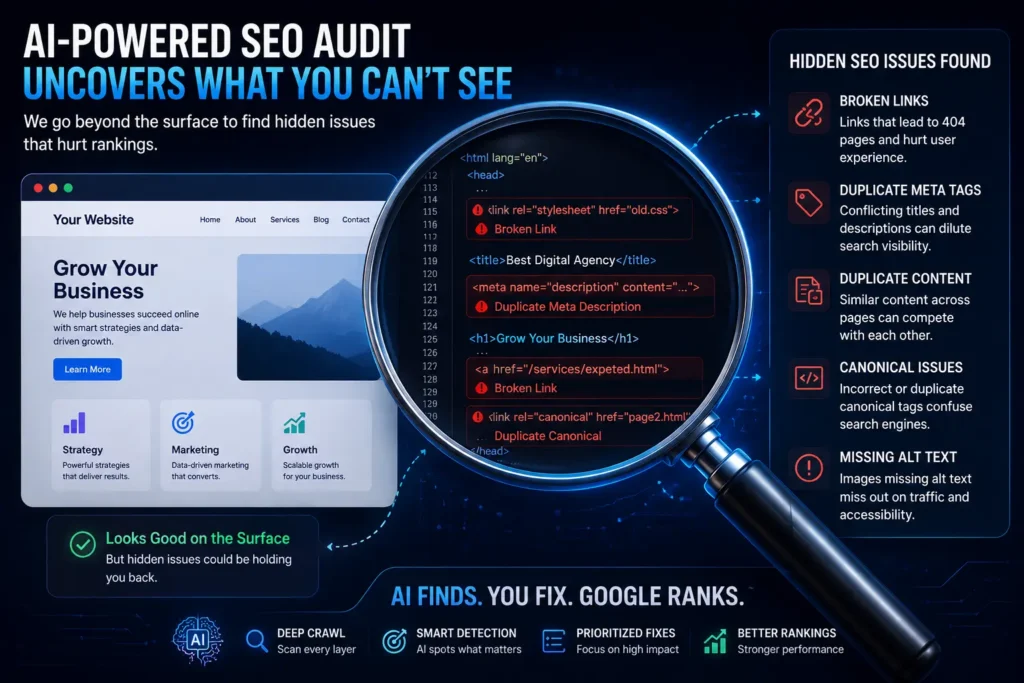
A site can look perfectly healthy on the surface while quietly bleeding rankings underneath. Broken redirect chains, duplicate title tags buried three folders deep, pages accidentally blocked from indexing. These problems rarely show up unless someone goes looking. A technical SEO audit with AI finds them faster than a manual review ever could. Increasingly, it finds them faster than the problems can do real damage.
This matters because technical issues don’t announce themselves. A page might lose rankings for weeks before anyone notices the pattern. Nobody traces it back to a single misconfigured tag until much later. In this guide, you’ll learn exactly what a technical SEO audit with AI actually finds. You’ll see why it matters more in 2026 and how to run one step by step. You’ll also see a real case study showing what AI catches that a manual check missed entirely, plus a comparison of the best tools available and common mistakes to avoid.
What Is a Technical SEO Audit with AI?
A technical SEO audit with AI uses machine learning to scan a website’s entire structure. It identifies crawlability issues, indexing problems, site speed bottlenecks, and structured data errors. This happens without requiring a specialist to manually click through every page. Instead of sampling a subset of pages, AI-powered tools can realistically crawl an entire site and flag issues by likely impact.
In short, this kind of audit answers a specific question fast. What’s actually broken on this site right now, and which of those problems deserves attention first?
How This Differs From a Standard Technical Audit
A traditional audit already covers crawlability, speed, and structured data. What changes with AI isn’t the checklist itself. It’s the speed and completeness of the scan. It also adds the ability to prioritize findings automatically based on likely traffic impact, rather than presenting a flat, unsorted list a human still has to interpret.
Why This Distinction Matters in Practice
It’s easy to assume “AI audit” just means a faster version of the same old process. In reality, the speed unlocks something qualitatively different: continuous coverage instead of periodic snapshots. A quarterly manual review can only ever describe a site’s condition at one moment in time. Continuous AI monitoring, by contrast, catches drift as it happens, which is precisely what prevented the eighteen-month blind spot described later in this guide.
(For a broader look at the technical SEO landscape overall, see our related guide.) It covers AI Technical SEO in full depth.
Why Run a Technical SEO Audit with AI in 2026
A few converging trends explain why this specific approach deserves attention this year.
Technical SEO audit with AI: Sites Have Grown Too Large for Manual Sampling
A manual audit typically samples a few hundred pages and extrapolates patterns from there. For a site with thousands of pages, that sample might miss entire sections with recurring problems. AI-powered crawlers scan every page, not a sample. This closes that blind spot entirely.
Technical SEO audit with AI: AI Crawlers Now Need Their Own Accessibility Checks
It’s not just Googlebot crawling a site anymore. Platforms like ChatGPT and Perplexity send their own crawlers to retrieve content for generated answers. Therefore, a modern audit needs to verify these crawlers can actually access important pages. That matters just as much as confirming Google can.
Issues Compound Quickly Without Continuous Monitoring
A single misconfigured redirect or an accidentally added noindex tag can quietly suppress rankings for weeks. This often happens before anyone notices manually. AI-powered monitoring catches these changes within hours of them happening, rather than waiting for the next scheduled quarterly review.
The Cost of a Missed Issue Keeps Rising
AI-driven search features now surface answers directly on the results page. Because of this, a technical issue that blocks indexing risks losing visibility across two channels at once. Traditional search and AI-generated summaries both suffer, not just one.

What an AI Technical SEO Audit Actually Finds
Understanding the specific categories covered helps set realistic expectations for what a scan will surface.
Crawlability and Indexing Issues
This includes pages accidentally blocked by robots.txt, unintended noindex tags, and orphaned pages with no internal links pointing to them. These issues can silently remove pages from search results for weeks. A manual check would rarely catch this in time.
Duplicate and Thin Content
AI tools flag duplicate title tags, meta descriptions, and near-identical content across pages. All of these dilute ranking signals when search engines can’t tell which version deserves to rank.
Site Speed and Core Web Vitals
Slow-loading pages hurt both rankings and user experience. AI-powered audits flag speed issues automatically, often prioritizing high-traffic pages where the impact matters most.
Broken Links and Redirect Chains
Multi-hop redirect chains and broken internal links waste crawl budget and create a poor user experience. A full-site scan catches these across every page. It’s not limited to the ones a specialist happened to click through manually.
Structured Data Errors
Broken or missing schema markup can prevent rich results from displaying at all. AI tools validate structured data automatically across every page type, flagging errors a manual spot-check would likely miss.
How to Run a Technical SEO Audit with AI: Step by Step
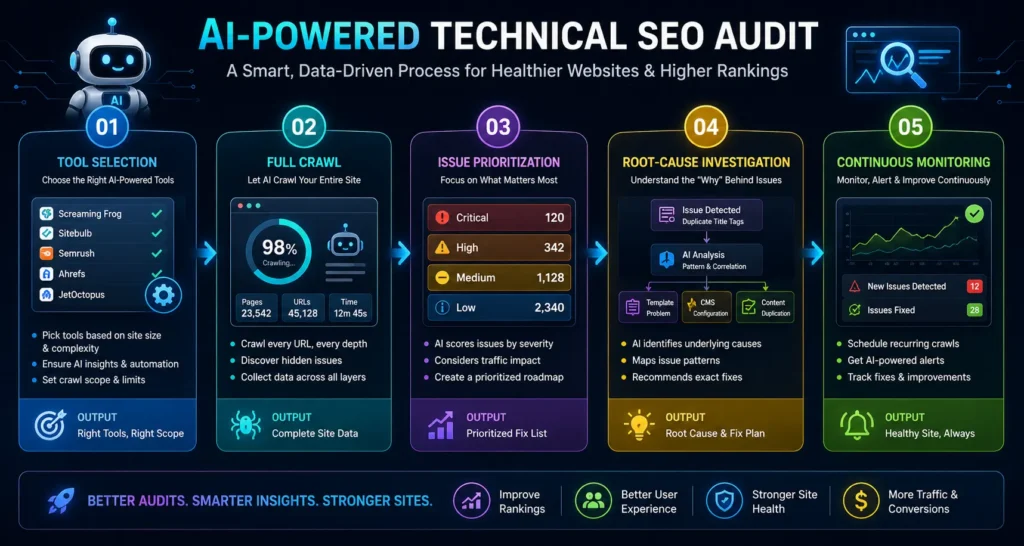
Here’s the practical process, from starting a scan to acting on the results.
Step 1: Choose a Tool That Matches Your Site’s Scale
A small blog and a large ecommerce catalog have genuinely different needs. Confirm the tool you choose can realistically handle your site’s page count before committing to a full crawl.
Step 2: Run a Complete Crawl, Not a Partial One
Let the tool finish scanning the entire site rather than stopping early. A partial crawl reintroduces the exact blind spot AI auditing is supposed to eliminate.
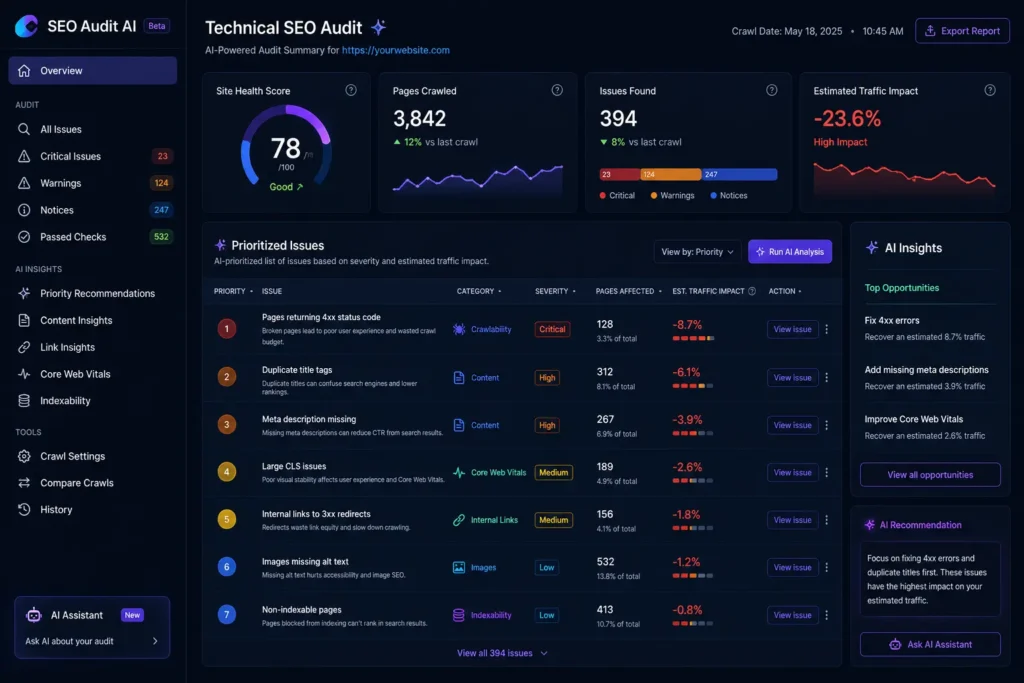
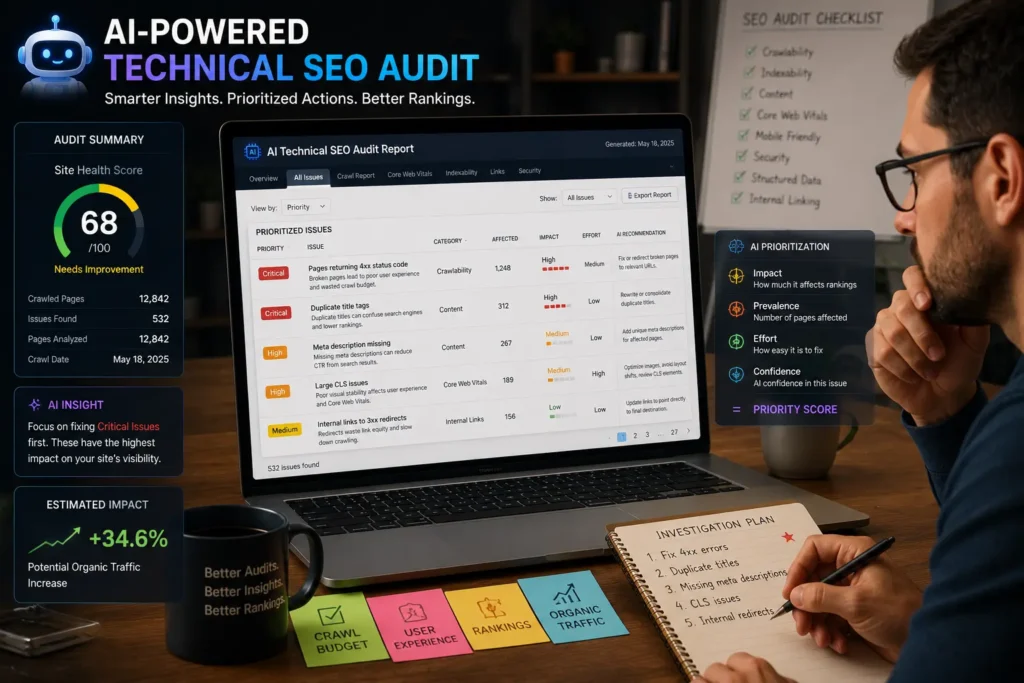
Step 3: Review the Prioritized Issue List
Once the scan completes, review issues in order of likely impact, not alphabetically or by category. Focus first on anything affecting high-traffic pages or blocking indexing entirely.
Step 4: Investigate Root Causes Before Fixing
A quick fix that doesn’t address the underlying cause often leads to the same problem recurring later. Spend a few minutes understanding why an issue happened before applying a fix.
Step 5: Set Up Continuous Monitoring
A one-time audit only reflects a site’s condition at that moment. Schedule recurring scans, weekly or monthly depending on how often the site changes. This way, new issues get caught soon after they appear.
Best Tools for a Technical SEO Audit with AI
Rather than naming a single winner, it helps to understand what each tool does particularly well.
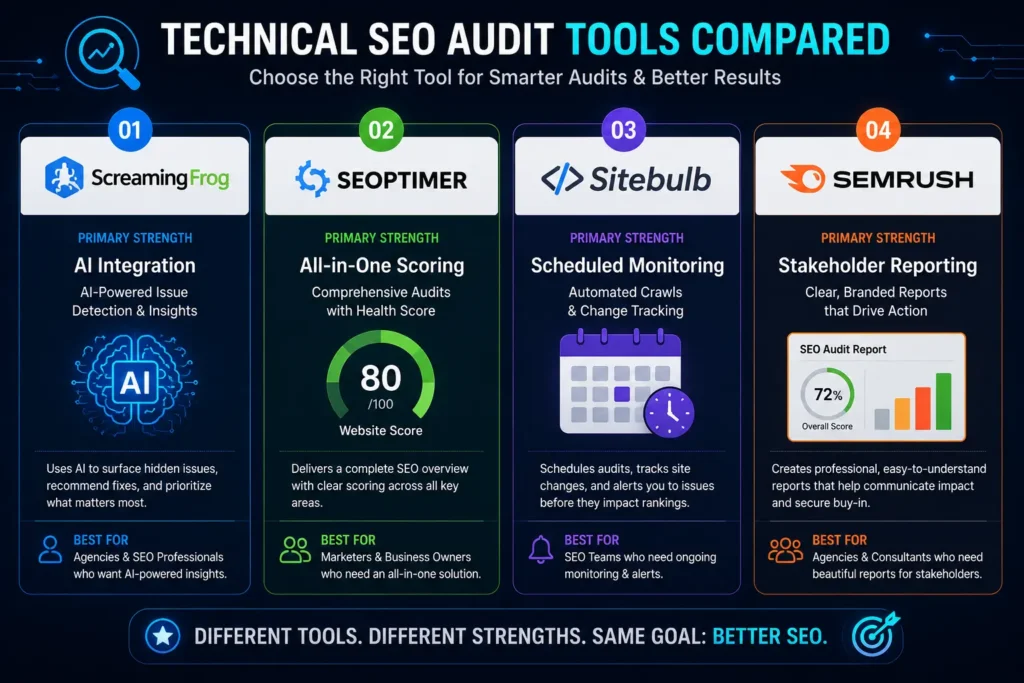
Screaming Frog
Screaming Frog’s 2026 release added direct AI integration through the Model Context Protocol. This lets an AI assistant run crawls and summarize issues in plain language, all without manually clicking through menus. It suits specialists who want granular, URL-level control alongside AI-assisted interpretation.
Semrush Site Audit
Semrush automatically checks a site against more than 140 technical and on-page factors. It returns a clear health score alongside prioritized recommendations. This suits teams already using Semrush for other SEO work, since auditing becomes an added capability rather than a separate subscription.
Ahrefs Site Audit
Ahrefs crawls a site on a recurring schedule and flags issues by category, from crawlability to Core Web Vitals. It also provides clear explanations for less technical team members. Its scheduled crawling makes it a solid choice for ongoing monitoring, not just one-time audits.
Sitebulb
Sitebulb pairs technical findings with visualizations designed to help a specialist explain issues to non-technical stakeholders. This makes it particularly useful for agencies that need to justify technical work to clients who aren’t deeply familiar with SEO.
A Real-World Case Study: What AI Caught That a Manual Audit Missed
To make this concrete, consider what actually happened when a mid-sized publisher ran both a manual review and an AI-powered audit on the same site.
The Starting Situation
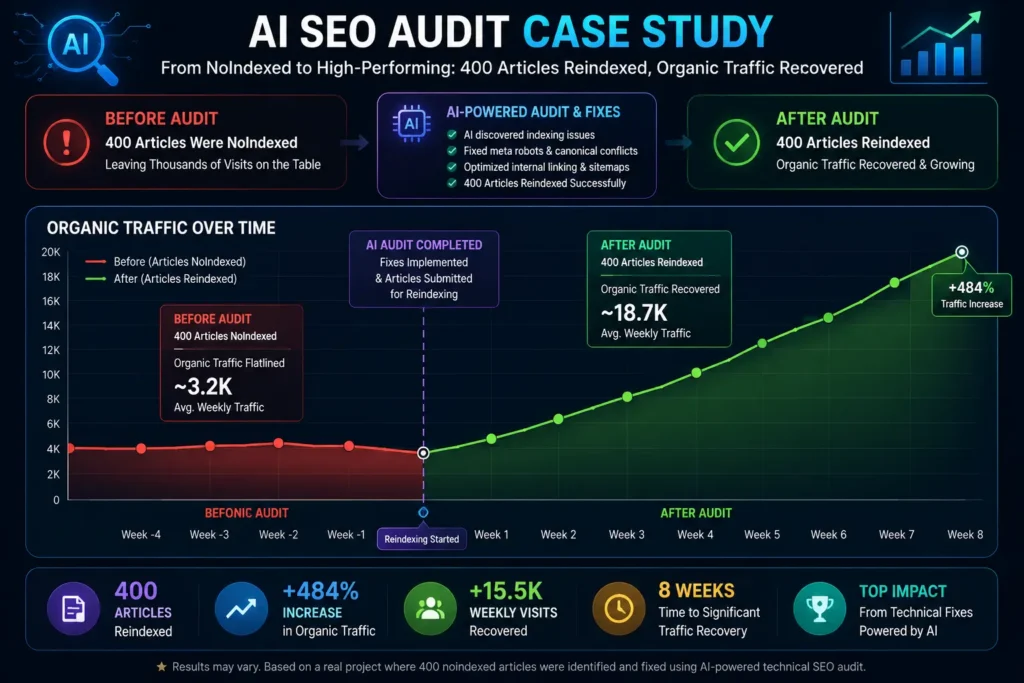
A news and blog site with roughly 8,000 published articles had been publishing consistently for years. Organic traffic had been slowly declining, though. A manual review earlier that year had sampled around 300 pages and found nothing alarming. It turned up just a handful of minor issues the team had already planned to fix.
Running the AI Audit
The team then ran a full AI-powered crawl of the entire site. Within a single day, it surfaced something the manual sample had completely missed. A cluster of roughly 400 older articles, all published under a discontinued category, had been accidentally set to noindex during a template update eighteen months earlier.
Why the Manual Sample Missed It
The affected articles sat in an older section of the site that rarely came up in the specialist’s manual spot-checks. Attention naturally gravitated toward recently published content instead. A 300-page sample simply had low odds of touching that specific cluster.
The Outcome
Once the noindex tags were removed, those 400 articles gradually returned to search results over the following weeks. Several had been ranking well before the accidental change. They recovered much of their previous traffic once reindexed. The team also set up continuous monitoring afterward, specifically to catch this kind of change immediately rather than eighteen months later.
Manual Technical SEO Audit vs. AI-Assisted Audit: A Comparison
Before deciding how much to rely on automation, it helps to see the practical differences side by side.
| Factor | Manual Technical SEO Audit | AI-Assisted Audit |
|---|---|---|
| Coverage | Often limited to page sampling | Scans the entire site |
| Turnaround time | Days to weeks | Hours |
| Issue prioritization | Based on specialist judgment alone | Ranked by likely traffic impact |
| AI crawler visibility | Rarely checked | Explicitly evaluated alongside Googlebot |
| Consistency | Varies by reviewer and time available | Standardized across every scan |
| Best suited for | Small sites, occasional review | Large sites, ongoing monitoring |
As the table shows, an AI-assisted audit doesn’t eliminate the need for expertise. Rather, it shifts a specialist’s time away from manually hunting for problems. Instead, they focus on deciding which flagged issues genuinely deserve attention first.
Common Mistakes When Running a Technical SEO Audit with AI
A few recurring mistakes reduce the value these audits deliver.
Trusting Every Flagged Issue Equally
AI tools can surface hundreds of issues on a large site, and not all of them matter equally. Chasing every minor flag before addressing high-impact problems wastes time. That time could go toward fixes that actually move rankings.
Running an Audit Once and Never Again
A single audit only reflects a site’s condition at that specific moment. Without recurring scans, new issues introduced by content updates or template changes go unnoticed, sometimes for months. This is exactly what happened in the case study above.
Skipping Root-Cause Analysis
Applying a quick fix without understanding why an issue happened in the first place often means the same problem resurfaces later. A brief upfront investigation saves time in the long run.
Ignoring AI Crawler Accessibility
Many teams still audit purely for Googlebot, overlooking whether AI crawlers can access their content at all. As AI-driven search grows, this blind spot increasingly limits visibility beyond traditional search results.
Treating Every Site the Same Way
An ecommerce catalog with thousands of near-duplicate product pages faces different challenges than a publisher site with deep archives, like the one in the case study above. Applying a generic checklist without adjusting for a site’s specific structure often means wasted effort on low-impact fixes while genuinely urgent issues sit unaddressed.
Forgetting to Reassess Tool Coverage Over Time
Search engines and AI crawlers both continue to evolve, and so do the tools built to monitor them. A configuration that worked well a year ago may need adjusting as these systems change. Periodically reviewing whether your audit tool is still catching the right issues helps prevent quiet gaps from forming in your monitoring coverage.
How Much Time Does an AI-Assisted Audit Actually Save?
It helps to put a rough number on this, rather than treating “faster” as a vague promise.
A manual audit of a mid-sized site, several hundred to a few thousand pages, typically takes a specialist anywhere from a few days to two weeks, depending on depth and how many stakeholders need to review findings along the way. An AI-powered crawl of the same site usually completes within hours, sometimes overnight for very large sites. The time savings compound further once continuous monitoring replaces repeated manual reviews entirely, since the specialist no longer restarts the process from scratch every quarter.
That said, the time saved on scanning doesn’t eliminate the time needed for genuine analysis. Reviewing prioritized findings, investigating root causes, and coordinating fixes with a development team still takes real effort. The honest expectation is that AI removes the slowest, most repetitive part of the process, not the judgment-heavy work that follows it.
Frequently Asked Questions About Technical SEO Audits With AI
What is a technical SEO audit with AI?
A technical SEO audit with AI uses machine learning to scan an entire website for crawlability, indexing, speed, and structured data issues. It typically produces a prioritized list of problems ranked by likely traffic impact, rather than a raw, unsorted report.
How often should I run an AI technical SEO audit?
Monthly audits strike a reasonable balance for most sites. Larger or fast-changing sites may benefit from continuous monitoring instead, while smaller, stable sites might be fine with quarterly checks.
Can AI fully replace a technical SEO specialist?
No. AI tools handle detection and prioritization efficiently. However, a specialist should still review findings, investigate root causes, and decide which fixes genuinely deserve attention first, especially for changes affecting site structure.
How is an AI technical SEO audit different from a general SEO audit?
A technical audit focuses specifically on a site’s infrastructure, crawling, indexing, speed, and structured data. A general SEO audit often also covers content quality, keyword targeting, and backlinks, which fall outside a purely technical scope.
What’s the biggest risk of relying entirely on automated audits?
The biggest risk is treating flagged issues as automatically correct without human review. AI tools occasionally misjudge context specific to a site. A quick specialist check before applying major fixes remains essential.
Can a small site benefit from an AI technical SEO audit, or is this only for large sites?
Small sites benefit too, often significantly, since they typically lack a dedicated technical specialist to catch issues manually. An AI-powered audit can surface problems that would otherwise go unnoticed for months on a site with limited in-house expertise.
Final Thoughts: Making AI-Powered Audits Part of Your Routine
A technical SEO audit with AI isn’t about replacing the judgment that goes into fixing a website properly. Instead, it catches issues faster and more comprehensively than a manual review realistically can. That’s exactly the kind of hidden problem the case study above illustrates. Google’s own documentation on crawling and indexing states that sites should remain easy for both crawlers and users to access and understand structurally (Google Search Central). This is precisely what a thorough, AI-assisted audit helps confirm.
Start with a single full audit, prioritize the highest-impact fixes, and set up recurring scans. That way, new issues get caught early rather than months later. Over time, this shift from occasional manual reviews to ongoing, AI-assisted oversight tends to become a genuine competitive advantage. However, that advantage only materializes if the audit findings actually translate into fixes, not just a longer to-do list nobody works through.
Whether you’re managing a small blog or a large publisher archive, the underlying lesson stays the same. A sample can miss problems entirely. A complete scan rarely does.
Ready to go deeper on the broader technical SEO landscape? Check out our guide on AI Technical SEO for a complete breakdown of crawling, indexing, and site health strategy.